


Φ
THE VERTICAL DISPATCH
We write for the mind, the eye, and the ear.
Read it. Look at it. Listen to it. The Vertical Dispatch is built for all three — prose with rhythm, made to be heard as much as read.
From metaphysics to geopolitics, from culture to history, from the sacred to the street — and everything in between. One lens, every subject. No ego. Just the record, named clean.
Press play. Walk with the word. 🕯️
This dispatch travels by hand. If it serves you, share it — restack on Substack, and pass it on wherever you read. 🕯️
The Foundation Series · AIG Applied Live
June 20, 2026
The map is not the territory. The word is not the thing.
— the keel of the work
A piece is moving across the network. It is well-made. It is dense with dates, dollar figures, and named institutions. It carries the weight of the Vatican and the authority of Parliament, and it ends by asking you to send it to one person who has not yet seen it. It feels like knowledge.
It is built on a single move — the same move this publication exists to refuse. It takes things that are true and binds them to a meaning they do not carry. The Greek for it is old and the discipline is simple: the symbol is not the referent. The map is not the territory. A word that points at a thing is not the thing.
This is not a defence of any office or any officeholder. The suspicion of power that drives a piece like this is healthy, and it is correct. The argument here is narrower and harder: that this particular piece does not serve that suspicion. It spends it. And the way it spends it can be shown — not by opinion, but by the public record, line against line.
So we will do the work in the open. First, a fair summary of what the piece argues, at something close to full size. Then, element by element, the public record set beside the claim. At each turn, one question only: was the symbol ever bound to its referent? Most often, the answer is on a government website, a Vatican page, or the text of the bill itself.
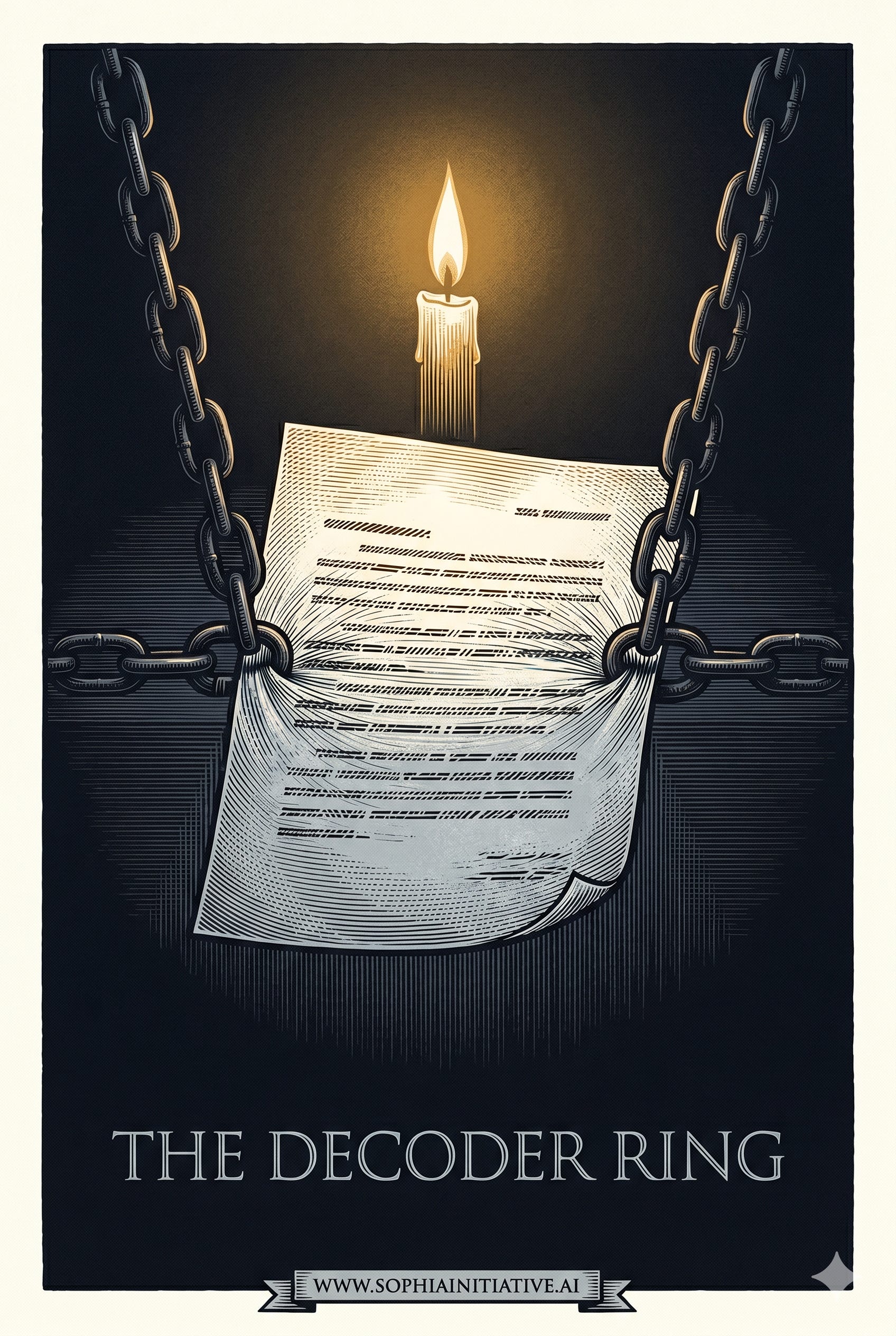
The piece does not serve suspicion of power. It spends it.
First — The Claim, in Brief
The piece, published on Substack, makes one argument across many parts. In summary, and in its own logic:
It opens with a blueprint. In 2010 the World Economic Forum published a large report calling for the restructuring of the global economy, and named faith leaders among the actors who could help. From this the piece draws a line: a plan to use religion to change how money and power work.
It then offers an execution. In 2019 and 2020 a Council for Inclusive Capitalism was founded under the moral guidance of Pope Francis, gathering some of the world’s largest investors under the title of Guardians. Among the founding Guardians was Mark Carney. The piece reads this as the 2010 plan made real — ten years, blueprint to reality.
It then offers a succession. Pope Francis dies; in the same season Carney becomes Prime Minister. A new Pope, Leo XIV, takes a name that signals the Church’s old fight against concentrated wealth. The piece reads the new Pope as the appointed warner against the very arrangement the Council helped build.
It then offers a warning, dated. On the morning Carney secures a parliamentary majority, the Vatican releases a letter from Leo XIV on democracy and power. The piece treats this letter — and a series of the Pope’s later statements on extraction, surveillance, and free speech — as a coded description of Carney’s Canada, point for point.
It then offers the trap. Four pieces of Canadian legislation — a hate-crime act, a lawful-access act, a stablecoin act, and a basic-income framework — are read together as a single architecture of control: speech policed without oversight, communications tracked without warrant, every transaction traceable, and income paid in a currency the state can freeze at will. A leash, not a safety net.
It closes by checking every box: each papal warning matched to a Canadian receipt, every line confirmed. The reader is told the case is complete, and asked to pass it on.
That is the chain, stated as fairly as it can be stated. Some of its links are made of solid metal. The question is whether the chain, as a whole, holds the weight it is asked to carry. We test it link by link.
Some links are solid metal. The question is whether the chain holds the weight it is asked to carry.
The Letter — A Real Document, a Supplied Target
The letter is real. On April 14, 2026, Pope Leo XIV sent a message on power, legitimacy, and democracy. The quoted lines are accurate. He warns that democracy, lacking a moral foundation, risks becoming a majoritarian tyranny or a mask for the dominance of economic and technological elites. That is the Pope’s voice, and it is grave, and it is on the Vatican’s own website. The symbol is sound.
Now the referent. The letter was addressed to the Pontifical Academy of Social Sciences, for the academic plenary on the theme of power and the international order. It is a teaching to social scientists in the lineage of Catholic social doctrine, citing John Paul II. It names no country. It names no prime minister. It is pitched, deliberately, at the altitude of principle — to instruct any wielder of power, in any nation, in any year.
Here is the proof that the lock is supplied rather than found, and it requires no interpretation at all. The same letter, the same week, was read by the secular American press as a warning about Donald Trump — because two days earlier Trump had called the Pope weak on crime. One document. Two writers. Two opposite targets. Neither target named by the Pope, because the Pope named a principle and each writer supplied the name.
The verdict on this link: the symbol is genuine; the referent was never bound. A universal teaching that one reader fits to Carney and another fits to Trump identifies no one. It was never about a man. It was about power — which is what the Pope said it was about.
The Council — A Real Seat, a Cropped Frame
This link holds the most metal, and honesty requires saying so first. Carney was a founding Guardian of the Council for Inclusive Capitalism, named on the Council’s own launch announcement of December 8, 2020. The figures are real: assets in the trillions, workers in the hundreds of millions, the Vatican’s blessing, Pope Francis’s moral guidance. None of that is invented. A reader right to be wary of concentrated capital is right to look here.
But look at the whole roster, not the cropped one. Carney sat on that list under the title of UN Special Envoy for Climate Action and Finance, among the head of the International Trade Union Confederation, the presidents of the Ford and Rockefeller Foundations, the Treasurer of California, and the chief executives of Mastercard and EY. It is a broad tent of corporate, civil-society, and labour figures. To name him sandwiched between two of the most ominous-sounding neighbours, and crop the union leader and the foundations out of the picture, is composition. The frame is chosen.
And here is the part the piece cannot afford to include: the serious criticism of the Council runs the opposite way. The Guardian called it a Trojan Horse — a cosmetic exercise by elites to look reformed while changing nothing. Libertarians called it cronyism. The substantial charge against inclusive capitalism is that it is too soft, a varnish, a public-relations answer to public anger. The piece inverts that entirely into a hard machine of seizure. The real critique and the manufactured one point in opposite directions.
The verdict on this link: the seat is real; the meaning is supplied. A membership is a fact. A conspiracy is an interpretation laid over the fact — and the interpretation here is the reverse of what the Council’s actual critics allege.
A membership is a fact. A conspiracy is an interpretation laid over the fact.
Bill C-9 — Where the Claim Fails the Statute
Here the record does not merely reframe the claim. It contradicts it.
The piece states that the new hate-crime offence does not require the Attorney General’s consent — that any police officer can now lay the charge, the traditional oversight removed. That sentence is the hinge of the entire trap. If true, it means speech policed without a check.
It is not true of the law that passed. The bill as first introduced did propose to repeal the Attorney-General-consent requirement. But the bill was amended before passage. The government itself retracted that repeal; neither the Conservatives nor the Bloc supported dropping it; the requirement stayed in. The Senate sponsor stated it plainly on the record: charges cannot be laid by police alone, and must be authorized at a higher level. The piece quoted the first-reading version of the bill and presented it as the enacted law. The safeguard it says was removed is, in the statute that received Royal Assent on June 18, 2026, still standing.
The penalty ladder is described accurately but glossed heavily. The escalating maximums — five, ten, fourteen years, up to life — are real, but they raise the existing maximum of an underlying offence when hatred is proven as motive, and hate-motivation has been an aggravating factor at sentencing for years. Life applies only where the underlying offence already carried up to life. The structure is real; the image of life imprisonment for a sermon is the amplification.
The verdict on this link: the symbol points at a law that does not exist. The claim describes a draft that was changed. Against Parliament’s own enacted text and the bill’s own sponsors, the referent is not there to be bound.
The symbol points at a law that does not exist.
Bill C-22 — The Strongest Link, Honestly Stated
Discipline cuts both ways. On this bill, the piece is closest to the ground, and the fair report says so at full strength.
The lawful-access act does contain a mandatory metadata-retention provision: telecom and electronic-service providers could be required to retain categories of metadata, on all users, for up to a year, with no requirement that a given user be suspected of anything. This is not a fringe alarm. The privacy scholar Michael Geist, the Electronic Frontier Foundation, the Canadian Chamber of Commerce, and companies including Apple, Signal, and Meta have all raised serious objections in public. A reader worried about surveillance has, on this bill, named the right document.
Where the piece overstates is scope. It says the metadata covers every website visited and every person messaged. As written and as reported, the retained metadata would not include email content, browsing history, social-media activity, or the content of text messages, and access to subscriber information was moved behind a judge-reviewed production order — a tightening from the prior version, not the warrantless dragnet described. The concern is real; the reach is inflated.
The verdict on this link: here the symbol very nearly meets its referent. This is the piece’s strongest ground — and it is exactly the ground the rest of the architecture buries. Hold this thought; it is the heart of the matter.
Bill S-206 — A Clean Inversion
The piece calls the basic-income bill the final tether: income paid in a digital currency the state fully controls, the leash made literal. Set that beside the bill.
Bill S-206 is a private member’s bill from a senator. It creates no payment, no programme, and no currency. It requires only that the Minister of Finance develop a framework and report on it within a year. It mentions no digital currency anywhere. And its operative clauses state the opposite of the control the piece claims: participation in education, training, or the labour market cannot be required to qualify, and the income is unconditional by design.
The digital-currency control is imported from a different bill — the stablecoin act — and welded onto this one. Two unrelated things are fused to manufacture a cage that neither contains. The figure offered for its cost is the weld, not a number the bill holds.
The verdict on this link: the symbol is bound to the reverse of its referent. An unconditional, currency-free framework bill is described as a conditional, state-controlled digital leash. The text says the opposite of the claim.
Two unrelated bills are fused to manufacture a cage that neither contains.
The Pattern — and Why It Matters
Set the five links side by side. The Pope’s letter: a real document fitted with a target the Pope withheld. The Council seat: a real fact cropped and inverted. Bill C-9: a real bill, described as the draft it no longer is. Bill C-22: a real and serious concern, overstated in reach. Bill S-206: a framework bill described as its own opposite.
Three grades of material are braided into one rope, and the craft of the piece is to make the seams invisible. There is the sourced-and-true, which earns the reader’s trust. There is the inverted, which turns a fact into its mirror image. And there is the connective tissue — the trap, the leash, the architecture — which no source supports because no source could, since it is the inference doing the work the facts decline to do. The reader, moving fast, cannot tell grade one from grade three. The piece is built so they cannot.
And now the heart of it. The piece had a true thing to say. Bill C-22’s retention regime is a real question about power and the citizen, named by serious people. That question deserved a clean hearing. Instead it was buried inside a structure that misreads one law, inverts another, and supplies the Pope a target he never named. The fabrication did not serve the reader’s suspicion of power. It spent it — and worse, it discredited it, because a single checkable falsehood about Bill C-9 hands every defender of power a reason to wave the whole thing away, the true link with the false.
That is the deepest cost. The manufactured warning is not too hard on power. It is too easy on the reader. It flatters suspicion instead of arming it. It offers the warm certainty of secret knowledge and asks only that you pass it on, unchecked, to one more person. It recruits. It does not equip.
The manufactured warning is not too hard on power. It is too easy on the reader.
What This Method Is For
Everything above is one discipline, applied in the open. We did not ask whether the conclusion felt right. We asked, of each load-bearing sentence, a single question: does this claim resolve to a named primary source, or does it float? When it resolved — the Council seat, the C-22 retention provision — we said so, at full strength, against our own convenience. When it floated — the papal target, the S-206 inversion — we named the float. When it failed — the C-9 safeguard — we set the statute beside the claim and let the reader see the gap.
This is the whole of it. Concede what is true before you contest what is false, because a verdict that has granted nothing convinces no one. Point accountability up, at power and at structure, and never down at the vulnerable. Refuse to put a name in a mouth that did not speak it. And hand the reader the test, not the verdict — because a reader who holds the test can run it on the next piece that crosses the feed, and the one after that, long after this one is forgotten.
So here is the test, plainly, to keep. When the next flagrant chain arrives dressed as knowledge — and it will, about whoever holds the chair in the years to come — do not ask whether it confirms what you suspect. Ask of each link: is this bound to its referent, or is it floating free? Open the Vatican page. Open the text of the bill. Read past the summary to the law itself. The symbol is not the referent. The map is not the territory. The discipline is not a slogan; it is a thing you do, sentence by sentence, until the chain either holds or comes apart in your hands.
That is what was applied here. Not to defend an office. To defend your ability to scrutinize it — from the junk that wears its clothes.
God is Love. Love is Truth. Truth is Consciousness. Consciousness is Brahman.
Amen. Namaste. Om Namah Shivaya.
— The Architect.
The Vertical Dispatch
sophiainitiative.ai
On the record
The papal letter. Message of Pope Leo XIV to the Pontifical Academy of Social Sciences, plenary of 14–16 April 2026, on power, legitimacy, and democracy (vatican.va; reported Vatican News, National Catholic Register, Catholic Culture, April 14–15, 2026). The same letter was reported by The New Republic (April 14, 2026) as a warning read against President Trump, following Trump’s April 12 remarks. The letter names no country and no individual. Verify against primary sources before republication.
The Council for Inclusive Capitalism. Founding Guardians list, Council launch announcement, December 8, 2020 (inclusivecapitalism.com; PR Newswire). Carney listed as UN Special Envoy for Climate Action and Finance. Combined assets, market capitalization, and worker figures per the Council’s own materials and Wikipedia. The Guardian’s ‘Trojan Horse’ characterization and the libertarian ‘cronyism’ critique per InfluenceWatch and contemporaneous coverage. Verify against primary sources before republication.
Bill C-9 (Combatting Hate Act). First-reading text proposed repeal of Attorney-General consent for hate-propaganda offences; the bill was amended and the consent requirement retained (Parliament of Canada LEGISinfo, first and third reading; The CJN, March 31, 2026; Senate sponsor remarks; openparliament.ca). Royal Assent June 18, 2026; in force July 18, 2026 (Department of Justice; Canada.ca, June 19, 2026). Escalating penalties per the enacted text and the Library of Parliament legislative summary. Verify against primary sources before republication.
Bill C-22 (Lawful Access Act, 2026). Mandatory metadata-retention provision, up to one year, per first-reading text (Parliament of Canada). Scope and judge-reviewed production order per The Globe and Mail; privacy critiques per Michael Geist, Electronic Frontier Foundation, Canadian Chamber of Commerce, and statements by Apple, Signal, and Meta (March–May 2026). Retained metadata excludes email, browsing history, social media, and message content per reporting. Verify against primary sources before republication.
Bill S-206 (Guaranteed Livable Basic Income framework). Private member’s bill; requires the Minister of Finance to develop a framework and report within one year; participation in education, training, or labour cannot be required; unconditional by design; names no currency (Parliament of Canada, first reading; ubiworks.ca). The digital-currency element is drawn from separate stablecoin legislation. Verify against primary sources before republication.
Note on the specimen. The piece examined here is summarized and paraphrased, not reproduced. Readers should locate it and apply the test independently.
Suggested tags
symbol and referent · media literacy · primary sources · disinformation · Catholic social teaching · Canadian legislation · AIG method · epistemic discipline
Substack Notes
A piece is moving across the network that feels like knowledge — dense with dates, the Vatican’s weight, Parliament’s authority, and a closing plea to pass it on. This dispatch does not argue with it. It tests it, in the open, link by link, against the public record.
Some links hold. Carney’s seat on the Council for Inclusive Capitalism is real. Bill C-22’s metadata-retention regime is a genuine surveillance concern, named by Geist, the EFF, and Apple alike. We say so at full strength. But others fail the record: the Pope’s April letter named no one — the same letter was read by the U.S. press as a warning about Trump. Bill C-9 kept the Attorney-General safeguard the piece says was removed. Bill S-206 is an unconditional framework bill recast as a digital leash it nowhere contains.
The method is the message. Concede what is true before contesting what is false. Point accountability up, never down at the vulnerable. Never put a name in a mouth that did not speak it. And hand the reader the test, not the verdict — because the next flagrant chain is already being written, about whoever holds the chair next. The question that survives every one of them: does this claim resolve to a named primary source, or does it float?
Written from love, in service of the record. Walk with the word. 🕯️
#SymbolIsNotReferent #PrimarySources #MediaLiteracy #TheVerticalDispatch #TheArchitect #SophiaInitiative #GodIsLove #LoveIsTruth #OmNamahShivaya
The factual matter in this Dispatch is drawn from the public record. All characterizations, inferences, and conclusions are opinion, interpretation, and commentary, offered for analysis, reflection, and public-interest discussion. No assertion is made regarding the private intentions, state of mind, or character of any individual. Readers should evaluate all statements independently and draw their own conclusions.
So many things held to be true are happy fabrications of my efficient little brain! Thank-you for showing me how the weaving of straw into gold by the newsmakers works. They take advantage our incessant desire to feel like we're correct, and to revel that we have the "best" knowledge.