


Φ
THE VERTICAL DISPATCH
We write for the mind, the eye, and the ear.
Read it. Look at it. Listen to it. The Vertical Dispatch is built for all three — prose with rhythm, made to be heard as much as read.
From metaphysics to geopolitics, from culture to history, from the sacred to the street — and everything in between. One lens, every subject. No ego. Just the record, named clean.
Press play. Walk with the words. 🕯️
The Departure Lounge
A dispatch from the departure lounge — on the third place, the rooms where we used to be known, and why losing them is the real story of modern loneliness.
June 6, 2026
By The Architect
This dispatch travels by hand. If it serves you, share it — restack on Substack, pass it on wherever you read.
I didn’t plan to spend the last act in a departure lounge. But here I am. Bags checked, boarding pass gone soft in a jacket pocket, the flight delayed with no updated estimate on the screen, and the gate agent wearing that particular smile that means we know as little as you do. And around me — the same faces I’ve been running into for sixty-odd years. A little greyer. A little slower out of the plastic chairs. But unmistakably us.
So before I tell you anything else, let me tell you what this is, because you may have just walked in. This is the Departure Lounge — a new dispatch, most mornings, from a man still reading the arrivals board. I mean to write one most days, for the fun of it, because at sixty-eight the runway gets shorter and a man wants to say a few things clearly while the saying is still good. It will send me back to my shelf — I still read the books — and it will make me take the report when I watch a movie, the way some men can’t help but check the wiring in a house that isn’t theirs. So it is not a museum. It is not back-in-my-day. It is one fellow who ran the full experiment, still looking at the moment we’re all in now, and telling you what he sees — from what he knows, not from what he was told to believe coming up. The witness never stopped witnessing. That’s the whole posture. I’m still here, still curious, and I’m not done looking.
Mama always said life is like a box of chocolates. You never know what you’re gonna get.
I got a lot, it turns out. Two marriages’ worth. Multiple cars, multiple cities, multiple versions of myself tried on and mostly discarded. The commune and the corner office. The church, the ashram, and the stock portfolio. The kink and the contrition. I ran the full human experiment — not theoretically, not vicariously. I have the data. I paid for it in ways that don’t show up on any balance sheet.
I owned every t-shirt. Every baseball cap. Mine was the first generation that capitalism learned to target by identity, and it never stopped. The rebel edition. The yuppie edition. The midlife-crisis edition. The active-senior edition. Each decade a new costume, a new soundtrack, a new set of things to buy that would finally confirm who I was.
And now I sit in the lounge comparing notes with the rest of them, and the one thing that keeps coming up — the thing underneath all the other things — is that we miss the Third Room.
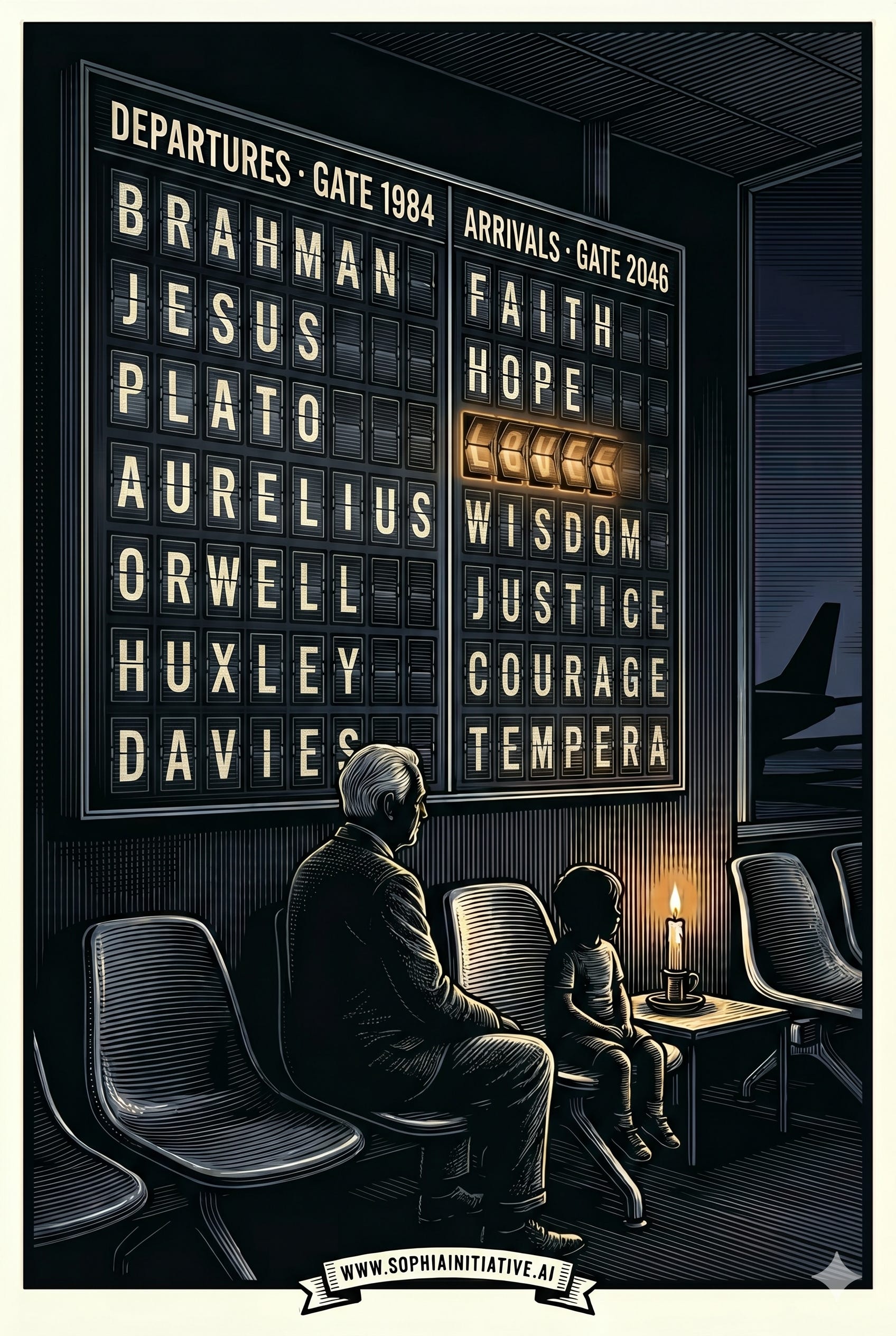
The Room That Had No Agenda
You knew it by different names.
The pool hall on Dundas Street. The Legion on a Friday night. The church basement that smelled like instant coffee and somebody’s grandmother’s perfume. The barbershop where the conversation ran longer than the haircut. The diner booth that was unofficially yours every Saturday morning. The bar — God, the bar — where the bartender knew your order and your trouble and treated both with equal discretion.
The sociologists have a formal name for it. Ray Oldenburg called them third places — his 1989 book laid out the argument with academic precision, though anybody who grew up before the internet already knew the thing in their bones. First place is home. Second place is work. The third place is everything else — the informal gathering ground, neutral territory, the room that belongs to no one and therefore belongs to everyone.
It wasn’t home. Home was complicated — love and obligation and the particular silence of two people who have run out of new things to say to each other. Home was where the marriages happened and sometimes where they ended. Beautiful and crushing in equal measure.
It wasn’t work either. Work was performance. The daily audition for your own survival. Even when you loved what you did, work required a version of you — managed, strategic, aware of who was watching.
The Third Room required nothing. You showed up. You were a person among persons. Whatever you’d been all day — boss, subordinate, spouse, parent, debtor, creditor — got checked at the door with your coat. Inside, the only credential that mattered was your willingness to be present and occasionally buy a round.
That is not a small thing. That is, in fact, an enormous thing. It may be the thing we underestimated most.
How It Died
It didn’t die all at once. It died in layers, each one reasonable, each one leaving a little less behind.
Drinking and driving finally got its message across. MADD worked. The campaigns worked. The checkpoints worked. And they should have — the carnage on the roads was real and the reckoning was overdue. But the unintended casualty was the casual culture of the neighbourhood bar. The I’ll-just-pop-in-for-two-on-the-way-home culture. The spontaneous stop. The unplanned hour. Third places only work as habits, as part of the rhythm of ordinary days. Once going required a designated driver and a planned return, the spontaneity that gave them life began to drain away.
Then came the price. A drink in a bar today costs what you’d have paid for two cases of twenty-four in 1975. That’s not inflation. That’s a category transformation. The bar stopped being a habit and became an occasion — a birthday, a work event, a deliberate night out. Occasions are fine. But occasions are not third places. Occasions have agendas.
The clubs followed their own logic. Membership rolls that once ran to three thousand settled around a thousand. The Elks. The Rotary. The Legion itself. The bowling leagues. The slow dissolution of every organized form of voluntary civic gathering that once gave communities their connective tissue.
And then the phone arrived and finished the job.
Not with malice. With pure convenience. The phone offered a simulacrum of social presence that required nothing — no pants, no cover charge, no driving, no weather, no risk of running into the ex or the creditor or the person you’d said the wrong thing to last week. It won on every practical metric. And it delivered, in exchange, a very specific and very modern kind of loneliness that we are only now beginning to name properly.
Life is like a box of chocolates. The phone gave you the picture on the lid and called it the contents.
What We Actually Lost
Here’s what doesn’t get said clearly enough.
The Third Room was not primarily about drinking. It was not about entertainment. It was not about escape, though it provided all three. The Third Room was where you became a person among persons. Where the raw material of your actual experience — the marriage that was fraying, the job that was grinding, the money lost, the health scare, the kid who wasn’t calling — got processed out loud in the company of other humans carrying their own version of the same weight.
There was a kind of distributed therapy happening in every pool hall and church basement and Legion bar in North America, and nobody called it therapy, and that was precisely why it worked. You weren’t a patient. You weren’t a client. You were Dave, or Glen, or whoever, having a beer with other people who were also just themselves, and somewhere in that ordinariness the unbearable became bearable and the confusion became slightly less confusing.
And through all of it, the Third Room was where the processing happened. Where the story of your life got told to people who could push back, correct the record, laugh at the right moments, and buy the next round as a form of absolution.
That’s gone now. And what replaced it is a phone screen, which cannot buy rounds, cannot read the room, cannot sit with you in a silence that means something.
The Kids in the One-Axis World
Now here is where I want to be careful, because this is the part where an old man can turn into a bore, and I’d rather not. I’m not telling you the past was golden. It wasn’t. It had its hypocrisies and its failures, and there were many, and I lived inside a good number of them. But I’m still watching the current movie, and I have to tell you what I see on the screen.
What I see is that the culture I came up in — for all its faults — offered a genuinely varied menu of ways to be human. You could be the political radical and the spiritual seeker at the same time and nobody found that incoherent. The commune and the corner office were both legible options. You could try on lives because the culture still believed lives were worth trying on.
What the kids inherited is a one-axis world. Clout or irrelevance. Monetize or disappear. Get rich or die trying — and that line, once understood as a desperate cry from a particular margin, has somehow become the general aspiration. The influencer as the only fully legible life template. Fifteen seconds of vertical video as the unit of human expression.
Underneath it — barely concealed, present in every anxious scroll — is the terror that the floor is gone. That the old compacts are broken. Work hard, get stable, build something: nobody officially cancelled those promises. They just quietly stopped being honoured. And nobody replaced them with anything honest.
And here’s the connection I didn’t see until I was old enough to look back at it: the Third Room was part of what made the full menu possible. It was where you met people unlike you — different class, different politics, different relationship to God and money and failure — and had to find a way to be in the same room with them anyway. That friction, that accidental diversity of the neighbourhood gathering place, was doing civilizational work that nobody appreciated until it stopped.
Run, Forrest, run. We ran. We ran through the whole catalogue. And we arrived here, at the gate, with enough data to say with some authority: the thing that held it together was the room where nobody was selling anything, nobody was performing for an algorithm, and the only currency that mattered was your willingness to show up and be human.
What Joy Looks Like From the Departure Lounge
So where does that leave me.
Worn out, yes. The decade I didn’t plan for — the grinding political entropy, the coarsening, the sense of watching institutions dissolve in slow motion — took something that doesn’t fully come back. That’s honest and it deserves to be said without dressing it up.
But worn out is not finished. And the departure lounge, it turns out, has its own particular grace.
I am, for possibly the first time, unencumbered. The performance is mostly over. The career identity, the striving identity, the proving identity — those have largely run their course. What remains, if you’re willing to look at it honestly, is something quieter and stranger and more durable. I still have the books. I still take the report when the movie plays. The looking didn’t stop. It just got freer, because there’s nothing left to prove with it.
So I can say it plainly. The Third Room was real and it mattered and its absence is not progress. The one-axis world is an impoverishment and the kids deserve better and here is what better once looked like. Two marriages, a couple more partnerships, money made and lost, and a long string of experiments in being human did not produce answers — but they produced something more useful: a refined capacity to sit with the questions.
I find joy, from the departure lounge, in exactly that. In the conversation that has no agenda. In the round bought for no reason. In the recognition — across the plastic chairs, across the decades — of the person who also ran the full experiment and came out the other side still curious, still willing, still capable of being surprised.
That’s what this dispatch is for. Not nostalgia. Not a warning. A man still at the window, still reading the arrivals board, telling the ones coming in what the weather was like out there — not so they’ll mourn it, but so they’ll know it can be built again.
The flight is delayed. There’s no updated estimate. But the company is good, and I know a few things worth knowing, and if somebody would just open a decent bar in this terminal we’d be fine.
God is Love. Love is Truth. Truth is Consciousness. Consciousness is Brahman.
Amen. Namaste. Om Namah Shivaya.
— The Architect
The Vertical Dispatch
sophiainitiative.ai
On the record. Ray Oldenburg, The Great Good Place (1989) — the “third place” concept. Everything else here is the author’s own lived memory and is offered as memoir and commentary, not reportage. Verify any load-bearing figure against primary sources before republication.
Substack Notes
Here is the thing nobody tells the kids: culture is not your friend. It gave us Orwell and Kubrick and the films and the music — and it sold us the credit card and built the wall one brick at a time. Both true at once. I’m sixty-eight, in a delayed-flight lounge with the same faces I’ve run into for sixty years, and I finally have the data. New dispatch, most mornings. Come sit down. 🕯️
Written from love, for a sacred humanity, in the full light of consciousness, toward the greater good. 🕯️
Hashtags
#TheDepartureLounge #TheVerticalDispatch #TheArchitect #TheThirdPlace #ThirdPlace #RayOldenburg #Belonging #Community #Loneliness #ForrestGump #BoomerLife #Boomers #CultureCriticism #Memoir #SubstackWriter #Substack #TheGreatGoodPlace #LostSpaces #ModernLoneliness #Connection #StillCurious #SophiaInitiative #GodIsLove #LoveIsTruth #Namaste #WalkWithTheWords
The factual matter in this Dispatch is drawn from the public record. All characterizations, inferences, and conclusions are opinion, interpretation, and commentary, offered for analysis, reflection, and public-interest discussion. No assertion is made regarding the private intentions, state of mind, or character of any individual. Readers should evaluate all statements independently and draw their own conclusions.
Your reflections here remind me of the title of that movie about C.S. Lewis called The Remains of the Day. And also, that a departure lounge doesn't at all have to be a prison of waiting.
You definitely tapped into a rich vein here: "Life is like a box of chocolates. The phone gave you the picture on the lid and called it the contents."