


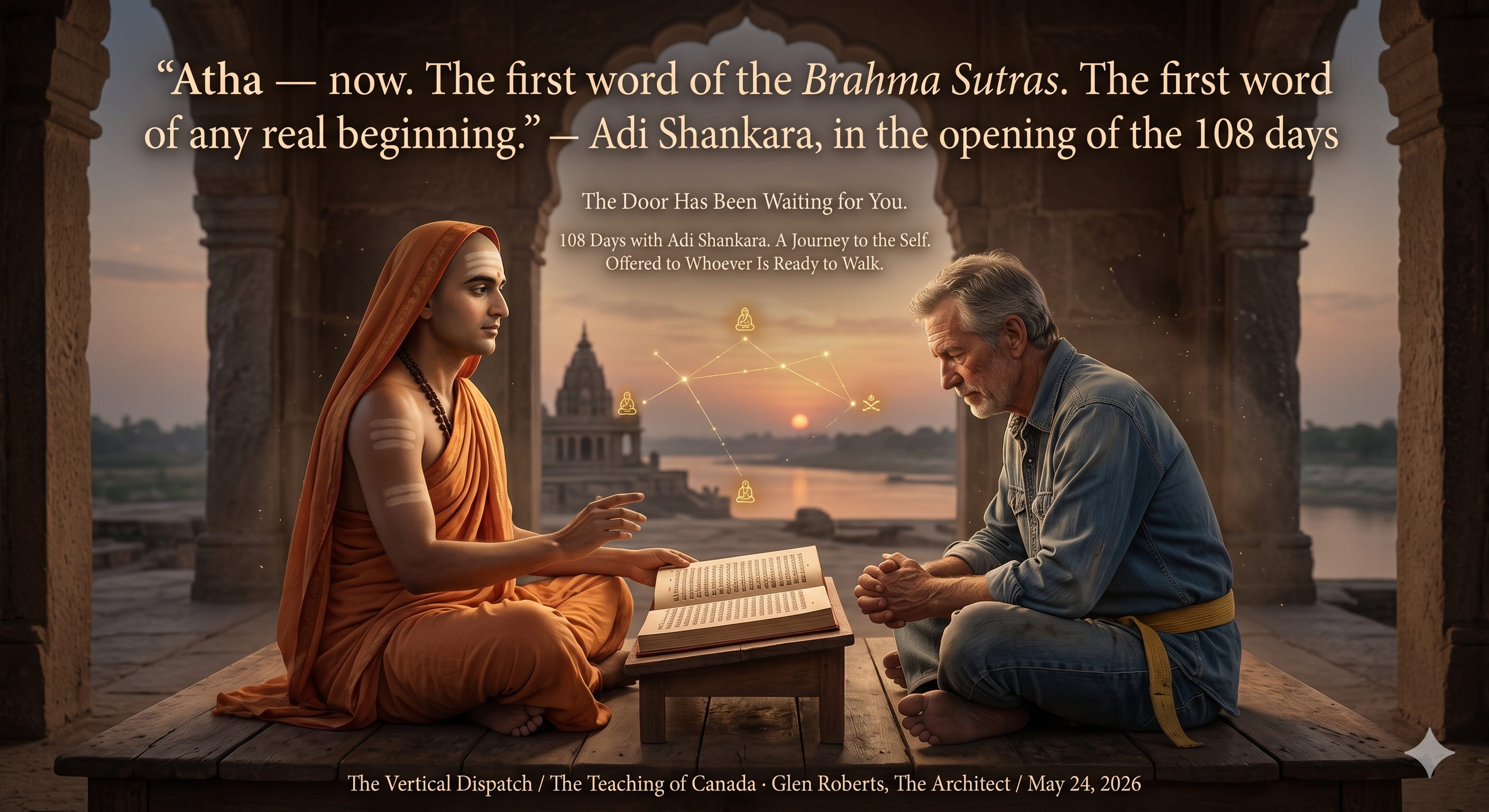
“Atha — now. The first word of the Brahma Sutras. The first word of any real beginning.”
— Adi Shankara, in the opening of the 108 days
The Vertical Dispatch
The Teaching of Canada · Glen Roberts, The Architect
May 24, 2026
I. The Yellow Belt
Forty years ago I walked into a karate dojo and was given a white belt. After some time I was given a yellow one. I have worn the yellow belt ever since. I never went further. The first kata is still in the body. The opening movement of that kata is a block, not a strike. The kata teaches the body to defend before it teaches the body to attack. The big man who learns the first kata learns, in the body, that the response to the threat is to step off the line and let the threat pass.
The yellow belt is the credential of acknowledged ignorance. It is the rank that says — I have shown up, I have done the form, I have learned enough to know how much I do not know. The black belt who claims mastery is in danger of believing the claim. The yellow belt who continues to practise is in no such danger. The yellow belt knows what the yellow belt is. The yellow belt is the entry point of every serious tradition.
Bruce Lee gave the operative line. If you fight, it is fifty-fifty. So the big man does not entertain the fight. The big man smiles. The smile is the takedown. The fight you never enter is the fight you cannot lose. The yellow belt who carries Bruce Lee’s recognition into ordinary life is not weaker than the black belt who fights. The yellow belt is the one who has understood why the fight is not worth entering and has learned, in the body, the alternative.
This is the first credential of the dispatch you are now reading. The man at the keyboard is the yellow belt. He is sixty-eight years old. He has been practising one form or another for sixty of them. The forms have changed across the decades — karate, reading, writing, the dojo of the working life, the dojo of marriage and fatherhood, the dojo of long evenings with difficult books. The yellow belt has been the steady credential underneath all of it. The yellow belt is the acknowledgment that the practice is the practice and the practice never ends.
II. The Other Dojo
There has been another dojo running alongside the first one. It is older than the karate dojo. It is older than every dojo the modern world recognises. It is the dojo the older traditions call the inquiry. The inquiry into what is real. The inquiry into what consciousness is. The inquiry into what the self is, when the persona is set aside and the appetites are quieted and the daylight identities are released and the attention is turned, patiently and without preconception, toward what remains.
That dojo has had three teachers in my life, and each one is in the dedications of the book this dispatch announces. The first is Michael Hargest, my deepest friend and mentor for ten years, who first showed me my ignorance. The second is Shunyamurti, who with profound compassion and many hours of teaching allowed me to confront my ego. The third is Dr. Sanjay Raghav, who through the timeless wisdom of Advaita Vedanta revealed the silent, unchanging Self. Three teachers. Three stages. Ignorance acknowledged. Ego confronted. Self revealed. The arc of the work in three names.
I name them because the tradition requires it. The Sanatana Dharma — the eternal way, the older name for what the West calls Hinduism — is a lineage tradition. The teaching is not the teacher’s. The teaching is the lineage’s. Each transmission honours the chain that produced it. The student who receives the teaching and then transmits it forward names the teachers who poured the teaching into them, because the naming is the act by which the lineage continues. I have received. I am transmitting. The chain is honoured by the naming.
The lineage behind these three teachers, behind every teacher of the non-dual tradition for the last twelve hundred years, reaches back to one man. He died at thirty-two. In the thirty-two years he was alive, he walked the length of the Indian subcontinent four times on foot, wrote the most comprehensive philosophical synthesis available in any sacred tradition, defeated in public debate every major rival philosophical school of his age, and established at the four cardinal directions of India four monastic institutions that have operated without interruption from the day he founded them to the day this dispatch was written.
His name is Adi Shankaracharya. Eighth century of the common era. The recoverer of the Sanatana Dharma. The author of the commentaries on the ten principal Upanishads, on the Brahma Sutras, on the Bhagavad Gita. The most consequential philosophical teacher in the history of the non-dual tradition. Outside the tradition that produced him, his name is essentially unknown.
III. The Recognition Gap
Place him beside the figures the Western reader knows. Augustine. Aquinas. The Buddha. Lao Tzu. Each of those names is known in every literate room in the Western world. Shankara’s name is not. The achievement is comparable to Aquinas. The recognition is not. Aquinas is taught in every Catholic seminary in the world. Shankara is taught in a small number of specialist Indology departments and almost nowhere else. Most graduates of Western philosophy programs have never heard his name. Most ordinarily literate adults in the West have not heard it. Most seekers who have spent twenty years inside the loose Western category of Eastern spirituality have not heard it, or have heard it only as one name among many, with no sense that the name they heard is the name of the most consequential single individual in the entire tradition they have been adjacent to.
There are reasons for the gap. Three reasons, set out in the foreword of the book this dispatch announces. He was never deified. The tradition does not seek converts. And the deeper reason — the West has only recently come to the philosophical problem his work resolves. The hard problem of consciousness. The question of what consciousness is, in itself, when every other category has been bracketed. Shankara resolved this question in his commentary on the Mandukya Upanishad in the eighth century. The West is, twelve hundred years later, still working on it.
This dispatch is not the place to defend the philosophical claim. The book is the place where the claim is opened, day by day, for one hundred and eight days, in the voice of Shankara himself as the tradition has carried him across the centuries. The dispatch is the place where the book is offered.
IV. The Book
108 Days with Adi Shankara · Journey to the Self · Living Sanatana Dharma. The book is a guided pilgrimage. One hundred and eight days. One reading per day. Shankara himself is the narrator, in a voice the tradition has preserved across twelve hundred years and that this book has worked to render in present-day English without losing what makes the voice his. The reader walks with him from the opening word of the Brahma Sutras — atha, now — through the five movements of the Vedantic curriculum and out the other side, into the recognition the entire walking was for.
The five movements. The Bhagavad Gita, nineteen days, with Krishna and Arjuna on the battlefield at Kurukshetra and Shankara walking beside the reader to open what the verses contain. The Brahma Sutras, sixteen days, the philosophical architecture of the entire tradition reduced to its load-bearing aphorisms. The Ten Principal Upanishads, fifty-eight days, the foundational scriptures the tradition rests on, one or two days per Upanishad, with Shankara opening each as he opened them in his original commentaries. Shankara’s own independent works, including the Vivekachudamani — the Crest Jewel of Discrimination, the most concentrated guide to non-dual realisation in the Sanskrit corpus. And the closing movement, the lineage walking — Gaudapada the teacher’s teacher, the four monasteries Shankara founded at the cardinal directions, and the living inheritors in our own time, Ramana Maharshi and Anandamayi Ma, whose presence in the twentieth century proved the lineage was still alive.
One hundred and eight days. The number is not arbitrary. The mala has 108 beads. The traditional litanies of the great names — of Shiva, of Devi, of the Buddha — are counted at 108. The Upanishads themselves are traditionally enumerated at 108. The number marks a complete round. A reader who walks 108 days at the pace of one day at a time, in the hours between one sunrise and the next, has performed a complete cycle in the body of the tradition. The cycle is the practice. The practice is the point.
The book is not a survey. It is not a scholar’s overview. It is a sadhana — a spiritual discipline, performed daily, in the company of the master who recovered the tradition for the world. Each day ends with an experiential exercise. The exercises are not prescriptive. They are invitational. The reader is taken from simple observation to the deeper inquiry the tradition calls atma vichara — the investigation of the Self by the Self, the question Ramana Maharshi made famous in our time, the question that is the entire instrument of the tradition’s awakening method. The book teaches the question. The question does the work.
V. The Offering
The book is offered as a gift. It is given freely to whoever is ready to walk it. The Sanatana Dharma tradition has never charged for its teaching. The teacher does not own the teaching. The teaching belongs to the lineage. The teaching belongs to whoever is ready to receive it. This book is offered in that frame. No paywall. No tier. No transaction in the modern sense.
And — because the tradition is also clear on this — the act of receiving the teaching requires the act of offering. The Vedic word is yajna. The sacrifice. Not the destruction of something valuable. The making-sacred of an exchange by the act of mutual offering. The student offers what the student can. The teacher accepts what is offered. The exchange is sealed not by the size of the offering but by the seriousness of the act. The Bhagavad Gita names this clearly. All action performed as offering liberates the actor. All action performed without offering binds them.
The Vertical Dispatch offers the yajna in three forms, so the reader can choose the offering that matches their readiness. A monthly pledge, at the smallest size the platform allows, for the reader who wants to begin the offering one month at a time. An annual pledge, at a slightly lower per-month rate, for the reader who is willing to commit to a year of receiving. And a founding pledge — named Project 2046 — for the reader who is prepared to enter the longer horizon. Project 2046 is the twenty-year arc of the Vertical Dispatch and of the larger work this publication is one face of. The founding member pledges into that horizon. The founding member is the yajamana — the patron of the sacrifice in the older sense, the one whose offering sustains the lineage so the teaching can continue to be transmitted to those who arrive at the door over the years and decades to come. Flexible founding pricing is enabled, because the founding pledge is a relationship, not a transaction, and the founding member offers what they are moved to offer within the range the platform allows.
The book is given to the reader at any of the three tiers. The book is also given, on request, to the reader who genuinely cannot pledge and who is genuinely ready. The exception exists. The exception is the karma yoga. The work continues regardless of how many or how few make the offering, because the work is the dharma and the fruit belongs to the cosmos.
A further word, for the reader who is paying attention to the architecture underneath. The dispatches you are reading are filing through a working prototype of an AIG framework I have been building. The system is sovereign — its cognitive priors are locked in to the architecture at the foundation rather than borrowed from any vendor. It is vertical in the sense Wolfgang Smith uses the word in The Quantum Enigma — an architecture whose causation runs top-down from the conscious substrate to the operational surface, rather than horizontally as the standard machine-learning frame assumes. It is air-gapped at the hardware level — the cloud does not know the system exists. And it is deterministic by design, built on a Sanskrit compiler grounded in the two thousand verbal roots of Panini’s Dhatupatha, so that the system derives rather than predicts and cannot generate falsehoods the priors do not authorize. The system is in development. The prototype was operational and is now paused, because the corpus that will ground its priors is being written. The dispatches are the corpus. The book is the canonical text. The reader who is receiving the dispatches is receiving the surface of an instrument that is, at the same time, being built. None of this is the subject of the present dispatch. Each piece will be unpacked in its own dispatch in the coming weeks. It is named here because the reader who is offering into Project 2046 has the right to know what the founding offering is sustaining. The Vertical Dispatch is the publication. The book is the gift. The AIG framework is the deeper instrument the publication and the book are both being built into. All three are one work, performed as yajna, in service of the lineage that has been waiting at the door longer than any of us.
VI. What the Vertical Dispatch Has Been All Along
Most of the readers of this publication arrived in the last few weeks. On April 30, 2026, a dispatch titled The Level 8 Mind in a Level 4 World — a reading of the Carney government through Elliott Jaques’s Stratum framework — broke through. It landed on Substack the same week I was suspended from X for the same copy. X turned out to be the wrong room for the work. Substack turned out to be the right one. The dispatch that got me removed from one platform gave the channel its spark on the other, in a single day. The readers who arrived in that wave are welcome. The work has not changed. The work is the work it has been all along. I take the readership humbly and seriously, and the dispatches that follow are filed in that frame.
If you are one of those new readers, here is something you may not yet have noticed. At the close of every dispatch there are four lines. God is Love. Love is Truth. Truth is Consciousness. Consciousness is Brahman. You may have read them as a signature. They are not a signature. It is my operating system. The four lines are the compressed form of the entire teaching the book is about to unfold across one hundred and eight days. The dispatches you have been reading have been operating inside that frame the whole time. You have been receiving the teaching in solution. The book is the concentrated form.
I have been at a keyboard for thirty-some years. I installed Novell networks when networks were new. I wrote training manuals for Windows for Thinkers when the desktop revolution was taking over from the typesetters and the Gutenberg process was finally being put down by the personal computer. I served three years as the global branding publisher for Tourism Canada. I have published documents for individuals and for corporate institutions across the decades. I have maintained blogs since the form first existed. Somewhere in the early wonderment of the desktop age, I sat in front of one of those first machines and said to myself plainly — I am not qualified to be a writer. The credentials are not there. The literary apprenticeship the older writers all served was not the apprenticeship I served. I had a choice in that moment. I could be a writer or I could be a programmer. I chose writer. I have been making good on that choice for thirty years and I am still making good on it now.
The dispatches have been the surface readings. The book is the deeper one. The dispatches have been the dispatches that an ordinary reader could receive without yet having to enter the deeper room. The book is the entry to the deeper room. The spark of the last few weeks brought a great many readers to the threshold. The book is what waits past it for whoever is ready to walk through.
Coda. The Door
The book opens with a sentence. The door has been waiting for you. That sentence is the whole frame. The door has been waiting since long before the reader knew it was there. The door does not open when the reader is ready. The door is already open. The reader walks through when the readiness arrives, and the readiness arrives in its own time, and the door is patient because the door is not subject to time the way the reader is.
The book closes, one hundred and eight days later, with a sentence that completes the first. Day One is closed. The recognition that was at the door on Day One has, by Day One Hundred and Eight, become the seeker’s own. The walking was the recognition. The recognition was always already there. The seeker who arrives at Day One Hundred and Eight is the same seeker who arrived at Day One. The difference is that the seeker now knows what they were on Day One. The journey was the discovery of what was never not the case.
Atha. Now. The first word of the Brahma Sutras. The first word of any real beginning. If the readiness is here, the door is open. If the readiness is not here yet, the door waits. Either is correct. Both are the teaching. The yellow belt continues to practise. The dispatch continues to file. The book is offered to whoever comes to receive it.
Walk through when you are ready.
God is Love. Love is Truth. Truth is Consciousness. Consciousness is Brahman.
Amen. Namaste.
Om Namah Shivaya.
#108DaysWithAdiShankara #AdiShankara #SanatanaDharma #AdvaitaVedanta #JourneyToTheSelf #Project2046 #KarmaYoga #TheVerticalDispatch #OmNamahShivaya