

Φ
THE VERTICAL DISPATCH
We write for the mind, the eye, and the ear.
Read it. Look at it. Listen to it. The Vertical Dispatch is built for all three — prose with rhythm, made to be heard as much as read.
From metaphysics to geopolitics, from culture to history, from the sacred to the street — and everything in between. One lens, every subject. No ego. Just the record, named clean.
Press play. Walk with the words. 🕯️
Canada and Climate · The Age of Consequences
As of 4 June 2026
“What is the problem to which this technology is the solution?”
— the question Neil Postman taught us always to ask first
This dispatch travels by hand. If it serves you, share it — restack on Substack, pass it on wherever you read. 🕯️
The Question Before the Answer
There is a discipline that has to come before any debate about energy, and almost no one observes it. Before asking which power plant to build, which sector to electrify, which industry to attract, one is obliged to ask the older and harder question: what, precisely, is the problem? Name the wrong problem and every solution that follows — however clever, however expensive — solves the wrong thing, and the country spends a decade and a hundred billion dollars discovering it. Name the right one and the solution, when it comes, fits like a key. This dispatch is an attempt to name the problem correctly, and then to follow the logic wherever it leads, without reaching for the fashionable answer before the question is even settled.
Start, then, with the debate as it is actually being conducted, because the shape of the argument tells you that the country has not yet found its problem.
Hislop’s Hole
The energy journalist Markham Hislop, who has covered this file for over a decade at Energi Media, has named one hole in the national plan cleanly, and the credit for the framing is his. Reviewing the Carney government’s National Electricity Strategy of May 2026, Hislop observed that the strategy targets supply — building generation, doubling capacity — but says little about demand: about actually replacing the gas furnace with the heat pump, the gasoline engine with the electric one, across the existing economy. His point, sharpened: building more electricity is not the same as electrifying. Canada’s electrification rate — the share of its final energy that comes as electricity — has sat, by the figures international analysts cite, somewhere around twenty to twenty-three percent for decades, while the path to net zero requires roughly half. You can pour new power into the system and watch that number not move, if the new power simply runs new things.
Hislop is right, and his hole is real. But there is a deeper hole beneath his hole, and it is the one the whole national conversation keeps stepping over. The reason the replace-versus-attract argument feels unwinnable — every megawatt sent to a battery plant is a megawatt not sent to a household furnace — is that the argument assumes a fixed pool of power in each province, to be rationed. It is a quarrel about how to slice a loaf. And it is the wrong quarrel, because the binding constraint in this country is not the size of the loaf. It is that the loaves cannot be passed between provinces.
A Country Not Wired to Itself
Here is the fact that reframes everything, and it is not in dispute. Canada’s electricity grid is not one grid. It is a patchwork of provincial systems with strikingly little capacity to move power between them — so little that British Columbia, Manitoba, Ontario and Quebec each trade more electricity south, into the United States, than they trade east or west with their fellow provinces. The country is wired to its neighbour more thoroughly than it is wired to itself. The Carney strategy’s own language concedes the point: the system, it says, is fragmented.
Sit with what that means in the Age of Consequences, because this is where energy stops being a utility question and becomes a sovereignty question. A long-trusted neighbour to the south has turned transactional and cold. And the Canadian provinces, holding some of the cleanest and cheapest power on the continent, are plumbed to send it across that southern border more easily than to send it to one another. Quebec’s surplus hydro cannot readily light an Ontario heat pump or power an Alberta household’s furnace, because the wires to carry it were never built. The replace-versus-attract debate is a quarrel conducted inside thirteen separate rooms, when the actual problem is that there are no doors between the rooms. That is the real hole. Not which power to build — whether the country is connected enough to use what it builds.
The Power That Has Lain Dormant
Name the problem correctly — a country not wired to itself — and the logic points somewhere specific, and somewhere the public conversation has scarcely dared to go. The solution that fits the problem is a national grid: the connective tissue, the interprovincial transmission, the doors between the rooms. Independent analysis has put the prize of a coast-to-coast electricity network in the range of well over a hundred billion dollars in net savings, by letting surpluses in one region answer deficits in another. The Balsillie Papers, in late 2025, sketched exactly such a blueprint — a national power corridor enabling a ten- to twenty-fold increase in interprovincial electricity trade. The logic is not exotic. It is the logic of every nation-binding project in Canadian history.
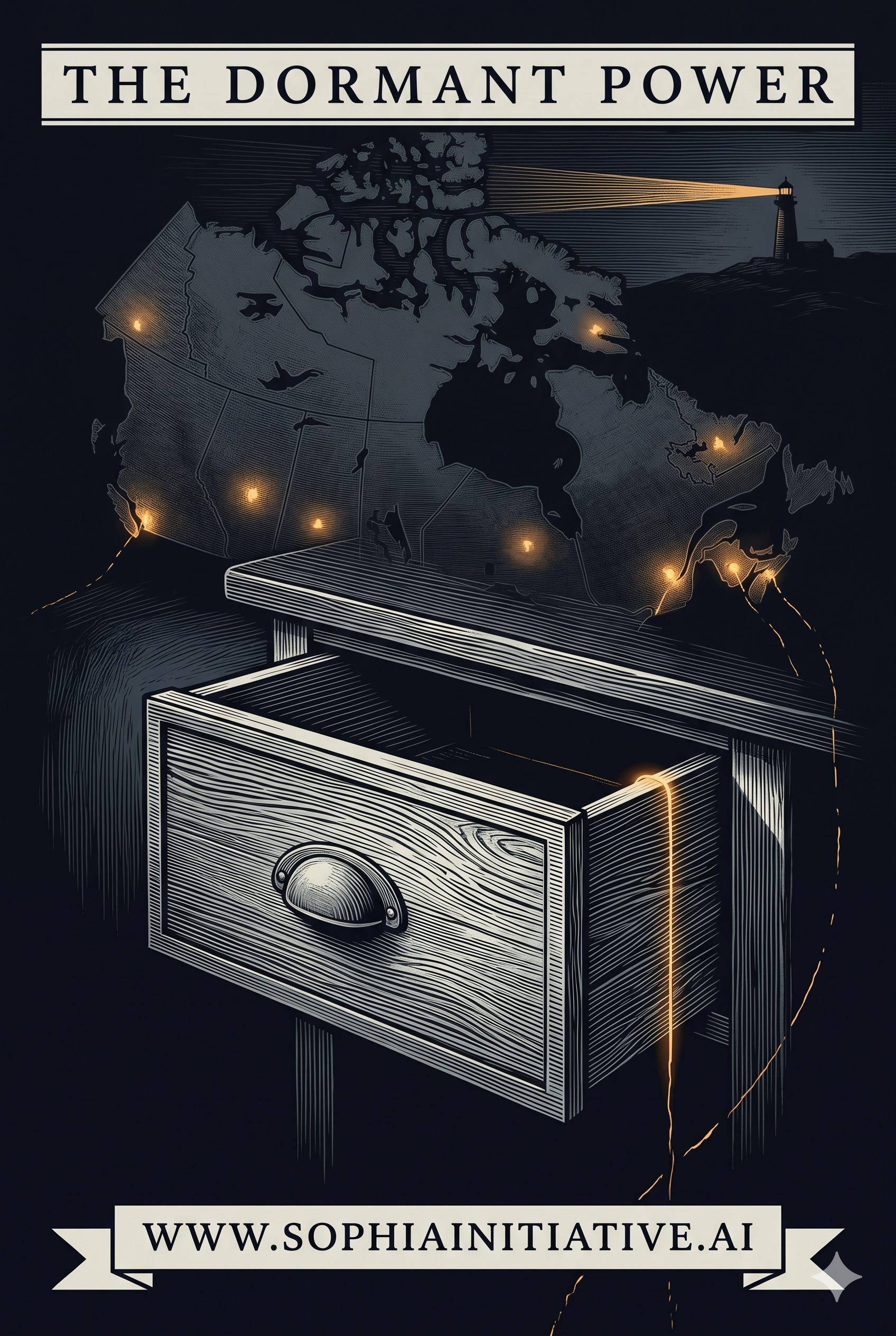
And here the title of this dispatch shows its second meaning. There is, in the Constitution Act of 1867, a federal power that bears directly on this — section 92(10)(c), which allows Ottawa to declare an interprovincial work to be for the general advantage of Canada, and so bring it under federal authority even over provincial objection. It is the power that built the country: the constitutional reach behind the transcontinental railway, asserted behind the interprovincial pipeline, the legal spine of nation-binding infrastructure. And as applied to an interprovincial power line, it has never once been used. No order has ever been issued designating an interprovincial transmission line a work for the general advantage of Canada. The tool that could wire the country to itself has lain in the drawer, untouched, for a hundred and fifty-eight years. There are two dormant powers in this story, and they are the same word: the electrical power the provinces cannot share, and the constitutional power Ottawa has never dared to pick up.
Why the Drawer Has Stayed Shut
It would be a failure of the discipline to name the solution and not name, at full strength, why it has not happened — because the reasons are serious, and a reader who weighs them may conclude the drawer should stay shut. This is the case others would make, and it deserves no strawman.
First, jurisdiction. Electricity generation and the wires inside a province are, by long constitutional settlement, provincial ground, and provinces guard that ground fiercely — Quebec above all, for which Hydro-Québec is not merely a utility but a pillar of identity built in the Quiet Revolution. For Ottawa to invoke a dormant declaratory power over provincial objection would be a constitutional confrontation of the first order, and cooperative federalism — the patient, consent-based approach — has been the Canadian way precisely because the alternative is so explosive. Second, and more subtle: a national grid would raise prices in the provinces that have the cheapest power. This is not speculation. Norway, hydro-rich and wealthy, built interconnectors to Europe and is now pulling back from them, its parliament in revolt, precisely because connection imported price volatility and raised domestic costs. Connect Quebec’s cheap hydro to a continental market and Quebecers may pay more to heat their homes so that Ontario can decarbonize. That is a real cost, borne by real households, and no amount of national-unity rhetoric makes it vanish. Third, the record of trying. The Atlantic Loop — a regional version of exactly this dream — stalled repeatedly, and the provinces backed away; what survives is a scaled-down fragment. The graveyard of Canadian grid integration is not empty.
So the honest statement of the bind is this. The logic of the correctly-named problem points clearly toward a national grid and the dormant power that could build it. And the political, constitutional and economic cost of picking that power up is so high that no government in a hundred and fifty-eight years has done it. Both of those are true at once. The solution fits the problem; the lock has held against every key so far.
The Captain and the Deep Water
Which returns us to the man at the wheel, and to the through-line this series has been following. The Prime Minister who announced this strategy is the same figure examined in these pages before: the architect of the world’s net-zero finance machine, now presiding over a domestic energy plan that, by Hislop’s reading, targets supply and leaves the harder demand-side problem largely unaddressed — and that quietly enlarges the role of natural gas while moving the net-zero grid goalpost from 2035 to 2050. His strategy speaks, rightly, of connecting the country’s fragmented grids east, west and north, and projects interprovincial transmission growing by up to seventy percent by 2050. But it commits no dollar figure to transmission as against generation, sets no firm date for an east-west connection, and gives no sign of whether Ottawa will ever pick up the dormant power to force the matter. It announces the ambition. It does not resolve the bind.
That is not, in itself, a charge against the captain. Naming a problem and breaking it are different acts, and the second is the work of years and of a federation’s hard consent, not of a single announcement. A captain in deep water is judged by whether he reads the water true and sets the boat at the right angle — not by whether the far shore arrives on the day he names it. What can be said, on the record, is that the water has now been read: the country knows its grid is fragmented, knows transmission is the binding constraint, and knows — if it cares to look — that a dormant constitutional power sits in the drawer. What it does not yet know is whether anyone will open the drawer.
The Drawer, and the Reader
This dispatch makes no recommendation, because reading the water and steering another’s boat are different jobs, and only the first belongs to a publication. It has tried only to do the thing the discipline demands: to ask what the problem actually is before applauding any solution, and to follow the logic to where it honestly leads. The problem is not which power Canada should build. The problem is that Canada is not wired to itself, and the tool to change that has gone unused since Confederation. The logic points at a national grid; the cost of building it is measured in provincial price, constitutional confrontation, and political nerve. Whether the prize is worth that cost is not a question the record can answer. It is a question for the country — which is to say, for the reader.
Every nation-binding thing Canada has ever built — the railway that made it one country, the seaway, the corridor of pipe — was once a dormant possibility that someone decided was worth the cost of picking up. The grid is the next such thing, sitting in the drawer with the power that could build it. The waters are rough, and a country wired to a cold neighbour more firmly than to itself is a country that has not yet decided what it wants to be. The drawer is closed. The hand that opens it, if any hand does, will not be ours. We only name the drawer, and the power asleep inside it, and hand the question to the people who own the house.

God is Love. Love is Truth. Truth is Consciousness. Consciousness is Brahman.
Amen. Namaste. Om Namah Shivaya.
— The Architect
The Vertical Dispatch
sophiainitiative.ai
On the record. The framing that “building more electricity is not the same as electrifying” is Markham Hislop’s (Energi Media, “The Huge Hole in Carney’s Canadian Electricity Strategy,” 19 May 2026; “Quebec is the Canary for Canada’s Electrification Strategy,” 1 June 2026); this dispatch extends his argument and credits it as his. Canada’s electrification rate is widely cited by international analysts (IEA and others) at roughly 20–23% of final energy and has been essentially flat for decades; it is not tracked annually in a single official Canadian series, so the figure is directional, not precise. The IEA Net Zero scenario requires roughly 50% globally by 2050. The Canada Energy Regulator’s Canada’s Energy Future 2026 (April 2026) projects electricity demand rising 26–84% by 2050 across its scenarios. Quebec’s electrification rate is reported in a 37–42% range depending on methodology (Chaire de gestion du secteur de l’énergie, HEC Montréal, 2025; other 2026 analyses). The Carney government’s National Electricity Strategy (“Powering Canada Strong”) was announced 14 May 2026; it aims to double grid capacity by 2050, describes the system as “fragmented,” projects interprovincial transmission growth of up to 27% by 2035 and 70% by 2050, amends the Clean Electricity Regulations to allow a larger near-term role for natural gas, and commits no published dollar split between transmission and generation (government strategy document; iPolitics; Electricity Canada, 14 May 2026; Pembina Institute, 15 May 2026; Environmental Defence, 14 May 2026). That provinces trade more electricity with US states than across provincial borders is documented (Electricity Canada; Financial Post, 17 Feb 2026). The estimate of net savings exceeding US$100 billion from a coast-to-coast network, and the 10–20x interprovincial-trade increase, are proponents’ estimates (Balsillie Papers, “TransCanada Power Corridor,” Oct 2025); they are projections, not settled figures. Section 92(10)(c) of the Constitution Act, 1867 is the federal declaratory power over works for the general advantage of Canada; no order-in-council has ever designated an interprovincial power line under it (Canadian Bar Association session, 20 Feb 2024; constitutional commentary). Norway’s retreat from new interconnectors over price contagion is reported (Keyfacts Energy, 21 Feb 2025; Statkraft, 17 Sept 2025). The Atlantic Loop’s repeated stalling, and the scaled-down NS–NB intertie that survives, are documented (Canada Infrastructure Bank, 6 March 2025; Canada’s National Observer, 3 June 2025). The Postman question is from Neil Postman’s Technopoly (1992). No figure in this dispatch is disaggregated by race, group, or class. This dispatch makes no policy recommendation and no assertion regarding the private intentions or character of any individual; it examines public structure and the public record only. Errors and omissions excepted; corrections will be made on notice. Verify against primary sources before republication.
#TheDormantPower #Electrification #NationalGrid #Section9210c #MarkhamHislop #EnergiMedia #MarkCarney #NationalElectricityStrategy #EnergySovereignty #HydroQuebec #NeilPostman #Technopoly #CanadaAndClimate #TheAgeOfConsequences #TheVerticalDispatch #TheArchitect #SophiaInitiative #GodIsLove #LoveIsTruth #OmNamahShivaya
Substack Notes
Canada keeps having the wrong argument about energy. Replace fossil fuels in homes and cars, or attract battery plants and data centres? Which power to build, which demand to serve? The energy journalist Markham Hislop named one real hole in the national plan — it targets supply and says little about actually electrifying the existing economy. This dispatch credits his framing and goes one layer deeper, to the hole beneath the hole.
Because the argument assumes a fixed pool of power in each province, to be rationed. And that is the wrong problem. The real one: Canada is not wired to itself. British Columbia, Manitoba, Ontario and Quebec each trade more electricity south into the United States than east or west with each other. The country is plumbed to a neighbour now turning cold more thoroughly than it is plumbed to itself. In the Age of Consequences, that is not a utility problem. It is a sovereignty problem.
Name the problem right and the title shows its second meaning. Section 92(10)(c) of the 1867 Constitution lets Ottawa declare an interprovincial work to be for the general advantage of Canada — the power that built the railway. Applied to a power line, it has never once been used. Two dormant powers, the same word: the electricity the provinces cannot share, and the constitutional power Ottawa has never dared pick up. And the cost of picking it up is real — higher prices in cheap-power provinces, constitutional confrontation, the graveyard of stalled grid projects. We put that opposing case at full strength.
This is not a policy recommendation. It is the discipline Neil Postman taught: ask what the problem actually is before applauding any solution. The problem is named; the logic is followed; the bind is honest. The drawer is closed, and the hand that opens it — if any hand does — will not be ours. We only name the drawer, and hand the question to the people who own the house. 🕯️
The factual matter in this Dispatch is drawn from the public record. All characterizations, inferences, and conclusions are opinion, interpretation, and commentary, offered for analysis, reflection, and public-interest discussion. No assertion is made regarding the private intentions, state of mind, or character of any individual. Readers should evaluate all statements independently and draw their own conclusions.
Thank you so much for laying this out so clearly! I subscribe to Energi Media on You Tube and have been getting a gist of this but you have connected it all- this is a must read for every Canadian
Oh boy! More issues with interprovincial trade barriers! Will the kids play nice in the sand box - or complain about Ottawa?