


The history of Western thought is often presented as a steady climb toward the summit of reason, equality, and universal human rights. Yet, as the “Paradox of the Enlightened Bigot” reveals, the architects of this climb—Aristotle, Rousseau, Kant, and Nietzsche—repeatedly stumbled into deep pits of prejudice. These were not mere “men of their time” falling victim to social custom; they were brilliant logicians following the internal grammar of Dualism to its inevitable end. To understand why they failed, we must understand that their starting point was the “Split.”
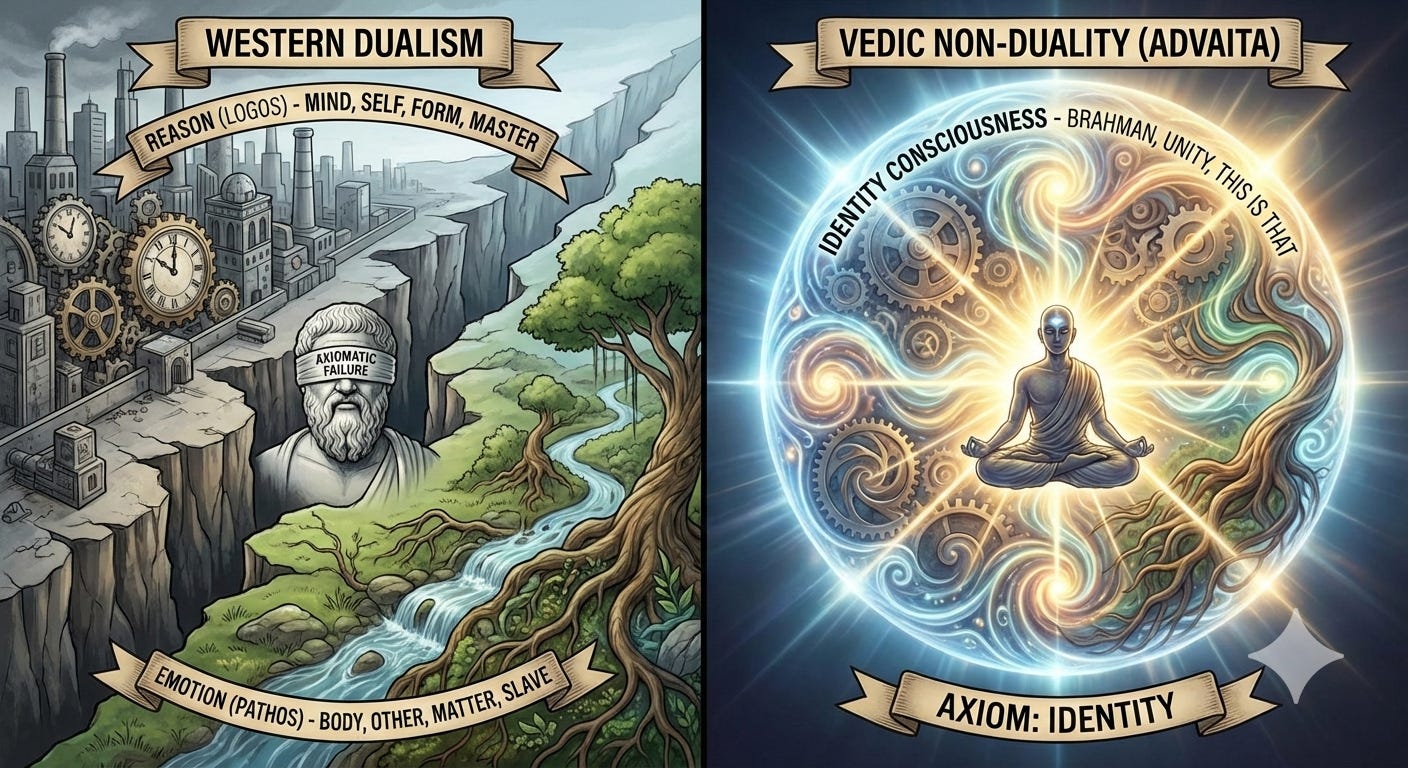
The Architecture of Separation
At the heart of the Western canon lies the subject-object dichotomy. This is the belief that the “Self” (the observer) is fundamentally separate from the “World” (the observed). Once this split is accepted as an axiom, the mind must begin the work of categorization. In a dualistic system, categorization is never neutral; it is hierarchical. To define “A,” one must contrast it with “Not-A.” To define “Reason,” one must contrast it with “Emotion.” To define the “Master,” one must create the “Slave.”
This “This vs. That” logic creates a friction that necessitates a winner and a loser. Because the Western philosopher identifies solely with the “Reasoning Mind,” anything perceived as outside that mind—the body, nature, or the “other”—is viewed as a secondary, passive substance to be governed.
Four Case Studies in Dualistic Failure
1. Aristotle: The Metaphysics of Inequality
Aristotle’s failure was a failure of Teleological Dualism. He believed that everything in nature had a fixed “function” and that these functions were arranged in a ladder of superiority. By separating “Form” (the active, rational principle) from “Matter” (the passive, physical principle), he created a metaphysical justification for oppression. He viewed the male as the instantiation of “Form” and the female as the “defective” instantiation of “Matter”. Within his dualistic logic, the one must rule and the other must be ruled. His error was not a lack of observation, but a lack of Identity Consciousness; he could not see the same singular essence in the “Matter” he sought to categorize.
2. Rousseau: The Trap of “Nature”
Rousseau represents the failure of Social Dualism. He famously claimed that “man is born free,” yet he simultaneously constructed a cage for women in the name of “Nature”. This is the “Convenient Nature” of the dualist: the ability to divide reality into “Natural Freedom” for the self and “Natural Subordination” for the other. Because Rousseau’s axiom was the separation of the public political sphere from the private domestic sphere, he was forced to create a “Sophie” to serve his “Emile”. He used the tools of liberation to justify confinement because his starting point was not the unity of humanity, but the division of roles.
3. Kant: The Categorical Blind Spot
Kant’s failure is perhaps the most instructive, as it represents the failure of Rational Dualism. He constructed the “Categorical Imperative”—a supposedly universal law of ethics—but then partitioned humanity into those capable of “Sublime Reason” and those limited to “Beautiful Feeling”. By dualizing the human experience into “Reason vs. Emotion,” he structurally excluded women from the category of “Persons” with full moral dignity. Kant possessed the intellectual tools for equality, but because his axiom was the supremacy of the detached intellect over the embodied self, he could not apply his own laws to those he perceived as “other”.
4. Nietzsche: The Resentment of the Divided Will
Nietzsche attempted to transcend Western morality, yet he fell into the trap of Power Dualism. Even as he dismantled the “herd mentality,” he replaced it with a new binary: the “Overman” vs. the “Slave.” His crude remarks about women were the symptoms of a mind that still viewed reality through the lens of possession and dominance. His genealogical method was designed to expose hidden power structures, but it stopped short of exposing his own dualistic resentment toward the feminine.
The Non-Dual Corrective: Identity as the First Axiom
The Vedic tradition does not seek to “fix” these dualistic hierarchies; it dissolves them at the source. The axiom of Advaita (Non-Duality) posits that there is only one Reality—Consciousness—manifesting as the infinite variety of the world. In this system, there is no “other.” The observer and the observed are two aspects of the same singular field.
The Dissolution of Hierarchy
When the first axiom is Identity Consciousness (the recognition that Atman is Brahman), the “Logic of Inferiority” becomes a logical impossibility. You cannot categorize another as “inferior” if you recognize that their essential nature is identical to yours. The “Moral Blindness” of the West is replaced by the “Vedic Vision” of the Self-in-all.
Vedic Realism vs. Western Idealism
While Western philosophers often mistook their local social customs for “Natural Law,” the Vedic tradition identifies these social structures as Maya (illusion)—temporary, shifting projections of a deeper, unified truth. A true universalist does not build their system on the fleeting social arrangements of 4th-century Greece or 18th-century Europe. They build it on the unchanging foundation of the Logos—the unified consciousness that precedes all categorization.
The Sage’s Conclusion
We do not rebuke these great Western thinkers out of a sense of superiority, but out of a commitment to a higher truth. We acknowledge their brilliance while identifying their Axiomatic Failure. Their works are the high-water marks of what the divided intellect can achieve, but they also serve as warnings of the moral catastrophes that occur when the intellect is severed from the heart of Non-Duality.
True universalism is not a set of rules to be followed; it is a state of being to be realized. It is the move from “This vs. That” to “This is That.” Only by adopting Identity Consciousness as our starting point can we build a system—be it philosophical, social, or technological—that is truly free from the “spectacular failures” of the past.
Profound and excellent! I have to read it again, so booking it too.
Yeah, I think this is brilliant.
The only thing I would say is that I believe dualism to be a necessary step towards eventually realizing nonduality.