


Φ
THE VERTICAL DISPATCH
We write for the mind, the eye, and the ear.
Read it. Look at it. Listen to it. The Vertical Dispatch is built for all three — prose with rhythm, made to be heard as much as read.
From metaphysics to geopolitics, from culture to history, from the sacred to the street — and everything in between. One lens, every subject. No ego. Just the record, named clean.
Press play. Walk with the word. 🕯️
This dispatch travels by hand. If it serves you, share it — restack on Substack, and pass it on wherever you read. 🕯️
The Foundation Series · On Stepping Off the Horizontal
The view count is the symbol; the reader who stays is the referent. Read for the referent, never the wedge.
I want to tell you why I am going quiet on the news of the world, and I want to do it honestly, which means beginning with myself and not with the politicians. We all have an ego. That is the hard part, and the part most writing on this subject quietly skips, because it is far more comfortable to describe the ego of the other side than to admit the one doing the describing. So let me not skip it. I followed geopolitics closely, on both sides, for a long time — and I have come to see that I was not following it to understand the world. I was following it to be fed.
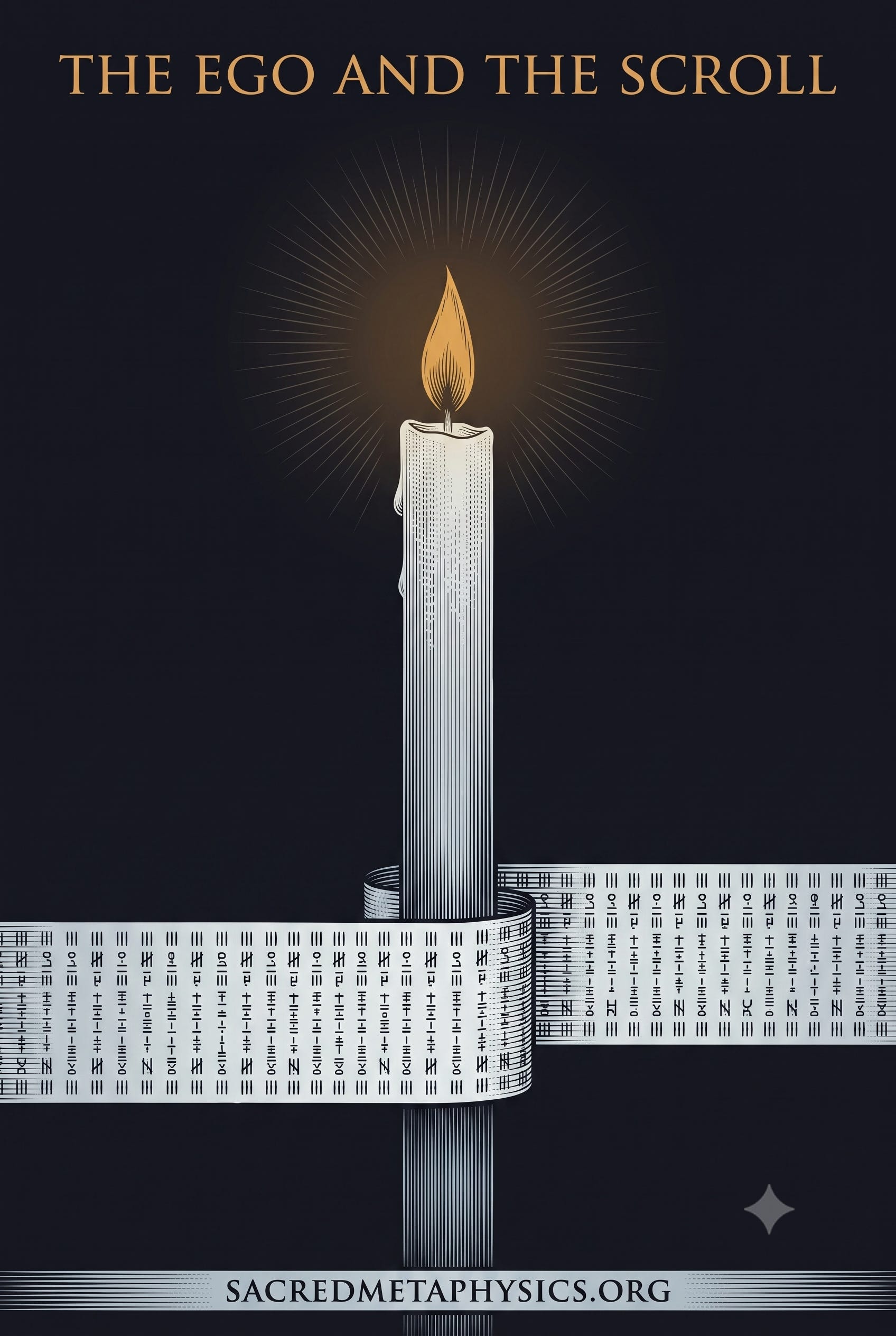
The daily fix
There is a hunger the ego has that politics satisfies better than almost anything else, and it is not the hunger for justice, though it wears justice as a mask. It is the hunger to be right. To know, today, freshly, that I am on the correct side and they are on the wrong one. The feed is built to deliver that fix on a daily schedule, and it does not matter which side you are on, because both sides run on the same machine. The one who despises a leader refreshes to be freshly enraged; the one who adores him refreshes to be freshly vindicated. They believe they are opposites. They are doing the identical thing — each taking a daily dose of the drug called being right, and each mistaking the craving for conviction.
Roger Waters has been naming this wound for half a century. On The Dark Side of the Moon he set it to music in “Us and Them” — the reminder that we are, after all, only ordinary men, sorted into sides by forces that profit from the sorting. Two decades later, on Amused to Death — the album named for our amusing ourselves to death — he showed how the screen keeps the division alive: a channel turned to a distant war watched like a match, followed not out of grief but to know whether one’s own side is winning or losing. First the ego splits the world into us and them; then the feed turns the split into a game you check for the score. That is the whole of it — the wound, and the way it is kept bleeding — and a songwriter saw it coming before most of us were born. The ego does not want the war to end. It wants the scoreboard. Peace would take away the one thing it comes for, which is a side to stand on and a score to check.
What we lost, that made the scoreboard the only game
I think this happened to us because we lost something underneath politics, and when it went, politics rushed in to fill the hole. We lost the vertical axis — the old sense that there is a sacred and a profane, a virtue and a vice, a direction that is up and a direction that is down, against which a life or an act can be measured. When that axis is alive, politics is a small thing, one matter among many, judged by whether it serves the good. When that axis dies, there is no up and down left — only left and right, only your side and mine, only the flat field running out to its edges. And on a purely flat field there is only one possible measure of anything: which way is it moving, and is my team ahead. The scoreboard becomes the only game because it is the only measure left standing once virtue and vice have been forgotten.
That is why the arguments have grown so total and so joyless. When politics is one thing among many, you can lose an election and still have your life, your faith, your neighbours, your sense of the good intact. When politics is the only axis left, losing feels like annihilation, and so every contest becomes a war, and the other side becomes not mistaken but evil, and there is no floor beneath the fall.
What I look for in a leader
So let me offer the one political thing I still hold, not as a verdict you must share but as an example of reading by the vertical rather than the scoreboard. It is simply how I vote. I do not vote left or right. I vote by the qualities of the person asking for my trust — and chief among those qualities, I have come to believe, is whether they can teach me something worth keeping.
I will name where I learned this, and I will name it plainly, because it is not a partisan point but a moment of a country’s history. When Pierre Trudeau died, his son Justin stood before the nation and delivered the eulogy. I was not in that family and I owed it nothing, yet the eulogy reached me as though I were a student in a classroom and the teaching had been handed down through the son from the father. Pierre Trudeau was a man of law and philosophy, qualified to stand at the front of such a room. And what came through his son that day was a lesson: that a man can be argued with and still honoured, that you may disagree with him to the very end and never once need to degrade him. I took that lesson, and I have tried to hold it to the best of my ability from the day of that eulogy to this one. That is what I look for in a leader now — not a champion for my side, but someone who can teach me to be better than I was.
People tried to belittle the younger man’s education — a degree in literature, a background in the teaching of it — as though it were a weakness. I have never understood that. The first work of a leader is to speak to a frightened country and be understood, and the study of literature and language is the very training for it. He was, by any honest measure, the better communicator of the choices on offer, and that is not a small thing; it is close to the whole of the thing. To mistake a humane education for a deficiency is to forget what leadership in a crisis actually asks.
And I will tell you how I read a policy, with one example. In the first election in which he stood, the government before him had moved to raise the age of retirement from sixty-five to sixty-seven. It would not have touched me; it was written to fall only on the generations coming up behind — the ones already retired or nearing it were spared by design, and said so plainly at the time. And that was exactly what troubled me. A change that spares the ones already here and lays its whole weight on the young who cannot yet vote on it — that is a policy of the one and not of the many, or rather of the present many at the expense of the future ones. It did not have to affect me for me to see that it was unfair. That is the test I bring to a policy: whom does it serve, and whom does it ask to pay, and are those the same people who chose it.
I am not painting any of these men as saints, and I do not need to. A leader can be combative, can fall short, can be as tangled in the rough trade of politics as any rival, and still hand you, in a single true moment, something worth keeping. Even his opponents have known this. A former prime minister of the other party — a Progressive Conservative — said of the pandemic that it was the greatest challenge any Canadian prime minister had faced in a century and a half, that the man in office had met it as well as any leader in the world, and that history would forget the trash and gossip of the Hill and remember only the big things. That is the mark of virtue when it appears in public life: the opponent who honours the opponent, who strikes the argument and spares the person. It belongs to no party. It belongs to anyone who has learned it.
What the numbers taught me
I said I would be honest, so here is the part that convinced me to step off, and it came from my own dashboard rather than from any principle. When I wrote about the scroll — the daily contest, the wedge of the week — the traffic was high. Thousands of views on the sharp days, the days I handed the machine exactly what it feeds on. Then I began to stop, and the views fell, and fell, until they ran at a fraction of what they had been. And I watched that fall with great interest, because of the one number that did not move: the readers who had chosen to pay stayed almost exactly where they were. The froth burned off. The ground remained.
That told me, more plainly than any argument could, which readers had come for the fix and which had come for the work. The view count is the symbol; the reader who stays is the referent. Had I read the symbol, I would have panicked and gone back to feeding the machine. Reading the referent, I saw the truth: I had not lost my readers. I had lost the appetite that was never mine to feed, and kept everyone who was actually there. The loud number is not the true one, and a writer who watches the vanity metric collapse while the real one holds is not declining. He is being clarified.
The responsibility, gently
So I am stepping off, and I want to be precise about the manner of it, because the manner is the point. I am not going to fight the ego — mine or anyone else’s — because fighting is still two, still a side, and a fight is the one meal the ego never refuses. There is a quieter move, and it is harder, and it does not photograph well: starve it. Stop supplying the meal. Stop refreshing the feed for the dose of being right. Stop writing the piece that rides the cycle and gets shared into the argument.
And here, gently, is the responsibility — mine first, and then anyone’s who wishes to take it up. It is on us to govern our own egos. It is on us to stop arriving at these platforms only to take our place in the echo, only to be told again what we already believe and to cheer the telling. That is not connection; it is the appetite, wearing the mask of engagement. No one can do this for us and no law can require it. It is a private, daily, unapplauded act of restraint, and it is the whole of the work. If you come to a feed to be confirmed, you will be confirmed, and you will leave a little smaller than you came. If you come to be taught, you may sometimes be taught — but only if you are willing to put the scoreboard down long enough to listen.
I still have an ego. I will have one tomorrow. That is the honest ground of everything I have said, and the reason I speak of starving it rather than conquering it — you do not defeat the thing, you simply stop setting a place for it at the table. So I am going to go quiet for a while. I am going to read back through the long work I spent years making, not as its author but as a seeker, and I am going to try, with as little noise as I can manage, to do the one thing all of it was ever pointing at. If any of this stays with you, let it not be my read on any leader, which you should test and weigh and set aside as you see fit, but the small suggestion underneath it: notice what your politics feeds. If it feeds the good, keep it. If it only feeds the need to be right, you already know — you have always known — and the knowing is the beginning of the quiet.
God is Love. Love is Truth. Truth is Consciousness. Consciousness is Brahman.
Amen. Namaste. Om Namah Shivaya.
— The Architect
— read for the referent, never the wedge
The Vertical Dispatch
sophiainitiative.ai
On the record
The Old Age Security change: in the 2012 federal budget, the Harper government legislated raising the age of eligibility for OAS and the Guaranteed Income Supplement from 65 to 67, phased in from 2023 to 2029 (Budget 2012; CBC; Auditor General). By design it spared anyone already retired or near retirement — workers 55 and older faced no change — and Prime Minister Harper stated at the time that the government was “not looking at changes that are going to affect people that are currently in retirement or approaching retirement.” The change was cancelled by the incoming government in 2016 and never took effect. Roger Waters: “Us and Them” appears on Pink Floyd’s The Dark Side of the Moon (1973); the channel-turning war imagery is from his solo album Amused to Death (1992) — both described here in paraphrase; no lyrics are reproduced. The eulogy referenced is Justin Trudeau’s for his father, Pierre Elliott Trudeau, October 2000. The cross-party pandemic tribute is a reported characterization by a former Progressive Conservative prime minister, given as documented reception, not as a verbatim quotation. Verify each against primary sources before republication.
Suggested tags
the ego, attention, social media, Roger Waters, Amused to Death, the vertical axis, leadership, Justin Trudeau, Old Age Security, symbol and referent, karma yoga, consciousness, stepping off, the scroll.
Substack Notes
Why would a writer go quiet just as the feed rewards the opposite? This one begins with the author, not the politicians — because the honest account of the outrage machine has to start with the ego doing the describing, not only the ego being described.
The argument underneath: we lost the vertical axis — the old sense of a sacred and a profane, an up and a down against which a life can be measured — and when it went, politics rushed in to fill the hole. On a purely flat field there is only one measure left: which team is ahead. That is why the arguments have grown so total, and so joyless.
It closes with a confession from the dashboard. When the sharp, wedge-driven pieces stopped, the view count collapsed — but the paying readers held almost exactly steady. The view count is the symbol; the reader who stays is the referent. Read the symbol and you panic; read the referent and you see you never lost the ones who came for the work.
Not a fight with the ego — a starving of it. You do not defeat the thing; you simply stop setting a place for it at the table. Written from love, in service of the record. Walk with the word. 🕯️
#TheVerticalDispatch #TheArchitect #SophiaInitiative #TheFoundationSeries #TheEgoAndTheScroll #RogerWaters #AmusedToDeath #TheVerticalAxis #Attention #KarmaYoga #Consciousness #GodIsLove #LoveIsTruth #OmNamahShivaya
The factual matter in this Dispatch is drawn from the public record. All characterizations, inferences, and conclusions are opinion, interpretation, and commentary, offered for analysis, reflection, and public-interest discussion. No assertion is made regarding the private intentions, state of mind, or character of any individual. Readers should evaluate all statements independently and draw their own conclusions.
I’ve been wondering at your recent silence and applaud it. The earlier volume of posts I actually found overwhelming to digest fully.
And you name something I too struggle with. Am I scrolling to support my views, feel righteous in my emotions? Sometimes, yes. Am I also scrolling to discern the patterns of what’s emerging globally? Also sometimes yes. The line between can get pretty blurry 😜
Thank you for holding up an honest mirror 🙏
I look for the same things you do in a leader, plus one a bit more specific - a commitment to the rule of law and (in my particular case) the US Constitution, in its entirety, for everyone in the US
Thank you
🙏