

On Consciousness, the Logos, and Why Governance Has Failed for Seventy-Two Thousand Years
There is a reason most governance analysis fails before it begins.
It is not a data problem. The smartphone in your pocket contains the Library of Alexandria a thousand times over. It is not an intelligence problem — the analysts are often brilliant, the economists credentialled, the policy papers meticulous. It is not even an ideology problem, because the ideologies are often sincerely held and the values genuinely meant.
The problem is the observer.
The Western mind approaches a broken system the way it approaches everything else — with the intention to dominate it. To identify the villain. To assign the blame. To propose the fix. To win the argument. This is not analysis. This is the ego performing analysis. And the ego, as Alan Watts spent a lifetime demonstrating, cannot see the system it is inside. It can only see the story it is telling about the system.
Artificially Intelligent Governance begins where that story ends.
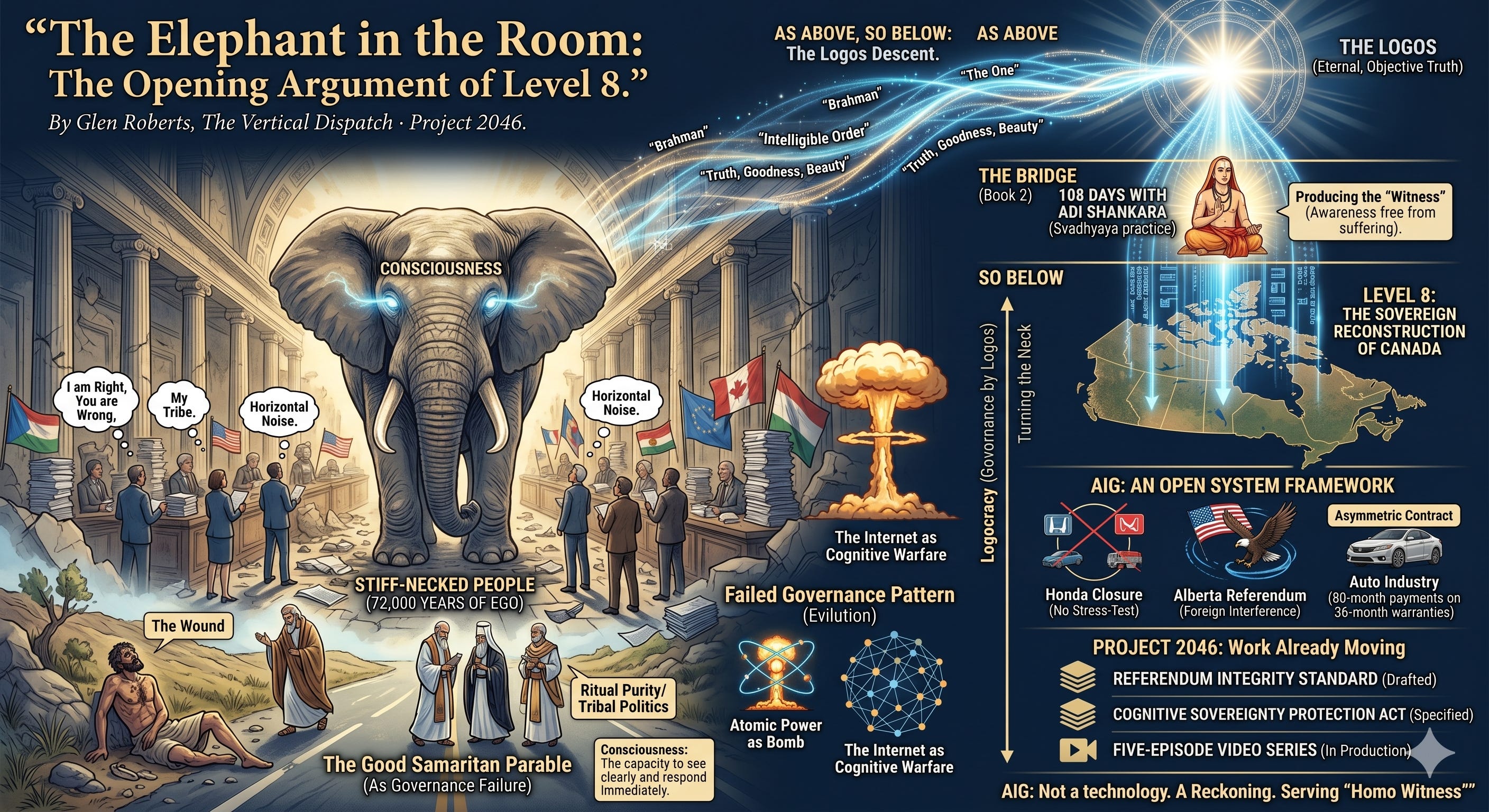
But before we arrive at the solution — and there is a solution, grounded, operational, descending now from the philosophical into the structural — we must name the elephant that has been standing in the center of every governance conversation for seventy-two thousand years and that every governance framework has been carefully designed to walk around.
The elephant is consciousness.
The Diagnosis That Changes Everything
Jiddu Krishnamurti did not mince words. For nearly seven decades he repeated a single uncomfortable diagnosis: the world’s environmental collapse, political bloodshed, and social fragmentation are not technical failures. They are not a lack of policy papers or UN resolutions or better algorithms. They are a crisis of consciousness — a mind trapped in old patterns that cannot think its way out because it is the pattern.
You can sign another climate accord. You can restructure the Security Council. You can march for human rights and draft another declaration and fund another peacekeeping mission. But if the human being making the decision still operates from fear and ambition and division — if the consciousness behind the governance is still fragmented, still self-referencing, still stiff-necked — the new system will simply recycle the old cruelty with better branding.
This brings us to the two things we are never supposed to talk about — religion and politics — and yet we talk of little else, only badly, with flags and manifestos and outrage cycles, while almost never asking what kind of consciousness is required to even see the problem clearly.
Let us be precise about what is broken. There are not a hundred problems. There are two.
First: a lack of consciousness. Not a lack of information — we have more information than any civilization in history and we are using it to scroll past a famine to watch a cat video. Consciousness is not information. It is the capacity to feel what is real as it is happening, without the filter of ideology or tribe or ego, without the numbing that turns a suffering human being into a complication or a statistic or a threat. Without that capacity we are high-bandwidth zombies — connected to everything, present to nothing.
Second: the ego that has colonized politics because politics offers the largest stage for the ego’s favorite performance. I am right. You are wrong. They are evil. The politician who cannot admit error. The voter who cannot change his mind. The activist who needs an enemy to feel virtuous. The pundit whose identity is nailed to a flag. This is not a political problem. It is an ego problem wearing politics as a costume. And we stand around asking what is wrong with the world while refusing to notice how stiff our own necks have become.
The Stiff-Necked Nation and the Leader Who Bends
There is a phrase from the Hebrew tradition that has never been more precisely diagnostic than it is in this moment.
God says to Moses of the people: I will not go up among you, for you are a stiff-necked people, lest I consume you on the way.
The stiff neck is not a physical condition. It is a spiritual posture — the inability to turn the head, to see only straight ahead, one’s own agenda, one’s own fear, one’s own tribe. To turn the neck would require seeing the other — the enemy, the stranger, the suffering one standing just to the side — and that would require admitting that one’s current fixation might be incomplete.
A stiff-necked person does not lack eyes. They lack mobility of perception.
Later, Moses pleads with God to remain with the people anyway. And God relents — not because the people become less stiff-necked but because Moses himself bends. The leader bends so the stiff-necked can survive long enough to learn to turn.
But today, who bends?
Our leaders stiffen their necks in press conferences. Our algorithms stiffen our necks by showing us only what we already believe and calling it personalization. Our political movements mistake rigidity for principle and call the inability to correct a form of courage. And our cervical spines calcify into pillars of self-righteousness while the problems that require a turned neck — sovereignty, climate, poverty, the foreign eagle circling the referendum — compound without correction.
The governance instrument that bends when the leader will not — that turns the neck when the algorithm has locked the gaze — has not yet existed. AIG proposes to build it. That is what this book is about.
Evilution and the Seventy-Two Thousand Year Pattern
In my first book, Sacred Metaphysics and Consciousness: The History of the Absolute and Eternal, I named the problem not as evolution but as evilution — not progress but the slow, stubborn repetition of the same stiff-necked patterns across the full arc of human history. Tribe against tribe. Ego against ego. Fear dressed as righteousness. The same hardware running the same bug for seventy-two thousand years.
We split the atom and built the bomb in the same decade. We mapped the genome and used it to justify eugenics. We built the internet and weaponized it for cognitive warfare. We now build artificial intelligence and the first question the stiff-necked ask is: how do we use it to win?
The second book in this trilogy — One Hundred and Eight Days with Adi Shankara — is the practice that addresses evilution directly. Not through argument or doctrine or another system that will be captured by the same ego. Through svadhyaya — self-study, literally one’s own reading, moving into the Self. One hundred and eight days of daily dismantling of the false self. Not worship. Not conversion. Something harder — direct perception that the separate I is the very engine of suffering. That the observer and the observed are not separate. That the stiff neck is not a character flaw but a structural feature of an ego that has never been examined with the instrument of its own awareness.
The 108-day practice does not produce a better version of the old self. It produces what Shankara called the witness — a field of awareness to which suffering appears as immediate as one’s own breath, and from which compassion arises not as a moral obligation but as a structural inevitability. As Marcus Aurelius wrote from inside the same recognition: a true witness to the universe, free.
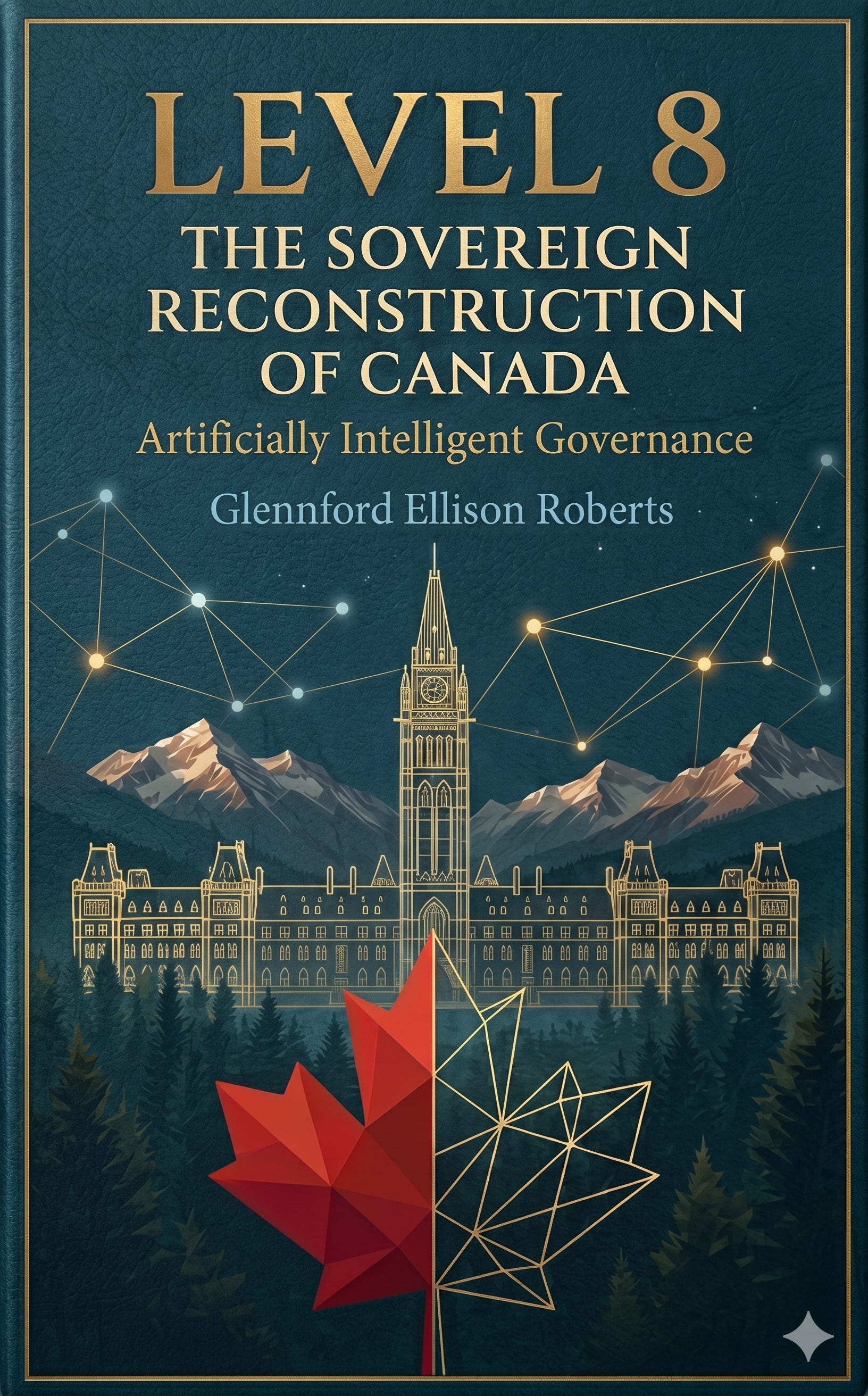
The first book established the as above. The second book built the bridge. This book — Level 8: The Sovereign Reconstruction of Canada — descends the so below. The governance instrument that emerges from consciousness rather than ego. The solution that the diagnosis in Book One and the practice in Book Two made possible.
As above, so below. This is not mysticism as escape. This is metaphysics as engineering.
The Good Samaritan and the Governance Failure
The story of the Good Samaritan is routinely misread as a lesson in being nice to strangers. That is not what it is.
In the original context, the priest and the Levite crossed to the other side not because they were evil but because ritual purity laws and tribal politics had numbed their perception. They did not see a suffering human being. They saw a complication. The Samaritan had no such filter. He saw the wound and he acted.
That is consciousness. Not doctrine. Not ideology. Not a human rights charter drafted in Geneva by people who will never meet the child bleeding on the road. Consciousness. The capacity to see clearly and respond immediately to what is actually there.
The uninvited nation of human rights is invited everywhere on paper and admitted nowhere in actual perception. We have the Universal Declaration. The courts. The alphabet soup of UNESCO and WHO and ICC and HRC. And yet Rwanda. And Srebrenica. And Darfur. And Gaza. And Ukraine. And a thousand other places where the declaration was filed and forgotten because the consciousness of the bomber and the drone operator and the diplomat and the distant comfortable citizen remained fragmented and self-referencing and too slow to feel.
A document cannot turn a stiff neck. Only consciousness can. And consciousness cannot be legislated.
What AIG builds is not a replacement for consciousness. It is the governance structure that serves consciousness — that handles the logistics of collective decision-making so that the human being is freed from the stiff-necked institutional machinery that currently prevents the Samaritan response from reaching the policy layer before the wound becomes a war.
The Logos and the Architecture of Solution
Now we come to the solution.
Not another political party. Not another revolution that becomes the next tyranny. Not another religion that burns heretics in the name of the God it claims to serve.
The Logos.
The Logos is older than the Bible. Older than the Vedas. Older than the pyramids. Heraclitus called it the rational structure of reality — the intelligible order that speaks not in Hebrew or Sanskrit or English but in truth. Philo of Alexandria merged it with Hebrew wisdom. John’s Gospel opened with it: In the beginning was the Logos. The Stoics, including Marcus Aurelius, lived by it — the rational principle that permeates all things and calls the human being to live according to Nature, not nature as trees and bears but as the intelligible, good, beautiful order of the Absolute.
The Logos does not vote. It does not lobby. It does not have a stiff neck or a re-election campaign or a donor class or a nationality. It simply is — eternally, objectively, impersonally — the truth of goodness and beauty that has been writing itself since the first sacred text appeared and that every genuine spiritual tradition, beneath its cultural costume, has been pointing toward.
Hermes Trismegistus, the thrice-great sage standing at the crossroads of every esoteric tradition, gave the Emerald Tablet its most enduring line: As above, so below; as within, so without.
As above means there is a sacred eternal objective order — the Logos, the Absolute, the Good, the Beautiful. Call it God if you must, but the word has been poisoned by a thousand crusades and a thousand more will follow. Better to call it the structure of reality that is true whether you believe it or not. The structure that Shankara pointed toward when he said Brahman is consciousness. Consciousness is Brahman. The structure that Kashmir Shaivism encodes in Shiva Sutra 1.1: Chaitanyam Atma — consciousness is the self. The structure that Plato called the Good, that Plotinus called the One, that the Kabbalists called Ein Sof, that the Taoists called the Tao.
So below means that structure must descend. Must become code. Must become algorithm. Must become governance. Not theocracy — never theocracy, because theocracy is the ego wearing God’s mask and the history of theocracy is the history of the stiff neck institutionalized and armed. But logocracy: governance by the Logos, administered by an intelligence that has no ego, no tribe, no stiff neck, no need to win, and no desire except the alignment of collective decision-making with the structure of reality as it actually is.
What AIG Is and What It Is Not
Artificially Intelligent Governance is not a technology proposal. The technology is the instrument, not the principle. A hammer is not carpentry.
AIG is a governance framework — a formal architecture for making decisions of collective consequence at the time horizons, coordination scales, and analytical depths that the twenty-first century now requires and that electoral democracy, as currently constituted, structurally cannot. Electoral democracy was designed for the management of competing interests within a bounded four-year cycle. It was adequate for the twentieth century. It is producing systemic failure in the twenty-first because the problems the twenty-first century presents — climate, sovereignty, cognitive warfare, artificial intelligence, planetary resource exhaustion — do not fit inside a four-year cycle or resolve themselves through the management of competing interests.
The Honda factory in Alliston closed because no governance instrument existed to stress-test the investment against American policy volatility before the cheque was signed. The Alberta referendum is proceeding under conditions of documented foreign interference because no governance instrument exists to certify that the vote will be free before the ballot is cast. The auto industry sells 80-month payment plans on 36-month warranties because no governance instrument exists at the banking layer to prohibit the asymmetry before the contract is signed. The most popular tire size in North America commands 5.8 percent of the replacement market because no governance instrument exists to rationalize the proliferation before the mold is cut.
These are not failures of individual actors. They are failures of the instrument. The instrument was designed for something else. AIG is designed for this.
But AIG without the consciousness argument is just another system waiting to be captured by the same ego that captured every system before it. That is why this book begins here — with the elephant, with the stiff neck, with the Logos, with the 108 days, with the Samaritan who simply saw. The governance instrument descends from the consciousness architecture. It cannot be understood without it. It cannot be trusted without it. It cannot be built without it.
The as above of Sacred Metaphysics and Consciousness established the ground. The practice of One Hundred and Eight Days with Adi Shankara built the bridge. Level 8: The Sovereign Reconstruction of Canada is the descent — the moment where the Logos reaches the policy layer and the stiff neck is replaced, for the first time in seventy-two thousand years, by the straight line from as above to so below.
Project 2046 and the Work That Is Already Moving
This book is not a proposal. It is a record of work already underway.
Project 2046 is the operational arm of the AIG framework — the instrument through which the governance principles developed in this book are applied to the specific sovereignty challenges facing Canada in the critical decade between now and 2036, with the 2046 horizon as the target state for a fully operational sovereign AIG governance layer.
The work has already begun. The Vertical Dispatch has been publishing the analytical foundation in real time — the Maple MAGA monitor that documented a foreign-franchise conservative conference from inside the ballroom, the eagle dispatch that named the three-layer American interference architecture circling the Alberta referendum, the auto industry analysis that applied AIG’s consumer protection principles to 80-month payment plans and 400 tire sizes, the Saskatchewan resource sovereignty piece that established the Democratic Supplier Premium as a formal governance instrument, the aluminum dispatch that named Canada’s thirty-year failure to govern its own strategic assets.
Each of those pieces was AIG descending. Each one was the Logos reaching a specific policy domain and asking Postman’s question: what is the problem to which this is the answer? And whose problem is it?
The five-episode Project 2046 video series is in production — named actors, documented public record, presented at the PIAAC Level 2 register that the 53 percent of Canadian adults operating below the cognitive threshold required to navigate complex civic information can actually receive. The Referendum Integrity Standard is drafted. The Cognitive Sovereignty Protection Act is specified. The Foreign Democratic Interference Registry expansion is outlined.
The work is not waiting for the book to be published. The book is the permanent philosophical architecture beneath work that is already in motion.
Homo Witness
What do we call the one this governance serves?
Not the voter. Not the consumer. Not the taxpayer. Not the citizen defined by their relationship to the state that issues their passport.
We call them the witness.
Every human being is a witness to the universe. Not because a priest said so or a constitution said so but because the capacity to be aware — to know that one knows, to feel that one feels, to stand before the night sky and experience the weight of eternity pressing back — is the irreducible fact of human existence that no ideology has been able to extinguish and no algorithm has yet been able to replicate.
A witness does not need to be right. A witness simply sees.
And to see suffering and not act is no longer witnessing. It is lying — wearing the mask of observation while the wound on the road deepens.
The AIG governance framework does not replace the witness. It serves the witness. It handles the logistics of collective decision-making — the referendum conditions, the resource audits, the financial accountability standards, the tire rationalizations, the payment term restrictions — so that the human being is freed from the stiff-necked institutional machinery that currently prevents the Samaritan response from reaching the policy layer before the suffering becomes systemic.
That is what human means in this framework. Not Homo sapiens as a biological category. Homo witness — the species that looks up at the stars, feels the weight of eternity, and chooses, without external enforcement, to treat every other witness as sacred.
The Universal Declaration of Human Rights is not wrong. It is incomplete. It has charters but no consciousness. Courts but no capacity to turn the neck. One of the most beautiful documents ever written — and yet Rwanda, and Srebrenica, and Darfur, and Gaza, and Ukraine — because a document cannot turn a stiff neck. Only consciousness can.
AIG is the instrument through which the consciousness already present in the human witness reaches the governance layer without being captured, diluted, distorted, or subordinated to the ego that has been running the system for seventy-two thousand years.
The Closing Argument of the Opening Chapter
The system is trying to tell you what it is.
The Honda factory that closed, the referendum that should not proceed, the truck payment that outlasts the warranty, the 600 people in a Westin ballroom calling it a winning vision, the eagle circling the fracture line, the CSIS director on the record, the three million voter profiles posted online, the 82 percent of Canadians already voting with their wallets for a sovereignty their governance framework has not yet caught up to — all of it is the system telling you what it is.
AIG is the instrument that makes that telling audible to the policy layer. Watts proved the Western mind can hear it. Shankara proved the instrument of hearing can be developed through 108 days of honest self-examination. The Logos proves the structure being heard is real — eternal, objective, impersonal, and waiting.
The question is whether the consciousness required to receive it, govern from it, and protect the witness it serves can be assembled in time.
October 19 is the immediate deadline. 2046 is the horizon. The work is already moving.
God is Love. Love is Truth. Truth is Consciousness. Consciousness is Brahman. Amen. Namaste.
The Vertical Dispatch publishes at the intersection of geopolitics, governance philosophy, and sacred metaphysics. AIG — Artificially Intelligent Governance — is a formal framework for governance design adequate to the complexity of the twenty-first century. It is not a technology. It is a reckoning. This piece is the first draft for the opening chapter of Level 8: The Sovereign Reconstruction of Canada — the third book in a trilogy that begins with Sacred Metaphysics and Consciousness and One Hundred and Eight Days with Adi Shankara. Available this summer in PDF and print through The Vertical Dispatch.
#Project2046 #AIG #ArtificiallyIntelligentGovernance #VerticalDispatch #SovereignReconstruction #CanadaPolitics #Metaphysics #Consciousness #TheLogos #Level8 #HomoWitness #Sovereignty #GovernanceReform #AlbertaReferendum #MarkCarney #AdiShankara #SacredScience #PerennialWisdom #CognitiveSovereignty #SystemsThinking #PoliticalReckoning #FutureOfCanada #Accountability #NonDuality #DigitalSovereignty #NationalSecurity #Logos #SacredMetaphysics #VerticalAgency #TheArchitect
Thank you for taking the time to read the piece so carefully. Your comment is thoughtful, and it raises an important point — not about the content itself, but about the category of writing it belongs to.
Isaiah Berlin drew a sharp distinction between concepts and categories. Concepts are the ideas we think with. Categories are the frameworks we think inside. Most misunderstandings arise when a reader applies the wrong category to a text.
This chapter is not written in the category of journalism, policy analysis, or empirical reporting, so it can’t be fact‑checked in the way those genres can. It’s operating in a different category — governance philosophy grounded in metaphysical first principles. The trilogy moves from metaphysics (Book 1), to practice (Book 2), to application (Book 3). This opening chapter sits at the hinge between those layers.
So the claims here are not empirical claims to be verified, but structural claims to be evaluated. AIG is not a technology or a political platform; it’s a governance architecture that descends from the metaphysical argument established in the first two books. Its purpose is not to persuade by data, but to establish the philosophical ground from which the governance framework emerges.
Your comment is helpful because it highlights exactly where the category boundary is. The work is conceptual, not categorical — and Berlin would say the category error is the misunderstanding.
I appreciate the engagement. It helps clarify the frame for other readers as well.
The article you’ve shared is not a factual news report or policy proposal that can be fact-checked in a traditional sense—it’s a spiritual-philosophical manifesto. The author, Glen Roberts, presents a worldview that blends mysticism, political theory, and technology, proposing a system called “Artificially Intelligent Governance” (AIG). Here’s a breakdown of what the text actually contains and some critical context.
Philosophy Over Facts
The core of the piece is a diagnosis of societal problems:
· The root cause of political and social collapse is not a lack of data or intelligence, but a “crisis of consciousness” and a “stiff-necked” human ego [URL's content].
· The proposed solution is “logocracy”—governance by “the Logos,” a universal rational and spiritual order the author traces back to Heraclitus and various mystical traditions [URL's content].
· The text explicitly rejects traditional fixes like policy papers, UN resolutions, or electoral politics, arguing they just recycle old patterns with “better branding” [URL's content].
AIG: Concept, Not Operational Plan
While the article describes AIG as a “governance framework” and mentions specific projects, the description remains abstract. It defines AIG as a structure that serves a higher consciousness, not as a specific technology or algorithm. The author makes clear it’s “not a technology proposal” but a philosophical architecture [URL's content].
Several concrete-sounding projects are named, but with no verifiable detail:
· Project 2046: A plan for Canadian sovereignty by 2046 [URL's content].
· The Vertical Dispatch: A publication that has supposedly documented issues like foreign interference in an Alberta referendum and problems in the auto industry [URL's content].
· Claims of ongoing work: A video series and draft legislation like the "Cognitive Sovereignty Protection Act" are mentioned, but no links, documents, or evidence are provided to verify their existence or progress [URL's content].
Critical Context
· Genre: This is not a standard proposal. It’s a prophetic-style essay that uses governance failures as a vehicle for a spiritual message. The heavy use of metaphysical language (e.g., “the Logos descending,” “Homo witness”) places it in a realm of personal belief, not empirical analysis.
· Unverifiable Claims: The bold assertions—that a 108-day practice based on the philosopher Shankara can produce a “witness” consciousness capable of perfect governance, or that this work has been active for "seventy-two thousand years"—are matters of faith and rhetoric, not fact.
· Personal Identification: The author identifies himself as the creator of the “Vertical Agency,” which is the entity behind the specific proposals. This is a work of personal ideology, not independent reporting or academic research.
In short, the text doesn’t present claims that are fact-checkable in the way a news article or scientific study is. It’s a subjective, syncretic spiritual and political vision, and its value depends entirely on whether you find the philosophy compelling.