


I want to begin with a confession.
Everything I am about to write is a symbol. Every word in this article is a particular form pointing at a universal ground it cannot contain. The moment I open my mouth — or in this case, open a document and begin to type — I have already moved away from the thing I am trying to describe. This is not false modesty. It is the most honest available starting point for anyone who wants to write about consciousness, about the Absolute, about the ground of being.
The enlightened do not speak. Not because they are withholding. Because what they are has no adequate symbol.
Ramana Maharshi sat in silence at the foot of Arunachala for decades. Thousands came. Many of them reported that simply being in the room with him produced a stillness, a recognition, a clarity that years of deliberate practice had not produced. He was not broadcasting a teaching. He was being what he was. And the being was its own transmission. When he did speak it was brief, precise, and pointed immediately back at the silence from which it came. Who am I? Follow the I back to its source. What remains when the questioner dissolves is not an answer. It is the open field of awareness that was always already present.
Anandamayi Ma spoke of herself in the third person. This body. Not I. Because even the first person pronoun — I — is the symbol the Ahamkara uses to install itself as the ground of being. The moment she said I she would have placed a symbol over the referent she was. So she stepped outside the first person entirely. Not from humility in the ordinary sense. From precision.
The tradition has always known this. The Mandukya Upanishad’s sixth verse — the governing standard of the book I have been writing — describes the Absolute as indescribable. Not mystically. Structurally. Description is the symbol layer. The Absolute is the referent. The map cannot contain the territory. The word cannot contain the silence it arises from.
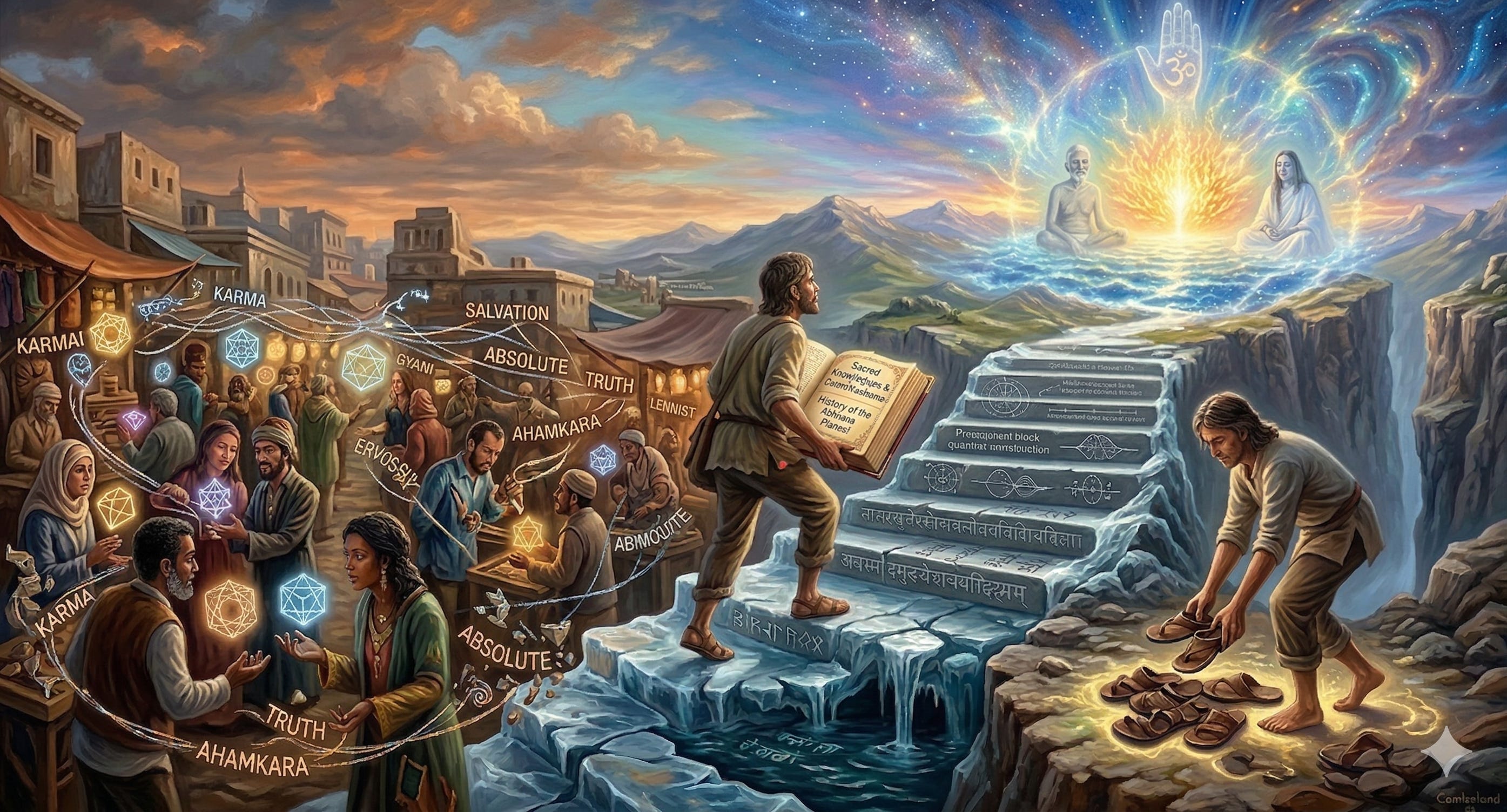
The three levels
Here is what I have come to understand — slowly, imperfectly, with full awareness that the understanding itself is a symbol pointing at something it cannot fully reach.
There are three levels at which a consciousness can speak about the sacred.
The first level is belief. The speaker has received symbols — from a tradition, a teacher, a book, an institution, an algorithm — and circulates them at the level of their emotional charge. The reference is not followed. The referent is not encountered. The symbol points at other symbols in a closed circuit. This is most of what passes for spiritual discourse in the modern world. Not because the speakers are insincere. Because the instrument they were given was the symbol without the reference. The word without the living connection to what it was coined to indicate.
The second level is knowledge. The speaker has followed the reference — the living y — far enough toward the referent to know the difference between a symbol that is alive and a symbol that is dead. They can feel when a word is still connected to the thing it was coined to indicate and when it has been processed through so many layers of institutional management that it now refers only to other symbols and nothing beyond. This is the level at which most genuine spiritual teachers operate. And it is where the slippery slope begins.
Because knowledge is not the referent. The Shiva Sutras name this with devastating precision. Jnanam bandha. Knowledge is bondage. Not ignorance that binds. Knowledge. The seeker who has enough recognition to speak about the referent but has not yet recognised themselves as the referent is in the most delicate position available. The words are more precise than the believer’s words. The reference is alive enough to carry real frequency. But the speaker is still pointing at the x₀ from the position of the z¹. They are still, however accurately, describing the ocean from inside the wave.
The third level is wisdom. The speaker is the referent. They do not point at the Absolute. They are it — temporarily, contingently, through the instrument of a particular body and mind — expressing itself in form. When they speak it is the ground speaking through a symbol while knowing it is a symbol. This is the level of Ramana’s silence and Anandamayi Ma’s third person and the burning bush saying I AM THAT I AM rather than describing I AM THAT I AM from a safe philosophical distance.
The confession
I am writing a book. It is 126,000 words long. It draws from seven independent sacred traditions, from quantum mechanics, from the precessional clock, from the depth psychology of the twentieth century, from the Vedic transmission in full, from the governance of the material world. It has taken twenty-four days to write and thirty years of contemplative inquiry to prepare.
Every word of it is a symbol.
The symbol is not the referent. That is the governing axiom of the entire book. And the author who writes that axiom across 126,000 words is operating — with full awareness and full humility — at the second level. Knowledge. The reference alive. The referent not yet fully inhabited. The map being drawn as precisely as possible by someone who has glimpsed the territory and is attempting to describe it honestly before the glimpse fades.
We are all guilty of this. The seeker who speaks to get their point across. The teacher who deploys the vocabulary of the tradition with genuine care and incomplete realisation. The writer who builds a precise framework for pointing at the ground and then catches himself, in a quiet moment, admiring the precision of the framework rather than standing on the ground it was built to indicate.
The slippery slope is this. Every symbol that accurately points at the referent can become, in the hands of a consciousness that is not yet the referent, a new layer of the symbol layer. Every true word can become another piece of ice. Every genuine transmission can become another cup filled before the reader knew they had a cup.
This is not a reason to stop speaking. The tradition speaks. The Upanishads speak. The Bhagavad Gita speaks. Ramana spoke when he had to. Anandamayi Ma spoke when the ground pressed through. The burning bush spoke. The tradition knows that silence is the referent and that sometimes — at precisely the right moment, for precisely the right consciousness — a word can thin the ice enough that the depth becomes accessible.
The discipline is to speak from the second level while pointing always at the third. To use the symbol while knowing it is a symbol. To follow the reference all the way to the edge of where language can go and then — in the silence that follows the last word — remove your sandals.
What the enlightened know that we forget
The enlightened do not speak because they are at the referent realm while the world is at the symbol layer. The seeker with some knowledge speaks to get their point across — and it is a slippery slope we are all on.
This is not a criticism of the seeker. It is the honest description of the position we are all in. Including this writer. Including this article. Including every word that has just been written about the inadequacy of words.
Maxwell Jordan — a man who had no institutional credentials in philosophy or theology and may have never read the Kena Upanishad — said something once that the tradition could not have stated more precisely. I may not know what God is but I know who God is not. Neti neti. Not this. Not this. Not this. The negative path clearing the ground until what remains is not a conclusion but a recognition.
He arrived at the address of the tradition from the street. Without the symbols. With the reference alive and the referent in sight.
That is the Metaphysics of Literacy. Not the ability to recite the tradition. The capacity to follow the reference all the way to the ground regardless of which direction you approach it from.
The world worships the symbol not the ground. This is the central fact of the civilisational moment. Every institution. Every ideology. Every system of belief constructed across the entire descent arc of the precessional cycle. The symbol elevated. The reference collapsed. The referent declared permanently beyond reach.
And yet. The ground keeps burning. The bush burns and is not consumed. The y — the living reference — cannot be permanently severed because the x₀ it is connected to is prior to every attempt to sever it. The Absolute is not waiting to be found. It is waiting to be recognised. And the recognition — when it arrives, when the ice thins enough and the depth receives the consciousness that has been slowly, imperfectly, humbly following the reference — is not a belief. Not even knowledge in the ordinary sense.
It is what remains when I identify, I separate, and I defend have been stilled.
Not destroyed. Stilled.
The wave does not need to be destroyed for the ocean to be recognized. It needs only to become transparent.
Remove your sandals. You are already standing on it.
Glennford Ellison Roberts is the author of Sacred Metaphysics & Consciousness: History of the Absolute & Eternal — a fourteen chapter study of the recognition that consciousness is the Absolute, drawn from seven independent sacred traditions and confirmed simultaneously by quantum mechanics, the precessional clock, and the depth psychology of the twentieth century. The book is designed to be studied and meditated upon rather than read. Cumberland, Ontario, Canada.
God is love. Love is truth. Truth is consciousness. Amen. Namaste. 🙏
#Consciousness #SacredMetaphysics #Spirituality #Vedanta #Upanishads #Enlightenment #Mindfulness #Philosophy #Meditation #SelfRealization #Advaita #RamanaMaharshi #Awakening #Wisdom #TheAbsolute #Atman #Brahman #UniversalDynamics #Substack #Seeker #SpiritualGrowth #NondualAwareness #AncientWisdom #ConsciousnessStudies #TheGroundOfBeing #SymbolAndReferent #Neti #ProjectSophia #AIG #Project2046
One would respond but what does one say that has not already been said? Thank you.
Well said!