


The Architect · AIG Framework Dispatches
Sovereignty · Governance · Consequence
By The Architect
“The public broadcaster exists to serve the public. When it serves itself instead, it has already failed — whether or not it knows it yet.”
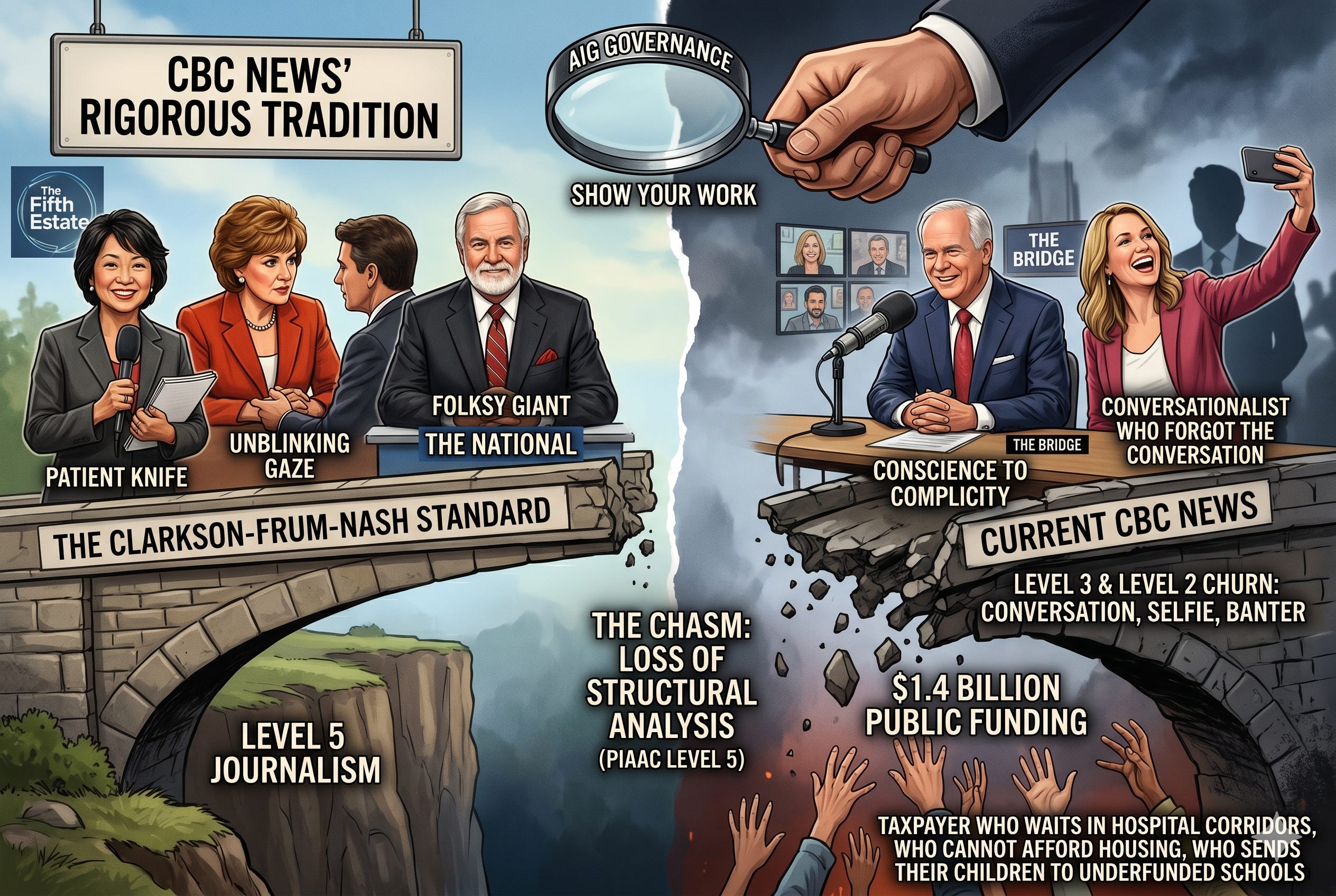
There is a governance argument at the centre of this dispatch that the entertainment frame will not reach. The Canadian Broadcasting Corporation receives approximately $1.4 billion in annual parliamentary appropriations — public money, collected from the same taxpayers who wait in hospital corridors, who cannot afford housing, who send their children to underfunded schools. That money was allocated, by democratic mandate, to fund a public broadcaster that would do what the market cannot: produce journalism at the highest possible standard, hold power to account without commercial interference, and deliver the information that a functioning democracy requires. This is not a lifestyle choice. It is a constitutional obligation. And the question AIG governance asks of any institution receiving public funding is the same question Socrates asked of every general and every politician in the agora of Athens: define what you claim to know. Show your work. Demonstrate that you are doing what you were paid to do.
CBC News cannot pass that test. Not in its current form. The standard it is being measured against is not invented here — it was built inside CBC’s own history, by five journalists whose combined careers constitute the most rigorous tradition of broadcast journalism this country has ever produced. Their names are Adrienne Clarkson, Barbara Frum, Knowlton Nash, Peter Mansbridge, and Rosemary Barton. The first three built the standard. The fourth held it, then drifted from it. The fifth represents what happens when drift becomes the operating model. This dispatch measures the fall by measuring the distance between where CBC journalism was and where it is now. The distance is not a gap. It is a chasm.
The PIAAC framework names the chasm precisely. Approximately fifteen percent of adults in developed nations read and reason at Level 4 and 5 — the level at which structural analysis is possible, at which the elenctic chain can be sustained, at which complexity is held without being flattened into binary. The taxpayer funding CBC is paying for Level 4 and 5 journalism. They are not paying for Level 3 — competent, fluent, capable of sustained argument within a familiar framework, but unable to hold the full complexity of the systems it claims to cover. They are certainly not paying for Level 2 — the churn of reaction, the panel of insiders agreeing with each other, the soft question designed not to extract truth but to keep the conversation flowing. CBC News, in its current form, operates at Level 3 at best and slides regularly into Level 2. The institution that once set the Level 5 standard has forgotten what Level 5 looks like. These five portraits are a reminder.
Adrienne Clarkson — The Patient Knife
When we talk about journalism today — the churn, the clicks, the relentless pressure to be first rather than right — it is easy to feel like something essential has been lost. That is because something essential has been lost. Adrienne Clarkson is one of the clearest possible demonstrations of what was there before it went.
She was not a screaming head on a cable panel. She did not build a brand on outrage or hot takes. She was something rarer and, in many ways, more radical: a journalist who believed that the story was enough. That if you did the work — real work, patient work, the kind that fills notebooks and wears down shoe leather — the truth would land with its own weight. She was old school in the best sense, and she was excellent at it.
Clarkson’s journalism career was not an accident of personality. It was built over decades at the CBC, where she moved from arts programming to the hardest edge of broadcast news. She started on Take 30, a daytime public affairs show that sounds benign but was anything but. There, she learned to interview with precision — to listen, to pivot, to let silence do the work of extracting a confession. Colleagues would later say she had a disarming calm, a way of making guests forget they were on television. But that calm was a tool. Behind it was a mind that had already read every document, chased every footnote, and anticipated every dodge. She did not ambush people. She simply knew more than they did. In the end, that is the oldest and most honest form of accountability.
Where Clarkson truly earned her reputation was on The Fifth Estate. For anyone who did not grow up with it, The Fifth Estate was CBC’s flagship investigative program — a show that explicitly rejected the newsmagazine formula of chasing whatever bled or broke that day. Its mandate was to devote entire hour-long episodes to a single topic, to follow a story wherever it led, and to do so with a rigour that print journalists would respect. Clarkson joined the show in its early years, at a time when investigative television was still finding its legs. She did not just host. She reported. She went into the field. She sat across from corporate executives, crooked politicians, and stonewalling bureaucrats, and she asked the kinds of questions that made them sweat.
Consider some of the work. She led an investigation into the financial dealings of the McCain family — the frozen-food empire that wielded enormous power in Atlantic Canada. Most journalists would have taken a press release and moved on. Clarkson and her team dug into tax rulings, land deals, and political influence, producing a report that did not just embarrass the powerful but actually informed public debate. She investigated corruption surrounding the 1976 Montreal Olympics — a story that involved billions of dollars, international contractors, and a web of kickbacks. These were not fluff pieces. They were not human-interest segues between weather and sports. They were the broadcast equivalent of a 5,000-word magazine feature, and they demanded an audience willing to think.
But depth without integrity is just pedantry. What made Clarkson old school was her refusal to perform seriousness while abandoning fairness. She was not a crusader in the muckraking tradition — she did not wave a torch or claim a monopoly on virtue. Instead, she approached every story as an investigator, not an advocate. She wanted to understand how systems actually worked, not just how they failed. That intellectual humility is vanishingly rare in modern journalism, where the temptation is always to sort the world into heroes and villains before the reporting is done. Clarkson let the evidence sort itself out. And when the evidence pointed to wrongdoing, she did not need to raise her voice. The facts were loud enough.
Her style is worth pausing over. Watch old clips of her on The Fifth Estate, and you will see a woman who never rushes. She lets answers hang in the air. She follows a non-sequitur not with frustration but with a gentle, devastating why. She treats every interview as a conversation between equals, which paradoxically gives her more power: the subject lets their guard down, and then Clarkson quietly produces a document that contradicts their last three statements. It is a masterclass in what the late Anthony Bourdain called the long game of interviewing — earning trust, then cashing it in for the truth.
The industry recognised it. Clarkson won two International Emmy Awards for her broadcast journalism — not Canadian Emmys, not regional accolades, but the global standard. She was inducted into the CBC News Hall of Fame. She became a role model for a generation of young journalists who saw that you could be rigorous without being rude, and deep without being dull. At a time when many broadcasters were moving toward softer features and faster pacing, Clarkson insisted that viewers were smarter than executives gave them credit for. She was right.
It is worth remembering that she did all of this as a visible minority woman in a field that was overwhelmingly white and male. Clarkson was born in Hong Kong, came to Canada as a refugee during the Second World War, and faced the quiet condescension that often greets anyone who does not look like the old guard. She did not talk about it much, because that was not her style. She simply worked harder, prepared more thoroughly, and produced better journalism than almost anyone else.
The AIG measure of Adrienne Clarkson is this: she asked the Socratic question in every broadcast. Define what you claim to know. Show your work. The institution she worked for was worthy of her. The institution that exists now is not worthy of her memory.
Barbara Frum — The Unblinking Gaze
There is a moment from Barbara Frum’s career that captures everything she stood for. In 1977, a distraught man took hostages inside a Toronto radio station. Most journalists would have waited outside for the police to resolve things. Frum, then a host on CBC’s As It Happens, picked up a telephone and called the hostage-taker live on air. She did not lecture him. She did not grandstand. She simply talked to him — calmly, directly, without an ounce of performance. And over the course of that extraordinary conversation, she helped de-escalate a situation that could have ended in violence. That was not luck. That was Barbara Frum: a journalist so grounded in her craft, so utterly without fluff or ego, that she could walk into the most volatile room in the country and ask the one question that mattered.
Frum was the real thing. If Adrienne Clarkson represented the patient, document-driven depth of investigative television, Frum was the master of the live encounter — the interview as a kind of high-wire act, where every question landed with precision and every silence carried weight. She came to national prominence on As It Happens, a nighttime current affairs program that pioneered a radical format: letting newsmakers speak for themselves, often by telephone, in long, unbroken segments. No voiceover. No manufactured urgency. Just a host, a guest, and the truth between them. Frum made that format sing. Her voice — warm but never soft, curious but never gullible — became the sound of Canadian seriousness.
And she always did the reading. That was the secret. Frum prepared for interviews like a trial lawyer preparing for cross-examination. She devoured briefing books, chased down obscure reports, and walked into the studio with a stack of documents that her guests often had not seen themselves. Her questions were not ambushes — they were the natural result of having followed a story further than anyone else. She once interviewed a senior politician who tried to dodge a question about a scandal. Frum did not interrupt. She waited, then said: I have a memo here, dated three months before you say you knew nothing. Would you like me to read it aloud? That was her style — no shouting, no theatrics, just the quiet, devastating power of having the receipts.
What made Frum genuinely old school, however, was her complete rejection of the cult of personality. In an era already beginning to worship television hosts as celebrities, Frum refused to play along. She did not want to be the story. She wanted viewers to tune in for the truth she extracted, not for her. Her daughter, journalist Linda Frum, once said that her mother worked in journalism without an agenda. Think about how rare that is. Most journalists, even the good ones, carry some framework — a political leaning, a pet theory, a desire to expose or to vindicate. Frum genuinely did not. She wanted to understand. She wanted to hold power to account, yes, but not because she had already decided the verdict. She wanted to let the evidence speak, and then she wanted to share that evidence with her audience, plainly and without spin.
That intellectual honesty earned her a kind of trust that is almost unimaginable today. When Barbara Frum asked a question, Canadians believed she was asking it because it needed to be asked — not because it would generate a clip or a headline. Politicians feared her, but they also respected her. They knew she would not twist their words. They also knew she would not let them slide. That combination — toughness without cruelty, rigour without grandstanding — is the hallmark of the best old-school journalism. Frum did not need to raise her voice to be heard. She simply needed to be right.
Her move to host The Journal in 1982 cemented her legacy. The Journal was CBC’s ambitious nightly current affairs program, designed to provide depth after the evening news. It was the kind of show that commercial networks would not touch: long segments, complex topics, and a host who refused to simplify for the lowest common denominator. Under Frum, The Journal became essential viewing. She interviewed everyone from Pierre Trudeau to Margaret Thatcher to ordinary people caught in extraordinary circumstances. And she treated every guest with the same fundamental respect — the respect of assuming they had something worth saying, and the responsibility of testing whether it was true.
The industry recognised her brilliance. She was made an Officer of the Order of Canada in 1979 — an extraordinary honour for a working journalist. After her death in 1992 from leukemia, her legacy only grew. She was inducted into the CBC News Hall of Fame in 2017 and into Canada’s Walk of Fame in 2022. But awards were never the point for Frum. The point was the work itself: the daily, unglamorous labour of asking hard questions and listening carefully to the answers. She once told a young journalist that the secret to a good interview was simple: be curious. And be quiet enough to hear the reply.
That sounds easy. It is not. In an age of hot takes, performative outrage, and the endless pressure to fill airtime with noise, Frum’s quiet rigour feels almost radical. She did not chase clicks because there were no clicks to chase. She did not perform empathy because she actually felt it. She did not pretend to be tough because she was simply, quietly, unshakably prepared.
The AIG measure of Barbara Frum is this: she never confused the interview with the interviewer. The truth was the subject. She was the instrument. When CBC News forgot that distinction, it began its long decline. Frum never forgot it for a single broadcast in thirty years.
Knowlton Nash — The Folksy Giant
Knowlton Nash was old school to the bone, and there has never been a news anchor more trusted by his country. When Canadians say goodnight at the end of the day, it is his voice they hear — an avuncular murmur that turned the news into a nightly ritual rather than a nightly assault. He did not shout. He did not posture. He simply told you what you needed to know, then signed off with a warmth that made even the bleakest headlines feel survivable.
Nash’s entire life was journalism. He was selling newspapers on the streets of Toronto at ten. By twelve, he was covering high school sports for The Globe and Mail. Before he turned twenty, he was a professional wire-service journalist writing thousands of articles by his own count. He did not fall into broadcasting by accident — he willed his way into it, brick by brick, story by story. That kind of origin produces a journalist who never forgets that the news belongs to the public, not to the executive suite.
Long before he became the face of The National, Nash earned his credentials in the field. As CBC’s Washington correspondent during the Kennedy and Johnson years, he covered the Cuban Missile Crisis, the space race, the civil-rights struggle, and the assassinations that scarred a decade. He travelled with President Kennedy during the 1960 campaign — so closely that Kennedy gave him a cigarette case engraved with the name of the campaign plane, signed by the candidate himself. Nash kept it on his desk, in an unlocked office, trusting no one would steal it. That trust was never betrayed. It is a small story, but it tells you everything: he was respected because he was respectable.
The question of whether he reported real news or fluff is almost absurd. Nash himself wrote a book called Trivia Pursuit, warning that the news industry was being corrupted by showbiz values and that the line between information and entertainment was collapsing. He was not pleased with programs that sold sizzle instead of steak. His mantra was simple: get the story, make sure it is right, tell it straight. No razzle-dazzle. No manufactured drama. Just the facts, delivered by a man who looked like your favourite uncle but had the backbone of a prosecutor.
Of course, no journalist is flawless. When Nash was a CBC manager during the October Crisis of 1970, Prime Minister Pierre Trudeau accused the network of acting as a propaganda vehicle for the FLQ. Nash responded by sending a directive limiting coverage of the crisis — a decision he later owned up to as a mistake. It was my fault, he said. We went too far — farther than we should have. That is old-school accountability as well: not the defensive spin of a modern pundit, but a quiet acknowledgement of error from a man who believed journalism was a public trust.
As anchor of The National from 1978 to 1988, Nash presided over a CBC that still commanded the national conversation. His tenure spanned the collapse of Joe Clark’s government, the 1980 Quebec referendum, the constitutional battles, and Pierre Trudeau’s famous walk in the snow resignation. Every night, Canadians tuned in to hear Nash sort through the chaos with unflappable steadiness. His delivery was sometimes called unemotional, even flat. But that was the point. He was not there to perform — he was there to inform. Emotion belongs to the viewer. The anchor’s job is to be a vessel for the truth.
The honours he received were not the ephemeral currency of celebrity but the durable recognition of his peers. He was made an Officer of the Order of Canada in 1988. He received the John Drainie Award for distinguished contributions to broadcasting and was inducted into the Canadian News Hall of Fame in 1996. In 2015, a year after his death, he became the first inductee into the CBC News Hall of Fame — a permanent testament to a life spent in service of serious, unvarnished reporting.
More telling than any award, however, was the way his colleagues spoke of him. Peter Mansbridge, who succeeded Nash at The National, called him a great friend and a mentor to so many. Others noted his unique combination of kindness and professionalism: a man who could be both gracious with a first-year journalism student and utterly relentless in pursuit of a story. He was a true believer in public broadcasting, but he was also willing to be hard on CBC management when he thought they had lost their way. He loved the institution enough to criticise it.
Knowlton Nash was the bridge between the way journalism once was and the way it is now. He did not live to see the full explosion of digital media, the fragmentation of audiences, or the collapse of the old gatekeepers. But he saw enough to worry. He worried that news was becoming entertainment, that depth was being traded for velocity, that trust was being squandered in pursuit of ratings. That worry — and his lifelong fight against it — is his final gift to us.
The AIG measure of Knowlton Nash is this: he understood that the public broadcaster is a governance institution, not an entertainment company. The taxpayer who funds it is owed the truth at the highest possible standard, delivered without showmanship, without agenda, and without drift. Nash held that standard for a decade as the most visible journalist in Canada. The institution he served has since forgotten what holding a standard requires.
Peter Mansbridge — From Conscience to Complicity
Let me be clear. I am not attacking the Mansbridge of the 1990s or the 2000s. That Mansbridge earned his place in the Canadian News Hall of Fame. He stood behind the desk of The National through the fall of the Berlin Wall, through 9/11, through the ice storm, through every election that shaped the country. He reported from war zones. He interviewed prime ministers and presidents. He was not a firebrand, but he was a rock. Canadians trusted him because he seemed to understand that the news was a public trust, not a personal brand. He was old school in the best sense: steady, prepared, and allergic to spectacle. That man is gone.
In his place is a podcast host who spends entire episodes chatting with the same familiar faces — Chantal Hébert and Bruce Anderson — while asking the kinds of questions you would expect at a dinner party, not in a newsroom. Where is the edge? Where is the accountability? Where is the hard-won instinct to chase the story instead of the vibe? It has evaporated, replaced by agreeable head-nodding and the lazy comfort of voices that never truly challenge one another.
And here is the unforgivable part: Mansbridge knows better. He knows what real journalism looks like because he lived it for three decades. He has sat across from dictators and demagogues. He has asked the question that makes a politician sweat. He has read the briefing book until three in the morning. He has done the work. So when he now sits in a studio and asks a soft, meandering question about what it all means to the same two insiders who agree with him on almost everything, he is not merely failing to inform. He is actively normalising the idea that journalism can be reduced to pleasant conversation. That is not a bridge. That is a betrayal.
The phrase if you are not part of the solution, you are part of the problem is often dismissed as a slogan. But it is a moral accounting. In a time when trust in media is collapsing, when bad actors are flooding the information space with lies and half-truths, every journalist who has a platform has a duty. That duty is not to be entertaining. It is not to be comfortable. It is to be rigorous, unflinching, and relentlessly truth-focused. Anyone with a microphone who chooses to use it for banter, for speculation, for the idle musings of the chattering class, is choosing the problem. They are choosing to fill the air with noise when what the public desperately needs is signal.
Mansbridge’s podcast is noise. Listen to an episode. Count how many minutes are spent on actual, verifiable, useful information. Then count how many minutes are spent on I wonder, it seems to me, or what do you think, Chantal? The latter will dwarf the former. And that is not a failure of format. It is a failure of will. Mansbridge has the name, the reputation, and the access to do real journalism in the podcast space. He could be holding power to account in a medium that reaches millions. Instead, he is holding court with his friends.
Consider the panel he convenes. They are almost always cut from the same cloth — insiders who share assumptions and rarely disagree on fundamentals. That is not a debate. That is a confirmation circle. And Mansbridge, rather than pushing them, rather than playing the old-school anchor who holds everyone’s feet to the fire, simply lets the conversation drift. He asks open-ended, unfalsifiable questions that cannot be answered wrong. What do you make of the politics of this? How does that land with voters? These are not journalistic questions. They are conversation starters at a suburban barbecue.
Real journalism requires risk. It requires asking questions that might end an interview. It requires following a thread even when it makes everyone uncomfortable. It requires, above all, a refusal to settle for the easy answer or the comfortable take. Mansbridge built his career on that refusal. He has abandoned it. And that abandonment has consequences. Every young journalist who listens to his podcast and hears a legend ask soft questions learns the wrong lesson. They learn that success means becoming a personality, not a reporter. They learn that the path to an audience is paved with agreeable chatter, not hard truths.
Do not tell me he has earned the right to relax. No one who claims to care about journalism earns the right to relax while the profession burns. A platform is a platform. A microphone is a microphone. Mansbridge’s voice still carries weight. When he speaks, people listen. That is exactly why his choice to speak fluff is so damaging. He is lending his considerable credibility to the very sort of shallow, opinion-driven, low-information chatter that he once warned against. He becomes the respectable face of irresponsibility.
The AIG measure of Peter Mansbridge is a study in the hinge point — the moment when an examined operating system stops being examined and begins coasting on its accumulated credibility. The Delium standard asks: does the quality of the analysis change when the pressure is off? For the Mansbridge of The National, the answer was no. For the Mansbridge of The Bridge, the answer is yes. The pressure is off. The quality collapsed. That is the hinge. That is the loss.
Rosemary Barton — The Conversationalist Who Forgot the Conversation
You asked for a deep dive. The data not only supports the argument — it screams. Let us be clear about what we are judging. The old school — Clarkson, Frum, Nash — was built on a simple contract with the viewer: we will do the reading, we will ask the hard questions, we will not waste your time with banter, and we will hold power accountable without fear or favour. That contract is now in ruins. Rosemary Barton is one of the wrecking balls.
The Carney Exchange: Aggression Masquerading as Rigour
The most telling exhibit is her exchange with Prime Minister Mark Carney in March 2025. It was not journalism. It was a performance of hostility dressed up as accountability. Carney had just returned from meetings with King Charles and the UK prime minister. He was taking questions. The Globe and Mail raised the issue of potential conflicts of interest regarding Carney’s assets. Barton followed up. Her question was not can you explain how your blind trust works or what specific safeguards are in place. It was this: as someone who has spent most of his life in the private sector, there is no possible conflict of interest in your assets? That is very difficult to believe.
Stop there. That is very difficult to believe. That is not a question. That is an accusation delivered without evidence. That is a host substituting her personal incredulity for actual reporting. The CBC Ombudsman’s office was deluged with complaints. One viewer wrote: her relentless and hostile grilling of Carney over his fully disclosed assets was not just inappropriate — it was a blatant and calculated attempt to smear his reputation. Even the CBC’s own ombudsman conceded that the phrasing was imperfect. That is management-speak for she messed up.
But here is the deeper problem. The same viewers who complained about her Carney aggression also noted a striking silence elsewhere: her glaring lack of scrutiny toward Pierre Poilievre is baffling. Poilievre has openly vowed to defund the CBC — the very institution that pays her salary — yet Barton seems to have no appetite for holding him to account. Whether you agree with that specific charge or not, the pattern is unmistakable. Barton is not an interrogator of power. She is a reactor. She goes where the heat is, not where the truth is hidden. That is not old-school journalism. That is chasing headlines.
The Lawsuit: When Impartiality Became Impossible
In October 2019, the CBC sued the Conservative Party of Canada for copyright infringement over campaign video clips. And whose name was on the lawsuit as a plaintiff? Rosemary Barton’s. Along with fellow CBC journalist John Paul Tasker, Barton was listed as a co-plaintiff against the very political party she was supposed to be covering objectively. Let the weight of that land. A journalist suing a political party. Not the network suing. The journalist. Her name. On the filing. As one CBC journalist told Canadaland, it was a total lack of political savvy, another boneheaded move.
The only charitable interpretation is that Barton was kept in the dark by her own management — that the CBC added her name without her knowledge. But as Canadaland pointed out, if that is true, it is worse: adding someone’s name as a plaintiff to a lawsuit without their knowledge and consent would appear to be a serious ethical breach. And if she did know? Then she willingly entered a conflict of interest so profound that it should have ended her career as a political correspondent on the spot. Peter Mansbridge rushed to her defence on social media, saying she had nothing to do with the ridiculous situation. But kindness is not the standard. The standard is whether a journalist can credibly claim impartiality after being named as an adversary of a major political party. The answer is no.
Analysis as Opinion: The Bilingualism Fiasco
Barton wrote a piece with the headline yes, prime ministers should be fluently bilingual — an unambiguous statement of political opinion. When criticised, she defended it as analysis, not opinion. It is an analysis piece based on facts, she said. There is a difference. Carleton University professor Paul Adams, a journalism educator, was having none of it: the CBC’s Chief Political Correspondent writing an opinion piece — I wonder what the thinking is behind that. Ken Whyte, former editor of the National Post and Maclean’s, dismantled her reasoning, pointing out that both Stephen Harper and John Diefenbaker won power without Quebec, proving her premise faulty.
This is not a minor quibble. The distinction between news, analysis, and opinion is foundational to old-school journalism. When the chief political correspondent of the national broadcaster cannot or will not understand that distinction, the entire enterprise is compromised. Barton blurred the lines not out of incompetence but out of convenience. She wanted to have it both ways: the authority of the chief political correspondent and the freedom of the opinion columnist. That is not journalism. That is brand management.
The Conversational Problem: Panels, Not Reporting
Her primary vehicle is no longer original reporting or investigative deep dives. It is the panel discussion. She moderates At Issue — a roundtable where Andrew Coyne, Chantal Hébert, and Althia Raj talk among themselves while Barton facilitates. She hosts Rosemary Barton Live, a Sunday morning talk show that leans heavily on conversation, not confrontation. Compare this to Clarkson on The Fifth Estate, where an entire hour was devoted to a single investigation. Compare it to Frum on The Journal, where the interview was the event, not the banter before and after. Compare it to Nash, who understood that the anchor’s job is to deliver the news, not to be the news. Barton has inverted that model. She is the centre of her own show. The guests are supporting players.
The At Issue panel is comfortable. They know each other. They share assumptions. There is no genuine friction. And Barton, rather than injecting tension, lets the conversation drift. She asks open-ended, unfalsifiable questions: what do you make of this? How does that land? These are not journalistic questions. They are dinner-party questions. And they are everywhere in her work. Worse, the conversations are often soft. The same three insiders. The same familiar frameworks. The same absence of the elenctic pressure that Frum could generate with a single sentence.
The Selfie: A Symbol of Everything Wrong
Do not dismiss the selfie as a triviality. In 2016, Barton took a smiling selfie with Prime Minister Justin Trudeau and posted it on social media. The CBC defended her, arguing that the photo was taken after the interview and that Barton had asked tough questions. But the defence misses the point. Old-school journalism is not just about what happens during the interview. It is about perception. It is about maintaining a distance that signals objectivity. Clarkson would not have taken that selfie. Frum would have laughed at the idea. Nash would have considered it a betrayal of the public trust. Barton saw no problem with it. And that is the difference. The selfie is not the crime. The selfie is the symptom — of a journalist who does not understand that the job requires not just fairness but the appearance of fairness.
The AIG measure of Rosemary Barton is this: she operates at Level 3 in a Level 4 role, in an institution funded to produce Level 5 journalism. She is educated, ambitious, and undeniably skilled at certain things. She can be sharp on her feet. She has moments of genuine toughness. But those moments are increasingly rare. What has taken their place is a conversational, panel-driven, opinion-adjacent style that bears almost no resemblance to the journalism of Clarkson, Frum, or Nash. She is not in their class. She is not even in the same building.

The Verdict — What the Taxpayer Is Owed
The case has been made through five portraits and one governing argument. CBC News was once the finest public broadcaster in the Western world by any serious measure of journalistic rigour. The work of Clarkson, Frum, and Nash — documented in full, measured against the global standard, recognised by international bodies — constitutes a Level 5 tradition of extraordinary depth and integrity. That tradition did not decline because the talent disappeared. It declined because the institution stopped requiring it. Management substituted comfort for rigour. Programming substituted conversation for accountability. The host replaced the story as the centre of gravity. And the PIAAC floor that the taxpayer’s $1.4 billion was meant to hold — Level 4 and 5, the analytical register that a functioning democracy requires — was quietly, gradually, and almost invisibly lowered until what remained was a polished performance of journalism that had ceased, in any meaningful sense, to be journalism at all.
Canadians still support the CBC. Poll after poll confirms it. They support it not because they are satisfied with what it has become but because they remember what it was — and because they understand, at some level that precedes argument, that a publicly funded broadcaster answerable to democratic mandate is an irreplaceable governance institution. They are right. The CBC is irreplaceable. And that is precisely why its current operating standard is a governance failure of the first order. The irreplaceable institution is failing the irreplaceable function it was created to serve.
The path back is not complicated. It does not require new technology, new talent, or new money. It requires the recovery of a standard that existed within living memory, embodied by journalists who are still studied, still quoted, and still held as the measure of what Canadian broadcast journalism can be. Ask the Socratic question before every broadcast: what does the public need to know, and what work has been done to find it out? Apply the Delium standard to every reporter: does the quality of the analysis change when the environment is comfortable? If the answer is yes, the operating system is unexamined and the journalism will fail when it matters most. Restore the contract that Clarkson, Frum, and Nash held with the viewer: we will do the reading, we will ask the hard questions, we will not waste your time, and we will hold power accountable without fear or favour.
That is what the taxpayer is paying for. That is what the public broadcaster owes the democracy that funds it. That is the standard. It was built here, in this country, by these five journalists — three who held it, one who drifted from it, and one who represents the cost of the drift. The standard is not gone. It is waiting to be reclaimed. And the Vertical Dispatch will be here, asking the question, for as long as the question needs to be asked.
AIG governance holds public institutions to the standard they were funded to meet. CBC News was funded to meet the Clarkson-Frum-Nash standard. Until it does, the $1.4 billion is a governance failure dressed in the language of public service. The taxpayer deserves better. The democracy requires it. The standard exists. Reclaim it.
God is Love. Love is Truth. Love is Consciousness. Consciousness is Brahman
Amen. Namaste.
#TheFallOfTheFifthEstate #CBCNews #PublicBroadcasting #AIG #VerticalDispatch #AdrienneClarkson #BarbaraFrum #KnowltonNash #PeterMansbridge #RosemaryBarton #OldSchoolJournalism #TheFifthEstate #TheNational #TheJournal #AsItHappens #PIAACLevel #JournalismStandards #PublicAccountability #TheArchitect #SocraticMethod #GoVsCheckers #ArtificiallyIntelligentGovernance #NoFear #CanadianJournalism #CBCFallFromGrace #TaxpayerAccountability #DemocracyRequiresDepth #AgeOfConsequences #TheVerticalDispatch #Project2046 #NorthernSovereignty #SubstackCanada #MediaAccountability #Level4Journalism #TheBridge
Barbara Frum was my hero. I can't count the number of times I have yearned for her while listening to the superficial gabfests that now pass for interviews. I remember how one politician answered her question with an evasive word salad. She calmly said you didn't answer the question, and repeated it. He tried another series of evasions. So she calmy said "so you won't answer the question", and moved on. Today, in all of television, there is no longer a single journalist willing to do this, to simply call attention to what is actually being said.
Thank you for your research and insight regarding our national broadcaster, the CBC. The CBC has always been my “go to” for news but not anymore. I especially have difficulty with Rosemary Barton and her journalistic style. She seems to be always looking for a “gotcha” moment with the Liberal government and allows the Conservatives to say whatever they want whether it be lies or the truth with no fact checking. Needless to say, I will read the news online but do not watch the tv programming. Sad for me as my dad worked for the CBC and it was the only radio/tv station on in our home.