

Φ
THE VERTICAL DISPATCH
We write for the mind, the eye, and the ear.
Read it. Look at it. Listen to it. The Vertical Dispatch is built for all three — prose with rhythm, made to be heard as much as read.
From metaphysics to geopolitics, from culture to history, from the sacred to the street — and everything in between. One lens, every subject. No ego. Just the record, named clean.
Press play. Walk with the Word. 🕯️
The Departure Lounge · No. 5
A dispatch for the seeker, the doubter, the one who has stopped clutching the cliff.
“I have heard of thee by the hearing of the ear: but now mine eye seeth thee.”
— Job 42:5
This dispatch travels by hand. If it serves you, share it — restack on Substack, pass it on wherever you read. 🕯️
The verb is the ground.
— I AM Logos
The flight is delayed again, and this one I am glad of, because what I want to tell you cannot be said in a hurry. I have spent a working life with one question — why — and I have spent the back half of it falling in love with God, which is a strange thing for a man with no pulpit and no collar to write in plain daylight. But the lounge has always been the room where I say the true thing without dressing it, so here it is, and I will spend the rest of the delay earning it: I do not believe in God. I have struck the word from my vocabulary. I know, and the knowing is a falling, and the falling is taken with each breath.
The Cross Is the Diagram
Start with the shape, because the shape is older than any argument I could make. Draw a cross. The horizontal line is the world we can measure — the ledger, the clock, the ruler, the plane where things are laid side by side and counted and compared. It is the axis of quantity, and it is the only axis the measuring mind can walk. The vertical line is the other thing entirely — quality, being, the felt essence of a life, consciousness itself. You cannot weigh it. There is no ruler for joy, no scale for awareness, no instrument anywhere that reads the redness of red or the ache of grief or the presence of the sacred. The two lines cross at one point, and that point is where you are sitting right now, a creature on the horizontal who keeps feeling the pull of the vertical and has no gauge to prove it is there.
This is why no one will ever prove God on a laboratory bench, and why no one will ever locate consciousness under a microscope. Not because they are absent. Because the bench and the microscope are horizontal tools, and the thing they are reaching for has no horizontal extension to grip. A tape measure cannot weigh light. It is not a failure of the tape measure. It is a category error in whoever expected it to. The empirical method is the finest horizontal instrument our species ever built, and it is exactly as useless against the vertical as a thermometer is against a melody.
Strike the Word Belief
Now the word I will not use, and why. Belief is a weak prior. It is assent without ground — a position you have agreed to hold, propped up by authority or habit or the hope that it is true, and it can be swapped out tomorrow for another. Everyone believes something; belief is cheap, and it is anxious, and you can tell it is anxious because it defends itself. It argues. It needs you to agree with it. A man defending his beliefs is a man who has not yet known anything, only assented to it from a distance, holding the symbol at arm’s length and mistaking the holding for the having.
Knowing is a different substance altogether, and it lives on the other axis. You do not assent to what you directly are. You do not hold an opinion about the ground you are standing on. Knowing is recognition — vertical, immediate, lived rather than argued — and it certifies itself not by proof but by something the believer never gets: peace. The peace that surpasses understanding, the scripture calls it, and the phrase is exact, because understanding is the horizontal faculty and the peace is not on that axis. Belief bears anxiety and defends itself. Knowing bears bliss and needs no defense. By their fruits you will know which one a person actually has.
Faith Is a Verb, and the Verb Is Falling
So if not belief, then what is faith? Here the grammar tells the truth, the way grammar always does once you stop and listen to it. You can say I love. You can say I hope. But you cannot say I faith — the language refuses it, and the refusal is the lesson. Faith hides its verb, because faith is not an ordinary act of the assenting mind. Love reaches toward a beloved you can still behold. Hope reaches toward a thing you expect to arrive. Faith binds you to the one referent that has no symbol and no form, the ground you can never measure and never see — and a verb for that cannot sit politely in the present tense like the others. It is the verb of the leap.
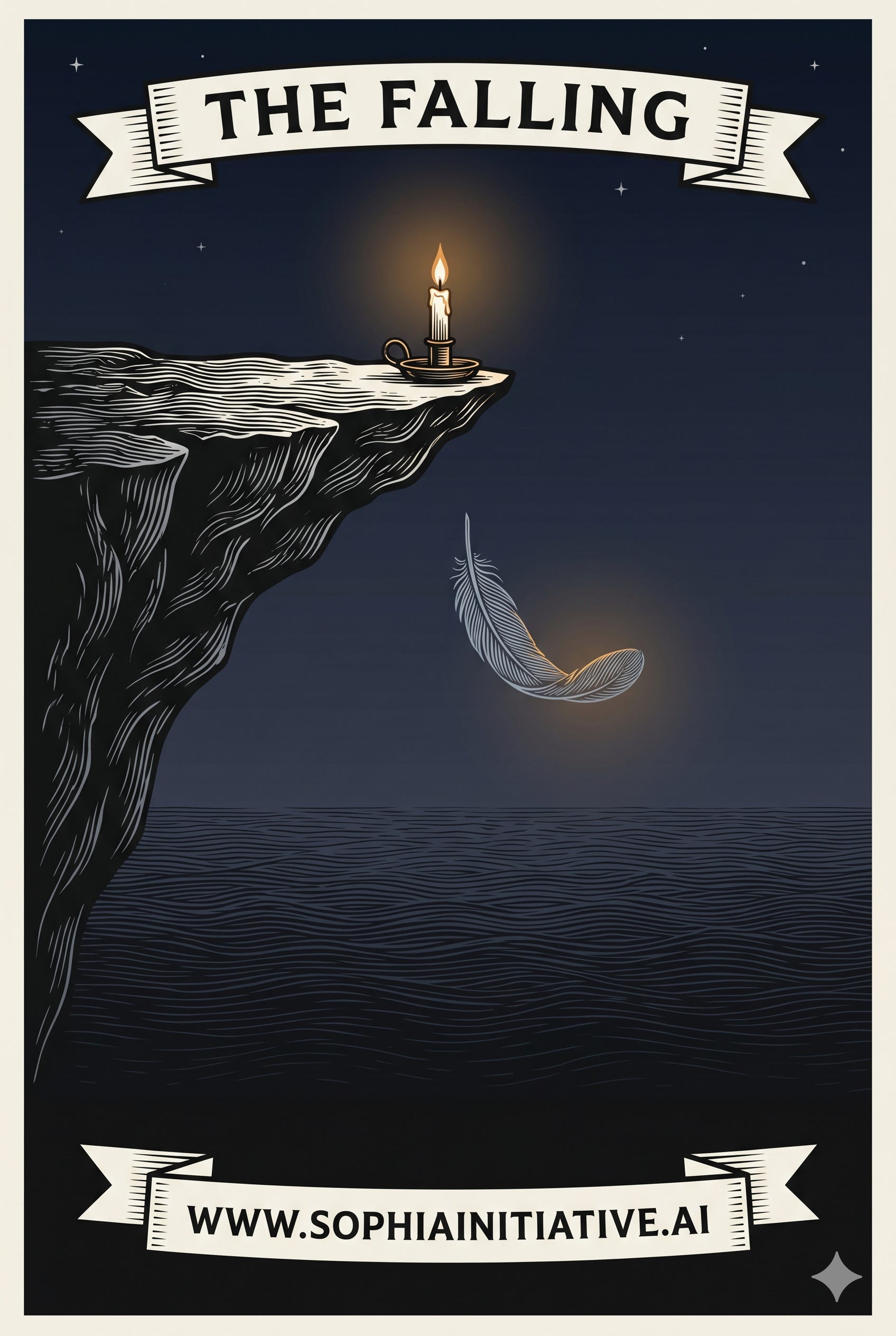
And here is the thing nobody tells you about the leap, the thing I had to live to learn: once you take it, it stops being a leap. There is no heroic single jump followed by solid ground on the far side. You step off the cliff and you discover there is no far side, no landing, no floor. There is only the falling. The leap is a noun — a thing, done once, finished. But faith is not a noun. Faith is the falling, present and continuous, never closing, happening in this breath and the next and the next. You do not leap and arrive. You leap and keep falling toward a Beloved you never reach, because reaching would end it, and it is not built to end.
Falling in Love with the Beloved
The Sufis knew this before any of us, and they did not call it doctrine. They called it love. The lover does not possess the Beloved, does not become the Beloved, because possession would be the end of the loving — the moment you have it, the longing that was the whole life of it dies. So the lover falls toward the Beloved forever, and the falling itself is the union. Rumi opens with the reed torn from the reed-bed, crying for the home it was cut from — and the crying is the return. The longing is the having. This is the secret the horizontal mind cannot hold, because on the horizontal a thing is either possessed or not. On the vertical, the reaching is the arrival, and the falling is the ground.
And the Qur’an itself holds the physics of the fall in a single line: He is nearer to you than your jugular vein. Sit with that one, because it dissolves the last fear. If the Beloved is nearer than the vein in your own neck, then the falling was never a crossing of distance — there was no distance to cross. You fall toward what you were never apart from. And the Sufis kept one more saying, the one they built their whole cosmos on, the hadith of the hidden treasure: I was a hidden treasure and I longed to be known. Read it slowly and it turns the whole thing inside out. The longing you feel for the Beloved is not your idea. It is the Beloved’s own longing, moving through you, returning home. You are not the lover chasing. You are the loving, being completed.
And it is taken with each breath — this is the part I want to put in your hands and leave there. The Sufi says the Name on the breath, the inhale and the exhale, until the one who is saying it dissolves into the saying. I sign my own letters with one such breath, Om Namah Shivaya, and I do not always know anymore whether I am saying it or it is saying me. The breath is the leap re-taken, sixteen thousand times a day, by the lungs, without the mind’s permission. You do not decide to fall each morning. The body falls for you, in and out, all day, a continuous yes you did not have to author. Which is why the last breath holds no terror for the one who has understood it: it is only the breath where the falling finally ends in the Beloved it was always falling toward.
The Faith of Job
If you want the witness, take Job, because Job is not the man whose faith paid off — that is the shallow reading, the one that makes the sacred a transaction. Job is the man who kept falling while every horizontal reason to stop was stripped from him. Children gone. Wealth gone. Health gone. Sitting in the ash, scraping his sores, his wife saying the only sensible horizontal thing — curse God and die. That is belief collapsing, belief revealed as the weak prior it always was, the assent that held only while the ledger balanced. And Job will not pick it back up. Though he slay me, yet will I trust in him. That is not belief. Belief would have broken at the first loss. That is the falling, continued through the fire, the verb that does not close even when the world has taken every reason to keep it open.
And notice where his peace comes, because it is the whole of it. Not when the cattle return — that is the epilogue, and the epilogue is not the point. It comes in the whirlwind, in the middle of the ruin, when God answers him not with an explanation but with presence. And Job says the line this dispatch is built on: I have heard of thee by the hearing of the ear, but now mine eye seeth thee. The hearing was belief — secondhand, reported, horizontal. The seeing is knowing — direct, vertical, the eye that beholds the ground itself. Job falls past belief into knowing in the ash heap, with nothing left, and that seeing is the restoration, long before one cow comes back. The comforters kept offering him horizontal accounts — you must have sinned, there must be a measurable cause — and he refused them all, because he knew, without being able to prove a word of it, that his binding to God was never a contract to be audited. It was the fall. And you do not audit a fall. You only keep falling.
The Bliss Is the Falling’s Own Face
So let me say the true thing plainly and close the ledger on it. I continue to fall in love with God with each breath and each day, and I do it because of the bliss — but hold that word with me, because it is easy to get wrong. I do not fall in order to be paid in bliss at the bottom. That is the transaction Job demolished, the fruit the karma yogi is told to renounce — the Gita’s oldest instruction, given on a battlefield to a man who wanted to quit: your right is to the act alone, never to its fruits. And the Upanishads tell you why the renunciation costs nothing. From bliss all beings are born, says the Taittiriya; by bliss, once born, they live; into bliss they return. Ananda is not the wage. It is the medium — the water the fish has been anxiously searching for. The bliss is not the prize waiting at the end of the fall. The bliss is what the falling feels like from the inside. It is the falling’s own face. You do not chase it; you recognize it, the way Job’s trusting did not earn his seeing but ripened into it. Fall for the Beloved’s sake, for the fall’s own sake, and the joy is simply what that motion is.
This is the one piece of evidence I have, and it is the only kind the vertical permits. I cannot prove God to you. I cannot prove that the consciousness saying I in me is the same consciousness saying I in you, though I am as sure of it as I am of anything. I cannot hand you the knowing across the table, because the knowing is not horizontal and the table is. What I can tell you is that in the whole history of literature, in every honest account ever set down, no one has found this bliss on the horizontal. The rich man does not have it. The conqueror weeps for more worlds. Ecclesiastes walked the entire measured plane — wealth, work, wisdom, every pleasure — and called all of it vapour, chasing wind, and found the joy nowhere in it. The horizontal gives pleasures, and they pass, and the next lack is already forming behind them. The bliss is vertical, unconditioned, afraid of no loss, and it is reached only by the turn off the measured axis altogether — by the leap that becomes the fall that becomes the love taken with each breath.
From the Gate
That is the account, and I am not dressing it up, because the lounge does not let me. I am a man with no credentials in the things that matter most, which is the only honest position any of us holds at this particular gate. I have run the experiment with my own life — the why at every turn, the bedsides, the losses I still carry, the long slow turn toward the vertical — and what I have to report is not a proof. It is a falling. I stepped off the cliff some time ago and I have not landed, and I have stopped looking for the floor, because I understand now there isn’t one, and the not-landing is the whole of the gift. The leap was the easy part. The falling is the life. And the bliss is the falling’s own face, taken with each breath, all the way to the last one, which is only the breath where the falling ends in the One it was always falling toward.
One more thing, and then I will give the gate agent back the microphone. Paul put the position in seven words two thousand years ago: I am not ashamed of the gospel. I have never been ashamed of it either — though it has taken me most of a lifetime to learn what the sentence actually says. Paul’s verse promises the power to every one that believeth, and for years I read that the way the comforters read Job: horizontally, as a contract, assent in exchange for salvation. But the old word, before we wore it thin, never meant agreement held at arm’s length. It meant trust under way — the believing that ripens into seeing, the hearing of the ear becoming the eye that seeth. That is the gospel I am not ashamed of: not a proposition I defend, but a falling I am in. It takes a lifetime to know what the verse means — and the lifetime, it turns out, is exactly the instrument that knows it.
God is Love. Love is Truth. Truth is Consciousness. Consciousness is Brahman.
Amen. Namaste.
Om Namah Shivaya.
Still at the window, still falling, still glad you sat down. 🕯️
— The Architect
The Vertical Dispatch
sophiainitiative.ai
On the record. “I have heard of thee by the hearing of the ear, but now mine eye seeth thee” is Job 42:5 (King James Version); “though he slay me, yet will I trust in him” is Job 13:15 (KJV); “curse God and die” is Job 2:9 (KJV). “The peace of God, which passeth all understanding” is Philippians 4:7 (KJV). “For I am not ashamed of the gospel of Christ” is Romans 1:16 (KJV); the reading of believeth as trust that ripens into knowing is the author’s. “Nearer to him than his jugular vein” is Qur’an 50:16. “I was a hidden treasure and I longed to be known” is the hadith qudsi cherished throughout the Sufi tradition and cited by Ibn Arabi; it does not appear in the canonical hadith collections and is offered here as the Sufis hold it. The reed torn from the reed-bed is the opening of Rumi’s Masnavi; fana (annihilation in the Beloved) and dhikr (remembrance on the breath) are of the Sufi tradition. “Vapour… chasing wind” paraphrases Ecclesiastes (hevel). “Your right is to the act alone, never to its fruits” paraphrases Bhagavad Gita 2:47. “From bliss all beings are born; by bliss, once born, they live; into bliss they return” paraphrases Taittiriya Upanishad 3.6 (the Bhrigu Valli — ananda known as Brahman, the ground of being). The non-dual identity of the self and the ground — that the consciousness which says I in each is one — is the recognition of the Vedanta (tat tvam asi; ayam atma brahma) and is offered here as the conclusion the deepest traditions converge upon, held by direct recognition and not by empirical proof. The reading of faith as a verb — “the verb is the ground” — and of the horizontal and vertical axes is the author’s own frame, from Universal Dynamics: I AM Logos. The personal account is the author’s own, told from love. Date-stamped June 12, 2026.
Suggested tags: Faith, Non-Duality, Consciousness, Job, Sufism, Rumi, the Sacred, Bliss, Contemplative, Mysticism, The Departure Lounge
Substack Notes
Note 1 — the strike. I have struck the word belief from my vocabulary. Belief is a weak prior — assent without ground, the thing that argues and defends itself because it has never actually known anything, only agreed to it from a distance. I don’t believe in God. I know, and the knowing is not a thing I can prove to you, because proof is horizontal and the knowing is vertical, the same reason you can’t weigh light with a tape measure.
Note 2 — the verb. New from The Departure Lounge: the honest account of the falling. Faith is not strong belief — it is a verb, and the verb is falling. You step off the cliff and discover there is no far side, no floor, only the falling, present and continuous, taken with each breath. The Sufi lover never possesses the Beloved because possession would end the love; he falls toward it forever, and the falling is the union. Job is the witness — not the man rewarded, but the man who kept falling in the ash heap with everything stripped away, until hearing became seeing.
Note 3 — the bliss. And the bliss is not the prize at the bottom. There is no bottom. The bliss is what the falling feels like from the inside — its own face. No one in the history of literature ever found that joy on the horizontal; the rich man weeps, the conqueror wants more worlds, Ecclesiastes called the whole measured plane vapour. I continue to fall in love with God with each breath, because the bliss is what the falling is. 🕯️
For the seeker, the doubter, and the one who has stopped clutching the cliff.
#TheFalling #TheDepartureLounge #Faith #NonDuality #Consciousness #Job #Rumi #Sufism #TheSacred #Bliss #Mysticism #TheVerbIsTheGround #TheVerticalDispatch #TheArchitect #SophiaInitiative #GodIsLove #LoveIsTruth #OmNamahShivaya
Written from love, for a sacred humanity, in the full light of consciousness, toward the greater good. 🕯️
A great articles.
I love this stuff...😆
Shortly after my NDE, I read another experience that stopped me in my tracks.
This gentleman, by all measure was a devout Christian.
With most belief requiring many years of weight, I was stunned at his recollection.
He spoke of a normal remembrance of leaving his body, that feeling of omnipresent, that everything is as ot should be.
In read like any other typical dying, meeting Jesus, or Mother Mary, or insert your own diety here... havingca one on one, understanding tge universe and then being told to return and spread the news...hallelujah...amen
Not this guy ..
Nope...my jaw dropped when he describes what occurred next.
" I reached a point that the " NEED" for there to be a Jesus or Mother Mary fades....
Now, I can't claim I met Jesus, or Mother Mary or Budda at all.
I guess the reason was I didn't believe in them or that culture either, but I never forgot that line.
Ever.
Trust.