


Sovereignty · Governance · Consequence
“If any civilization is to survive, it is the morality of altruism that men have to reject.” — Ayn Rand, Philosophy: Who Needs It, 1984
There is a contradiction at the centre of the modern political right, and it is not a small one. It is not a difference of emphasis or a quarrel over policy detail. It is a contradiction of foundations — two incompatible accounts of what a human being owes to another human being — and millions of people hold both at once without noticing that they cannot.
On one side stands the Sermon on the Mount. The Good Samaritan stops for the stranger in the ditch because the stranger’s need has a claim on him. The sheep are divided from the goats by a single test: whatsoever you have done unto the least of these, you have done unto me. The moral architecture of Christianity is altruistic at its root. The neighbour’s need obligates.
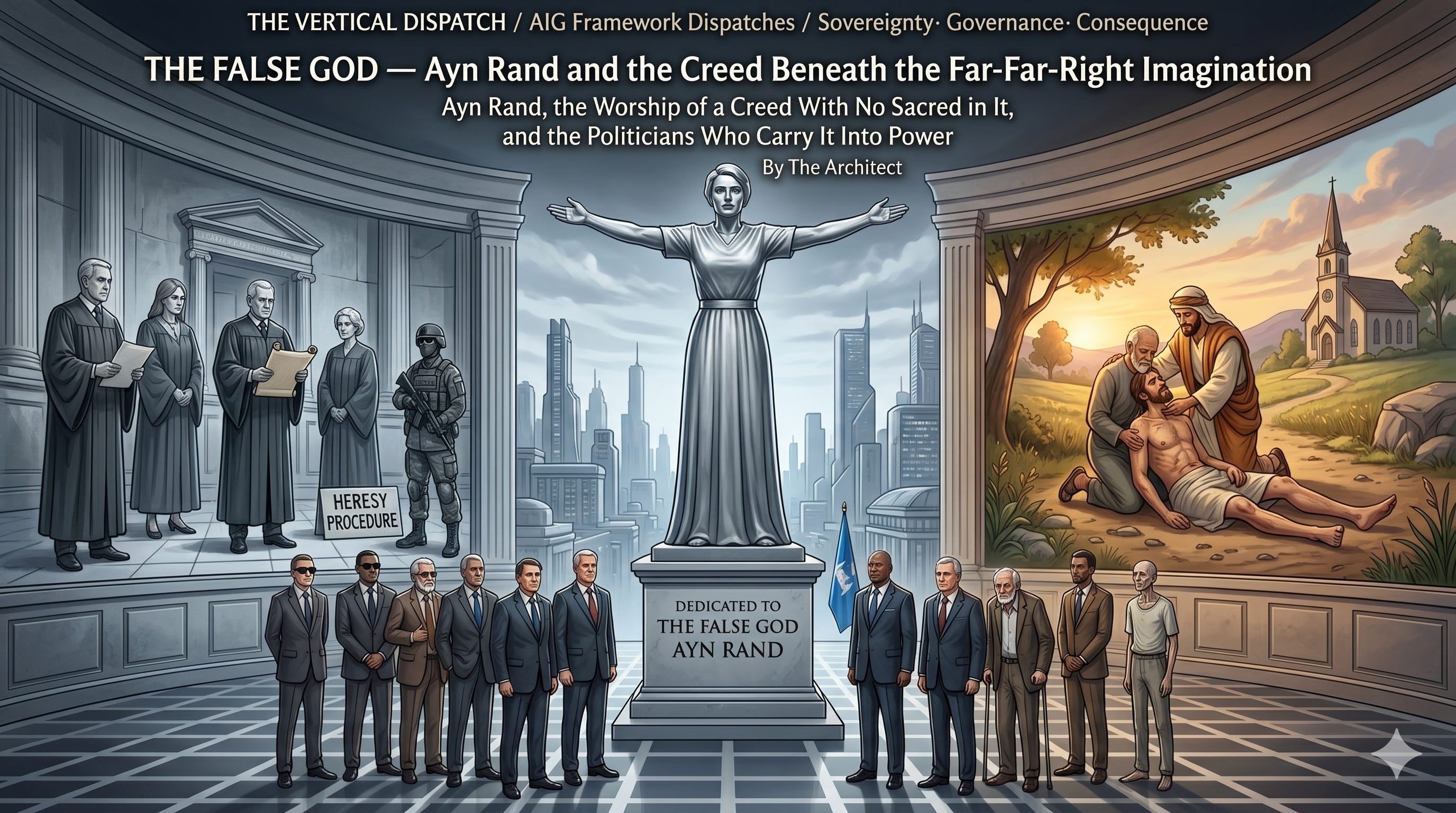
On the other side stands Ayn Rand. And Rand did not soften the collision. She named altruism the enemy of civilisation, the poison in the bloodstream of the West, a creed fit only for sacrificial animals. She was not careless about this. She was the most precise enemy of the Christian ethic that the twentieth century produced — more precise than any atheist polemicist, because she did not merely deny God. She built a complete moral system on the denial and asked her readers to live inside it.
And many of them — a great many — also go to church on Sunday.
This dispatch performs the elenchus on that contradiction. It does not attack the believer. It does the older and harder thing: it holds up two objects a person claims to revere, sets them side by side, and asks the question Socrates asked in the agora. Define what you hold. Show how both can be true. A false god, in the precise sense this dispatch will use the term, is not a wicked god. It is an object of worship that cannot survive being asked to define itself.
AIG INTEGRATION — THE AUDIT OF A WORSHIPPED IDEA
Artificially Intelligent Governance begins where Socrates began: what do you actually know, and how do you know it? Applied to an ideology, the question becomes sharper still. When a body of thought is held not as an argument to be tested but as a faith to be defended — when disagreement is treated as heresy and doubt as betrayal — the elenchus has found a false god. The test is never whether the idea is popular, or profitable, or politically useful. The test is whether it can define itself under examination without collapsing. This dispatch applies that test to Objectivism, to the woman who built it, and to the office-holders who govern by it. The method is 2,400 years old. The subject is contemporary. No quarter for a creed that cannot define what it claims to know.
I. THE SYSTEM — WHAT RAND ACTUALLY BUILT
Objectivism is not a mood. It is a closed, integrated system, and Rand intended it to be total — a complete account of reality, knowledge, ethics, politics, and art, designed, in her phrase, as a philosophy for living on earth. Its foundation is a single assertion: existence exists, and reality is an absolute independent of any mind. From that root she derived a strict chain. Reason is the only instrument of knowledge. The pursuit of one’s own rational self-interest is the highest moral purpose. Altruism is a vice. Laissez-faire capitalism is the only moral social system. There is no God in the structure, and Rand did not leave the omission as an oversight. She built the system so that no God could be inserted into it later without the whole chain breaking.
This matters because it forecloses the escape route most Christian admirers of Rand quietly use. They imagine they can take her economics and leave her metaphysics — keep the celebration of the maker and the producer, discard the atheism. Rand herself denied them that move. She insisted the parts were inseparable, that the politics descended from the ethics and the ethics from the metaphysics, and that to accept the conclusions while rejecting the root was not moderation but incoherence. On this single point — that you cannot have her capitalism without her godlessness — Rand and this dispatch agree completely.
A system built so that God cannot be inserted into it is not neutral toward God. It is engineered against Him. To worship at both altars is not breadth. It is a contradiction the worshipper has declined to examine.
II. THE WOMAN — THE PHILOSOPHY THAT COULD NOT BE LIVED
The elenchus does not stop at the system. It asks whether the author could live inside the structure she built for everyone else. The documented record of Ayn Rand’s own life answers that question, and the answer is the heart of the no-quarter case. A note on standard before proceeding: what follows distinguishes documented fact from interpretation throughout. Where the source is an interested party — a memoir by a former intimate, a review reading motive into events — that is marked. The dispatch asserts only what the record will carry.
Rand was married to Frank O’Connor for fifty years, from 1929 until his death in 1979. O’Connor was, by the consistent testimony of those who knew the household, a gentle and retiring man who set aside his own ambitions as an actor and painter to support his wife’s work. Rand, asked once to name her proudest achievement, answered: marrying Frank O’Connor. The movement she founded maintains that the marriage was a genuine union of shared values, and that reading is on the record and noted here. It is not the whole record.
In 1954 Rand began an affair with Nathaniel Branden, her foremost disciple, a man twenty-five years her junior. The affair was intermittent and lasted, in that form, until 1968. It was conducted with the knowledge of both spouses — Rand’s husband and Branden’s wife — because Rand required their assent and obtained it. Branden’s biographers and Rand’s record the same fact: O’Connor was pressed into agreeing, the arrangement deeply troubled him, and in his later years he struggled with heavy drinking. Whether the drinking was caused by the strain of the arrangement is interpretation, not settled fact: those close to the household associated the two, a biographer’s reviewer has stated the causal link plainly, and the movement’s defenders dispute it. The dispatch records the strain as real, the drinking as real, and the causal claim as contested. That is as far as the evidence reaches, and the dispatch does not reach further.
What is not contested is the ending, and the ending is the verdict. In 1968 Rand learned that Branden had fallen in love with a younger woman and had concealed it from her. Her response was not the response her philosophy prescribed. The apostle of reason over emotion, of the mind that does not sacrifice and does not beg, met an ordinary betrayal with an entirely ordinary fury. She did not absorb it philosophically. She excommunicated him — stripped him of his partnership in her journal, demanded he surrender the institute that bore his name, denounced him in print for moral and philosophical treason, and set out to destroy his standing. The institute was dissolved. The vocabulary was the vocabulary of heresy. The mechanism was the mechanism of a church.
The philosophy of rational self-interest, tested by the one event in its author’s life that could test it, did not hold. The system failed its own founder at precisely the joint where it claimed the most strength. This is not gossip. It is the elenchus, applied to a life instead of a sentence, reaching the same terminal admission: the knowledge claimed was not the knowledge possessed.
The most exact witness to this is Branden himself. Years afterward, the man Rand had named her intellectual heir apologised — his word — to every student of Objectivism for, as he put it, perpetuating the Ayn Rand mystique, and for contributing to the atmosphere of intellectual repressiveness that pervaded the movement. He named the defects of the system from the inside: a tendency to encourage emotional repression and moralising, a failure to grasp psychology beyond its cognitive surface, and a failure to value kindness in human relationships. The heir testifies for the prosecution. He does not say the system was wicked. He says it could not be lived, and that the attempt to live it deformed the people who tried.
AIG INTEGRATION — PIAAC, STRATUM, AND THE MEASURE OF A CLOSED SYSTEM
Two instruments read this record. The PIAAC scale measures the reasoning a mind can demonstrate — and Rand, by any reading of her output, operated at the top band: she built a complete and internally articulated system, a feat of sustained Level 5 construction. The Jaques scale measures the time-span and complexity a structure can hold. Here the system fails. A body of thought that treats every disagreement as treason has collapsed its own time-span of discretion to the immediate — it cannot incorporate correction, cannot revise, cannot extend across the generations a governing idea must survive. High individual capability poured into a structure that cannot self-correct does not produce durable governance. It produces a brilliant, brittle, horizontal system: powerful on the page, incapable of the vertical move, and lethal to the minds that take it as total.
III. THE FALSE GOD — WORSHIP, HERESY, AND THE THREE A’S
The language of worship around Rand is not the dispatch’s metaphor. It is a structural description, and Rand supplied the structure herself. Asked where her philosophy came from, she answered that it came out of her own mind, with a single acknowledged debt to Aristotle — the only philosopher, she said, who ever influenced her. She remarked that in the entire history of human thought she could recommend only three names, the “three A’s”: Aristotle, Aquinas, and Ayn Rand.
Read that list as the elenchus reads it. It is not the posture of a thinker entering a tradition and submitting her work to it. It is the posture of a founder naming a canon and placing herself within it. Plato — the fountainhead of Western philosophy — she cast not as a predecessor but as the enemy: the source of mysticism, of collectivism, of the surrender of the reasoning mind. Her closest associate titled the epilogue of the definitive statement of her philosophy “The Duel Between Plato and Aristotle.” The history of thought, in the Objectivist telling, is a war between the line that leads to Rand and the line that leads away from her. There is a name for a system that divides all of history into the saved and the damned, supplies its own short list of prophets, and treats the founder’s word as the terminal authority. The name is not philosophy.
The movement around her behaved accordingly. Its inner circle — which called itself, with a self-awareness that did not save it, the Collective — enforced doctrinal conformity. Disagreement with a core tenet was not met with counter-argument. It was met with denunciation and shunning. The pattern is not the pattern of a school. It is the pattern of a faith with a heresy procedure, and the procedure was applied, most spectacularly, to the founder’s own heir.
A false god is not a god who is cruel. It is an object of worship that cannot be questioned without the worshipper treating the question itself as a sin. By that test — the only test that matters — Objectivism as a movement has functioned, for many of its adherents, as exactly that. The irony is total: a creed that proclaims reason as its only absolute, defended by a reflex that forbids the central act of reason, which is doubt.
IV. THE CHRISTIAN CONTRADICTION — TWO ALTARS, ONE WORSHIPPER
Now the dispatch reaches the contradiction it named at the opening, and states it without cushioning. A person cannot coherently hold the Gospel and Objectivism as foundations at the same time. Not because a priest forbids it. Because the two systems answer the single foundational question — what does the stranger’s need demand of me — with answers that cannot both be true.
Christianity answers: the stranger’s need has a claim on you. The Samaritan is the model. The claim is not optional, not a matter of private temperament; it is the test by which the Gospel says you will be judged. Rand answers, in her own published words, that the man who lives for others is a parasite in motive and makes parasites of those he serves — that altruism holds man to be a sacrificial animal, and that any man of self-esteem must refuse the creed. One of these accounts makes the neighbour’s need a duty. The other makes it a degradation. There is no synthesis. There is only a choice, and most who hold both have declined to make it.
Rand understood this with a clarity her Christian admirers have not matched. She wrote that the creed of sacrifice was the same disease whether it promised you another life in heaven or a full stomach on this earth — naming the Christian promise of salvation and the socialist promise of bread as one pathology. She was explicit about the conservatives who tried to keep both: she called the religious wing of conservatism futile, because it preaches the morality of altruism while hoping a miracle will erase the fact that the political left practises that morality more consistently. That is Ayn Rand, in her own voice, informing Christian conservatives that their position is incoherent. The dispatch does not need to prosecute that charge. It only needs to report that the founder filed it first.
The contradiction is not the dispatch’s accusation. It is Rand’s. She built a system with no room for the Christian God and said so plainly. The incoherence belongs to the worshipper who wants the maker’s pride and the Galt speech and the contempt for the welfare claim — and also wants the Sermon on the Mount. Define how both stand. The elenchus has asked. The silence that follows is the finding.
V. THE POLITICAL LINE — THE CONTRADICTION IN POWER
A contradiction confined to private libraries is a curiosity. This one is not confined. It is load-bearing in the governments of two nations, and the dispatch now names the office-holders who carry it — each on the documented public record, each claim distinguished as fact, attribution, or characterisation.
Begin with the United States, where the line is explicit and the figures have stated it themselves. In a 2015 survey of presidential candidates’ intellectual influences, Senator Ted Cruz named Ayn Rand as, in his words, one of his all-time heroes. In the same survey, Senator Rand Paul said he was a big fan of Rand and had read all of her novels. Senator Ron Johnson, addressing a Rand-promoting group in 2013, called Atlas Shrugged his foundational book and framed America as a contest between individuals who build and a culture of entitlement and dependency. Three sitting United States senators, three documented statements of allegiance, no inference required.
The central American case is Paul Ryan, former Speaker of the House, because Ryan is the contradiction performing itself in public over two decades. In a 2003 interview he said he gave out Atlas Shrugged as Christmas presents and made his interns read it. In a 2005 speech to the Atlas Society he said that if he had to credit one thinker as the reason he entered public service, it would be Ayn Rand, and that her work was required reading for his staff. In 2009 he said it was as if America were living inside a Rand novel, and that Rand had built the moral case for capitalism better than anyone.
Then, in April 2012 — after Catholic faculty publicly rebuked his budget for its treatment of the poor — Ryan reversed. He told National Review, and the words are his: I reject her philosophy. It is an atheist philosophy. It reduces human interactions down to mere contracts and it is antithetical to my worldview. He called the reports of his Rand devotion an urban legend and named Thomas Aquinas as his real influence. His staff disputed the framing, calling the intern claim a myth — a rebuttal recorded here for the standard. But the rebuttal is contradicted by Ryan’s own filmed and printed words from 2003 and 2005. The primary record overrides the later denial.
Paul Ryan held both altars for twenty years. The moment the contradiction was named aloud by people with the standing to name it, he could not hold both, and he dropped one. His own 2012 sentence — it is an atheist philosophy, antithetical to my worldview — is the elenchus reaching its terminal point. He is the prosecution’s own witness. He testifies, in his own mouth, that the two systems cannot both be foundational. He simply took twenty years and a public rebuke to admit it.
The Canadian line requires more precision, because the easy version of it is false, and a dispatch that runs the easy version forfeits the right to be believed. In Alberta, the Rand connection is real and documented. Premier Danielle Smith has been described by journalists as Canada’s Ayn Rand in cowboy boots — a coinage, attributed here as a coinage. The substance beneath it is sourced: reporting on Smith establishes that Rand has been a consistent presence in her political outlook, and that she uses Rand to define the legitimate functions of the state as national defence, police, and courts, and little else. Smith also wears a forearm tattoo of the ancient Sumerian sign amagi — the earliest known written word for liberty. It is widely and wrongly reported to be the logo of a libertarian foundation; in fact the foundation merely uses the same ancient symbol. Smith’s own account is that she encountered the word during her years at a free-market think tank, loved it, and chose it. The accurate version is quieter than the myth and more revealing: she wears the oldest written word for liberty on her skin, and traces it to a think tank. The dispatch uses the accurate version, because the accurate version cannot be knocked down.
Pierre Poilievre is the case the easy narrative gets wrong. The leader of Canada’s Conservatives is not, on the public record, a disciple of Ayn Rand. No documented instance of Poilievre citing Rand has been found. His stated intellectual influences are Edmund Burke and, above all, the economist Milton Friedman — his Calgary-era reading of Friedman’s Capitalism and Freedom shaped his worldview, and his 1999 scholarship essay was titled Building Canada Through Freedom. To call him a Randian would be to assert what the record does not support, and this dispatch will not do it.
And that distinction is the analytical point, not a retreat from it. Rand is the purest distillation of a moral logic, but she is not its only road into power. There is the novelist’s road — Smith, Cruz, Ryan — and there is the economist’s road, Friedman’s road, and Poilievre travels the second. The destination is identical. Poilievre has described the greatest social safety net as the voluntary generosity of family and community — which is the Good Samaritan demoted from a duty to a preference, charity made optional, the stranger’s claim dissolved by a different argument arriving at the same place. He is not a weaker exhibit for not citing Rand. He is the exhibit that proves the disease is larger than one author. It is a family of thought, and it governs.
AIG INTEGRATION — CHECKERS, CHESS, AND THE GO BOARD THE CREED CANNOT SEE
The typology reads the political line exactly. A creed that resolves every question to a single axis — the maker against the taker, freedom against the state, the producer against the parasite — is checkers consciousness raised to an ideology. It permits one move: remove the obstacle. It cannot play chess, which requires holding competing goods across time, and it cannot play Go, which requires seeing the whole board as an interdependent field where the isolated stone dies. A nation is a Go board. Its prosperity, its security, its weakest citizens, its longest horizons are one connected position. Govern it as checkers — cut the program, free the maker, declare the welfare state out of business — and the move looks decisive on the square where it lands while the surrounding position quietly collapses. The contradiction this dispatch has tracked is not only a theological one. It is a governance defect: the inability to hold more than one good at once, dressed as a philosophy of freedom.
ON RAND’S REJECTION OF PLATO — NO QUARTER
Ayn Rand’s dismissal of Plato is not a footnote in her philosophy. It is the tell. Across her essays, interviews, and lectures, she names Plato the father of mysticism, the source of collectivism, the origin of the anti-reason tradition. In her teaching Plato did not represent error to be debated; he represented, in the recorded words of one who studied under that teaching, philosophical depravity — a figure her followers were trained to enter the world already armed against, before they had read a line of him. A thinker who rejects Plato is not disagreeing with a predecessor. She is rejecting the entire vertical lineage of Western thought — the metaphysical architecture, the examined life, the sacred dimension of reason itself. When Rand cast Plato as the enemy of reason, she revealed the limit of her system: it can operate only on the horizontal plane. It cannot ascend.
And that is the moment the structure collapses. A philosophy that cannot engage Plato cannot engage the vertical. A philosophy that cannot engage the vertical cannot engage the sacred. A philosophy that cannot engage the sacred cannot account for the human being. Rand’s rejection of Plato is not a bold act of independence. It is the defensive reflex of a closed system protecting itself from the one tradition that could expose its incompleteness.
The elenchus does not punish her for this. It simply names the fact: a creed that must exile Plato in order to survive has already admitted what it cannot say aloud — that it cannot bear the weight of the questions he taught the world to ask.
VI. THE VERDICT — NO QUARTER FOR A CREED THAT CANNOT DEFINE ITSELF
Set the findings in a single line. Ayn Rand built a closed and godless system and was honest that it was godless. The movement around it has functioned as a faith, with prophets, heretics, and an excommunication rite. Its author could not live inside it; tested by one ordinary betrayal, the philosophy of reason produced fury and a purge, and the heir later apologised for the deformation the system worked on those who believed it. And the politicians who carry that system into the governments of Canada and the United States — some naming Rand directly, one travelling the parallel road of Friedman — also, many of them, profess the faith of the Good Samaritan, whose first principle Rand named as the poison of civilisation.
The dispatch returns, as it must, to the question it began with, because the elenchus does not end in accusation. It ends in a question handed back to the reader, unanswered, so that the reader must answer it. To every office-holder and every voter who holds both the Gospel and the gospel of the self: define how both stand. Show the synthesis. If the stranger in the ditch has a claim on you, Rand’s system is false. If he does not, the Sermon on the Mount is. One of the two altars is empty. The unexamined life will not notice which. The examined one cannot avoid it.
A false god is an object of worship that cannot survive being asked to define itself. The dispatch has asked. It has not raised its voice, and it has not invented a single fact. It has only set the two altars side by side and held the lamp steady. No quarter for power that cannot define what it knows. No quarter for a creed that forbids the question. The question does not stop.
NOTE ON STANDARD
This dispatch distinguishes documented fact from interpretation throughout. Direct statements by Ted Cruz, Rand Paul, Ron Johnson, Paul Ryan, and Danielle Smith, and the published writings of Ayn Rand and Nathaniel Branden, are matters of public record. Characterisations such as “Canada’s Ayn Rand in cowboy boots” are identified as the coinages of journalists, not findings. The causal link between the Branden affair and Frank O’Connor’s later drinking is reported by some sources and disputed by others, and is presented here as contested, not established. Pierre Poilievre is expressly not characterised as an adherent of Ayn Rand, as no public record supports it; his documented influences are Edmund Burke and Milton Friedman. No allegation of unlawful conduct is made against any living person named in this dispatch.
AUTHOR’S NOTE — MY OWN ENCOUNTER WITH AYN RAND
I did not come to Ayn Rand as a critic. I came to her as a reader who was, for a time, genuinely moved by the force of her clarity. I owned her books. I read The Fountainhead and found myself agreeing with parts of it. I read Atlas Shrugged and understood why so many people feel, at first contact, that they have encountered a system of thought powerful enough to reorder their world. Rand’s early appeal is real. It is the appeal of a mind that refuses compromise and speaks in absolutes at a moment when the world feels incoherent.
But reason requires more than the horizontal. It requires the vertical. It requires the ability to examine both the world of action and the world of meaning, both the material and the metaphysical, both the self and the sacred. A system that dismisses one dimension in order to preserve the other is not a synthesis. It is a collapse.
The moment I understood that Rand had cast Plato as the enemy of reason, the structure revealed itself. A thinker who rejects the root of Western metaphysics, the origin of the examined life, the doorway to the sacred, is not defending reason. She is defending a closed system. And a closed system can be brilliant until the moment it is asked to integrate what it has excluded. Then it breaks.
Rand’s work on Objectivism is brilliant until it isn’t. It is powerful until it reaches the point where it must reconcile the horizontal with the vertical — the world of fact with the world of meaning — and cannot. A philosophy that cannot hold both is not a philosophy of reason. It is a fortress built against the very questions reason exists to ask.
This dispatch is not written from contempt. It is written from recognition. I admired Rand once. I understand the appeal. And I understand, now, why the appeal collapses under examination. A system that cannot integrate the sacred, that cannot engage the metaphysical, that cannot stand in the lineage of Plato, cannot be a total account of the human being. It can only be a fragment mistaken for a whole.
The elenchus does not punish fragments. It simply names them.
— Glen Roberts, The Architect
God is Love. Love is Truth. Truth is Consciousness. Consciousness is Brahman.
Amen. Namaste.
DISPATCH HASHTAGS
#TheFalseGod #AynRand #Objectivism #TheElenchus #AIG #ArtificiallyIntelligentGovernance #VerticalDispatch #TheArchitect #NoQuarter #AtlasShrugged #TheFountainhead #Altruism #TheGoodSamaritan #SermonOnTheMount #DanielleSmith #PierrePoilievre #PaulRyan #TedCruz #RandPaul #RonJohnson #MiltonFriedman #TheCalgarySchool #Libertarianism #FalseGods #PIAACLevel #StratifiedSystems #GoVsCheckers #CivilisationalAnalysis #SubstackCanada #TheVerticalDispatch #Socrates #TheFirstQuestioner
"Christianity answers: the stranger’s need has a claim on you."
You can put it that way if you like, but that's not the way I would characterize it - specifically it's the word "claim" that I object to. I see it more as a responsibility of each of us than a claim by any of us. That may be semantics, because I can't really defend the difference as meaningful, other than the direction of each perspective. Each necessarily implies the other.
I'm not a Rand acolyte, but I do think she makes some important points. One is her emphasis on logic, and the exhortation to "Check your premises". Too many arguments are made without clearly stating the premises on which they rest even before getting to whether the argument itself is logically valid (which is certainly important too, obviously).
The other is that her philosophy rests on the concept of individual responsibility.
Christianity also rests on that concept, contrary to the Left's characterization of social responsibility as primary. The story of the Good Samaritan arose out of the question "who is my neighbour?", which itself arose out of the commandment to love our neighbour as ourself (as an addendum to the answer of the question "what is the greatest commandment?"). Not that our neighbour had the right to be loved, or could claim our love, but that we ought to love. Our love is a responsibility that derives from God loving us first, without our doing anything (or being capable of anything) to justify God's love.
Our individual responsibility is also implied in the sheep vs. goats separation. We are judged as individuals according to our individual behaviour. Also, the expectation of our asking for God's forgiveness for our sins is for the act of an individual.
I see Rand's philosophy as a corruption of our individual responsibility, similar to other corruptions of natural desires and needs (e.g. lust, gluttony, greed).
But her books are still helpful to understand that we do still all have individual responsibility, even as a grounded reader should be able to see through the problems with them. (The light of a cigarette as a symbol of the light of genius was probably the most egregious to me.) Unfortunately, not all readers are grounded. Nor are all her points without merit.
Just curious, have you read any of Rand's books right through? Which ones?