

“On the field of dharma, on the field of the Kurus, my people and the Pandavas assembled, eager for war — what did they do, Sanjaya?” — Bhagavad Gita 1.1
— ★ —
Look at where you are standing.
You are on a battlefield. You did not choose this. Or rather — you chose everything that led here, every small choice threading back through years, and now the consequence stands before you in the form of faces you love, arrayed on the other side of a line you are about to cross. This is Kurukshetra. This is also your life.
The blind king Dhritarashtra sits far from the field and asks his minister Sanjaya: what is happening out there? What are they doing? He asks because he cannot see. He has never been able to see. And Shankara — that piercing eighth-century mind who read every word of this song more carefully than perhaps anyone before or since — Shankara noticed that the Gita begins with a blind man’s question. He did not think this was an accident.
The blindness is not in the eyes. It has never been in the eyes. It is the fundamental human condition of not knowing what we are — of looking out at a world full of forms, full of names, full of people we love and people we fear, and mistaking the entire display for reality. Shankara called this avidya. Not ignorance in the ordinary sense of lacking information. Ignorance in the root sense: a-vidya, the absence of seeing. The blindness that makes a king ask a servant to describe a war that is happening inside him.
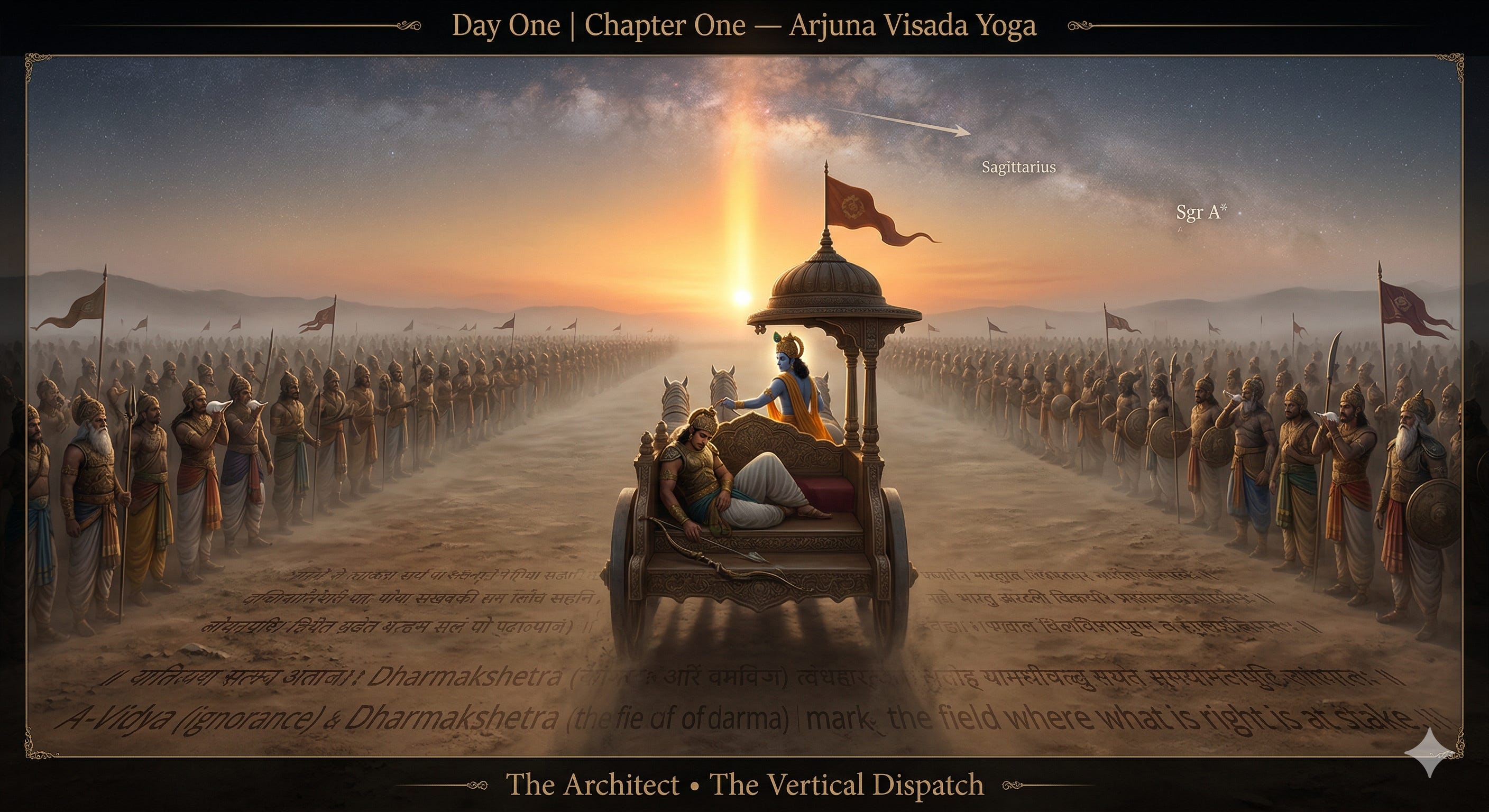
Now Arjuna stands in the chariot. I have placed him there. He is the best of warriors — not young, not naive, trained for decades in every art of combat, courageous beyond measure. He asks me to drive the chariot between the two armies so he can see who he is about to fight. I do. And what he sees undoes him.
He sees his grandfather Bhishma, white-haired, holding his conch. He sees his teacher Drona, who taught him everything he knows about the bow. He sees uncles, cousins, sons of friends, old companions, beloved faces on both sides of the line. And something in him breaks. Not his courage — he has not yet lost his nerve. Something deeper breaks. His sense of purpose. His certainty that he knows what is right.
His limbs go heavy. His mouth dries. His famous bow — Gandiva, the bow given to him by fire itself — slips from his fingers. He tells me his skin is burning, his mind is whirling, he sees omens of disaster. He sits down in the chariot. In the middle of the field. With both armies watching. And says: I will not fight.
— ★ —
I want you to stay here for a moment before we move on. Stay with Arjuna sitting down.
Because this — exactly this — is the beginning of every genuine spiritual life. Not a decision to seek. Not a moment of inspiration. Not a vision or a dream or a beautiful feeling in a temple. The beginning is the moment the thing you were holding falls from your hands and you cannot explain why, and the ground you thought was solid reveals itself as the surface of a river.
Shankara is very precise about what is happening to Arjuna. He says: the grief is not wrong. The love Arjuna feels for his family is not an error. The error is in what Arjuna believes about them. He believes they can die. He believes he can lose them. He believes the forms he sees — grandfather, teacher, cousin, friend — are the truth of what they are. He has confused the names and the forms with the Self that wears them. This confusion is the root of all human suffering, and Arjuna is simply the first person honest enough to collapse under its weight publicly.
Most people carry this confusion for an entire life and call it living. Arjuna drops to the floor of the chariot and calls it catastrophe. This is why he can be taught. This is why I speak.
I have been in this chariot since before the war began. I was in the chariot before Arjuna arrived. This is the detail that Shankara holds like a jewel: Krishna is always already in the chariot. The teaching is always already present. The guide is not summoned by the crisis — the crisis only makes the student finally capable of hearing what has been spoken from the beginning.
— ★ —
Look again at the first word of the entire Gita. Dharmakshetre. On the field of dharma. Not just Kurukshetra — the geographical plain. Dharmakshetra. The field where what is right is at stake. Shankara saw this as the Gita announcing its entire purpose in its opening breath: this is a teaching about what dharma actually is, which means it is a teaching about what you actually are, which means it is a teaching about the nature of reality itself.
A battlefield is the right place for this. Not a temple, not a forest hermitage, not a quiet room with incense. A battlefield, with the conches already sounding and the arrows already notched, with everything you have built your life around standing forty yards away waiting to be decided. That is where the real question lives. Not in the comfortable hours of practice, but in the moment when everything you thought you were is asked to justify itself.
Arjuna’s bow on the floor of the chariot is the most important image in the first chapter. He did not put it down gently. He let it fall. And in that falling, Shankara hears something that no one else in the armies can hear: the first note of surrender. Not spiritual surrender — he does not know that yet. He thinks he is surrendering to despair. But the hand that lets go of the instrument of ego-action, even in grief, even in confusion, has begun something it cannot take back.
The chapter ends there. Arjuna in the chariot, bow on the floor, armies waiting, the great silence before the teaching begins. And I am looking at him. I have always been looking at him. I am looking at you.
— ★ —
Before tomorrow — and there is no hurry, let this day breathe — sit with one question. Not a philosophical question. A felt one.
What have you been holding that has begun, quietly, to feel too heavy? What bow have you been gripping that your hands already know does not belong to you?
You do not need to answer. The question itself is the chariot.
— ★ —
Tomorrow: Chapter Two — The Eternal Self
What Cannot Die
The Architect • The Vertical Dispatch

Glennford Ellison Roberts Author — Sacred Metaphysics & Consciousness: History of the Absolute & Eternal Cumberland, Ontario, Canada
God is love. Love is truth. Truth is consciousness. And consciousness is balance. Amen. Namaste.. 🙏
#BhagavadGita #Gita18Days #ChapterOne #ArjunaVisadaYoga #KurukshetraField #KrishnaTeaches #Shankaracharya #Advaita #VedicWisdom #SanatanaDharma #HinduPhilosophy #SpiritualAwakening #Consciousness #AncientWisdom #YogaPhilosophy #Dharma #Moksha #SpiritualSeeker #Avidya #NonDuality #TheVerticalDispatch #TheArchitect