

“Whenever dharma declines and the purpose of life is forgotten, I manifest myself on earth. I am born in every age to protect the good, to destroy evil, and to reestablish dharma.” — Bhagavad Gita 4.7–8
— ★ —
Something shifts in Chapter Four. For three days I have been teaching Arjuna about the nature of the Self, about action without the burden of the doer, about the wheel of existence and the offering that keeps it turning. Today I stop teaching about the Self and begin speaking about myself.
This is not a small thing. The Absolute does not typically speak in the first person about its own history. But Arjuna has been faithful — he has stayed in the chariot, he has listened, he has followed the teaching even when it has cut against everything he thought he knew. And so today the teaching deepens in a way that could not have happened on day one.
I tell him: this knowledge is ancient. I gave it first to Vivasvan — the solar principle, the first light of consciousness — and Vivasvan gave it to Manu, and Manu gave it to Ikshvaku, and through the royal lineage it came down across the ages. But in time it was lost. Covered over by smaller concerns, by the accumulated weight of forgetting, by the slow erosion of every truth that is not constantly renewed.
Arjuna looks at me. He says: you are standing beside me now. Vivasvan was born at the beginning of time. How could you have taught him?
It is the right question. And the answer stops everything.
— ★ —
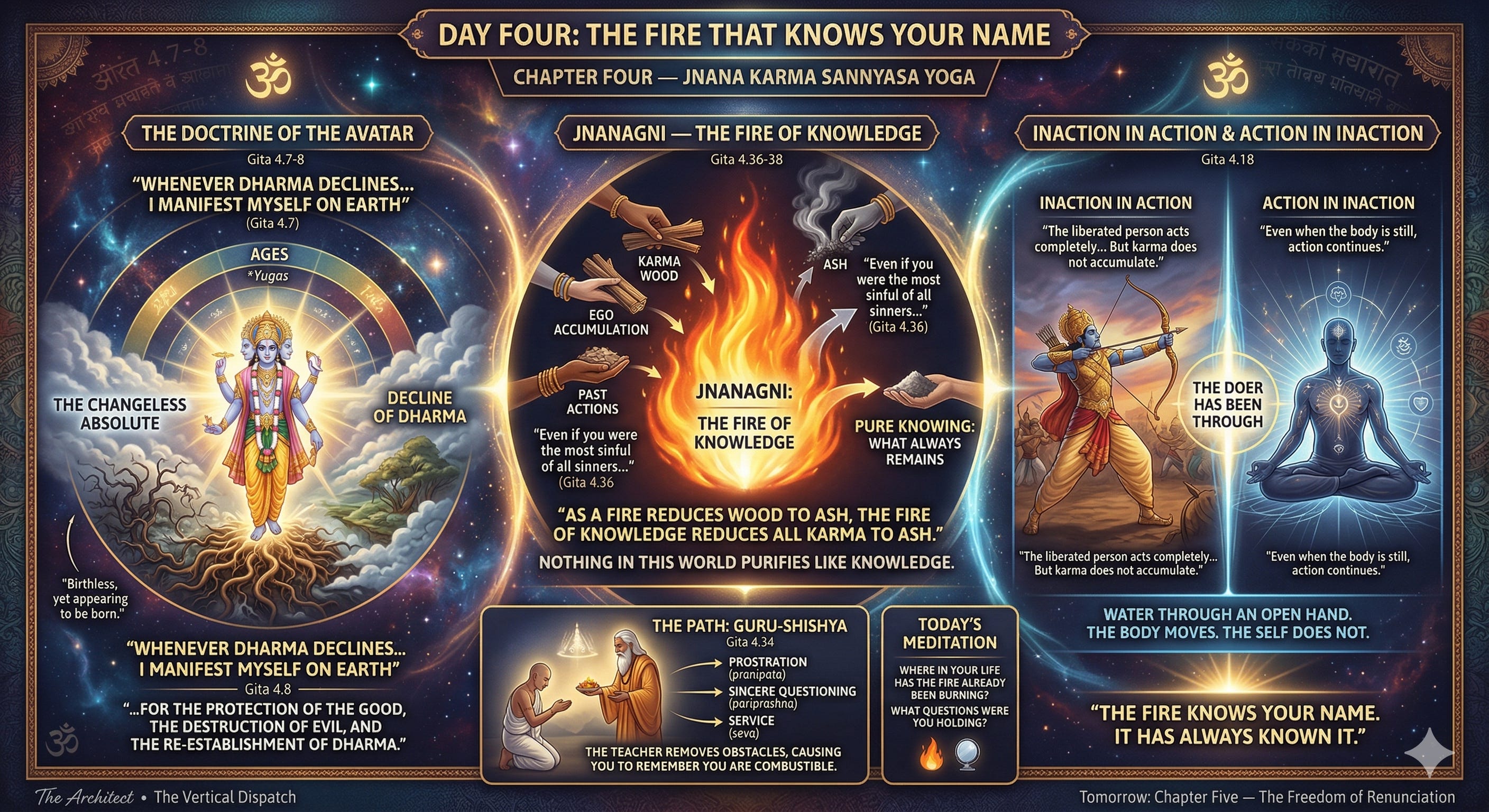
Both you and I have passed through many births. I remember them. You do not.
This is not mythology. Shankara was precise about this. What I am describing is not a God who has lived successive human lives the way a soul accumulates incarnations. I am describing the nature of the Absolute itself — birthless, yet appearing to be born. Changeless, yet appearing to change. Without beginning or end, yet entering time whenever time requires it. The appearance of birth is for the sake of those who need the teaching embodied — who need to see wisdom walking on two feet, making decisions, bearing consequences, living what it teaches. Not because the Absolute actually enters limitation. Because limitation sometimes needs to see its own ground walking toward it wearing a recognisable face.
This is the doctrine of the Avatar. And it carries within it a truth that reaches far beyond any single incarnation.
Yada yada hi dharmasya glanir bhavati Bharata.
Whenever dharma declines — whenever the knowledge of what is real fades, whenever the understanding of what a human life is actually for becomes obscured by smaller appetites and shorter visions — I come. Not as punishment. Not as rescue from the outside. As the Absolute recognising that the time has come to make itself visible again, to walk among those who have forgotten what they are and remind them by being what they have forgotten.
Age after age. Every tradition that has ever carried genuine wisdom has felt this — the sense that the teaching arrived through a person, that the person was more than a person, that something was present in the transmission that could not be fully accounted for by the biography. This is what the Gita is naming. Not claiming exclusivity for one incarnation. Describing a pattern as old as consciousness itself.
— ★ —
Now I give Arjuna something that Shankara called the most stunning passage in the chapter. I ask him: do you know the difference between action and inaction?
He thinks he does. Action is when the body moves. Inaction is when it is still. But I tell him: even the wise are confused about this. And then I say the thing that takes years to fully enter.
The one who sees inaction in action, and action in inaction — that one sees clearly. That one is awake among the living.
What does this mean? The liberated person acts — visibly, completely, with full commitment to whatever the moment requires. They fight if fighting is called for. They speak if speaking is called for. They build, love, serve, create. From the outside nothing distinguishes their action from anyone else’s. But inside the action something is absent that is present in almost every other human being who acts: the sense of a separate doer accumulating the consequences of what they do.
When the doer has been seen through — when the passenger has been recognised as the passenger and not confused with the chariot or the horses or the road — action continues but karma does not accumulate. Because karma belongs to the doer. And the doer, on examination, turns out to be a construction of memory and habit and desire that the witnessing Self has been mistaken for. When that mistake is corrected, the action flows through and leaves nothing behind. Water through an open hand.
This is inaction in action. The body moves. The Self does not.
— ★ —
Then comes the verse that this entire chapter has been moving toward. The verse that Shankara read as the most radical statement in all of Chapter Four.
“Even if you were the most sinful of all sinners, you would cross over all evil by the boat of knowledge alone. As a fire reduces wood to ash, the fire of knowledge reduces all karma to ash. Nothing in this world purifies like knowledge.” — Bhagavad Gita 4.36–38
Jnanagni. The fire of knowledge.
Not ritual. Not austerity. Not years of discipline, not the accumulation of good deeds carefully balanced against the weight of past wrongs. Knowledge. The direct seeing of what is real. This alone — this single act of genuine recognition — burns the entire accumulation to ash. Not because it cancels the past the way one weight cancels another. But because it destroys the one who accumulated it. The fire does not negotiate with the wood. It does not leave some of it standing out of respect for how long it took to grow. It reduces everything to ash and what remains is the fire itself — the pure knowing that was always present underneath the accumulation.
Shankara held this as the most democratising statement in the Gita. It requires nothing from you except the willingness to see clearly. No birth in the right family. No years of prior preparation. No initiation into the correct lineage. Even the one who carries the heaviest burden of past action — even that one — can be carried across by this single boat. Because the burden belongs to the ego, and the fire of knowledge is what sees through the ego to what was never burdened.
This is why I said at the beginning of this series: you do not need to have read anything before this. You need only a real question. A genuine ache to know what you are. That question, held sincerely, is already the fire beginning to catch. Every sincere seeking is jnanagni already lit. The burning has already started. You may not feel it yet. But it started the moment you became unable to be satisfied with the answers you had been given.
— ★ —
One more thing Chapter Four gives you, and it is personal.
I tell Arjuna: go to the one who has seen the truth. Go with humility, with genuine questions, with the willingness to serve the transmission rather than simply extract information from it. The wise who have seen will teach you.
Tad viddhi pranipatena pariprashnena sevaya.
Know this through prostration, through sincere questioning, through service. Shankara read this as the Gita’s explicit teaching on what the tradition calls the Guru-shishya relationship — the living transmission from one who has seen to one who is ready to see. Not because the teacher possesses something the student lacks and must hand it across. But because the presence of one who has seen creates the conditions in which the seeing becomes possible for the one who has not yet seen. The teacher does not give you the knowledge. They remove the obstacles to what you already are.
This is satsang — being in the company of truth. It is why traditions gather. Not for the comfort of shared belief but for the living contact with someone in whom the fire is already burning. That fire is contagious in the best possible sense. Proximity to it causes something in you to remember that you too are combustible.
You are reading these words. Something brought you here. The fire has already found you. The question now is only whether you are willing to be wood.
— ★ —
Today the meditation is this: where in your life has the fire already been burning — the moments of genuine seeing, however brief, however quickly covered over by the ordinary mind — and what were the conditions that allowed them?
Not what did you see. Where were you standing when the seeing happened? Who were you with? What question were you holding? Because those conditions are not accidental. They are the shape of your own readiness. And readiness, once recognised, can be cultivated.
Tomorrow: Chapter Five — The Freedom of Renunciation
The Architect • The Vertical Dispatch

Glennford Ellison Roberts Author — Sacred Metaphysics & Consciousness: History of the Absolute & Eternal Cumberland, Ontario, Canada
God is Love. Love is Truth. Truth is Consciousness. Consciousness is Brahman.
Amen. Namaste.. 🙏
#BhagavadGita #Gita18Days #ChapterOne #ArjunaVisadaYoga #KurukshetraField #KrishnaTeaches #Shankaracharya #Advaita #VedicWisdom #SanatanaDharma #HinduPhilosophy #SpiritualAwakening #Consciousness #AncientWisdom #YogaPhilosophy #Dharma #Moksha #SpiritualSeeker #Avidya #NonDuality #TheVerticalDispatch #TheArchitect