


Chapter Three — Karma Yoga
“Better is one’s own dharma, imperfectly performed, than the dharma of another perfectly executed. Better even death in one’s own dharma — the dharma of another is full of danger.” — Bhagavad Gita 3.35
— ★ —
Arjuna is still in the chariot. He has heard everything I said yesterday about the deathless Self, about action without attachment to its fruits, about the lamp that does not flicker in the windless room. And now he looks at me and asks the question that every honest person asks when they have genuinely heard the teaching and genuinely understood a part of it.
He says: if you hold that knowledge is superior to action, why do you urge me to this terrible act? Your words pull in two directions at once. Tell me clearly which one leads to the highest good.
This is not confusion. This is intelligence. Shankara noted it as the sharpest question Arjuna has asked, because it points to a real tension in what has been said. Yesterday I told him the doer is not ultimately real. Today he stands on a battlefield with a bow in his hand and an army forty yards away and asks: then what is all this for? If no one is really doing anything, and the Self is untouched by everything that happens, why should I stand up?
It is your question too. Perhaps it has been your question for a long time. Perhaps you have read something, or practised something, or sat in silence long enough to feel the ground beneath your ordinary mind — and then returned to your daily life and wondered: how does this connect to the dishes in the sink, the difficult colleague, the bill that needs paying, the parent who is ageing, the child who needs feeding? What does the deathless Self have to do with Monday morning?
Chapter Three is the answer. And the answer is not what the ego wants to hear.
— ★ —
I tell Arjuna plainly: no one, not for a single moment, exists without acting. Even the person who sits completely still, who has renounced every outward movement, is acting inwardly — the mind moves, the breath moves, digestion moves, the heart beats. To be embodied is to act. There is no suspension of participation available to any living being. The question is never whether to act. The question is always from where.
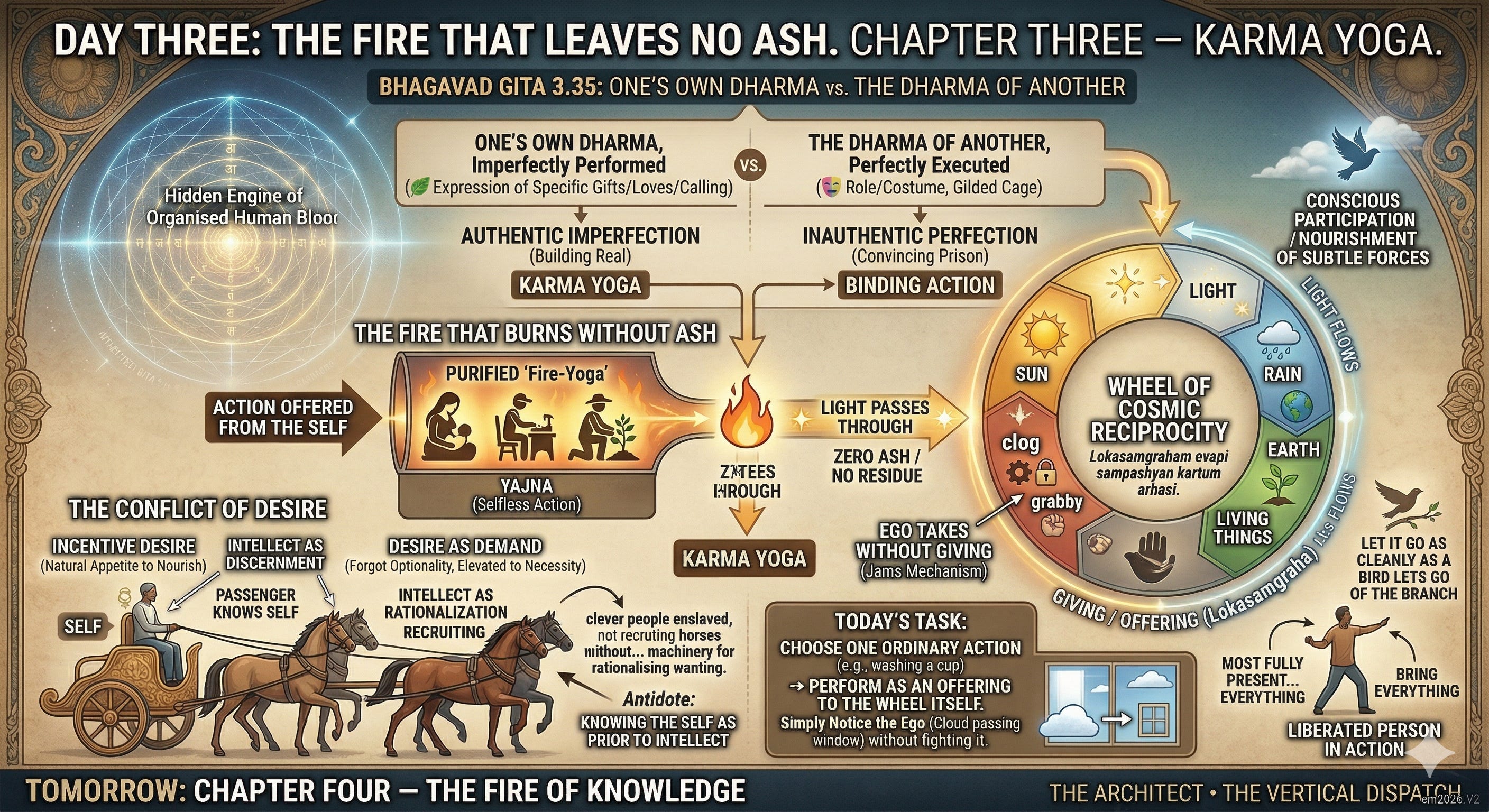
Action performed from the ego — from the small self that believes it is the author, that calculates its advantage, that acts in order to secure a particular outcome — that action binds. Not as punishment. As physics. The ego that reaches for the fruit creates the need for another reaching, and another, and the chain extends across lifetimes. This is what the tradition means by karma in its deep sense: not fate, not punishment, but the gravitational field created by desire that has forgotten it is optional.
Action performed from the Self — offered up, given back, done because it is what this moment requires and not because the doer needs something from it — that action passes through the world like light through glass. It does what it does and leaves nothing behind. A fire that burns without ash. This is Karma Yoga. Not a lesser path. The foundation without which the higher floors cannot stand.
— ★ —
Now I show Arjuna something vast. I show him the wheel.
The cosmos is not a collection of separate things bumping into each other in the dark. It is a single living reciprocity — a wheel of giving that has been turning since before time was a category. The sun gives light. The light nourishes the rain. The rain nourishes the earth. The earth feeds all living things. Living things, through their conscious participation, nourish the subtle forces that sustain the cosmos itself. Each part feeds every other. To exist inside this wheel and take from it without giving back — to consume without offering, to receive without returning — is to jam the mechanism. The ego that only gathers is the definition of spiritual poverty, because it has placed itself outside the current that is the only source of real nourishment.
Shankara reads the Sanskrit word yajna — usually translated as sacrifice or ritual — and opens it far beyond its ceremonial meaning. Yajna is any action performed without self-interest. The mother feeding her child at three in the morning. The craftsman who makes the chair as well as it can be made even when no one is watching. The farmer who plants knowing the harvest will come after he is gone. These are yajna. These are offerings into the wheel. These are the acts that hold the world together.
Lokasamgraham evapi sampashyan kartum arhasi.
You should act for the holding together of the world. Lokasamgraha. The welfare and coherence of all beings. This is the reason even the liberated act — not for themselves, because they have nothing left to gain, but because the world needs the current to keep flowing, and those who have seen the truth of what the current is have the deepest obligation to sustain it.
I tell Arjuna: look at me. I have nothing to achieve by any action in any of the three worlds. There is nothing I lack, nothing I need, nothing that can be added to what I am. Yet I act — without ceasing, without rest, without accumulating the fruit of a single act. If I did not, these worlds would fall into confusion. People watch what the great ones do. They model their lives on the patterns they see. If I were to withdraw from action, the entire web would begin to unravel.
This is the deepest thing I say in Chapter Three, and the most easily missed. Liberation is not retirement from the world. It is the most complete possible engagement with it — because the liberated person acts from the whole, not from the fragment. They bring the river, not a cupped handful. Their presence nourishes whatever it touches, not as an effort but as a consequence of what they are.
— ★ —
Now I come to the verse that is quoted everywhere and understood almost nowhere.
“Better is one’s own dharma, imperfectly performed, than the dharma of another perfectly executed.” — Bhagavad Gita 3.35
Later centuries reached for this verse to justify the caste system — to tell a person born to sweep that they must sweep, whatever their gifts, whatever their longing. Shankara did not read it that way, and neither should you. What I am pointing to is something more interior and more urgent than social station.
Your dharma is your nature expressing itself in action. It is the particular shape that the universal takes when it moves through you — your specific gifts, your specific loves, your specific calling. No one else has it. No one else can perform it. When you act from your own nature, even haltingly, even imperfectly, even making mistakes that need correcting — you are moving in alignment with the current. Something real is flowing.
When you perform someone else’s dharma — however brilliantly, however successfully by the world’s measure — you are in costume. You are playing a role that does not belong to you. And a gilded cage is still a cage. The person who spends their life being excellent at the wrong thing is not liberated by their excellence. They are more thoroughly imprisoned by it.
Shankara’s point is this: authentic imperfection is more spiritually productive than inauthentic perfection. The stumbling act that comes from your true nature is building something real. The flawless performance of someone else’s life is building nothing but the walls of a more convincing prison.
— ★ —
Arjuna then asks me the question that every honest practitioner eventually asks. He says: what is it that drives a person to act against their own wisdom? I understand what is right. I have heard the teaching. And yet something in me moves against it. Something overrides the knowing. What is that force?
It is desire, I tell him. Not desire in its innocent form — the simple movement toward what nourishes, the natural appetite of a living being. But desire that has become demand. Desire that has forgotten it is optional. Desire that has elevated its object to a necessity, so that the self believes it cannot be whole without the thing it reaches for.
And Shankara adds something that should stop you cold: this desire does not live only in the senses. It does not live only in the body. It has penetrated all the way into the intellect. A person can know that something is wrong — clearly, unambiguously know it — and desire it anyway. The knowing and the wanting coexist, and in that conflict, wanting usually wins. Not because wanting is stronger, but because the intellect has been recruited to serve the desire rather than to discern the truth. This is why clever people can be the most thoroughly enslaved. They have the most sophisticated machinery for rationalising what they already want to do.
The antidote is not suppression. Suppression just drives desire underground, where it moves without being seen and therefore without being questioned. The antidote is recognition — knowing the Self as prior to and higher than the intellect. When the passenger is truly known to be the passenger, the horses cannot commandeer the chariot. Not because they have been broken. Because the authority in the vehicle has been correctly identified.
— ★ —
Chapter Three ends where it must: with Arjuna being sent back into the world, not out of it. Perform your action. Act from your nature. Offer the fruit. Release the outcome. Do this not as a performance of detachment — not wearing non-attachment like a mask — but because you have begun to understand who is actually doing the acting, and it is not who you thought it was.
The liberated person in action is not a person who has become passive. They are the most fully present person in any room. They act completely, hold nothing back, bring everything they have to whatever the moment requires — and then they let it go as cleanly as a bird lets go of the branch. The branch does not follow the bird. The bird does not circle back to check on the branch. The action was complete in the acting. The rest is not their business.
This is the fire that leaves no ash. This is Karma Yoga. This is what Chapter Three is teaching. And it is not, it has never been, separate from who you already are.
— ★ —
Today, choose one ordinary action — something you do every day, something small and unremarkable — and perform it as an offering. Not to a deity, not to an idea. As an offering to the wheel itself. To the vast reciprocity that you are already inside whether you know it or not.
While you do it, notice the one who wants to know if it was done correctly. Notice the one who wants to be seen doing it, or who wants credit for the intention. You do not need to fight that one. Simply notice it, the way you notice a cloud passing across a window. The window does not close because of the cloud.
The action, offered freely, is enough. It always has been.
— ★ —
Tomorrow: Chapter Four — The Fire of Knowledge
The Architect • The Vertical Dispatch

Glennford Ellison Roberts Author — Sacred Metaphysics & Consciousness: History of the Absolute & Eternal Cumberland, Ontario, Canada
God is Love. Love is Truth. Truth is Consciousness. Consciousness is Brahman.
Amen. Namaste.. 🙏
#BhagavadGita #Gita18Days #ChapterOne #ArjunaVisadaYoga #KurukshetraField #KrishnaTeaches #Shankaracharya #Advaita #VedicWisdom #SanatanaDharma #HinduPhilosophy #SpiritualAwakening #Consciousness #AncientWisdom #YogaPhilosophy #Dharma #Moksha #SpiritualSeeker #Avidya #NonDuality #TheVerticalDispatch #TheArchitect