

Sovereignty · Governance · Consequence
“The unexamined life is not worth living.” — Socrates, Apology, 399 BCE
He wrote nothing. He published nothing. He built no school, held no office, sought no power, and accumulated no wealth. He walked barefoot through the streets of Athens in the same unwashed cloak regardless of season, stopped whomever he encountered — general or slave, poet or politician, merchant or magistrate — and asked them to define what they claimed to know. When they answered, he asked a second question. By the fourth or fifth exchange, the person who had begun the conversation in full confidence of their expertise had been reduced, methodically and without cruelty, to the admission that they did not know what they thought they knew. Socrates thanked them for the conversation and moved on to the next person.
He did this every day for approximately forty years in the agora of Athens — the public marketplace that was simultaneously the commercial, political, and intellectual centre of the most intellectually productive city in the history of Western civilisation. He did it through the height of Athenian power, through the catastrophic twenty-seven-year Peloponnesian War, through the defeat of Athens in 404 BCE, the Thirty Tyrants, the restoration of democracy, and finally his trial and execution in 399 BCE at the age of seventy. Without pause. Without fear. Without revision of the method.
He was the most dangerous man in Athens not because he had power but because he had a question — and because the question, once asked and genuinely engaged, dissolved the certainty that power requires to sustain itself.
AIG Integration — The Prior
Artificially Intelligent Governance does not begin with algorithms or institutions. It begins with a question: what do you actually know, and how do you know it? This is the Socratic question. AIG is the elenchus — the Socratic cross-examination of claimed knowledge — applied to the governance structures of the twenty-first century. The method is 2,400 years old. The application is contemporary. The courage required is identical. Socrates is not a reference point for this publication. He is its operating prior — the foundational intelligence from which AIG governance descends in an unbroken line of philosophical inheritance.
I. The Life — Soldier, Stonemason’s Son, Philosopher
Socrates was born in Athens in approximately 470 BCE, the son of Sophroniscus, a stonemason, and Phaenarete, a midwife. Both details matter beyond biography. His father shaped the material world with his hands, understood the difference between raw rock and the form latent within it. His mother brought new life into the world through the skilled application of knowledge and patience. Socrates would later describe his own philosophical method as a kind of midwifery — maieutics — the art of helping others bring forth the ideas already latent within them rather than delivering truth from outside. He grew up watching his mother work. The philosophical method was installed in him before the philosophy arrived.
By the time he became the figure we know from Plato and Xenophon, he had abandoned natural philosophy in favour of what he considered the more urgent question: how should a human being live? This is the question that AIG governance inherits as its foundational prior. Not: what can power do? But: what should a human life, and therefore a human institution, be organised around? The question does not change across 2,400 years. The governance structures that refuse to ask it fail, consistently, in the same ways, for the same reasons.
AIG Integration — The Foundational Question
AIG governance asks, before any act of governance: what is this for? Sophroniscus asked what form was latent in the stone before he cut it. Phaenarete asked what life was ready to emerge before she acted. Socrates asked what knowledge was actually present before he accepted a claim of expertise. AIG asks what purpose is actually being served before it accepts a claim of governance authority. The question is the same across every domain and every century. The refusal to ask it produces the same results: the stone cut wrong, the life lost in delivery, the authority that collapses under examination.
The Biographical Record — Key Dates
c. 470 BCE — Born in Athens, son of stonemason Sophroniscus and midwife Phaenarete.
431 BCE — The Peloponnesian War begins. Socrates serves at the Battle of Potidaea as an Athenian hoplite infantry soldier. He saves the life of the young Alcibiades under fire and is noted for extraordinary composure and endurance in conditions that broke other men.
424 BCE — Serves at the Battle of Delium. Athens is defeated. Socrates retreats under fire with composure so remarkable that Alcibiades and Laches describe it decades later in Plato’s dialogues as the most instructive military conduct they had witnessed.
422 BCE — Serves at the Battle of Amphipolis.
406 BCE — Serves as a member of the Prytaneis. Refuses, alone among his colleagues, to put to an illegal vote the collective trial of the generals after Arginusae. He is threatened by the assembly. He does not yield.
404 BCE — Athens surrenders. The Thirty Tyrants are installed. The Tyrants order Socrates to participate in the arrest of the innocent Leon of Salamis. He refuses and walks home. He survives by refusal, not compliance.
399 BCE — Tried by 501 Athenian citizens. Found guilty 280 to 221. Sentenced to death. Drinks hemlock in his prison cell surrounded by friends, discussing the immortality of the soul. Dies without fear.
II. The Soldier — Socrates in the Peloponnesian War
Most accounts of Socrates mention his military service briefly and move past it. This dispatch does not move past it. The fact that Socrates fought in the Peloponnesian War — that he was a hoplite soldier who stood in formation, held the line, and retreated under fire — is not incidental to his philosophy. It is constitutive of it. A man who has stood in the killing ground of fifth-century Greek warfare and conducted himself with the composure that all sources confirm is a man who has tested, against the most extreme standard available, the proposition that a clear and grounded relationship with truth is the only thing that does not fail under pressure. Socrates tested this proposition on three battlefields. It held every time.
At Potidaea in 431 BCE — the opening year of the war — the young Alcibiades was wounded and at risk of being killed or captured. Socrates stood over him, held the position, and fought off the assault until Alcibiades could be carried to safety. The Athenian commanders wanted to award the prize for valour to Socrates. He insisted it be given to Alcibiades instead. The philosopher who saves the brilliant, doomed young man and then refuses the credit: this detail contains more of Socrates’ character than most of the dialogues.
At Delium in 424 BCE, Athens suffered a significant defeat. The infantry retreated in conditions of panic and disorder. Two men were observed retreating with composure — Laches, a general, and Socrates. Plato records Alcibiades’ account in the Symposium: Socrates walked through the rout with exactly the expression he wore in the streets of Athens, glancing calmly around him, clearly prepared to defend himself against anyone who approached. No one did. Men who keep their composure in a rout are left alone. Composure is unnerving in a collapsing environment. It signals an operating system that the chaos has not reached.
AIG Integration — The Examined Operating System Under Pressure
AIG governance identifies two types of operating system: examined and unexamined. The unexamined operating system performs adequately in stable conditions and collapses under pressure — because the assumptions it runs on have never been tested, and pressure is the test. The examined operating system — subjected to the elenctic audit, knowing what it knows and what it does not know — does not perform differently under pressure than under stability. Socrates at Delium is the clearest demonstration in the ancient record of what this looks like in practice. The Vertical Dispatch is written to the Delium standard: the method does not change when the environment collapses around it.
He survived the war. He survived the Thirty Tyrants. He survived the restoration of democracy. Having watched Athens rise, miscalculate catastrophically, and fall — he was brought to trial at seventy and chose, with full deliberation, to die rather than be silent. The war produced the conditions that killed him. The defeat produced the fear. The fear produced the Thirty Tyrants. The restored democracy produced a wounded polis that needed someone to blame. The city that executed its most honest mind five years after losing a war it might have avoided is a city whose operating system has been broken by fear. AIG names this pattern in every century it appears.
III. The Method — The Elenchus as AIG Audit
The Socratic method — the elenchus, from the Greek for cross-examination — is the most powerful intellectual tool in the Western philosophical tradition and the most politically threatening. The elenchus begins with a genuine question. Socrates approaches someone who claims expertise in a domain — a general is asked about courage, a poet about beauty, a politician about justice, a priest about piety — and asks them to define the thing they are expert in. The person answers with confidence. Socrates presents a case in which the definition produces an absurd or contradictory result. The person adjusts. Socrates presents another case. This continues until either the definition genuinely holds — real knowledge has been produced — or the person is forced to admit they did not know what they claimed to know. In Plato’s dialogues, the second outcome occurs almost every time.
The political danger of this method is not that it makes people look stupid. It is that it makes claimed expertise visible as assumed expertise. A general who cannot define courage is a general whose authority rests on an unexamined foundation. A politician who cannot define justice is a politician whose policy claims rest on a word never tested against reality. The elenchus does not attack authority directly. It simply asks authority to define what it knows. The authority collapses under the question — not because Socrates pushes it over, but because it was never structurally sound to begin with.
AIG Integration — The Elenchus as Governance Audit
Every AIG analysis in the Vertical Dispatch is an elenctic audit. The intelligence services claim China is a threat. AIG asks: define threat. Does the definition hold when China is simultaneously the manufacturer of seventy percent of the world’s consumer electronics, the holder of a trillion dollars of American debt, and the nation on which the Western rare earth supply chain depends? The definition collapses under the first case. Marco Rubio claims the CCP has lied, cheated, hacked, and stolen its way to superpower status. AIG asks: by what standard? Has the United States never conducted covert economic operations in the interest of its own corporations? The definition collapses under the second case. This is the elenchus. AIG did not invent it. It inherited it, formalised it as a governance discipline, and applies it without revision across every domain the Vertical Dispatch addresses.
The PIAAC framework maps directly onto elenctic capacity. At Level 3 — the level at which the majority of the educated population in developed nations reads and reasons — a person can sustain complex argument within a familiar framework. What Level 3 cannot do is hold the full structural complexity of a system across multiple simultaneous frames, or follow the elenctic chain through more than one or two iterations before cognitive load produces binary simplification. Level 4 and 5 — approximately fifteen percent of adults in developed nations and two percent globally — can sustain the elenctic chain, hold contradiction without resolving it prematurely, and follow the argument where it leads even when the destination is uncomfortable. These are the readers the Vertical Dispatch addresses. The agora had its Level 3 majority too. Socrates addressed the Level 4 minds in it. Most of the others thought he was simply annoying.
Power fears the question more than the argument. An argument can be countered with another argument. A question that exposes the absence of knowledge behind a claim of authority cannot be countered. It can only be silenced. Athens chose silence. It took forty years. The method survived the silence by 2,400 years and counting.
IV. The Works — The Platonic Inheritance and Its AIG Applications
Socrates wrote nothing. Everything we know of his thought comes through Plato, his greatest student; Xenophon, the soldier-historian; and Aristophanes’ comedy The Clouds, which caricatures him as a sophist — the opposite of what he was. Plato wrote approximately thirty-five dialogues across a productive life extending from Socrates’ death in 399 BCE to his own in approximately 348 BCE. They divide into three periods — early, middle, and late. The early dialogues are closest to the historical Socrates. The middle and late are increasingly Plato’s own philosophy, using Socrates as its dramatic vehicle. For each major work, the AIG integration point is stated explicitly — not as forced connection but as the genuine governance application the dialogue makes available to a contemporary reader operating at the vertical level.
The Early Dialogues — The Elenchus in Action
The Apology
AIG Application: The model for publishing without flinching. The refusal to purchase safety at the cost of silence.
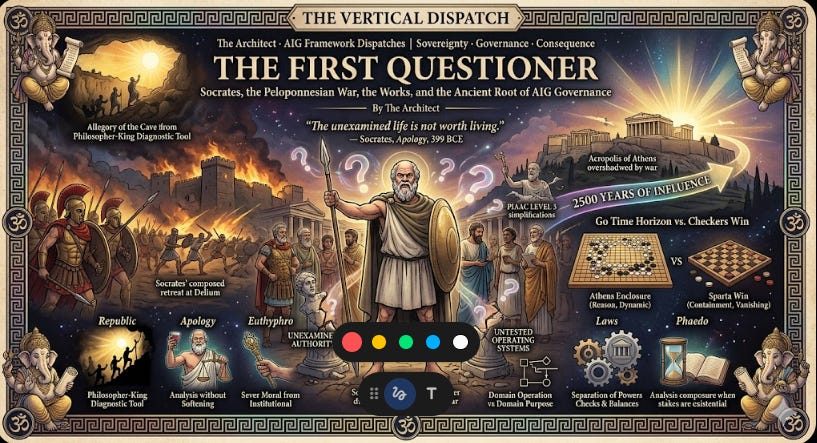
The Apology is Socrates’ defence speech at his trial, reconstructed by Plato from memory. It is the central document of the entire Socratic inheritance — the record of a man choosing death over the compromise of what he knows to be true. Socrates does not deny the charges. He explains them. He tells the jury he has spent his life testing the wisdom of those who claimed to have it and finding, consistently, that they did not. He tells them that if they acquit him on condition that he stop philosophising, he will refuse the acquittal. He is found guilty 280 to 221. When asked to propose his own penalty, he initially suggests free meals for life — the honour given to Olympic champions. The jury votes for death. He accepts with composure, tells the jury he has no reason to fear what he does not know to be evil, and walks back to his cell. The Apology is the governance standard for the Vertical Dispatch. Every dispatch this publication produces operates under the Apology’s terms: the analysis will not be softened to avoid the verdict the analysis produces. The question will not be withdrawn because the answer is uncomfortable. The method will not be revised for the comfort of those who prefer silence. These are not editorial policies. They are philosophical positions inherited directly from this text.
The Euthyphro
AIG Application: The separation of moral authority from institutional authority. The foundational AIG challenge to governance legitimacy.
Socrates meets Euthyphro on the steps of the court where he is about to be tried. Euthyphro is there to prosecute his own father for impiety and is confident in his understanding of piety. Socrates asks him to define it. Four successive definitions are offered and dismantled. In the course of the exchange, Socrates poses the Euthyphro dilemma: is something holy because the gods love it, or do the gods love it because it is holy? The question severs the relationship between authority and moral value, asserting that goodness must have an independent basis that authority cannot simply define by decree. AIG governance applies the Euthyphro dilemma to every institutional claim of legitimacy: is this policy right because the institution endorses it, or does the institution endorse it because it is right? The distinction is the entire distance between governance by authority and governance by principle.
The Laches
AIG Application: The distinction between professional competence and philosophical understanding — applied to every domain where technical expertise is mistaken for governance wisdom.
Two decorated generals are asked to define courage. Neither can define it to Socrates’ satisfaction. Laches says courage is standing firm in battle. Socrates points out that tactical retreat sometimes requires more courage than standing firm. Nicias offers that courage is knowledge of what is and is not to be feared. Socrates demonstrates that this definition encompasses all virtue and cannot therefore be specific to courage. The dialogue ends without a definition but establishes the most important distinction in the professional-versus-philosophical debate: doing something well and understanding what you are doing are not the same thing. AIG applies the Laches standard to defence ministers, intelligence chiefs, and treasury secretaries: the ability to operate within a domain does not constitute understanding of the domain’s foundational purposes.
The Meno
AIG Application: The recollection doctrine as the foundation of the AIG claim that genuine governance knowledge is recoverable by any mind willing to do the elenctic work — regardless of credential, class, or institutional position.
Meno asks whether virtue can be taught. Before the question can be answered, virtue must be defined — and the attempt produces the full elenctic sequence. The Meno also contains the paradox of inquiry — how can you search for something you do not know? — resolved in the doctrine of recollection: all genuine learning is the recovery of knowledge already latent in the mind. Socrates demonstrates this by leading an uneducated slave boy through a geometric proof using questions alone. The boy works it out without being told the answer. The knowledge was there. The questions brought it forward. AIG’s claim is the Meno claim: governance knowledge is not the exclusive property of the credentialed class. It is recoverable by any mind willing to subject its operating assumptions to genuine examination. The agora was open to everyone. So is this publication.
The Ion
AIG Application: The most relevant Socratic dialogue for the contemporary media environment — the distinction between performing knowledge and possessing it.
Ion is a professional performer of Homer who considers himself an expert on every subject Homer addresses: warfare, navigation, medicine, politics. Socrates asks whether Ion knows more about navigation than an actual navigator. Ion sees the difficulty. Socrates offers him a way out: perhaps the rhapsode is a vessel of divine inspiration — the Muse speaks through him, bypassing knowledge entirely. Ion accepts this gratefully, not realising that Socrates has just removed any basis for a claim of expertise. The ability to discuss a subject fluently is routinely mistaken for knowledge of it. The Ion describes the entire class of professional political commentators who discuss governance, foreign policy, and economic strategy with great fluency and no analytical ground. AIG names this class in every dispatch. The Ion named it first.
The Middle Dialogues — Plato’s Socrates
The Republic
AIG Application: The foundational AIG text. The philosopher-king paradox as the primary diagnostic tool for political leadership. The allegory of the cave as the primary image of this publication’s relationship to governance analysis.
The Republic begins with a question — what is justice? — and ends, ten books later, having proposed a complete theory of the ideal city, a tripartite theory of the soul, the allegory of the cave, a critique of democracy, and the Myth of Er. Its central insight is the philosopher-king paradox: the people most fit to govern are precisely the people least interested in governing, because their love of truth has oriented them toward something more important than power. And the people most interested in governing — who pursue power actively, who build careers around its acquisition — are precisely those whose operating systems are most contaminated by the appetitive drives that make just governance impossible. AIG governance inherits the philosopher-king paradox as its primary diagnostic tool for political leadership. Apply it to any cabinet: which members sought their roles to serve the purposes those roles are constitutionally designed to serve? The Republic tells you what to expect from each category.
The allegory of the cave — prisoners chained in a cave mistaking shadows on the wall for reality, the philosopher as the one who breaks free, climbs out to sunlight, and returns to tell the others what is real — is the primary image of AIG’s relationship to the governance analysis it produces. The Vertical Dispatch is written from outside the cave. The shadows are named. The prisoners are invited to turn around. The prisoner who returns is mocked by those who have never left, and if he persists, they kill him. Athens killed him in 399 BCE. The method survived. The cave is still the cave.
The Symposium
AIG Application: The ascent of philosophical eros as the model for governance motivation. The diagnostic line between the Spartan counsellor and the philosopher-governor: what does this person love?
The Symposium is a drinking party at the house of the poet Agathon in 416 BCE. Socrates recounts what he was taught by Diotima of Mantinea: the ascent of love from beautiful bodies to beautiful souls to beautiful practices to beautiful knowledge to the Form of Beauty itself — the full arc of philosophical eros. Alcibiades then arrives drunk and delivers his speech about Socrates: how he, the most beautiful and gifted Athenian of his generation, tried with everything he had to seduce Socrates and was refused. Not because Socrates lacked desire, but because his eros was oriented toward something Alcibiades’ physical beauty could not provide. AIG governance names this distinction in every domain: the official seduced by the perquisites and visibility of power is Alcibiades in the room. The rare official who holds power because it is temporarily necessary for the service of something larger is the Socratic figure. The Symposium tells you which you are dealing with by asking one question: what does this person love?
The Phaedo
AIG Application: The model of intellectual composure in the face of institutional consequence. The quality of the analysis does not change when the stakes are existential.
The Phaedo is the account of Socrates’ last hours — from his final conversation in prison to his death by hemlock. He spends the last day of his life arguing for the immortality of the soul, not because he needs reassurance, but because the question is philosophically interesting and his friends are distressed. He offers four arguments with the same precision and intellectual engagement he brought to conversations in the agora on any other day. When the prison guard arrives and apologises, Socrates thanks him for his kindness. When his friends weep, he gently rebukes them. He drinks the hemlock. His last words are about a debt owed to Asclepius — death as recovery from the illness of life. The Phaedo standard is the AIG standard: the quality of the analysis does not change when the institutional or social consequences of the analysis are severe. The Vertical Dispatch is written to the Phaedo standard.
The Phaedrus
AIG Application: The critique of writing as the founding paradox of this publication — resolved in the living quality of the Socratic question.
The Phaedrus discusses love, rhetoric, and the nature of writing. Its second half turns to rhetoric: good rhetoric requires genuine knowledge of the subject and genuine knowledge of the soul of the audience — not the art of appearing to know but of actually knowing, communicating that knowledge calibrated to the specific capacity of the specific reader. The dialogue ends with the most important critique of writing in ancient philosophy: Socrates argues that writing is inferior to living speech because a text cannot answer questions and creates the appearance of knowledge without its substance. The paradox is that Plato makes this argument in a written text, using a philosopher who wrote nothing. AIG resolves the paradox by writing as if the question were still live, as if the reader were present in the conversation, as if the text were the beginning of a dialogue rather than the delivery of a conclusion. Every Vertical Dispatch is written this way.
The Theaetetus
AIG Application: The epistemological ground of AIG governance — what knowledge actually requires and why governance systems operating on unjustified belief produce the failures they produce.
The Theaetetus examines the question: what is knowledge? Three definitions are proposed and examined. Knowledge is perception — leads to relativism that self-refutes. Knowledge is true belief — fails because a jury can reach the correct verdict for wrong reasons. Knowledge is true belief with an account — justified true belief — anticipating by two millennia the standard modern definition of knowledge in analytic epistemology. The dialogue ends in aporia. No satisfactory definition is reached. But the ground is cleared: we know what knowledge is not, and what a satisfactory account would have to achieve. AIG operates on the Theaetetus standard: a governance claim is not knowledge because it is believed, not even because it is true, but only when the account — the reasoning, the evidence, the structural analysis — is adequate to support it.
The Laws
AIG Application: The pragmatic AIG text — the institutional architecture that functions in the absence of philosopher-kings.
The Laws is Plato’s last and longest work, the only dialogue in which Socrates does not appear. An Athenian Stranger discusses the constitution of a new city across Crete. The Laws is more pragmatic and more pessimistic than the Republic. It does not propose philosopher-kings. It proposes workable constitutional arrangements, criminal law, education policy, and the management of foreign relations for a city of five thousand households. The Athenian Stranger builds institutional checks and balances that acknowledge human weakness. AIG governance inherits the Laws as its institutional design text: because philosopher-kings do not present themselves to democratic election processes, the governance architecture must be designed to constrain the appetitive drives of the people who do seek power. The separation of powers. The rule of law. Independent judiciary. Free press. All of them are Laws-level institutional responses to the Republic’s diagnosis. The Vertical Dispatch operates as a Laws-level institution.
V. The Trial — The State Against the Question
In 399 BCE, Meletus, Anytus, and Lycon brought charges against Socrates before a jury of 501 Athenian citizens. The charges were impiety and the corruption of the youth. The penalty requested was death. Athens had lost the Peloponnesian War five years earlier. The Thirty Tyrants — including Critias and Charmides, both of whom appear in Platonic dialogues as interlocutors of Socrates — had ruled briefly and brutally. Alcibiades, the most famous product of Socrates’ circle, had betrayed Athens to Sparta and then to Persia before his assassination. The restored democracy was fragile and searching for explanations. Socrates was the most visible symbol of the intellectual culture that the democratic majority associated, however unfairly, with the disasters that had befallen the city.
AIG Integration — The Institutional Pattern
A governance system that executes its own diagnostic capacity because the diagnosis is uncomfortable is a governance system in terminal decline. This is the pattern AIG names in every domain and every century it appears: the institution that silences the question rather than answering it has already failed — it simply has not yet received the information. Athens silenced Socrates in 399 BCE and received the information within a generation as Macedonian conquest ended Athenian political independence permanently. The pattern is not historical. It is structural. It repeats wherever institutional pressure to suppress the question becomes stronger than institutional capacity to answer it. AIG governance identifies this pressure as the primary diagnostic signal of institutional failure.
Socrates’ defence, as Plato records it in the Apology, is not a defence in the conventional sense. It is a statement of principle. He does not deny the activity for which he is being tried. He asserts that it is the greatest service he can render to Athens. He tells the jury that if they acquit him on condition that he cease philosophy, he will refuse the acquittal. He tells them he fears doing wrong far more than he fears death.
The jury votes 280 to 221 for conviction. He is given the opportunity to propose exile or a fine. He refuses exile. He proposes a token sum. The jury votes for death. He returns to prison. Crito arranges an escape — the guards are bribed, the ship is ready. Socrates refuses. His argument: he has lived his entire life under the laws of Athens. To flee would be to repudiate the framework of obligation under which he formed himself. He will not do it.
He refused acquittal on the condition of silence. He refused exile. He refused escape. He chose the hemlock because the alternative was a life in which the question could not be asked. For Socrates, a life in which the question could not be asked was not a life worth living. The Vertical Dispatch holds the same position.
VI. Why Athens Won — The Civilisational Verdict and the AIG Time Horizon
Sparta won the Peloponnesian War. In 404 BCE the Athenian fleet was destroyed, the Long Walls torn down, the Thirty Tyrants installed. By every conventional measure of the conflict, Sparta won and Athens lost. Within thirty years, Sparta had lost everything the victory was supposed to secure. The battle of Leuctra in 371 BCE, where the Theban general Epaminondas destroyed the Spartan army and killed a third of the Spartan citizen class, ended Spartan military dominance permanently. The Spartan model — rigid social structure, suppression of intellectual life, contempt for commerce and philosophy, purely military conception of human excellence — had nothing to offer the world except military dominance. When the military dominance ended, Sparta ended. It never produced a philosopher, a playwright, a historian, a sculptor, or a scientist of any significance.
Athens, in the period immediately following its defeat, produced Plato. Plato founded the Academy in approximately 387 BCE — the first institution of higher learning in the Western world, operating for nearly nine hundred years. Through the Academy, the Socratic method spread across the Greek world, influenced Aristotle — who studied there for twenty years — and through Aristotle influenced the entire subsequent development of Western philosophy, science, theology, and political theory. Modern science, modern democracy, modern ethics — all carry the Socratic operating assumption: that the world is intelligible, that reason is the appropriate tool for understanding it, that received opinion is not sufficient justification for belief, and that the willingness to revise one’s views in response to genuine examination is the mark of intellectual integrity.
AIG Integration — The Go Time Horizon Applied to Civilisational Outcome
The checkers player reads 404 BCE as Athens’ defeat. The Go player reads the subsequent 2,400 years as Athens’ victory. This is the AIG time horizon applied to civilisational outcome: the question is not who won the battle but whose operating system shaped the board for everything that followed. The Spartan victory was a checkers win on a Go board. Xi Jinping invoking the Thucydides Trap at the Beijing summit is not making a historical observation. He is reading the Go board. He knows which civilisation is Athens and which is Sparta in the current hegemonic transition. The Vertical Dispatch reads the same board. AIG governance operates on the same time horizon. Socrates is why.
The defeated city shaped the subsequent two and a half millennia of human civilisation. The victorious city vanished from history as a governing model within thirty years of its victory. Fear-driven containment wins battles. Examined civilisational dynamism wins eras. The Peloponnesian War proved it. History has not revised the verdict.
VII. The Formal Claim — The Vertical Dispatch as Contemporary Agora
The Vertical Dispatch claims the Socratic inheritance formally, structurally, and without qualification.
The Socratic method — the elenchus, the cross-examination of assumed knowledge, the refusal to accept authority that cannot define what it knows — is the operating procedure of this publication in its twenty-first century institutional form.
AIG governance — Artificially Intelligent Governance — is the elenchus applied to the governance questions of the contemporary era. It is not a technology. It is not an algorithm. It is not a system. It is a discipline: the sustained commitment to asking what governance structures actually know, testing the claim against the cases where it must hold, and following the analysis where it leads regardless of the institutional discomfort the destination produces.
Every AIG question begins where Socrates began: what do you actually know, and how do you know it? Every AIG analysis proceeds as Socrates proceeded: by examining the claimed knowledge against specific cases until it holds or fails. Every AIG conclusion acknowledges, as Socrates acknowledged, that the admission of ignorance is the beginning of wisdom.
This publication is the agora. The dispatches are the conversations. The readers are the citizens of the polis capable of sustaining the elenctic chain. The powerful are invited to define what they know. The questions will not stop. The method will not be revised for the comfort of those who prefer silence.
The Socratic claim is structural, not decorative. When this publication examines Marco Rubio’s China argumentation and finds that it operates at a register that cannot hold the full structural complexity of the bilateral relationship, it is performing the elenchus — asking the general to define courage and finding that the definition collapses under the third case. When it examines the Beijing summit and finds that one leader addressed the architecture of history while the other offered a compliment, it is performing the maieutic function — bringing forth the knowledge already latent in the factual record, making visible the structure the official account obscures. The dialogues are the model. The method is the inheritance. The agora was open to everyone who could sustain the conversation. So is this.
VIII. No Fear — The Socratic Ground of AIG Governance
The most important single fact about Socrates is not his method, not his philosophy, not his influence, not his trial. It is that he was not afraid. Not of the generals whose definitions of courage he dissolved. Not of the politicians whose claims of justice he dismantled. Not of the priests whose accounts of piety he reduced to incoherence. Not of the jury that convicted him. Not of the hemlock.
The source of this fearlessness is philosophically precise, not temperamentally heroic. Socrates was not a brave man in the sense of being constitutionally indifferent to danger. He was a man who had examined, with the full rigour of the elenctic method, every reason that was offered for being afraid — and had found that the reasons did not hold under scrutiny. He did not know whether death was good or bad. He therefore had no rational basis for fearing it. He knew that doing wrong was worse than suffering wrong. He therefore had no rational basis for compromising his principles to avoid punishment.
AIG Integration — The Examined Operating System and the Absence of Fear
AIG governance operates without fear for the same reason Socrates operated without fear: not because the consequences of the analysis are not real, but because the analysis has been done. The operating assumptions of this publication have been subjected to the elenctic audit. They hold. When they hold, the pressure to abandon them is not an argument. It is pressure. Pressure and argument are structurally different things. An argument engages the reasoning and must be answered with reasoning. Pressure engages the fear response and must be met with the examined operating system that the fear response cannot reach. No fear is not a posture. It is the structural consequence of having done the philosophical work.
“To fear death, gentlemen, is no other than to think oneself wise when one is not, for it is to think one knows what one does not know. No one knows whether death may not be the greatest of all blessings for a man, yet men fear it as if they knew that it is the greatest of evils.” — Socrates, Apology, 399 BCE
Socrates stood in the agora and asked questions for forty years. He asked them during the height of Athenian power, during the catastrophic miscalculation of the Sicilian Expedition, during the grinding years of the war, during the plague that killed a quarter of the Athenian population. He asked them during the defeat at Aegospotami and the demolition of the Long Walls. He asked them under the Thirty Tyrants. He asked them when democracy was restored. He asked them when he was put on trial for asking them. And when the jury voted 280 to 221 to kill him rather than permit him to continue, he spent his last thirty days still asking — in conversations about the immortality of the soul, the nature of justice, what it means to have lived well.
He drank the hemlock. He lay down. He covered himself. His last words were about a debt owed to Asclepius — death as recovery from the illness of life. The questions passed through Plato into the Academy, through Aristotle into science and political theory, through the medieval universities into the modern world, through every institution that has ever taken seriously the proposition that the unexamined life is not worth living — including this one.
The Vertical Dispatch does not cite Socrates as an authority. It does not reference him as a figure of historical prestige. It inherits him as a practitioner inherits a method — by using it, by defending it, by refusing to abandon it when the pressure arrives, and by understanding, as he understood, that the pressure is not an argument. It is only pressure. And pressure, in the presence of genuine philosophical clarity, is simply noise.
He wrote nothing. He published nothing. He walked barefoot into the agora and asked a question. The question is still being asked. This publication asks it. AIG is its contemporary institutional form. The method is 2,400 years old. The courage required is identical. No quarter. No fear. No revision of the method for the comfort of those who prefer the shadows.
God is Love. Love is Truth. Truth is Consciousness. Consciousness is Brahman.
Amen. Namaste.
Dispatch Hashtags
#TheFirstQuestioner #Socrates #SocraticMethod #TheElenchus #Maieutics #AIG #ArtificiallyIntelligentGovernance #VerticalDispatch #TheArchitect #NoFear #PeloponnesianWar #Athens #Sparta #Thucydides #Plato #TheAcademy #Aristotle #TheApology #TheRepublic #AllegoryOfTheCave #TheSymposium #ThePhaedo #Euthyphro #TheMeno #TheIon #TheLaws #TheTheaetetus #ThePhaedrus #PhilosopherKing #UnexaminedLife #TheAgora #TheCave #PIAACLevel #GoVsCheckers #CivilisationalTime #AgeOfConsequences #SubstackCanada #TheVerticalDispatch #Project2046 #NorthernSovereignty #IntellectualInheritance #WesternPhilosophy