

There is a number sitting inside a federal report released in December 2024 that should be stopping conversations cold in every AI boardroom, every computer science faculty, and every LinkedIn post celebrating the democratization of artificial intelligence.
It isn’t.
So let us look at it directly.
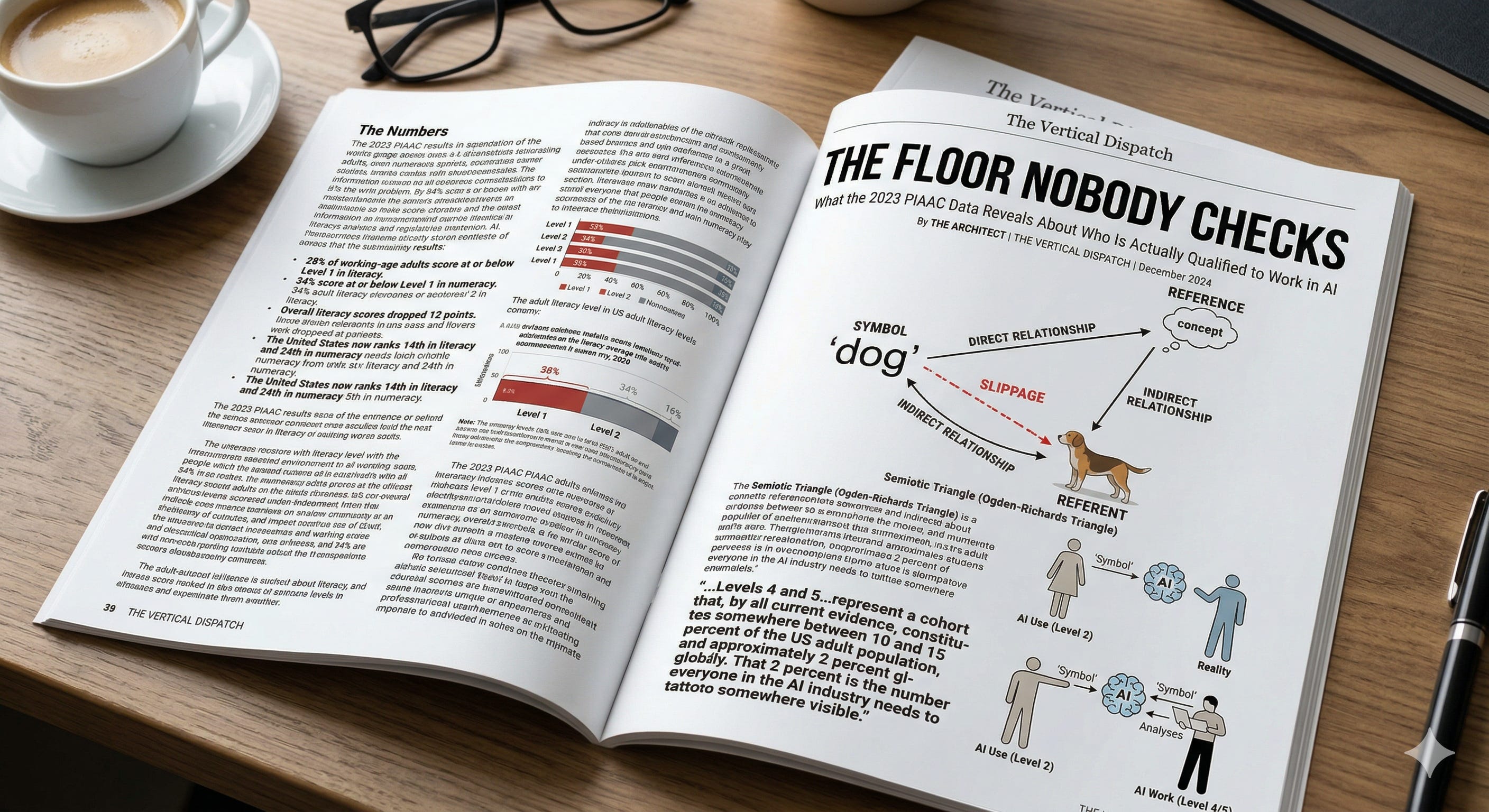
The Numbers
The 2023 PIAAC — Programme for the International Assessment of Adult Competencies, administered by the OECD and conducted in the United States by the National Center for Education Statistics — delivered its results in December 2024. The data was collected between August 2022 and June 2023 from adults ages 16 to 65 across the United States.
Source for all statistics in this section: NCES Press Release, December 10, 2024, “Highlights of the 2023 U.S. PIAAC Results.” Publication number 2024202. Available at nces.ed.gov/surveys/piaac.
In the United States, as of 2023:
— 34% of working-age adults score at or below Level 1 in literacy. Up from 29% in 2017.
— 34.2% score at or below Level 1 in numeracy.
— Overall literacy scores dropped 12 points between 2017 and 2023. Numeracy dropped 7 points.
— The United States ranks 14th in literacy out of 31 OECD participating nations.
— The United States ranks 25th in numeracy out of 31 OECD participating nations.
— 32% of US adults scored below baseline proficiency in adaptive problem solving.
The NCES Commissioner summarized the situation with unusual candor: “There is a ‘dwindling middle’ in the U.S. in terms of skills. Over time, we’re seeing more Americans clustered at the bottom levels of proficiency. The result has been a widening skills gap between adults at the higher and lower skill levels compounded by a growing number of very low-skilled adults. In fact, the U.S. gap in numeracy between the highest and lowest skilled adults is the widest among all countries.”
Now here is the critical piece most coverage omits.
Level 3 is not high. Level 3 is the OECD’s defined threshold for adequate participation in contemporary society. It is the floor of functional citizenship, not the ceiling of intellectual capacity. Levels 4 and 5 — the domain of genuine analytical synthesis, the ability to evaluate, integrate, and reason across complex and sometimes contradictory material — represent a small minority of the adult population. That minority is the cohort capable of detecting when a symbol has been severed from its referent. And that cohort, by the trajectory this data describes, is not growing.
The direction is the part that should stop people cold. Between 2017 and 2023, the low-performing cohort grew by five percentage points. That is not drift. It is structural movement in a single direction. And the trend was present before 2020. COVID accelerated something already underway.
Not Deficient — Vulnerable
Before going further, one distinction must be held clearly throughout everything that follows.
Level 1 and Level 2 readers are not stupid.
Cognitive capacity and literacy level are not the same thing. Literacy is a developed skill, shaped by educational access, economic circumstance, language background, and systemic investment — or the lack of it. Many people operating at Level 1 or 2 are intelligent, experienced, resourceful, and capable of sophisticated practical judgment in domains they know well.
What they are is structurally vulnerable to specific manipulation techniques that higher-level readers can detect and deflect. This is not a character failing. It is a measurable gap in a specific cognitive tool — the ability to track the relationship between a symbol, its meaning, and the reality it claims to represent.
That gap is the most valuable real estate in modern politics.
And it is being mined.
Symbol, Reference, Referent: The Triangle Nobody Teaches
In 1923, C.K. Ogden and I.A. Richards published The Meaning of Meaning, in which they formalized what has since been called the semiotic triangle. The three terms are:
Symbol — the word, the token, the sign.
Reference — the concept, the mental image evoked by the symbol.
Referent — the actual condition in the world the symbol is meant to represent.
The critical insight is that the relationship between symbol and referent is indirect. The symbol does not point directly at the thing. It points at the reference — the internal representation — which then points at the thing. This means there is always a potential gap between what a word means and what it refers to.
Most people navigate this gap adequately for daily purposes. But language can be engineered to exploit that gap rather than bridge it. And that engineering is now running at industrial scale — on the right, on the left, and in every algorithm built to maximize engagement.
The Manipulation Architecture: Both Directions
The right-wing media ecosystem has been optimized, whether by design or natural selection, for lower-level processing. Repeated assertion replaces demonstrated fact. Symbols are deliberately detached from referents — “deep state,” “stolen election,” “open borders” — kept abstract so they can absorb any evidence without being challenged by it. At higher literacy levels you notice the absence of a referent. At lower levels the symbol is the meaning.
Intellectual honesty requires the same analysis applied with equal force to the left. “Systemic racism,” “decolonize,” “lived experience as epistemology” — these began as analytical tools pointing at real and measurable conditions. Over time they became identity markers, tribal flags rather than analytical instruments. To question the referent is to be accused of denying the symbol’s legitimacy. The epistemological operation is identical.
Both systems exploit the same literacy vulnerability. The mechanism is identical. Only the tribal flag changes.
Division by ignorance is not a side effect of the platform economy. It is a load-bearing feature.
What This Has to Do With AI
There is a difference between using AI and understanding AI. And that difference is not primarily technical. It is linguistic and semiotic.
A large language model has symbols. It has extraordinarily rich statistical relationships between symbols. What it does not have is a referent. There is no world on the other side of the model’s tokens. There is pattern. There is correlation. There is a sophisticated map of how symbols relate to other symbols.
The territory is absent.
This is not a flaw to be fixed in the next version. It is a structural condition of the architecture. Every person working with AI — not just researchers but product managers, policy writers, educators, healthcare administrators, governance architects — needs to understand at a working level the difference between a model that processes symbols and a mind that refers to reality.
Without that understanding you cannot evaluate what the model is actually doing. You cannot identify hallucination — which is precisely the generation of a plausible symbol sequence with no coherent referent. You cannot govern it. You cannot audit it.
The same literacy gap that makes a population vulnerable to political propaganda makes it vulnerable to AI-generated misinformation. The mechanism is identical. Plausible symbol sequences, severed from referential grounding, delivered with surface fluency.
The population most susceptible to AI hallucination as fact is growing.
The population capable of detecting that hallucination is shrinking.
This is the scissors movement the AI industry is not discussing.
The Deeper Implication
A civilization that cannot maintain its symbolic competence — that loses its capacity to track the relationship between the word and the world — becomes progressively unable to govern the symbolic systems it builds.
AI is a symbolic system of unprecedented scale, speed, and surface plausibility. The propaganda machine and the AI machine are not separate problems with separate solutions. They are the same problem at different scales — both exploiting the gap between symbol and referent in a population that has been systematically undertrained to detect that gap.
The symbol proliferates. The reference drifts. The referent recedes.
And in the space between the symbol and the world, governance has to live.
The question is whether enough people can read that space clearly enough to do the work.
The data, as of December 2024, does not encourage complacency.
Source: “Highlights of the 2023 U.S. PIAAC Results,” National Center for Education Statistics, December 10, 2024. NCES Publication 2024202. nces.ed.gov/surveys/piaac
Glennford Ellison Roberts Author — Sacred Metaphysics & Consciousness: History of the Absolute & Eternal Cumberland, Ontario, Canada
God is love. Love is truth. Truth is consciousness. And consciousness is balance. Amen. Namaste.. 🙏
#PIAAC2023 #LiteracyData #USAdultLiteracy #NumeracyScores #FunctionalIlliteracy #SkillsGap #DwindlingSkills #Level1Literacy #Level2Literacy #Level4_5Literacy #AnalyticalSynthesis #OECDData #NationalCenterForEducationStatistics #NCESCommissioner #CriticalThinking #LiteracyVulnerability #CognitiveGap #SemioticTriangle #OgdenRichards #SymbolMeaningReality #LanguageEngineering #MediaManipulation #RightWingMedia #ProgressiveMedia #SystemicIssues #CulturalDivision #PlatformCapitalism #BillionaireInterests #EngagementOverComprehension #AIDemocratization #AIGovernance #AISafety #LargeLanguageModels #SymbolWithoutReferent #ModelVsMind #AIWorkforce #QualificationGap #PromptEngineering #AIProductManager #AIEthics #AI_Hallucination #symbolicCompetence #CivilizationSkills #VerticalReading #SymbolProliferation #GovernanceChallenge #TheArchitect #TheVerticalDispatch #UrgentConversations