

Φ
THE VERTICAL DISPATCH
We write for the mind, the eye, and the ear.
Read it. Look at it. Listen to it. The Vertical Dispatch is built for all three — prose with rhythm, made to be heard as much as read.
From metaphysics to geopolitics, from culture to history, from the sacred to the street — and everything in between. One lens, every subject. No ego. Just the record, named clean.
Press play. Walk with the word. 🕯️
This dispatch travels by hand. If it serves you, share it — restack on Substack, and pass it on wherever you read. 🕯️
Sacred Metaphysics · The Departure Lounge
June 25, 2026
“For the good that I would I do not: but the evil which I would not, that I do.”
— Romans 7:19
Paul wrote the truest sentence ever set down about the human condition, and he wrote it as a confession, which is the only honest way to write it. The good that I would, I do not; the evil that I would not, that I do. Read it slowly. It is not a complaint about other people. It is a man turning the lamp on himself and reporting, without a lawyer, what he finds: that he is two. That there is in him one who wills the good and another who does the opposite, and that the second one wins more often than the first would ever admit at the dinner table. Every tradition that has ever taken the soul seriously begins here, at this fracture, because there is no spiritual life that does not start with the discovery that you are divided against yourself.
This is a teaching of sacred metaphysics, and it descends from two pieces this lounge has lately set down — one on the tenant of hate you must refuse at the gate of your heart, one on how both hate and love are learned. Those pieces asked you to feel the despising of a wrong and yet refuse the hate, both at once, all the way down. And a reader, fairly, asked the question underneath: what is it that does the refusing? What stands at the gate and turns the tenant away? The answer is a single faculty, the oldest the soul owns, and it has a name the modern world has nearly forgotten how to say without embarrassment. The name is virtue. And the act of virtue, stripped to its bone, is the freedom to say no.
The Walking Contradiction
Stay a moment longer with Paul’s sentence, because it is more than a confession — it is the whole of metaphysics in a single line, and I do not say that lightly. To will the good and do the evil is not Paul’s private failing. It is the structure of every being born into form. Contradiction is the condition of the embodied soul: the one who wants and the one who acts, the eternal and the appetite, housed in one trembling frame and rarely agreeing. The verse is the cleanest prose ever written about what it is to be a creature — because to be a creature is to be a contradiction that walks. That is the phrase I have come to use, and I use it about myself first: I am a walking contradiction. So are you. So is everyone who has ever drawn breath in a body.
And here is what that does, which is the most generous thing a single recognition can do. When I look at another person — any person, the one I admire and the one I cannot stand — and I see the walking contradiction in them, I am not ranking them. I am recognizing them. I am seeing myself. The man who knows his own fracture cannot stand above another’s, because he is looking into a mirror. This is the highest reading there is, and it has nothing to do with the decoding of a page: it is the living, real-time seeing of the contradiction in yourself and in the one across the table, held open from the moment you wake to the moment you close your eyes. It is awareness wearing work boots. And it is the ground of every mercy, because you cannot truly forgive what you have not first recognized in yourself — and the contradiction, once you see it plainly in the mirror, you can no longer pretend is only ever in them.
Vice Is the Problem
Begin where the trouble begins. Vice is not, first of all, the dramatic sin — the theft, the betrayal, the cruelty. Those are its late fruit. Vice, at the root, is simply being moved. It is the condition of the boat with no keel, turned by whatever wave happens to strike it: the appetite that pulls and is obeyed, the ego that is stung and lashes out, the desire that whispers yes and is never once told no. The drink you did not need and took anyway because your friends were taking theirs. The grudge nursed past all reason because letting it go felt like losing. The flattery swallowed whole because it tasted of the thing you most wanted to believe about yourself. Vice is the self being steered by its own hungers, and it wears a thousand faces, and not one of them is the face of freedom — though every one of them feels, in the moment, exactly like freedom. That is the lie at the centre of it. The yes feels free. The yes is the chain.
And it is not the property of one sex, so let us be honest at the table, men and women both, because the lounge does not let anyone off. The man flattered into the bed that was not his to enter, and the woman who set the trap of that flattery knowing the ring on his hand. The wife who keeps the cold ledger of every slight and calls it memory, and the husband who calls his silence strength when it is only cowardice wearing a better coat. The vanity that spends an hour on the mirror and the vanity that spends it on the resume. The appetite for the body, the appetite for the last word, the appetite to be right, to be admired, to be envied, to be soothed. Vice is human before it is anything else, and it is evenly distributed, and the first act of any honest spiritual life is to stop pointing across the table and turn the lamp on your own plate.
The Freedom to Say No
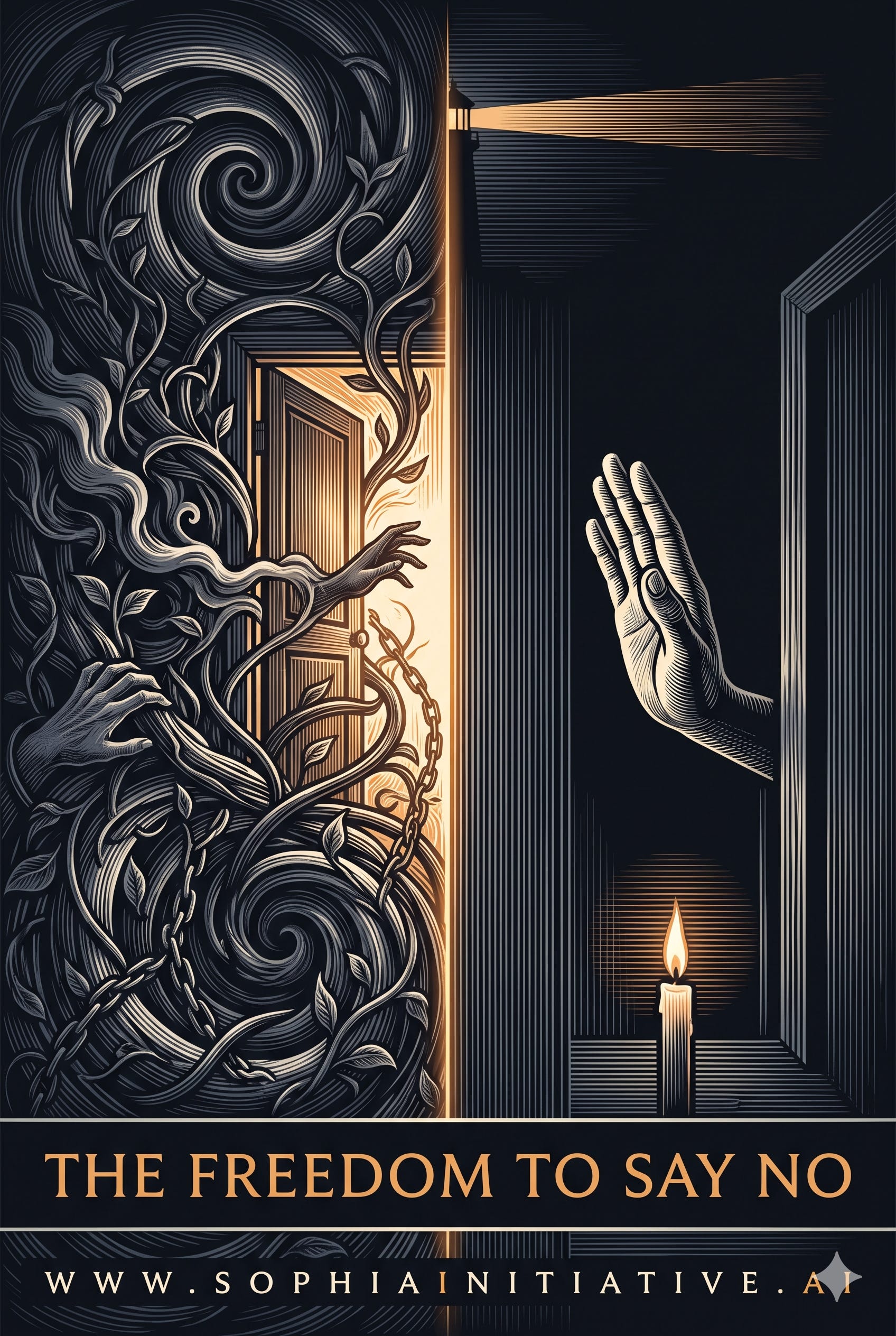
Here, then, is the whole of the teaching, and it can be said in a single line: the only freedom that is truly yours is the freedom to say no. Anyone can say yes. The yes requires nothing — no strength, no self, no keel. To say yes to the drink, the bed, the grudge, the ego, the easy pleasure, is not an act of freedom at all; it is the absence of one. It is being carried. But the no — the no to the thing you genuinely want, for the sake of the thing you have bound yourself to — that is the act of a free man, because he is the one steering and not the one steered. The appetite is the wave. The no is the hand on the tiller. And the man who can hold that tiller against a wave he feels in his whole body is the only free man there is. Everyone else is just going where the water goes.
Notice what kind of freedom this is, because it is the strangest in the world: it is the one freedom no one can take from you, and the one no one can give you. A tyrant can take your liberty, your property, your life. He cannot take your no. Epictetus knew this from inside a slave’s body — that some things are up to us and some are not, and that the whole of our freedom lives in the narrow, unconquerable room of the things that are: our own assent, our own refusal. They can chain the body. The no is yours. And by the same token, no one can hand you this freedom either — no law, no wealth, no office confers it. It is built only one way, by exercise, by saying the small no ten thousand times until the muscle is real. It is the only freedom you must earn, and the only one no one can steal.
The Virtue of Courage
And the name of the muscle is courage. We have shrunk that word down to the battlefield, to the soldier and the fire, but the old traditions knew it was larger than that. Courage is the virtue that holds the line when everything in you wants to break it — and the hardest line to hold is not the one in front of the enemy but the one in front of your own desire. It takes a kind of courage to die well. It takes the same courage, in smaller coin, paid daily, to say no to the open door when the house is empty and no one would ever know. The temperance the ancients praised — self-mastery, the senses made servant instead of master — is not a cold thing, not the absence of fire. It is courage standing watch over appetite. It is the charioteer holding the reins of horses that genuinely want to bolt.
And here is the keel of it, the thing that separates the free man from the merely cold one, and the Gita says it more precisely than I can. Krishna does not tell the seeker to flee the world or kill his desire. He says the self-controlled man moves among the objects of the senses, free from both craving and aversion, his senses his servants and not his masters, and so attains peace. Moves among them. Not away from them. The freedom is not in feeling nothing — the man who feels nothing has not conquered the wave, he has only never been to sea. The freedom is in feeling the full pull of the thing and steering anyway. The married one’s no to the open door is not contempt for desire; it is fidelity to a vow, which is desire felt in full and governed. That is where the courage lives — not in not-wanting, but in wanting, and saying no, and meaning it.
The Watch at the Gate
Now return to the question those two earlier pieces left open. What stands at the gate of the heart and refuses the tenant of hate? This. This same faculty, this same no. The watch you keep over your own heart — turning away the hatred even when the despising is justified, even when every nerve says let it in — is the freedom to say no, exercised on the subtlest appetite of all: the appetite to hate, which is sweet, which feels like strength, which feels, like every vice, exactly like freedom while it fits the chain to your wrist. To despise the deed and refuse the hate is the same act as refusing the drink, the bed, the grudge, the ego. It is the no, kept at the gate, by the virtue of courage. The whole moral life is one muscle, and this is it.
So the order of the soul stands clear, and it runs only one way. Vice is the problem — the self steered by its hungers. Virtue is the solution — the self that has learned to hold the tiller. Freedom is not the yes that the world keeps selling; freedom is the no that no one can sell you. And the no is courage, and courage is the keel, and the keel is the one thing that lets a person glide safe over the wave instead of being rolled beneath it. My own father read a wave once without fear and set the boat at the angle that carried his people over it, and I have spent a life learning that every discipline of the soul is that same act in smaller water: the steady no to the easy turn, the hard line held, the appetite mastered so the people aboard come through. The good that I would, I do not — yes, Paul, still, every day. But the whole of the spiritual life is the slow closing of the gap between the will and the deed, one no at a time, until the man you are catches up at last to the man you meant to be.
The Bow
And what, in the end, separates the one who has begun this work from the one who has not? Not the contradiction itself — both are walking contradictions, and will be to the grave; the saint does not resolve the fracture, he only stops lying about it. The difference is the knowing. The yogi, the sadhu, the soul that has turned the lamp on itself, knows that it is divided, and that knowing is the whole of the difference — not because it lifts him above anyone, but because it lowers his eyes. The one still early in the long work of self-examination has not yet seen it; he still believes the contradiction lives only in others, across the table. And the one who knows does not hold this against him, for he remembers standing exactly there, and trusts that one day the other will see it too. That trust is itself a kind of love.
This is why we bow. When you look another soul in the eye and say Namaste — the divine in me bows to the divine in you — and they meet your eye and return it, something has happened that no transaction can counterfeit: two walking contradictions have, for one instant, each set down the pretense of standing above the other, and acknowledged at once both the fracture and the light behind it. That mutual bow is where the truest reading is taken — not in the interrogation, not in the scoring, but in the moment two people lower their eyes to one another and mean it. It is the contradiction-sight made flesh, formalized into a greeting older than any of us. And it is the only posture from which one divided soul can ever safely read another: not from above, looking down, but from the bow, looking across. Namaste, brother. The light in me sees the light in you. The fracture in me knows the fracture in you. And between those two recognitions, if we are very still, the reading comes.
God is Love. Love is Truth. Truth is Consciousness. Consciousness is Brahman.
Amen. Namaste. Om Namah Shivaya.
— The Architect.
The Vertical Dispatch
sophiainitiative.ai
On the record.
“For the good that I would I do not: but the evil which I would not, that I do” is Romans 7:19 (King James Version); the surrounding passage (7:15–25) is Paul’s account of the divided will. The teaching that one attains peace not by fleeing sense objects but by moving among them with the senses mastered — “free from both attraction and repulsion” (rāga and dveṣa) — is Bhagavad Gita 2.64; the rendering and the gloss that the senses become servant and not master follow the classical commentaries (Shankara and others). The distinction between what is “up to us” (our assent and refusal) and what is not is the foundation of Epictetus’ Enchiridion (c. 125 CE) and the Stoic discipline of desire; temperance as self-mastery is treated as a cardinal virtue across the classical and Christian traditions. The reading of freedom as the capacity to refuse, of courage as the virtue standing watch over appetite, and of the “watch at the gate” are the author’s own, developed from Universal Dynamics: I AM Logos and continuous with two prior Departure Lounge pieces on hate and love. The keel-image of the father reading the wave is the author’s own memory, told from love; first names only, and the memory of events governs the record. No living person is named. Date-stamped June 25, 2026. Verify scripture and commentary against primary sources before republication.
Suggested tags:
Sacred Metaphysics, Freedom, Courage, Virtue, Vice, Romans 7, Bhagavad Gita, Stoicism, Epictetus, Self-Mastery, The Departure Lounge
Substack Notes
THE FREEDOM TO SAY NO. Paul wrote the truest sentence ever set down about being human, and he wrote it as a confession: the good that I would, I do not; the evil that I would not, that I do. Every spiritual life begins at that fracture — the discovery that you are two, one who wills the good and one who does the opposite. New from The Departure Lounge: a teaching of sacred metaphysics on the one freedom no one can take and no one can give. 🕯️
VICE IS THE PROBLEM; VIRTUE IS THE SOLUTION. Vice is simply being moved — the boat with no keel, turned by whatever wave strikes it. The yes to the drink, the bed, the grudge, the ego: every one of them feels exactly like freedom while it fits the chain to your wrist. That is the lie at the centre of it. The yes feels free. The yes is the chain. And it is evenly distributed — men and women both, no one let off the hook.
THE NO IS COURAGE. The only freedom truly yours is the freedom to say no — the no to the thing you genuinely want, for the sake of the thing you have bound yourself to. Epictetus knew it from inside a slave’s body: they can chain the body, but the no is yours. The Gita names the rest: you do not flee the world or kill desire — you move among the objects of the senses and feel the full pull and steer anyway. That is courage. That is the keel. And it is the same watch you keep at the gate of your heart when you refuse the tenant of hate.
Written from love, in service of the record. Walk with the word. 🕯️
#TheFreedomToSayNo #SacredMetaphysics #Virtue #Courage #Romans7 #BhagavadGita #Stoicism #Epictetus #SelfMastery #TheDepartureLounge #TheVerticalDispatch #TheArchitect #SophiaInitiative #GodIsLove #LoveIsTruth #OmNamahShivaya
The reflections in this Dispatch are offered as spiritual and philosophical commentary, drawn from scripture and the classical traditions, for contemplation and discussion. Scriptural and philosophical interpretations are the author’s own. Readers should consult primary sources and their own conscience, and draw their own conclusions.
This writing is for the mind, the eye, the ear, and above all the soul. I appreciate the way you include the Bible and the Gita in your metaphysical writings. This piece is worth many re-readings. Thank you.
Sometimes I embed a hard piece in humour, eg we humans dont actually have that much free will, but we do have some free won’t ! And therein lies the path.
Raising our children, we impose those boundaries on them. Hopefully with constancy and care. As adults we must do this for ourselves.
But what in us discerns there is even a choice? The self that discerns or witnesses this choice is not the same kind or level of self that just blindly follows. Building this “higher awareness “ self is our human work. At first, we can feel quite special doing this. Spiritual pride. (Says one who’s done this 😉). Then we see that we’re all doing this, at different velocities, and the capacity to do so comes not from us. And starts who knows where.
In our current times, where oligarchs have not had a NO in a long time, we can see the damage this causes. Which makes our small daily self discipline even more important; keeping the patterns of our own keel going, embedding this deeply in the grooves of our universal trajectory