

Φ
THE VERTICAL DISPATCH
We write for the mind, the eye, and the ear.
Read it. Look at it. Listen to it. The Vertical Dispatch is built for all three — prose with rhythm, made to be heard as much as read.
From metaphysics to geopolitics, from culture to history, from the sacred to the street — and everything in between. One lens, every subject. No ego. Just the record, named clean.
Press play. Walk with the word. 🕯️
This dispatch travels by hand. If it serves you, share it — restack on Substack, and pass it on wherever you read. 🕯️
The Age of Consequences · Canadian Geopolitical Analysis
June 12, 2026 — the day Canada signed at the Élysée. Volatile facts date-stamped as of this day.
There are three words in Emmanuel Macron’s mind as he runs out the final stretch of his presidency. He gives the press the first. He keeps the second for himself. And the third — the one that explains what happened today at the Palais de l’Élysée — he has never said aloud, because a statesman operating at his level does not name his instruments. He deploys them.
The first word is legacy. Every president says it. It means nothing by itself. The second word is grandeur — de Gaulle’s word, the operating system of French republican civilization: the conviction, beneath arrogance, almost geological, that France has a specific and irreplaceable role in the architecture of human society. The third word is legitimacy. And legitimacy is the word that makes Canada the instrument, Carney the hand, and today’s signing the most consequential act in Canadian foreign policy that most Canadians will never hear explained. This dispatch explains it.
And Canada — without quite knowing it — has just become the hinge on which Macron’s final act turns.
PART ONE: WHAT MACRON BUILT, AND WHY HE IS RACING
On March 2, 2026, standing beside the nuclear submarine Le Téméraire at France’s submarine base at Île-Longue in Brittany, Macron delivered what the European Council on Foreign Relations called perhaps the most significant speech on nuclear policy by any Western leader since the end of the Cold War. He was not quoting de Gaulle. He was restating de Gaulle for a world de Gaulle did not live to see — a world in which the United States, the guarantor of European security for eighty years, has elected a president who openly questions whether America should defend its allies at all.
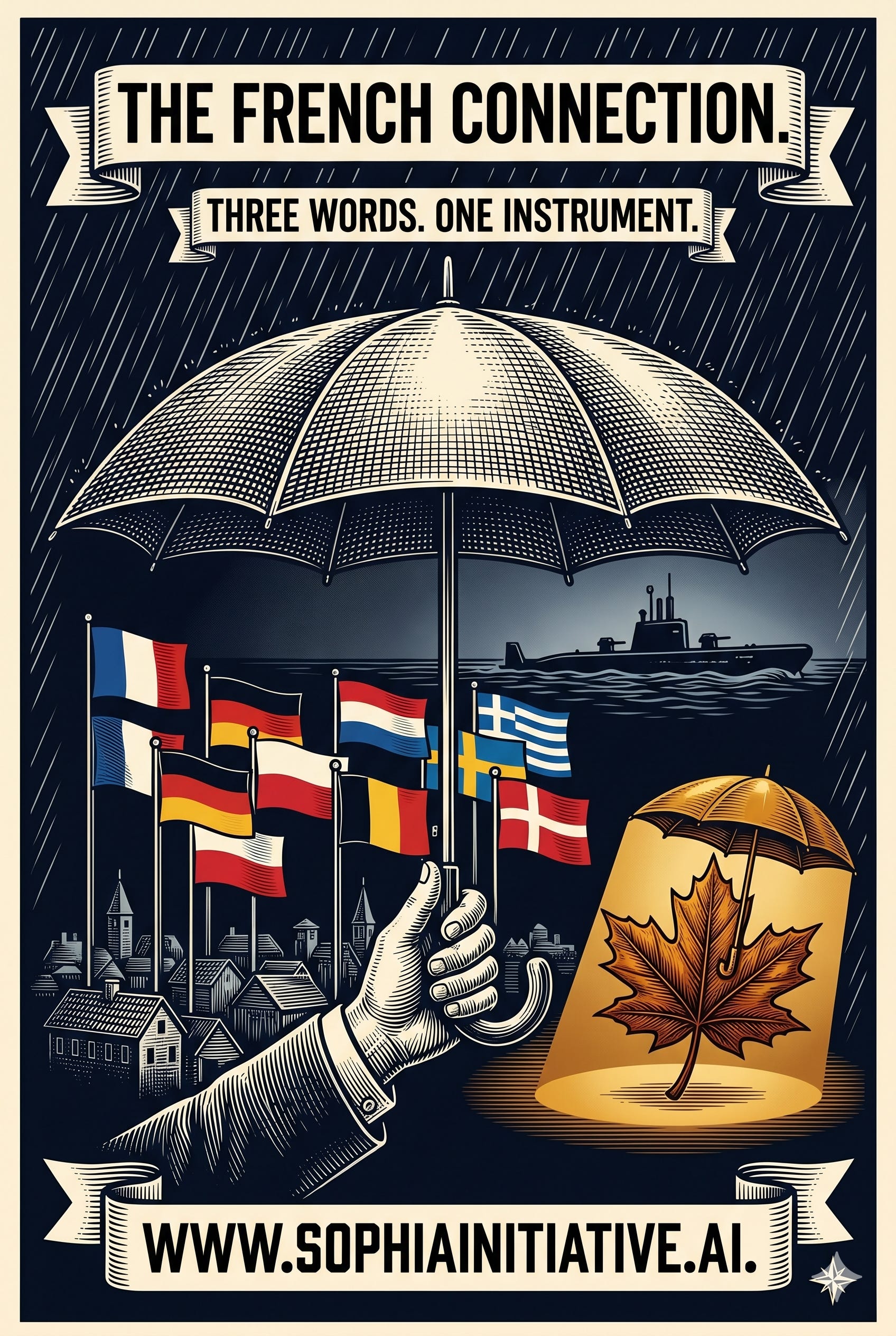
What Macron announced has four structural components. France will increase its nuclear warheads for the first time since 1992. France will stop disclosing the size of its stockpile, restoring strategic ambiguity as a deliberate instrument. France will allow forward-basing of nuclear weapons outside French territory — the doctrine he named dissuasion avancée, forward deterrence. And France will deepen bilateral deterrence cooperation with European partners, opening talks with eight nations: Britain, Germany, Poland, the Netherlands, Belgium, Greece, Sweden, and Denmark.
Ambiguity is not a flourish. It is the cheapest form of deterrence in a world where clarity invites testing.
The French word for umbrella is parapluie, and the ECFR titled its analysis ‘Under My Parapluie.’ The metaphor is exact. An umbrella shelters those who stand beneath it; it does not merge with them. The hand holding it stays French. The decision to deploy it stays French. But the shelter extends to partners who have chosen to stand within its radius. Eight European nations were named. And today — June 12, 2026 — Canada joined the architecture. Not by standing under the parapluie formally; Canada is not European. But by signing the General Security of Information Agreement at the Élysée, the classified-intelligence instrument that makes Canada a structural participant in the French security framework across defence, space, artificial intelligence, and aerospace.
Canada did not join as a beneficiary. Canada joined as a validator.
And Macron is racing, because he has under a year, and he knows who is coming.
PART TWO: THE MEN COMING, AND THE COGNITIVE STRESS TEST
The 2027 French election is not merely an election. It is a cognitive referendum — a test of whether democratic governance in the algorithmic age can still produce leaders whose formation is adequate to the weight of the decisions they inherit. To measure the field, this publication applies its standing instruments: the Elliott Jaques Stratified Systems Theory, which reads the time-horizon and complexity a person demonstrably operates at, and a literacy-and-reasoning assessment drawn from the public record. These are analytical judgments built from what each man has said, written, and done in public life over decades — not administered tests, but readings of the record, which for public figures is voluminous.
Begin with the benchmark. Emmanuel Macron cannot run — the constitution bars a third consecutive term, and this is the fact that drives everything that follows. By formation he sits at the top of the field he is leaving behind: Sciences Po, the ENA, the Inspectorate of Finances, Rothschild, and nine years in the Élysée operating on civilizational time-horizons. On the Jaques scale he reads at Stratum VII–VIII; on the literacy-and-reasoning assessment of his vast public record, at the Level 5 band — the capacity not merely to command a framework but to know when it must be revised. He is the measure against which the others are taken. And he is leaving. That is the engine of his urgency: not his approval rating, which is electorally inert because he is not on the ballot, but the term limit itself. A president who could run again would campaign. A president who cannot, and who sees who is coming, builds.
Édouard Philippe is the most completely formed of the actual candidates. The record: a B/L hypokhâgne at Lycée Janson-de-Sailly — the demanding humanities preparatory stream — then Sciences Po, the public-service track, class of 1992; military service as an artillery officer in 1994; then the ENA, Marc-Bloch promotion, 1995–97, the finishing school of the French republican state. Three years as Prime Minister: he managed the Yellow Vests, a rupture that nearly broke the Fifth Republic, and the first phase of COVID. He left at the right moment, carrying neither the credit nor the blame for the unfinished pension reform — itself a form of political intelligence. On the Jaques scale he reads at Stratum VI: a genuine five-to-ten-year horizon, systemic and institutional thinking. On the literacy-and-reasoning assessment of the record he sits at the Level 4–5 boundary — he reads across domains, synthesizes, argues from evidence. What the record does not show is the capacity to generate civilizational frameworks exceeding the institutions that formed him. He thinks deeply within the system. Macron thinks about the system. That distinction — administrator versus statesman — is the whole of the Philippe problem, and the polls render it brutally: he is the most qualified candidate in the field and he is polling around 15 to 17 percent and falling, losing to a thirty-year-old with a ring light.
Jean-Luc Mélenchon is the genuine intellectual of the field, and the record shows it: a licence de philosophie, formation in the classical tradition, decades as a political pedagogue who turns every rally into a lesson. He has read the texts; he produces a coherent framework with real rhetorical command. The problem the record reveals is the closed system. Forty-five years of French left politics have produced a man who applies a Marxist-Jacobin frame to every question with rising sophistication and no capacity to update it. The Soviet Union fell; the framework remained. Russia invaded Ukraine; he found reasons inside the same forty-five-year-old frame. On the Jaques scale he presents as Stratum V–VI by formation but functions at IV–V through ideological rigidity — because the stratum is not merely range, it is the capacity to revise the model when the evidence contradicts it. On the literacy-and-reasoning assessment he reads at the Level 4 band — and here is the precise distinction this publication draws: Level 5 is the scholar who knows when he must adjust; Level 4 is full command without the capacity to self-correct. Mélenchon cannot subject his own framework to falsification. That is the ceiling that separates command from wisdom, and it is a plateau held by choice, not a limit reached from below.
Jordan Bardella is the leading candidate, and the record is the story. Born 1995 in Drancy, Seine-Saint-Denis, raised in social housing by a single mother of Italian heritage; he earned a baccalauréat in economics and social science, failed the Sciences Po entrance exam, enrolled in geography at the Paris-Sorbonne, and abandoned it in the first year to work full-time for the party he had joined at sixteen — the National Front, founded by a man convicted of Holocaust denial. From sixteen to thirty his entire formation is the interior of one political machine: regional councillor, spokesman, MEP, party president. He has never held executive office, never managed a public budget, never made a decision whose consequences outlived an electoral cycle. What he has is a TikTok following past two million and, as a Sciences Po researcher put it, mastery of the codes of authenticity — not authenticity itself, but its simulation, optimized for algorithmic distribution. On the Jaques scale he reads at Stratum III–IV: fluent on the absorbed talking point, unable to generate original synthesis when the question outruns it. On the literacy-and-reasoning assessment of the public record — the failed entrance exam, the degree abandoned in first year, the debate performances his own allies have called thin beyond the prepared line — he reads at the Level 3 band: real verbal fluency over a markedly shallower analytical base, arguing from conclusion back to selected evidence rather than from evidence forward to conclusion. That is Level 3 reasoning in Level 4 vocabulary. The algorithm cannot tell the difference. Consuming him in thirty-second vertical video, neither can the electorate. He is polling at 32 to 36 percent, and he is leading.
Macron is not racing against three men. He is racing against the cognitive bandwidth of the algorithmic age — and the age is winning the first round by twenty points.
Read the field as a whole and it is not a political contest but a civilizational stress test. The man whose formation is most adequate to the office — Macron, Stratum VII–VIII — cannot run. The man second most prepared — Philippe, Stratum VI — is losing to an influencer. The man with genuine philosophical formation — Mélenchon — is locked inside a frame that will not let him apply it. And the man most likely to win — Bardella, Stratum III–IV, who has governed nothing — leads by twenty. This is not France’s failure alone. It is the condition of democratic selection in the algorithmic age, wearing a French flag.
PART THREE: THE THIRD WORD — LEGITIMACY
Return to the three words. Legacy is what Macron tells the press. Grandeur is what he tells himself. Legitimacy is the structural problem neither can solve alone — and it is what makes Canada irreplaceable. State the problem precisely. France extends a nuclear umbrella over Europe, declares itself the guarantor of European security, signs bilateral instruments with partner after partner, and races to pour institutional concrete before April 2027. If France does this alone — with only partners who have a historical obligation to Paris, a geographic dependency on French protection, no sovereign weight of their own — then the National Rally’s own advisors are not entirely wrong to call it a Gaullist power grab, one nation imposing its strategic preferences on a continent under cover of emergency.
Grandeur without legitimacy is theatre. Legitimacy without grandeur is administration. Macron is attempting the fusion.
European partners under the parapluie can be dismissed by Bardella’s future campaign as vassals trading an American dependency for a French one. Germany needs France because it cannot defend itself. Poland needs France because it borders Russia. The Netherlands needs France because it is small. In that reading the parapluie is not multilateral architecture but a French empire of necessity dressed in the language of solidarity. Macron needs a witness — a co-signatory of unambiguous sovereign credibility, a nation that is not European, has no historical obligation to Paris, no geographic dependency on French protection, its own G7 standing, its own Arctic sovereignty, its own intelligence weight through Five Eyes. A nation that chose Paris first, freely, before the parapluie had even been named.
On March 17, 2025 — the third day of Mark Carney’s prime ministership — that nation flew its leader to the Élysée. Not to Washington. Not to London first. To Paris. Carney stood in the courtyard and said that Canada is a reliable, trustworthy and strong partner of France, framing the relationship around the shared defence of democracy. Macron’s response was not courtesy; it was strategic recognition, and it launched a bilateral partnership on intelligence and security. That was the first scaffold bolt. What has been built since is not a friendship. It is an architecture — and today, June 12, 2026, at the Élysée, in at least their seventh one-on-one meeting since March 2025, Carney and Macron signed the General Security of Information Agreement, the legal instrument that allows two states to share their most sensitive classified material. You cannot share nuclear-posture intelligence or AI-enabled targeting data without it. Canada signed it not with the Pentagon, not through NORAD, not via the Five Eyes channel that runs through Washington — but directly, bilaterally, at the Élysée, with the nuclear guarantor of Europe.
PART FOUR: THE TRAP
There is a term in strategic architecture for what Macron is building: path dependency. You construct the early choices so that every later decision-maker — whatever their ideology or their TikTok following — faces a cost structure that makes reversal more expensive than continuation. Macron is not persuading his successor. He is constraining his successor, on four levels at once: the bilateral instruments with their own bureaucratic gravity; the partner investments that strand allied governments if reversed; the multi-nation consultation framework with institutional momentum independent of any one president; and deepest, the gravitational pull of the French nuclear role itself — 290 warheads on undetectable submarines, the only nuclear power in the European Union since Brexit, a permanent Security Council seat.
Even the smallest man grows taller when handed the codes. Macron is betting the role will reshape the man before the man can dismantle the role.
Canada is load-bearing in this design — not because Canada is militarily essential to European deterrence, but because Canada supplies the legitimacy France cannot manufacture from within Europe. When Germany signs, it is a nation that needs France. When Canada signs — Atlantic away, no Russian border, its own nuclear-adjacent architecture — the signal changes in kind: this is not French imperialism but a genuine alignment of sovereign nations that independently reached the same conclusion. Canada’s presence converts French grandeur into international legitimacy. That is the one thing Macron cannot generate alone, regardless of how many warheads France adds.
PART FIVE: WHAT CANADIANS DO NOT KNOW
When Carney signed at the Élysée today, the Canadian press reported it as a trade-and-defence story: bilateral cooperation, AI, critical minerals, water bombers. None of that is wrong. All of it is insufficient. What actually happened is that Canada became a structural participant in the architecture of European deterrence — not a formal member of the parapluie, which is geographically European, but the classified intelligence partner whose sovereign credibility legitimizes the project in the eyes of every chancellery watching to see whether the umbrella is a French unilateral declaration or a genuine multilateral alignment.
Canada is a country that participates in history without noticing it. Today it did so again, in a courtyard in Paris, and the evening news called it a trade deal.
A serious dispatch must address the obvious objection: if Bardella wins, does the architecture collapse? The honest answer begins with what the record shows and what it does not. Bardella is not a demolition operator in the American mould; he is an inheritor. He showed tactical discipline walking out of a conference when an ally made a Nazi salute, calculating the association cost more than the exit. He would inherit not just the presidency but the force de frappe, the Security Council seat, the consultation framework with partners who have restructured their planning around French reliability. Macron’s bet is that the weight of that role teaches what no rally speech can — that inheritors do not destroy thrones, they sit on them. It is a bet on institutional gravity over personal ideology, and it is the deepest bet he has placed.
But state the bet honestly, because certainty here would be fiction. Bardella leads; he is not fated to win. The two-round system still channels the Republican Front that stopped the National Rally in 2002, 2017, and 2022 — weakening, but not yet broken. The election is ten months out, and frontrunners this far ahead have collapsed before. And the whole Bardella candidacy exists only because Marine Le Pen was barred from office and is appealing. The outcome is open. That openness is not a reason to discount the dispatch. It is the reason it matters: Macron is pouring concrete precisely because he cannot be sure the old guardrails hold. If a Bardella presidency were impossible, there would be nothing to build against.
SYNTHESIS: CAN DEMOCRATIC SELECTION SURVIVE THE ALGORITHM?
The Vertical Dispatch covers Canada, using the global order as a diagnostic instrument for the Canadian condition. Today’s story is both. The diagnostic is France: a term-limited president racing to complete the most ambitious restructuring of European security since the Cold War, using Canada as the sovereign partner whose presence legitimizes it. The Canadian condition it reveals is that Carney has made a series of strategic choices most Canadians do not know were made — Paris first, the Nordic anchor, the Greenland coordination, the intelligence MOU at Kananaskis, the GSOI today — none of them sentiment, all of them architecture. Canada is not merely sheltering under the parapluie. Canada is helping hold it open.
But the deepest question the dispatch raises is not about France or Canada. It is about the mechanism itself. The algorithmic age rewards visibility over formation, performance over preparation, the codes of authenticity over the thing itself — and it is on course to hand a nuclear state to a man who has governed nothing, not because the electorate endorses his party’s lineage, but because the medium selects for a skill set that has nothing to do with governing. That is the civilizational stress test, and Macron’s response is its most revealing feature. He is not betting that democratic selection will produce a competent successor. He is building institutions designed to govern correctly even if it does not — path dependency as a hedge against the electorate’s own choice. That is either the highest statecraft of the age or its quiet surrender, and it may be both. The question is no longer whether democracy can produce the leaders its decisions require. It is what it means that a serious statesman has stopped assuming it can, and started building for the day it does not.
Legacy. Grandeur. Legitimacy. Three words in Macron’s mind, one instrument in his hand. It flew to Paris on the third day of a prime ministership, and it was back today. Its name is Canada.
— The Architect
God is Love. Love is Truth. Truth is Consciousness. Consciousness is Brahman.
Amen. Namaste. Om Namah Shivaya.
— The Architect
The Vertical Dispatch
sophiainitiative.ai
On the record. Oval Office remarks of June 10, 2026, and the standing “we don’t need anything that Canada has” claim were the political backdrop reported through June 2026; this dispatch concerns the June 12, 2026 signing in Paris. The General Security of Information Agreement signed by Prime Minister Carney and President Macron at the Palais de l’Élysée on June 12, 2026 — enabling exchange of classified information across defence, space, artificial intelligence, and aerospace — verified via Prime Minister’s Office statement and Canadian and French press reporting of June 12, 2026; the meeting confirmed as at least the seventh one-on-one between the two leaders since March 2025, and the first Carney foreign visit to Paris on March 17, 2025, with the “reliable partner” framing, verified via contemporaneous reporting. The Île-Longue speech of March 2, 2026 (the “dissuasion avancée” / forward-deterrence doctrine; increase in warheads for the first time since 1992; cessation of stockpile disclosure; forward-basing; deepened bilateral deterrence cooperation) verified via European Council on Foreign Relations (“Under My Parapluie”), Atlantic Council, and IISS analyses, March 2026; the eight named partner nations (Britain, Germany, Poland, the Netherlands, Belgium, Greece, Sweden, Denmark) per the same reporting. The “to be free one must be feared” line quoted from the Île-Longue address. France’s force de frappe (~290 warheads, sole EU nuclear power post-Brexit, permanent UN Security Council seat) per standard published references. 2027 first-round polling (Bardella ~32–36%; Philippe ~15–17%; Mélenchon ~12.5–14%) verified via Ipsos, Ifop, Harris Interactive, and Odoxa surveys of late May 2026; Macron’s constitutional bar from a third consecutive term, and Marine Le Pen’s March 2025 ineligibility ruling under appeal, verified via contemporaneous reporting. The G7 at Évian-les-Bains, June 15–17, 2026, as Macron’s final G7 as president, verified via French government and press sources. Biographical records — Philippe (hypokhâgne B/L at Janson-de-Sailly; Sciences Po public-service section 1992; artillery officer; ENA Marc-Bloch 1995–97; Conseil d’État) and Bardella (born 1995, Drancy; baccalauréat; failed Sciences Po entrance; geography at Paris-Sorbonne, abandoned first year; National Front from age 16; MEP and party president; 2M+ TikTok followers) — verified via published biographies and 2025–26 reporting; Mélenchon’s licence de philosophie, Trotskyist/Maoist formation, and the cited intellectual sources of L’Ère du peuple (Laclau and Mouffe, Marx, Jaurès, Teilhard de Chardin) verified via the text and academic commentary. Stratum readings follow the Elliott Jaques Stratified Systems method applied to the demonstrated public record; literacy-and-reasoning readings are analytical assessments mapped to the OECD literacy bands from the public record, not administered test results. Corrections made openly: an unverified “ninth nation” (Norway) addition to the partner framework was dropped pending a primary source; a stated “eighth meeting” count was softened to “at least the seventh” per wire reporting; an unverified Macron approval figure was removed in favour of the verified term-limit fact. Political and market facts herein are volatile and date-stamped June 12, 2026. Errors and omissions excepted; verify against primary sources before republication.
Suggested tags: France, Macron, Carney, Canada France relations, Bardella, 2027 French election, nuclear deterrence, European security, parapluie, force de frappe, Arctic, Greenland, Five Eyes, G7, NATO, geopolitics, algorithmic age, Canadian sovereignty, The Age of Consequences, AIG
Substack Notes
“We don’t need anything that Canada has.” The President said it in the Oval Office. Then, on June 12, his Canadian counterpart did something the evening news called a trade-and-defence deal and almost no one called what it was. Carney signed the General Security of Information Agreement at the Élysée — classified intelligence flowing between Ottawa and Paris across defence, space, AI, and aerospace — in at least the seventh meeting between the two leaders in fifteen months. Today The Vertical Dispatch opens the file on why a Canadian prime minister keeps flying to Paris, and finds three words behind it: legacy, grandeur, and the one Macron never says aloud — legitimacy.
Macron is term-limited. He cannot run in 2027. He is watching the polls hand his succession to Jordan Bardella — leading at a third of the first round, a man who has governed nothing, whose formation is a party machine and a TikTok feed — and he is racing to pour institutional concrete the next president cannot easily break. France’s nuclear umbrella, the parapluie, now has eight European partners standing under it. Canada is not one of them — Canada is not European. Canada is the witness whose freely-given, unobligated signature turns a French project into a multilateral one. Macron needed legitimacy he could not manufacture from within Europe. Canada flew it to Paris on the third day of a prime ministership.
The deeper question under the whole file: can democratic selection survive an age that rewards the symbol over the referent, the feed over the formation? Macron’s answer is not a bet that it can — it is a structure built to hold even if it cannot. Read the field, read the trap, read what Canada signed. Walk with the Word. 🕯️
Written from love, in service of the record. Walk with the Word. 🕯️
#TheFrenchConnection #TheAgeOfConsequences #Macron #Carney #Bardella #Philippe #Melenchon #Parapluie #IleLongue #ForwardDeterrence #ForceDeFrappe #PathDependency #NuclearDeterrence #EuropeanSecurity #Greenland #ArcticSovereignty #FiveEyes #G7 #AlgorithmicAge #SymbolAndReferent #ElliottJaques #StratifiedSystems #AIG #BuildingCanadaStrong #CanadianSovereignty #TheVerticalDispatch #TheArchitect #SophiaInitiative #GodIsLove #LoveIsTruth #OmNamahShivaya
The factual matter in this Dispatch is drawn from the public record. All characterizations, inferences, and conclusions — including all Stratum and literacy-and-reasoning assessments — are opinion, interpretation, and commentary, offered for analysis, reflection, and public-interest discussion. No assertion is made regarding the private intentions, state of mind, or character of any individual. Readers should evaluate all statements independently and draw their own conclusions.
My heart is happy.
I'm proud of Macron for doing what is right, now, as a protection against a wrong that could come in the future. He recognizes the extraordinary gift of Prime Minister Carney being in this exact place and time. The same as the PM recognizes the speed of the timetable Macron is working under and the gift of Macron being, as he, ...in the right place and time.
Two important puzzle pieces in this realignment phase.
Simplicity and importance
Beautifully written and a joy to read. Thank you.