

✦ THE VERTICAL DISPATCH ✦
Analysis · Philosophy · Civilization
By The Architect · The Vertical Dispatch
Somewhere right now, a seventeen-year-old is watching a ninety-second TikTok summary of Hamlet. The ghost appears. The prince anguishes. Ophelia drowns. A narrator with a pleasant voice explains what it all means. The video ends. The algorithm serves the next one.
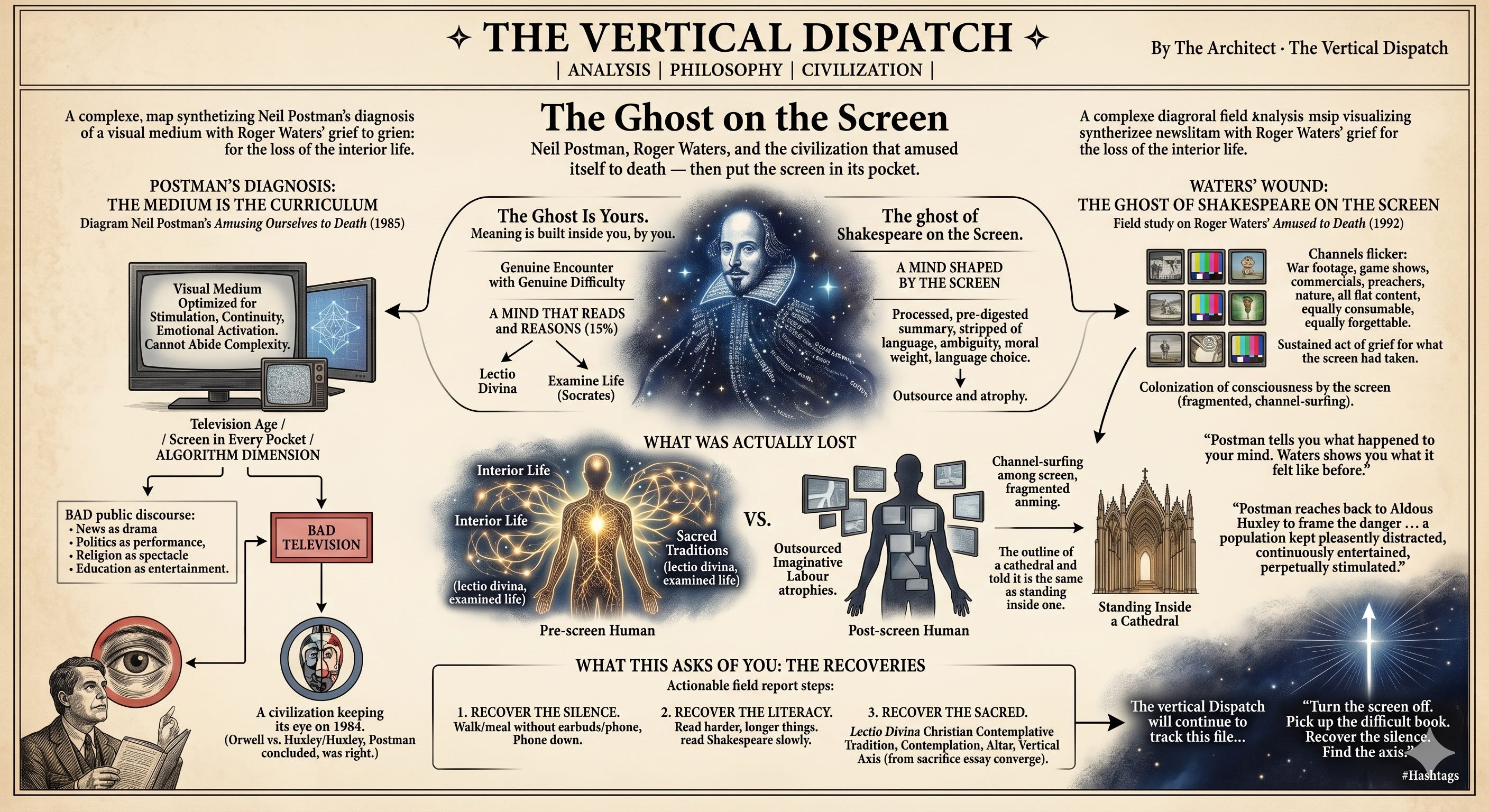
The seventeen-year-old believes, in some functional sense, that they have encountered Shakespeare. They have not. They have encountered a processed, pre-digested, visually delivered summary of a plot — stripped of the language, stripped of the ambiguity, stripped of the moral weight that lives inside the specific and irreplaceable words Shakespeare chose. They have received the outline of a cathedral and been told it is the same as standing inside one.
Neil Postman predicted this in 1985. Roger Waters felt it in 1992. Together, they constitute the most complete diagnosis of what has happened to the Western mind that the late twentieth century produced. And the civilization they were diagnosing has not recovered. It has accelerated.
This is what we need to examine. Not with nostalgia. Not with the comfortable superiority of those who read long books. But with the precision that the moment requires — because what Postman and Waters identified is not a cultural preference. It is a civilizational emergency. And it is now three decades deeper than when either of them named it.
Postman’s Diagnosis: The Medium Is the Curriculum
Neil Postman was not a cultural snob. He was a media ecologist — a thinker who understood that every communications technology carries within it a philosophy, a set of cognitive demands and permissions that shape the minds of those who use it, regardless of the content being transmitted.
His argument in Amusing Ourselves to Death was not that television was vulgar, though much of it was and is. His argument was structural and prior to content entirely: television, as a medium, is constitutionally incapable of sustaining the kind of discourse that self-governance requires. Not because the people who make it are stupid or malicious. But because television is a visual medium optimized for stimulation, continuity, and emotional activation. It cannot abide complexity, ambiguity, or the sustained linear argument that reason requires. Every television broadcast, however serious its intentions, must resolve into image, must maintain pace, must never ask the viewer to hold a thought longer than the medium’s attention economy will tolerate.
The result, Postman argued, was not merely bad television. It was the colonization of all public discourse by the logic of television. Politics became performance. News became drama. Religion became spectacle. Education became entertainment. The form ate the content. And a public trained from childhood to receive meaning in the form of moving images and emotional beats lost, gradually and without noticing, the cognitive musculature required to receive meaning in any other form.
Postman reached back to Aldous Huxley rather than George Orwell to frame the danger. Orwell feared a boot stamping on a human face forever. Huxley feared something more insidious: that no boot would be necessary, because the population would be kept so pleasantly distracted, so continuously entertained, so perpetually stimulated, that the capacity for the kind of thought that might resist oppression would simply atrophy from disuse.
Huxley, Postman concluded, was right. And television was the mechanism.
“We were keeping our eye on 1984. When the year came and the prophecy didn’t, thoughtful Americans felt relieved. We forgot that there was another book about the future.”
— Neil Postman, Amusing Ourselves to Death
Waters’ Wound: The Ghost of Shakespeare on the Screen
Roger Waters approached the same territory from a different direction entirely. Where Postman was the diagnostician, Waters was the mourner. Amused to Death — released in 1992, seven years after Postman’s book, and drawing its title directly from it — is not an argument. It is an elegy. A sustained act of grief for what the screen had taken.
The album opens with a television being switched on and never switched off. Channels flicker through the entire record — war footage, game shows, evangelical preachers, nature documentaries, political speeches — all rendered at the same volume, the same emotional temperature, the same flickering pace. This is not a technical choice. It is the thesis. In the world Waters is depicting, the Gulf War and a car commercial occupy the same cognitive and emotional register. Everything has been flattened to content. Everything has been made equally consumable and equally forgettable.
And then, near the heart of the album, the ghost of Shakespeare appears.
Waters does not use this image sentimentally. Shakespeare is not invoked as a symbol of high culture versus low culture — that reading is too thin, too comfortable, too easily dismissed as elitism. Shakespeare is invoked as a diagnostic instrument. As the measure of what a civilization is capable of when its primary medium of communication demands imaginative labour rather than passive reception.
When you read Hamlet — genuinely read it, with the full resistance and difficulty that genuine reading requires — the ghost appears in your mind. You construct it. You bring to it everything you are: your losses, your unresolved griefs, your knowledge of fathers and sons and the unbearable weight of what the dead leave behind. The ghost is yours. The meaning is built inside you, by you, through an act of sustained imaginative and moral effort.
When you watch a ninety-second TikTok summary of Hamlet, the ghost appears on the screen. Someone else has constructed it. Someone else has decided what it means. Your task is only to receive, to react, to scroll to the next thing. The imaginative labour has been outsourced. And what is outsourced, consistently and completely, atrophies.
This is the wound Waters is naming. Not the loss of Shakespeare as cultural heritage. The loss of the cognitive and spiritual capacity that Shakespeare both required and developed. The loss of the interior life that is built, and can only be built, through the friction of genuine encounter with genuine difficulty.
“The ghost of Shakespeare haunts this album because Shakespeare represents the last clear signal before the noise took over — the last moment when the medium demanded everything the human mind could give.”
— The Architect
The Synthesis: Diagnosis and Wound Are the Same Thing
Postman gives us the mechanism. Waters gives us the cost. Together they describe something that neither could fully name alone.
Postman’s analysis is structural and, in the end, almost bloodless in its precision. He shows us how the medium reshapes the mind. He demonstrates, with intellectual rigour and historical depth, why a television-saturated culture cannot sustain the cognitive architecture that democracy, science, religion, and art each require in their different ways. He is right about all of it. And reading him, you understand the mechanism completely.
But you do not feel the loss. Because Postman is working inside the very medium — the written, linear, argumentative book — that he is defending. His analysis is a demonstration of its own thesis. And it reaches the fifteen percent who still inhabit that medium.
Waters reaches somewhere else. The album does not argue. It enacts. It puts you inside the experience of a consciousness that has been colonized by the screen — fragmented, channel-surfing, unable to hold a feeling long enough to understand it, unable to distinguish the real from the represented. And then it plays the ghost. And in that moment, in the gap between what the album has made you feel and what the ghost represents, you feel the loss in your body. Not as an intellectual proposition. As a wound.
That is the synthesis. Postman tells you what happened to your mind. Waters shows you what it felt like before. Together they constitute a complete account of the civilizational trade that was made — largely without consent, largely without awareness — in the second half of the twentieth century. The trade of depth for stimulation. Of construction for reception. Of the difficult interior encounter with meaning for the frictionless exterior consumption of entertainment.
And the trade, once made, compounds. Because a mind that has been shaped by the screen finds the alternative — the book, the argument, the sustained encounter with difficulty — not merely less entertaining but experientially painful. The cognitive musculature required has weakened. The attention span has contracted. The tolerance for ambiguity has diminished. The capacity to sit with a thought long enough to understand it has been replaced by the reflex to reach for the next stimulation.
This is not a metaphor. This is what the neuroscience of attention and the PIAAC literacy data both confirm from their different directions. Approximately fifteen percent of adults in developed nations read and reason at the levels that genuine civic and cultural engagement requires. The remaining eighty-five percent are not stupid. They are the product of an environment that has been systematically optimized — by the logic of the medium, by the economics of the attention economy, by forty years of decisions made by people who understood that stimulation is more profitable than depth — to produce exactly this result.
Postman saw it coming. Waters felt it arriving. We are living in what they diagnosed.
What Was Actually Lost
It is worth being precise about this, because the tendency is to frame the loss sentimentally — as the loss of great books, or classical music, or the kind of dinner-table conversation that no longer happens. That framing is both true and too small.
What was lost is the interior life. The capacity to be alone with a thought long enough for it to become yours. The ability to hold complexity without resolving it prematurely into a feeling. The tolerance for the kind of sustained engagement with difficulty — intellectual, moral, spiritual, aesthetic — that is the only means by which a human being grows into the full height of what being human means.
Every serious tradition in human history has understood this. The Vedic tradition calls it the movement from the gross to the subtle — the progressive refinement of perception that allows the practitioner to encounter reality at increasing depth. The Christian contemplative tradition calls it lectio divina — the slow, repeated, meditative reading of a text until it opens into something the surface reading cannot reach. The philosophical tradition, from Socrates onward, calls it the examined life — the willingness to subject your own assumptions to sustained, rigorous, uncomfortable scrutiny.
All of these practices require the same thing: time, silence, sustained attention, and the willingness to be changed by what you encounter. All of them are structurally incompatible with the logic of the screen. Not because the screen is evil. But because the screen is optimized for exactly the opposite — for speed, for stimulus, for the rapid delivery of pre-processed meaning that requires nothing of the receiver except the capacity to feel a reaction and scroll to the next thing.
Shakespeare’s ghost haunts the album because Shakespeare is the precise measure of the gap. Not because Shakespeare is the summit of human culture — though he is extraordinary — but because Shakespeare, received properly, requires everything. He requires you to slow down. To hold the language until it opens. To bring your full interior life to bear on questions that have no clean answers. To be genuinely disturbed by what you encounter and to let that disturbance do its work on you.
A civilization that produced Shakespeare — and more importantly, a civilization that could receive Shakespeare, that had the cognitive and spiritual equipment to be fully present to what he was offering — was a civilization operating at a certain altitude. The question is not whether we still produce great artists. We do. The question is whether we still have a public capable of receiving them. Whether the cognitive and spiritual equipment required for genuine encounter with genuine depth still exists in sufficient numbers to constitute a culture rather than a niche.
“The crisis is not that we have stopped producing Shakespeare. The crisis is that we have produced a world in which Shakespeare arrives as a ninety-second video and the viewer believes they have been to the play.”
— The Architect
Three Decades Deeper
Postman published Amusing Ourselves to Death in 1985. Waters released Amused to Death in 1992. Both were diagnosing the television age — a world in which the screen was large, fixed, and occupied the living room.
That world now seems almost quaint.
The screen is now in every pocket. It is present in every moment of potential silence — in the queue, on the train, in the thirty seconds between one activity and the next that used to constitute the unstructured time in which the mind could wander, make connections, process experience, and occasionally arrive at something it had not been directed toward by an algorithm. Those thirty seconds have been colonized. The last territories of unmediated experience have been enclosed.
The algorithm, which did not exist in Postman’s or Waters’ time in its current form, has added a dimension of optimization that neither of them fully anticipated. Television offered a menu, however limited. The algorithm learns you. It maps the precise contours of your existing preferences and serves you an endless stream of content calibrated to keep you in exactly the emotional and cognitive state you are already in. It does not challenge. It does not disturb. It does not ask you to encounter something that exceeds your current capacity. It feeds the existing appetite rather than developing a new one.
This is the completion of what Postman feared and Waters mourned. The television age produced a public that had difficulty sustaining complex thought. The algorithm age is producing a public that is actively guided away from it. The medium no longer merely fails to develop the cognitive musculature. It systematically atrophies it, one served preference at a time.
And the ghost of Shakespeare recedes further with every scroll.
What This Asks of You
This is where we land. Not in nostalgia. Not in the comfortable superiority of those who have read the books and heard the album and understood the diagnosis. In three asks. Each one real. Each one available. Each one an act of resistance that Postman would recognize and Waters would feel.
The first ask is the screen. Not its elimination — that is neither possible nor necessary. But the recovery of silence. The deliberate, daily practice of putting the device down and allowing the mind to exist without direction, without stimulation, without the algorithm’s guidance. The unstructured thirty seconds. The walk without the earbuds. The meal without the phone on the table. These are not aesthetic preferences. They are the minimum conditions for the recovery of an interior life. A mind that is never silent cannot hear itself think. A mind that cannot hear itself think cannot grow. A civilization of minds that cannot grow cannot self-govern. The logic is that simple and that serious.
The second ask is the literacy. The PIAAC data is not a verdict. It is a baseline. The fifteen percent who read and reason at levels four and five did not arrive there by accident or by genetic fortune. They arrived there because somewhere in their formation — in a home, a classroom, a library, a relationship with a teacher or a parent or a text that demanded something of them and rewarded the effort — the cognitive musculature was built. That process is not closed. It is available to anyone willing to do the work. Read longer things. Read harder things. Read things that do not immediately confirm what you already believe. Read Shakespeare — actually read him, slowly, with a dictionary if necessary, letting the language open rather than demanding that it yield immediately. Every act of genuine reading is an act of cognitive resistance. Every hour spent inside a text that demands your full attention is an hour in which the algorithm does not win.
The third ask is the sacred. This is where Postman’s diagnosis and Waters’ wound and the companion essay on sacrifice all converge. The deepest cost of the screen age is not cognitive. It is spiritual. The replacement of the altar by the feed. The replacement of the vertical axis by the horizontal scroll. The elimination, from the architecture of daily life, of the practices — prayer, contemplation, ritual, the slow reading of sacred texts, the silence before the divine — that orient the self toward something larger than its own preferences. A civilization that has lost its vertical orientation has lost the ground from which sacrifice becomes possible, love becomes more than sentiment, and meaning becomes more than a feeling that the next video can replace. Recover the vertical. In whatever form your tradition or your search makes available. It is the root from which everything else the screen has taken can, in time, grow back.
Turn the screen off. Pick up the difficult book. Recover the silence. Find the axis. These are not lifestyle suggestions. They are the acts of a civilization choosing not to finish what Postman diagnosed and Waters mourned.
✦ ✦ ✦
Neil Postman died in 2003. Roger Waters is still touring. The ghost of Shakespeare is still on the screen. The question is whether enough of us can still see it for what it is — not content, not entertainment, not a ninety-second summary — but the measure of everything we were capable of, and the measure of the distance we have travelled from it.
The album ends with a television being switched off.
The silence that follows is the point.
— The Architect
The Vertical Dispatch is written for the fifteen percent. If you found your way here, you already know why.
#NeilPostman #RogerWaters #AmusedToDeath #AmusingOurselvestoDeath #Shakespeare #MediaEcology #AttentionEconomy #TheScreen #Literacy #PIAAC #TheAlgorithm #CognitiveFreedom #TheInteriorLife #Huxley #BraveNewWorld #Philosophy #Civilization #TheVerticalDispatch #TheArchitect #Substack #LongformWriting #SacredMetaphysics #FaithOverKnowledge #TheAxis #Consciousness #WhatWeLost #CulturalDiagnosis #PublicDiscourse #SlowReading #Sovereignty