

Φ
THE VERTICAL DISPATCH
We write for the mind, the eye, and the ear.
Read it. Look at it. Listen to it. The Vertical Dispatch is built for all three — prose with rhythm, made to be heard as much as read.
From metaphysics to geopolitics, from culture to history, from the sacred to the street — and everything in between. One lens, every subject. No ego. Just the record, named clean.
Press play. Walk with the word. 🕯️
This dispatch travels by hand. If it serves you, share it — restack on Substack, and pass it on wherever you read. 🕯️
The Age of Consequences · Media Criticism
June 15, 2026 — the day a deal was announced but not yet signed. Volatile facts date-stamped as of this day.
“The map is not the territory. The word is not the thing.”
— the governing axiom of this publication
On Sunday, June 14, 2026, the President of the United States posted four words to a social-media account: the deal with Iran was “now complete.” Within hours, the same fact — a memorandum of understanding to end the war that began on February 28, with a signing set for Friday in Switzerland and the Strait of Hormuz to reopen — was carried by every major press in the world. And here is the thing worth a reader’s whole attention: it was not carried the same way twice. Washington reported a victory. Tel Aviv reported an exclusion. Tehran reported a caution. The Gulf reported an oil price and a security calculation. Beijing reported a vindication of patience. One fact. Nine mirrors. Nine different images.
This dispatch does not report the war. It reports the reporting. Begin from the publication’s oldest discipline, stated plainly: the map is not the territory, and the news is not the event. Every dispatch from every capital is a claim — a symbol laid over a referent that none of the reporters filing it can fully see. To use the proper word, it is conjecture: an account assembled from fragments, shaped by the interest of the one assembling it. This is not an accusation levelled at foreign presses and withheld from our own. It is the condition of all reporting everywhere, and the honest move is to hold every mirror — including the one a North American reader looks into each morning — to the same glass. We do not read the hearts of editors. We cannot. We read what they chose to put in the frame, and what they chose to leave out, and we let the reader measure the distance.
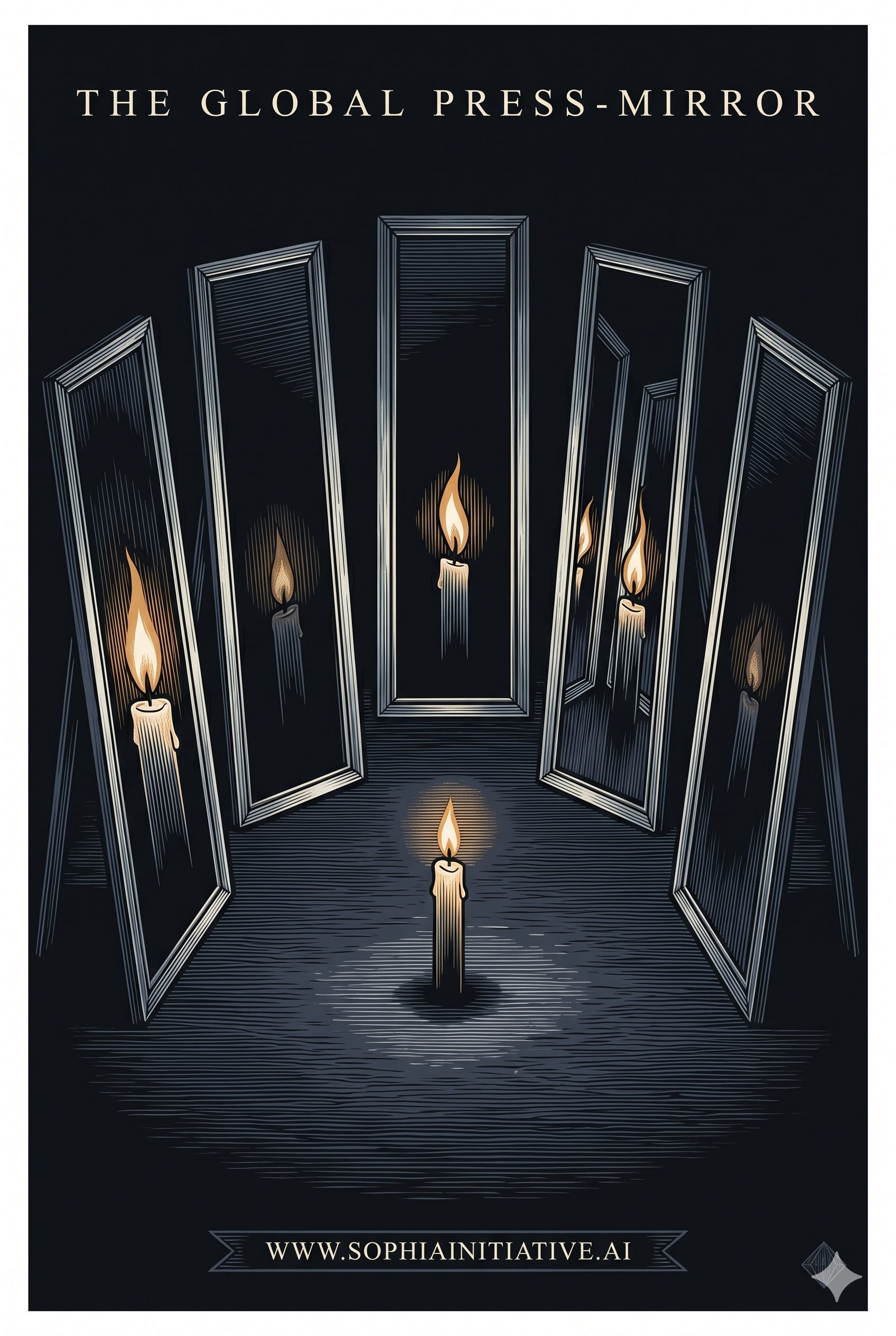
This dispatch does not report the war. It reports the reporting. One fact, nine mirrors, nine different images — and the news is never the event.
I. Washington: The Deal as Triumph
In the American frame, the announcement is an accomplishment, and the grammar of it is personal and total. “The Deal with the Islamic Republic of Iran is now complete. Congratulations to all!” The follow-on imagery escalates the register from statecraft to spectacle: a call for the ships of the world to start their engines, a toll-free strait, a naval blockade lifted by presidential authorization. The American press, across the spectrum, foregrounded the breakthrough and the markets: global indices soaring, oil falling more than four dollars a barrel on the prospect of restored shipping. The frame is closure achieved, a war ended by force of will. What sits at the edges of that frame, mentioned but not centred, is that the document is unsigned, that the signing is set for a later day, and that sixty days of nuclear talks — the only point that ever mattered — have not yet begun. The triumph is the headline. The conditionality is the footnote.
II. Tel Aviv: The Deal as Exclusion
Read the same announcement in the Israeli frame and the centre of gravity shifts entirely. The story there is not that the war ended but that Israel was not in the room when it did. The reporting foregrounds that Israel was not included in the negotiations over the deal, that its forces would not withdraw from land seized in Lebanon, and that the President had publicly and crudely disparaged the Israeli Prime Minister’s judgment even as he claimed the win. Where Washington’s frame is a leader ending a war, Tel Aviv’s frame is an ally finding out the terms of its own war’s ending from a podium it was not standing on. The same four words — “now complete” — read in one capital as victory and in another as a door closing on the way out. Neither press is inventing facts. Each is choosing which fact stands at the front.
III. Tehran: The Deal as Caution
In the Iranian frame, the loudest note is restraint, and it cuts directly against the American grammar of completion. Where Washington says “complete,” Tehran’s officials say wait. The foreign ministry spokesman, carried in Iranian state media, said plainly that the timing must be seen, that the signing would not be tomorrow. The foreign minister allowed only that a memorandum “has never been closer” — closeness, not conclusion. Iranian outlets had earlier published a list of purported provisions — sanctions lifted, blockade ended, frozen funds released — that the negotiating parties then pushed back against publicizing. The Iranian frame is of a nation that does not concede it has surrendered, that insists on its own plan beside the American one, and that will not let a foreign president’s timeline become its own. The referent is the same memorandum. The Iranian mirror shows a thing not yet done, on terms not yet conceded.
Where Washington says “complete,” Tehran says wait. The same memorandum, read in one capital as a finish line and in another as a thing not yet done.
IV. The Gulf: Six Boats, Not One Fleet
There is a phrase the Western frame reaches for by reflex — “the Arab reaction” — and the Gulf press dissolves it on contact. There is no single Arab account of this announcement, because there was no single Arab experience of the war. Iran struck all the Gulf states during the fighting; the readings now diverge accordingly. The Emirati frame has been the most hawkish, its envoy having said earlier that a simple ceasefire was not enough. The Saudi frame is the hedge — a call for any settlement to address all the issues that have shaped regional stability for decades, which is to say, do not hand us a half-peace. The Qatari frame is coexistence, the recognition that Iran will be a neighbour for the future of humankind. The Omani frame is the dissenter’s middle road, the one Gulf state that openly criticized the original strikes. Above all of them sits the single fact every Gulf paper led with regardless of politics: the price of oil and the reopening of the strait. The Gulf did not read this announcement as a moral event. It read it as a shipping lane and a security recalculation — and it read it in at least four different registers at once.
V. Beijing and Moscow: The Deal as Vindication
China’s frame is the patient broker’s, and it rewards a careful reader. From the war’s first day Beijing’s words were strong — the killing of Iran’s supreme leader called a grave violation of sovereignty, the strikes condemned as a trampling of the UN Charter. But the deed beneath the word was restraint: no intervention, an abstention at the Security Council, and a quiet message of displeasure sent in both directions — to Tehran for closing the strait, to Washington for the blockade. The Chinese press now frames the deal’s arrival as proof that its line was right all along: dialogue over force, the strait reopened, stability restored, Beijing positioned to broker between the Gulf and Iran while the Americans spent the ordnance. Moscow’s frame ran hotter from the start — its foreign ministry decrying the reckless step and warning of catastrophe — but its deed, too, was abstention. Both capitals condemned loudly and acted lightly, and both now frame the outcome as confirmation. The gap between the volume of the word and the weight of the deed is itself the story their mirrors do not show — and the one this dispatch marks.
Both capitals condemned loudly and acted lightly — and both now frame the outcome as confirmation. The gap between the volume of the word and the weight of the deed is the story their own mirrors do not show.
VI. And for the North American Reader — You Are On
It would be the easy thing, and the dishonest one, to turn this glass on eight foreign capitals and exempt the ninth — the one a Canadian or American reader looks into over coffee. So turn it. The North American press is not outside the mirror-hall; it is one more mirror, and it framed this announcement too. It led, in the main, with the markets and the breakthrough — the same triumph-frame as the White House, because proximity and language and advertiser interest pull a press toward the posture of its own government and its own economy, in Ottawa and New York no less than in Tehran or Beijing. The Canadian reader who feels, watching the foreign coverage, that the others are spinning while ours simply reports, is experiencing the one illusion this dispatch exists to break. There is no unspun mirror. There is only the question of whether you can see the frame around the one you happen to be standing in front of. The discipline is not to find the honest press. It is to read every press as conjecture, your own included, and to keep your eye on the referent — the unsigned page, the sixty days not yet begun, the strait not yet open — underneath all nine images of it.
VII. The Open Question
So the question is handed to the reader, not settled here. When the same four words are read in one capital as victory, in another as exclusion, in another as caution, in another as an oil price, and in another as vindication, which of the nine images is the event? The answer the governing axiom forces is uncomfortable: none of them. Each is a symbol; the war is the referent; and the referent, as of this writing, is a memorandum not yet signed, a strait not yet reopened, and a nuclear question pushed sixty days down the road with a threat of resumed attacks attached to it. The honest reader does not pick the truest mirror. The honest reader remembers there is a territory beneath every map, and asks of each frame the only question that survives a war: what was left outside it, and whose interest left it there? The deal may be signed Friday. It may not. What will not change is the lesson the mirror-hall teaches — that the news is never the event, and the first discipline of a free mind is to know which one it is looking at.
God is Love. Love is Truth. Truth is Consciousness. Consciousness is Brahman.
Amen. Namaste. Om Namah Shivaya.
— The Architect.
The Vertical Dispatch
sophiainitiative.ai
On the record. The anchor event — President Trump’s June 14, 2026 statement that the deal with Iran was “now complete,” the lifting of the US naval blockade, and the reopening of the Strait of Hormuz — per NPR, The Times of Israel, and NBC News, with a signing reported as set for Friday in Switzerland per Pakistani PM Shehbaz Sharif (NBC News, CNBC). The war began February 28, 2026, with joint US-Israeli strikes; Iran’s Supreme Leader Ali Khamenei was killed and his son named successor; Iran counter-struck Israel, US bases, and Arab Gulf states, and closed the Strait of Hormuz; a conditional ceasefire was declared April 8, 2026, mediated by Pakistan, and repeatedly violated — per the UK House of Commons Library and Wikipedia summaries of primary reporting. American framing (triumph; markets soaring; oil down ~$4/barrel; “Ships of the World, start your engines”) per NBC News and NPR. Israeli framing (Israel excluded from negotiations; no withdrawal from Lebanon; Trump’s disparagement of PM Netanyahu) per The Times of Israel. Iranian framing (FM spokesperson Esmaeil Baghaei urging caution on timing, “not tomorrow”; FM Abbas Araghchi: a memorandum “has never been closer”; Mehr News’ 14 purported provisions; parties pushing back on publicizing contents) per CNBC and Iranian state media as reported. Gulf framing (UAE ambassador: “a simple ceasefire isn’t enough”; Saudi call to “address all issues”; Qatar’s coexistence note; Oman’s dissent; the Gulf is not a unified bloc) per the UK House of Commons Library and Chatham House. Chinese framing (FM spokesperson Mao Ning’s condemnation, March 2, 2026; UNSC abstention; Wang Yi–Araghchi contacts; convergence with Gulf priorities; call to reopen the strait) per the PRC Ministry of Foreign Affairs, the Washington Institute, IISS, and Chatham House. Russian framing per the Washington Institute compendium. The 60-day nuclear-talks window and threat of resumed strikes per PBS News and The Times of Israel. This dispatch reads the framing choices of the named outlets only; it makes no claim about the private intentions, sincerity, or state of mind of any editor, government, or individual. The situation is highly volatile and the deal was unsigned as of this writing. Volatile facts date-stamped June 15, 2026. Errors and omissions excepted; verify against primary sources before republication.
Suggested tags: Iran war, US-Iran deal, Strait of Hormuz, media criticism, press framing, Israel, Tehran, Saudi Arabia, UAE, Qatar, Oman, China, Russia, Gulf states, symbol and referent, conjecture, Marshall McLuhan, Neil Postman, The Age of Consequences, AIG
Substack Notes
On Sunday the US President posted four words: the Iran deal is “now complete.” Within hours the same fact circled the world — and was not carried the same way twice. Washington reported a triumph. Tel Aviv reported being shut out of its own war’s ending. Tehran said wait, not tomorrow. The Gulf read an oil price and a security recalculation, in four different registers. Beijing framed it as the vindication of patience. One fact. Nine mirrors. Nine images.
The Global Press-Mirror does not report the war. It reports the reporting — laying the single announcement beside the way Washington, Tel Aviv, Tehran, Riyadh, Abu Dhabi, Doha, Muscat, Beijing, and Moscow each framed it, and letting the reader measure the distance between the symbol and the thing. The method is the publication’s oldest: the map is not the territory, and the news is never the event. All reporting is conjecture — a claim laid over a referent no reporter fully sees.
And the mirror is turned on the North American reader too — no exemption. The press a Canadian reads over coffee is one more mirror, framing this deal with the same proximity-pull as every capital frames its own. The illusion that ours simply reports while the others spin is the one illusion this dispatch exists to break. There is no unspun mirror. There is only the discipline of reading every press — your own included — as conjecture, with your eye on the referent underneath: an unsigned page, a strait not yet open, sixty nuclear days not yet begun. Walk with the word. 🕯️
Written from love, in service of the record. Walk with the word. 🕯️
#TheGlobalPressMirror #IranWar #USIranDeal #StraitOfHormuz #MediaCriticism #PressFraming #SymbolAndReferent #Conjecture #Israel #Tehran #GulfStates #SaudiArabia #UAE #Qatar #Oman #China #Russia #McLuhan #Postman #TheAgeOfConsequences #AIG #TheVerticalDispatch #TheArchitect #SophiaInitiative #GodIsLove #LoveIsTruth #OmNamahShivaya
The factual matter in this Dispatch is drawn from the public record. All characterizations, inferences, and conclusions are opinion, interpretation, and commentary, offered for analysis, reflection, and public-interest discussion. No assertion is made regarding the private intentions, state of mind, or character of any individual. Readers should evaluate all statements independently and draw their own conclusions.
I continue to say that I will believe it when all 3 sides sign it, when the bombs and the bullets actually stop and stay stopped. When the people against whom atrocities are being committed are made as whole as is possible (you can't bring back dead people, so they will never be made completely whole), and when those who committed the atrocities are held to account. Not a moment before.
This is why your readership has increased. You are offering something we can call truth, including the difficult bits. 🙏