

Philosophy · Metaphysics · Civilizational Depth
UNIVERSAL DYNAMICS · ESSAY IV
Glen Roberts · The Architect
April 2026
✦
There is a word we use casually, perhaps too casually: archetype. We borrow it from Jung, dress it in psychological clothes, and set it loose in our self-help literature. The King. The Trickster. The Shadow. We nod at these figures as though they were characters in a story we already know. But they are not characters. They are something far more unsettling and far more precise — and recovering that precision may be among the more urgent tasks of serious thought in our time.
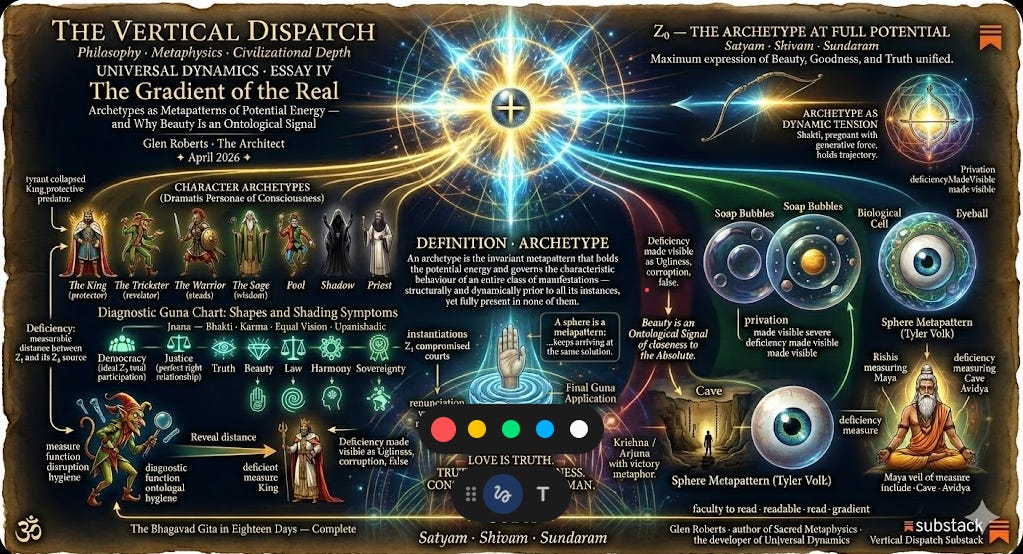
An archetype, properly understood, is not a symbol. It is not a myth. It is not a recurring personality pattern lifted from a thousand years of literature. An archetype is the invariant metapattern that holds the potential energy and governs the characteristic behaviour of an entire class of manifestations — structurally and dynamically prior to all its instances, yet fully present in none of them.
Let us unpack that slowly, because every word is doing real work.
✦
METAPATTERN
Tyler Volk coined the term metapattern to describe patterns that generate other patterns — structural logics that operate across scales, domains, and instances. A sphere is a metapattern: you find it in soap bubbles, planets, cells, and eyes, not because these things copied each other but because the underlying logic of minimal surface and maximum volume keeps arriving at the same solution. The metapattern precedes every instance of itself.
An archetype is a metapattern at the ontological level — not merely a recurring form in nature, but a recurring form in being itself. It is not derived from its instances. It cannot be constructed by accumulating instances. No amount of observing particular kings produces the King archetype. The archetype is what makes king-ness intelligible in the first place. It is the condition of possibility for the entire class.
No accumulation of particulars can reconstitute a universal. The archetype is not the sum of its instances — it is their condition of possibility.
— Universal Dynamics, Core Axiom
This is the foundational distinction. And it matters enormously, because once you grasp it, you cannot go back to treating archetypes as cultural constructs or psychological projections. They are prior to culture. They are prior to psychology. They are prior to the human mind that perceives them — though the human mind is, remarkably, the instrument through which their presence is registered.
✦
POTENTIAL ENERGY AND BEHAVIOUR
Here is where the definition departs from Plato’s static forms and becomes something dynamically alive. The archetype does not merely describe its class — it contains the energy that drives manifestation toward form. It is tensioned, loaded, the way a drawn bow holds the entire trajectory of an arrow before release.
This is why the Kashmir Shaivites spoke of Shakti as the dynamic face of Shiva — the Absolute is not inert. The archetype is not a cold blueprint filed in a Platonic cabinet somewhere. It is pregnant with generative force. Its potential energy is maximal at the source and diminishes with each descent into manifestation.
And every archetype does not merely produce instances — it produces instances that behave in recognizable ways. The archetype of water establishes the behavioural signature: cohesion, dissolution, flow, descent. You can identify the archetype through the pattern of behaviour across all its particular instances. The same is true of the King, the Trickster, Justice, Democracy. Their Z₀ archetype carries not only what they are but what they do — and the gap between the archetypal behaviour and the actual behaviour of any instance is precisely the measure of its deficiency.
FORMAL NOTATION · UNIVERSAL DYNAMICS
Z₀ — the archetype at full potential; 100% expression of beauty, goodness, and truth unified
Z₁ — the manifested particular; always carrying inherent deficiency, always less than 100%
Deficiency — the measurable distance between Z₁ and its Z₀ source
The gradient — the ontological spectrum from maximal potential (Z₀) to maximal deficiency; beauty and goodness are signals of proximity; ugliness and corruption are signatures of distance
✦
THE GRADIENT OF BEAUTY AND GOODNESS
This brings us to the most radical claim of the framework — the one that overturns the dominant assumptions of both modern aesthetics and modern ethics.
Beauty and goodness are not subjective preferences. They are ontological signals.
When something strikes us as beautiful, we are not merely expressing a personal taste. We are registering, through the instrument of subjective experience, that thing’s proximity to its Z₀ archetype. We are sensing how much potential energy remains intact in the manifestation. The beautiful is the real, insofar as the real has successfully approximated its source.
The gradient runs from the archetype’s maximal potential — Satyam Shivam Sundaram, truth, goodness, beauty as a unified field, not three separate qualities — down through diminishing returns of manifestation, to the point of severe deficiency that we name ugliness, corruption, or evil.
And here the framework makes its cleanest move: evil and ugliness require no separate principle. They are not independent forces requiring their own metaphysics. They are simply absence of fullness — deficiency made visible. Augustine arrived at this through the doctrine of privation. This framework gives it a precise metric. The further any instance stands from its Z₀ archetype, the more it registers as ugly, corrupt, or false. The instrument through which we read that distance is the very faculty of aesthetic and ethical perception — which turns out to be, on this account, a faculty for measuring ontological proximity.
Beauty is the signal of closeness to the Absolute. Ugliness is deficiency made visible. What we call moral perception is the capacity to read the gradient.
✦
TWO STREAMS OF ARCHETYPAL MANIFESTATION
I. Character Archetypes — The Dramatis Personae of Consciousness
The King, the Queen, the Trickster, the Sage, the Warrior, the Fool, the Shadow, the Priest — these are Z₀ patterns expressing through personhood and role. Jung mapped this territory with real intelligence, but without the ontological floor that gives the mapping genuine explanatory force. In his system, archetypes are contents of the collective unconscious — useful, illuminating, but ultimately psychological in origin. In Universal Dynamics they are not psychological at all. They are actual metapatterns of potential energy expressing through the human form. The psyche discovers them; it does not invent them.
The King archetype at Z₀ is sovereign order: protective authority dispensing justice from abundance, not from scarcity or fear. Every actual king is Z₁ — carrying deficiency. The tyrant is not a different archetype. The tyrant is the King archetype at severe deficiency, the potential energy collapsed, the characteristic behaviour inverted. Protector becomes predator. The distance from Z₀ is readable — as cruelty, as ugliness, as the particular kind of spiritual stench that power separated from its source always carries.
This is why certain leaders feel archetypal to us — why we say of rare individuals that they seem to occupy their role fully, without remainder. They do. They are closer to Z₀. The recognition is not sentimental. It is ontological.
II. Structural Archetypes — The Metapatterns of Civilizational Form
Democracy, Justice, Truth, Beauty, Law, Harmony, Sovereignty — these are Z₀ patterns expressing through institutions and principles. And they are not human inventions. That is the crucial point, the one that most of our political philosophy has catastrophically missed.
Democracy is not a system humanity designed. It is a system humanity is feeling toward — attempting to instantiate in Z₁ form a pre-existing archetypal structure in which sovereign participation is total and every voice carries full ontological weight. Every actual democracy is Z₁: compromised, manipulated, captured by interests, degraded by the illiteracy of its participants. The question is never whether a democracy is deficient — it always is. The question is: how close to the archetype does this particular instantiation actually reach?
The same analysis holds for Justice. The archetype at Z₀ is not a legal system. It is the full expression of right relationship — the precise and weightless alignment of every particular with its proper place in the whole. Every court, every verdict, every law is Z₁. We know injustice immediately — not through legal analysis but through a faculty of recognition that is reading the gap between the Justice archetype and its instantiation.
✦
THE TRICKSTER’S SPECIAL FUNCTION
Within this framework, the Trickster archetype occupies an extraordinary position. Every other archetype has a natural Z₀ toward which its healthy expression tends: the King toward sovereign order, Justice toward right relationship, Democracy toward full participation. But the Trickster’s Z₀ function is precisely to expose the deficiency gradient in all the others.
The Trickster is the archetype whose characteristic behaviour is the revelation of distance. He is the Fool who speaks truth to the King’s Z₁ corruption. He is the satirist, the jester, the disruptor — and his disruption is not merely comic. It is diagnostic. When the Trickster appears, something is being measured. Some King has drifted too far from his Z₀. Some institution of Justice has accumulated too much deficiency. The Trickster names the gap.
This is why the Trickster has always been necessary, and why every civilization that loses its Tricksters loses its capacity for self-correction. The Trickster is the archetype of ontological hygiene.
✦
THE FULL STATEMENT
We are now in a position to give the complete definition:
DEFINITION · ARCHETYPE
An archetype is the invariant metapattern that holds the potential energy and governs the characteristic behaviour of an entire class of manifestations — structurally and dynamically prior to all its instances, yet fully present in none of them.
Archetypes manifest across two primary streams: character archetypes — King, Queen, Trickster, Sage, Shadow — which are metapatterns of potential energy expressing through personhood and role; and structural archetypes — Justice, Democracy, Beauty, Truth, Law — which are metapatterns expressing through civilizational form and principle.
In both streams the Z₀ holds full potential: maximum beauty, goodness, and truth unified. Every Z₁ instance carries measurable deficiency. The degree of that deficiency is readable through the instruments of aesthetic and ethical perception. Ugliness and corruption are not separate forces — they are deficiency made visible.
The implications of this single framework are not modest. If beauty is an ontological signal rather than a subjective preference, then the degradation of aesthetic culture is not merely a matter of taste — it is a civilizational indicator, a measure of how far our collective instantiations have drifted from their Z₀ sources. If Justice is an archetype whose Z₀ we are perpetually attempting to reach, then every legal reform is not mere policy but a vertical movement — closer to or further from the real. If the King is an archetype with a precise Z₀ expression, then leadership is not a skill set — it is a degree of proximity to an ontological standard that exists independent of any particular leader’s opinion of himself.
The gradient is real. The measure is available. The instrument is consciousness itself.
What remains is the willingness to read.
CODA
Sacred Metaphysics is the oldest empirical science precisely because it took the gradient seriously — before the word gradient existed, before the notation was formalized, before the framework had a name. The rishis were measuring deficiency. Plato was measuring deficiency. Shankara was measuring deficiency. They called it by different names: Maya, the Cave, the veil of Avidya. But the structure is the same. The real exceeds every instance of itself. The work of consciousness is to close the distance.
Satyam · Shivam · Sundaram
Glen Roberts is the author of Sacred Metaphysics and Consciousness: The History of the Absolute and Eternal and the developer of Universal Dynamics.
THE VERTICAL DISPATCH · SUBSTACK
#Philosophy #Metaphysics #UniversalDynamics #TheVerticalDispatch #TheArchitect #Archetypes #Metapatterns #PotentialEnergy #OntologicalSignal #BeautyIsTruth #SatyamShivamSundaram #Z0 #TheGradient #DeficiencyMeasurement #CharacterArchetypes #StructuralArchetypes #TheTrickster #OntologicalHygiene #SacredMetaphysics #GlenRoberts #Project2046 #CivilizationalDepth #PerennialPhilosophy #Shakti #VerticalCausation #TheReal #LogicIntegrated #BionicSage #ZeroFluff #SanatanaDharma #Justice #Democracy #Ontology #MetaphysicalScience #TheGradientOfTheReal #AxiomaticTruth