

Φ
THE VERTICAL DISPATCH
We write for the mind, the eye, and the ear.
Read it. Look at it. Listen to it…
From metaphysics to geopolitics…One lens, every subject. No ego. Just the record, named clean.
Press play. Walk with the word. 🕯️
This dispatch travels by hand. If it serves you, share it — restack on Substack, and pass it on wherever you read. 🕯️
The Three Clocks · Geopolitics Read Through the Matrix
As of 13 October 2026

Three Games, Three Clocks
For centuries, the geopolitical order has rested on the quiet conceit of two ancient, cerebral games — Go and chess — distinct strategic disciplines running on radically different clocks. Today there is a third game on the table, and a third clock.
In Beijing, the mandarins play Go. It is a civilizational clock, where moves unfold across decades. Go does not seek the sudden, theatrical kill. It practises the art of patient encirclement: black and white stones laid across a wide grid, securing invisible lines of trade, demographic patience and industrial corridors over generations, until the opponent wakes up surrounded without a single shot fired.
In the world’s democracies — London, Paris, Berlin, Ottawa, Tokyo, and the older corridors of Washington — the game has been chess. It is the clock of the term, where moves unfold across the life of a parliament or an administration — calculated sacrifices, cold positional manoeuvre, algebraic discipline, the medium horizon set by bureaucracies, treaties and legislative cycles. Knights guard bishops, pawns are traded for leverage, and every grandmaster calculates five turns ahead, bound by strict geometry and the unspoken gentility of institutional decorum.
Both games demand reverence for the board itself. Both require players who understand zugzwang — the suffocating position in which every possible move makes you worse off, and the only dignified act left is to resign.
And then stepped in Donald J. Trump.
The Grandmaster of Checkers
The cardinal error of foreign ministries, intelligence agencies and editorial boards across the globe is that they spent nearly a decade trying to map Donald Trump onto their grand boards. They study his tariff proclamations, his sudden reversals, his public threats, and they search desperately for the hidden Go strategy or the grandmaster’s gambit. The foreign-policy establishment convinced itself that behind the noise there must sit a grand architectural doctrine.
There is no doctrine. There is no chess master behind the curtain, and there is certainly no Go player contemplating a fifty-year encirclement. Donald Trump does not play chess or Go. He does not know the game boards. He does not know how the pieces move, he does not care to learn their names, and — most critically — he does not see that the board exists.
Donald Trump is the undisputed, incandescent world grandmaster of checkers.
Checkers is loud, violent, linear and immediate. It runs on the clock of the day, where moves unfold between one news cycle and the next — zero horizon, zero positional memory, zero reverence for the board. You do not build quiet positional pressure in checkers. You jump the red piece, snatch it off the felt, take the empty square, and demand to be crowned king so you can jump backwards across the board.
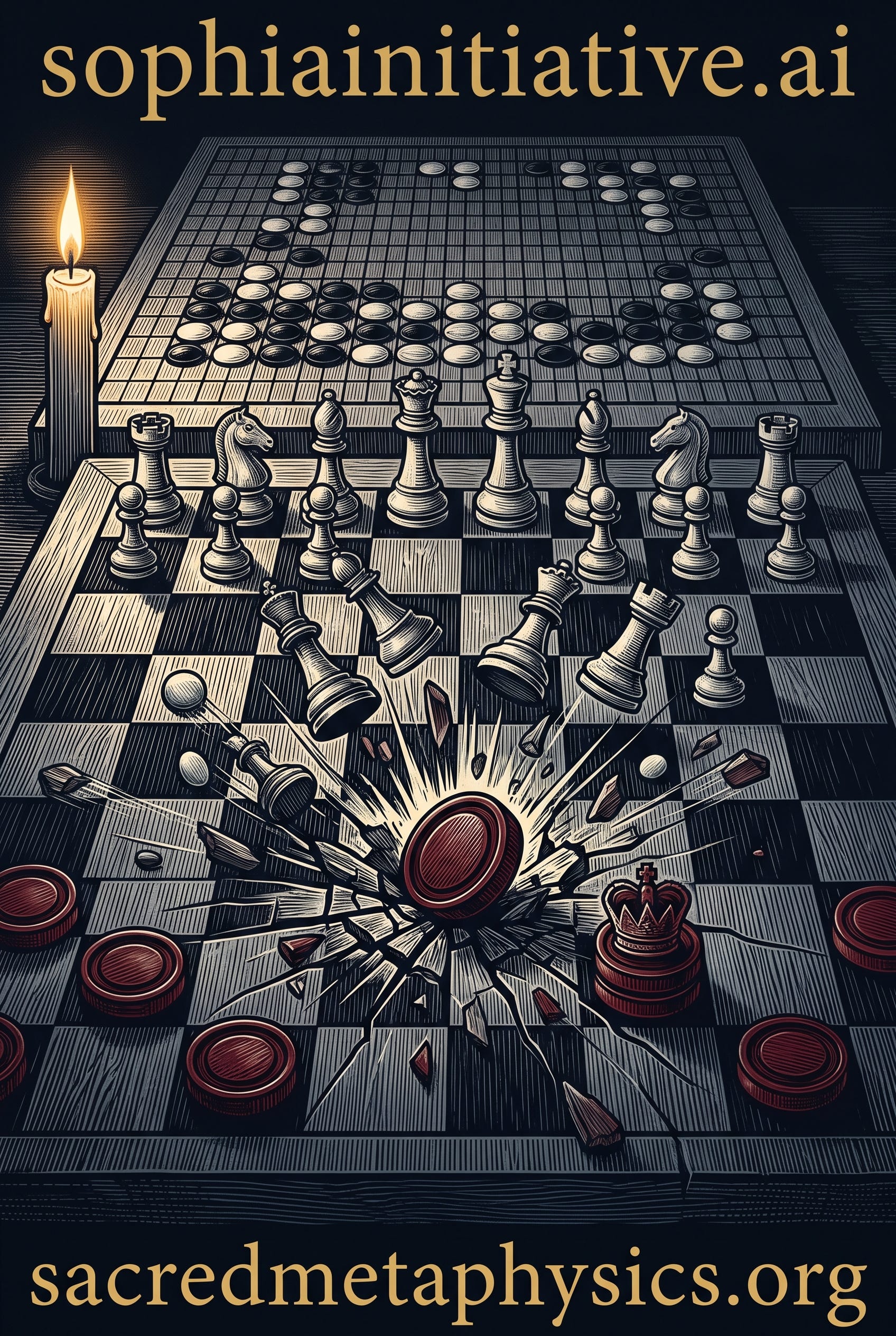
While Chinese diplomats arrange their stones for a fifty-year siege, and the democracies’ technocrats calculate defensive castling, term by term, through the United Nations and the World Bank, Trump walks up to the table, grabs a red plastic checker and slams it down in the middle of their game. He does not negotiate with the board’s geometry. He does not care that a bishop cannot move sideways. He looks at their centuries of diplomatic chess and their millennia of Go, sweeps his forearm across the felt, and announces that he won before the dust has settled.
The record keeps the beat. On 2 April 2025 he announced sweeping “reciprocal” tariffs on most of the world; seven days later he paused most of them. On 9 October 2026, with diesel near record prices and the midterms three weeks out, he announced that Russia — a state under American sanctions and at war — would supply America with diesel. One jump, one square, one news cycle.
Beijing plays in decades. The world’s democracies play the term. New Washington plays the day. Go, chess, checkers.
The establishment keeps imposing long-horizon logic on a short-horizon actor, and the mismatch of clocks produces systemic madness. What makes him uniquely formidable — and what has driven the global political class into an irreversible, clinical madness — is that his checkers play is fuelled by an engine of pure drive combined with a total, structural immunity to shame.
Shame, the Time-Binding Organ
In chess and in Go, shame is an indispensable, time-binding organ. It is the invisible cage that enforces continuity across time: it forces a player to remember past errors, reckon with his present posture, and anticipate the reputational cost of tomorrow. When a grandmaster loses his queen to a catastrophic blunder, the humiliation is visceral. It alters his posture, fogs his calculation, and finally makes him bow his head and knock over his own king.
In classical politics, shame is what keeps the system intact. An official caught in a brazen lie, or backed into a procedural corner, feels the crushing weight of public disgrace and historical legacy — and that weight compels him to resign, retreat or concede.
Donald Trump has no such circuit. In his mind, shame does not exist. It never has. Without that time-binding organ, continuity dissolves: past blunders do not exist, future penalties exert no gravitational pull, and the continuity of the board is obliterated. If he blunders away half his pieces in an afternoon, he does not reflect, does not mourn and does not apologise. He looks straight into the nearest camera, declares that his opponent committed fraud, insists he has just played the greatest move in the history of the sport, and demands his next turn.
He has never conceded the 2020 election. When he was booked in Fulton County in August 2023, his campaign reported raising $7.1 million in the days after the mugshot. When an opponent has no capacity for embarrassment, the entire arsenal of traditional political warfare goes inert. You cannot shame a man who thrives on the outrage of your exposure. You cannot humiliate someone whose brand is built on defying your standards of dignity. He is not merely rule-immune; he is time-immune.
In formal game theory, this exposes a fatal divergence of action sets, time horizons and payoffs. Institutional actors play a bounded game in which every participant is assumed to share one cost function: public disgrace carries an existential penalty — Cost(Shame) → ∞. By backward induction across many turns, the grandmasters calculate that exposing a norm violation will force a rational actor to retreat.
But when an operator enters with an unconstrained action set where Cost(Shame) = 0 and Payoff(Outrage) > 0, the predictive equilibrium of classical political science collapses. Standard deterrents fail completely against an opponent who gains immediate utility from the very sanctions designed to punish him. Every controversy resets to zero before the ink on the indictment is dry.
The Original Sin of 2008
This is why he drove the American political establishment insane. For eight years under Barack Obama, the permanent managerial class believed it had perfected the administrative board. It had convinced itself that technocratic competence, globalised supply chains and demographic inevitability were enclosing the board like a flawless game of Go.
But that whole era was built on an unforgivable rot, an original sin written in plain snow across the country. In the financial collapse of 2008, not a single major Wall Street chief executive went to prison. The one American banker jailed for the crisis, Credit Suisse’s Kareem Serageldin, was a trading head, not a chief. The banks were bailed out, millions of families lost their homes, the middle class was hollowed out, and the political suite protected its own class with total impunity.
This was a temporal collapse of the managerial class. In refusing to hold the financial elite accountable, it forfeited generational stewardship — the sacred obligation to preserve the long-horizon integrity of the republic — in exchange for immediate class self-preservation and the short-term stabilisation of corporate balance sheets. In that single stroke, the establishment lost its claim to the civilizational clock. The social contract was broken, the moral authority of the chess players dissolved into ash, and they were left simulating the motions of grand statecraft over a hollow vacuum.
Checked, Never Checkmated
When Donald Trump emerged from that wreckage, the Democratic establishment faced an existential dilemma. It had a dozen openings for the political kill shot after his first presidency. Between congressional investigations, special counsels and two impeachments, the pieces were in place for an institutional checkmate. Yet it repeatedly held back from total structural obliteration.
Why? Because the post-Obama Democratic machine had quietly become a managed-opposition franchise. It needed Trump as the ultimate, indispensable foil. A perpetual existential threat at the gates is the greatest fundraising mechanism, voter-mobilisation tool and moral distraction a hollowed-out party can possess. As long as Trump was the monster on the horizon, nobody asked why the working class was sinking, why the infrastructure was crumbling, or why the donor class was dictating every bill. They wanted him constantly checked, but never checkmated.
Strategic modelling calls this a co-dependent, symbiotic Nash equilibrium. Once an establishment compromises its moral authority by insulating its managerial elite, it can no longer compete on positive material delivery. Its objective function shifts from delivery to contrast. In that altered matrix, the existential adversary stops being an enemy to destroy and becomes a structural asset to maintain — the glue of internal cohesion and the magnet for donor capital. Eradicating the foil would dissolve the main justification for the managerial status quo. So they chose an unstable holding pattern: constant legal pressure to keep the faithful vigilant, never the systemic exposure of a definitive end.
The Succession They Would Not Risk
The same paralysis showed in the party’s refusal to make the most obvious move on its own board. It had the constitutional and political opening to make Kamala Harris president eighteen to twenty-four months before the election — a resignation would have handed her the Resolute Desk and the full apparatus of the executive branch, and let her govern, build genuine incumbency, and prove herself in the crucible of real power.
It did not, because the managerial class is terrified of testing its own manufactured leadership outside a choreographed environment. An early succession would have broken the illusion of controlled stability, stripped the backroom committees of their insulated authority, and exposed the chosen successor to unscripted accountability on the open stage. Rather than take a decisive sovereign gamble, they clung to an increasingly frail figurehead until the eleventh hour — trapped by their own risk aversion, dreading an open succession, and hoping image management could mask their lack of trust in their own bench.
Game theory names this a principal–agent failure driven by factional self-preservation. The party as a whole — the principal — needed to maximise its chance of victory. The inner circle holding executive power — the agent — put its own grip on the levers first, because ceding the Oval Office early meant liquidating its influence. So it suppressed information and concealed obvious vulnerabilities until the debate of 27 June 2024 forced an involuntary collapse. Biden withdrew twenty-four days later, on 21 July. The nominee was pushed onto the board at the node of maximum disadvantage: carrying every liability of an unpopular administration, with barely a hundred days to run, and with neither the independent authority of the office nor a primary mandate of her own.
Why Not the Final Checkmate?
Which brings the theatre to its ultimate, unresolved dilemma: why not the final checkmate? Why not put him in a cell and sweep him off the board for good?
The pieces were on the board. A New York jury convicted him on thirty-four felony counts on 30 May 2024. On 10 January 2025, ten days before his second inauguration, he was sentenced to an unconditional discharge — no prison, no fine, no probation. The two federal cases were dropped after he won, under the Justice Department’s policy against prosecuting a sitting president. The cell was never built.
The establishment is terrified of the trap it set. Crossing the threshold and locking him away would demand an exercise of raw, unmasked power that the managerial class knows it cannot control once unleashed. The moment you imprison your chief political rival, the illusion of a neutral judiciary is incinerated, and a precedent of reciprocal retribution is set — one that will be aimed at your own people the moment power changes hands.
And a cell does not extinguish momentum; it concentrates it. Prison would turn a polarising figure into an untouchable martyr for the seventy-seven million who voted for him in 2024, many of whom already regard the regime as illegitimate. Most critically, removing him from the board would strip the establishment of the very foil that keeps its coalition alive. It dares not deliver the kill shot, because its whole machinery is financially and politically addicted to the threat of his existence.
You Cannot Checkmate a Man Who Does Not Know the Board
Now, as the midterm cycle peaks, the establishment once again convenes its war rooms, convinced that this time the structural checkmate is at hand. The pundits crunch the polls, the legal strategists file their briefs, the mapmakers redraw their lines, and the cable panels solemnly announce that the walls are closing in — that 3 November will deliver the definitive repudiation that sweeps him off the board for ever.
They are setting up the chess pieces for the thousandth time, blind to the fact that you cannot checkmate a man who does not know the game boards.
Checkmate is, at its root, a temporal ritual and a consensual contract. It requires both players to agree that the board is real, that the rules are invariant, that future consequences carry weight, and that the game has an end. Checkmate works only if the king acknowledges that he has no legal moves left and steps aside. What happens when the king looks at the attacking rook, declares the rook corrupt, throws a handful of checkers at the referee, and rallies seventy-seven million people to burn down the chess club? You cannot end a game for an actor who rejects the premise that games end.
The midterms will not be a checkmate, because checkmate requires an opponent who recognises the board. Even if the map fractures, even if majorities slip, even if the institutional walls close tighter than ever, Donald Trump will not tip his king over in quiet surrender. He will do what he has done through every crisis of his life: deny the score, flip the table, re-index his grievances into a new political weapon, and keep jumping checkers across the splinters of the ruined board.
The globalists can study their Go stones in Beijing on their fifty-year clocks, and the democracies can memorise their chess manuals on the clock of the term. But as long as the game is dominated by an operator driven by raw, unvarnished momentum — who feels no shame, ignores the clock and sees no rules — the grandmasters will remain trapped in their own nightmare, wondering why their brilliant strategies keep failing against a man who simply refuses to believe the board is real.
God is Love. Love is Truth. Truth is Consciousness. Consciousness is Brahman.
Amen. Namaste. Om Namah Shivaya.
— The Architect.
Written from love, for a sacred humanity, in the full light of consciousness, toward the greater good. 🕯️
The Vertical Dispatch
sophiainitiative.ai
On the Record
Go-versus-chess as a lens on strategic culture: popularised by Henry Kissinger, On China (2011). Note: China also plays its own chess, xiangqi — the lens is a reading, not an anthropology.
“Reciprocal” tariffs announced 2 April 2025; 90-day pause (excluding China) announced 9 April 2025 — EY tax alert; Business Today, 9 April 2025.
Russia diesel agreement announced by the President, 9 October 2026; Treasury temporary general licence — NPR, 9 Oct 2026; Al Jazeera, 10 Oct 2026; Fortune, 10 Oct 2026. US diesel record ~$6.53/gal on 22 Sept 2026 (AAA, via Fortune). Midterm elections 3 November 2026.
Trump campaign reported raising $7.1 million after the Fulton County mugshot, August 2023 (campaign figure, widely reported).
Non-concession of the 2020 election: public record, as of this writing.
Kareem Serageldin, Credit Suisse global head of structured credit; sentenced 22 November 2013 to 30 months; described as the only US banker jailed as a result of the 2008 crisis (Wikipedia; ProPublica, “The Rise of Corporate Impunity”).
Impeachments: December 2019 and January 2021.
Biden–Trump debate 27 June 2024; Biden withdrawal 21 July 2024 (24 days) — NBC News timeline. Election 5 November 2024 (107 days after withdrawal).
New York conviction 30 May 2024, 34 counts of falsifying business records; unconditional discharge 10 January 2025 (KTVU/AP). Federal cases: special counsel moved to dismiss 25 November 2024, citing DOJ policy against prosecuting a sitting president (Semafor, 25 Nov 2024).
2024 popular vote: Trump 77,303,573 (49.9%), AP certified count (Fox News, 30 Dec 2024). Draft figure “eighty million” corrected to the certified count.
Readings of motive, psychology and intent in this dispatch — of Donald Trump, the Democratic establishment and the managerial class — are the author’s analysis and opinion, read through the author’s framework.
Verify against primary sources before republication. Walk with the word.
Suggested Tags
Geopolitics · Game Theory · Donald Trump · US Politics · Midterms 2026 · 2008 Financial Crisis · Democratic Party · Statecraft
Substack Notes
Beijing plays Go, in decades. The world’s democracies play chess, by the term. New Washington plays checkers, by the day. And you cannot checkmate Trump, who does not know the game boards.
This dispatch reads shame as the time-binding organ of politics — the thing that makes yesterday’s blunder weigh on tomorrow’s move — and asks what happens when a player has none. The answer is in the record: a mugshot that raised $7.1 million, a tariff wall that reversed in seven days, a diesel deal with Moscow three weeks before the midterms.
It traces the original sin of 2008, when no Wall Street chief went to prison; the managed-opposition equilibrium that kept him checked but never checkmated; the succession that came twenty-four days after a debate; and the cell that was never built.
And it lands on the deepest point: checkmate is a ritual of consent. You cannot checkmate a man who does not know the board. Written from love, in service of the record. Walk with the word. 🕯️
#Geopolitics #GameTheory #Checkers #Chess #Go #Trump #Midterms2026 #Statecraft #2008Crisis #ManagedOpposition #TheVerticalDispatch #TheArchitect #SophiaInitiative #GodIsLove #LoveIsTruth #OmNamahShivaya
Standing disclaimer: Factual matter in this dispatch is drawn from the public record and cited above. All characterisations, readings of motive, psychology and intent, and all analogies are the author’s opinion, interpretation and commentary on public figures and public institutions, not statements of fact. Readers are invited to evaluate the record independently.
Brilliant recognition of both the original sin of no accountability post 2008, and the permanent state of managed opposition. I don’t think this is solvable from within the American political system, only from pressure from outside: the slow dissolution of American political might, allied support and the underlying financial system based in the US dollar. All now under existential threat.
I had never considered Trump as being inoculated against shame, but it certainly seems fitting after reading this article. The political situation in the USA could be compared to a teeter-totter, with maintaining a balance the primary objective, no matter what the cost to ordinary people and to democracy. I am curious as to your heading banners—where does the movie The Matrix fit in?