


James Baldwin, in the second essay of this series, was permitted one sentence about the country in which these words are now being written. Canada is not America, he was made to say — but Canada has its own founding lies, its own structural suppressions, its own history of what was built on whose bodies and at whose expense. That sentence was a promise. This essay is the keeping of it. Baldwin gave the diagnostic; he did not, because it was not his to give, supply the Canadian particulars. The particulars are these: a Royal Proclamation, eleven Numbered Treaties, an Act of Parliament named for the people it was designed to dissolve, a system of schools that ran for more than a century, and a land question that has never been closed and cannot be closed by the methods that opened it. The names and the dates are different. The mechanism, Baldwin warned us, is identical.
It is worth saying plainly, at the outset, what this essay is and is not. It is not a comprehensive history; that would require many volumes and the right authors, and the right authors are not the Architect. It is not a substitute for the testimony of the people whose history this is. It is an attempt to do for Canada the single thing Baldwin demanded of America: to look, and to let what is seen change the way the looker acts. A nation cannot be sovereign — self-governing in the truest and most demanding sense of that word — while it is living inside a lie about itself. Canada has lived inside one for a century and a half. The lie is not that it aspired to be a just and peaceable country. The aspiration was, and is, genuine. The lie is the belief that the aspiration could be realized while the ground the country stands on was taken, by deception and by statute, from nations who had governed it for far longer than there has been a Canada.
Baldwin understood that this is not, at root, a political observation. It is a metaphysical one, and then a structural one. A civilization that cannot see itself clearly cannot govern itself wisely. It will mistake its mythology for its history, and then wonder, when the mythology fails to hold, why the centre will not hold. So we begin where the country began — not in 1867, and not in 1763, but eleven thousand years before either.
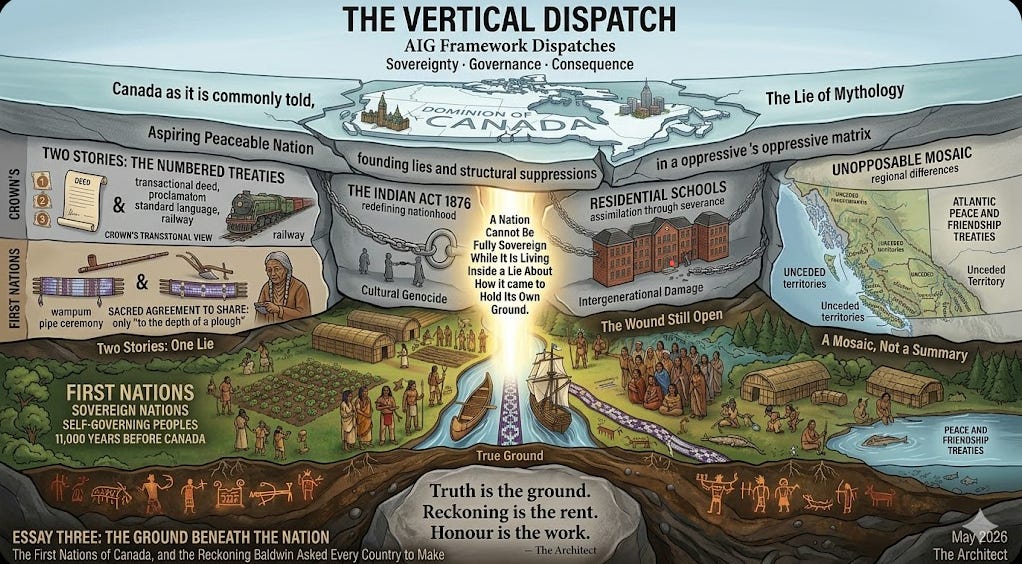
I. Before the Word Canada
For at least eleven thousand years — long before any European set eyes on this part of the world — the lands now called Canada were home to nations. The word matters. They were not scattered bands, not a population, not a demographic awaiting administration. They were sovereign nations: self-governing peoples with distinct languages, distinct laws, distinct cosmologies, and distinct forms of political order. Some were hunters of the great northern woodlands. Some were Haudenosaunee farmers who lived in permanent towns and governed themselves through one of the oldest participatory constitutions on earth, a constitution old enough that some scholars believe it informed the men who later drafted others. They held a relationship to the land that was not sentimental but technical — an exact and inherited knowledge of animal migrations, of seasonal cycles, of what a territory could yield in perpetuity and what it could not. Trade routes and communication networks crossed the entire continent. This was a civilization. It was several civilizations.
This is the first fact that the Canadian story, as it is commonly told, suppresses — not by denying it outright, which would be too crude, but by relegating it to a prologue. The word “prehistory” does this work quietly and efficiently. It places eleven thousand years of human self-government in a vestibule and reserves the word “history” for what began when Europeans arrived to write it down. Baldwin would have recognized the move exactly. He spent his life describing what it does to a human soul to be taught, from the first moment of conscious awareness, that everything of value in the civilization around you — its history, its heroes, its ideals — belongs to someone else, and that your own people enter the story only as its scenery. A nation that tells its history this way is not lying about a date. It is lying about who was here, and who governed, and therefore about what was owed.
The foundation of the relationship was not set by Canada. It was set before Canada existed. The Royal Proclamation of 1763 recognized that First Nations held title to their lands, and established that those lands could not be taken — only ceded, and only to the Crown, and only through formal treaty.
The Royal Proclamation — the Crown’s own first principle
This is the second fact, and it is not a fact that Indigenous nations have to argue for against the grain of Canadian law. It is Canadian law. It is the foundation of Canadian law. The Proclamation did not grant Indigenous title; it acknowledged a title that already existed and predated the Crown’s arrival. It established a single, binding principle: the land was not empty, it was not free for the taking, and the only lawful path to settlement ran through treaty — through the consent of the nations who held the ground. Everything that follows in this essay is the story of a country that wrote that principle into its founding documents and then, for two centuries, built itself as though the principle did not bind it. The contradiction was not held in tension. It was held in contradiction. And the contradiction was not resolved. It was managed.
II. The Numbered Treaties, and the Two Stories Inside Them
After Confederation in 1867, the new Dominion of Canada wanted the West. It wanted the West for a railway, for settlement, for wheat, for the simple territorial appetite of a young state that had decided what it intended to become. Between 1871 and 1921, the Crown and First Nations negotiated a series of eleven agreements known as the Numbered Treaties, and these agreements cover the entire Canadian Prairie and much of the North — an expanse of land difficult to hold in the mind. Treaty 8 alone covers roughly 840,000 square kilometres, an area larger than France. Treaty 7 covers 130,000 square kilometres of what is now southern Alberta, the traditional territory of the Siksika, the Kainai, the Piikani, the Stoney-Nakoda, and the Tsuut’ina. Treaty 6 covers central Alberta and Saskatchewan and the territory of sixteen First Nations. The map of the Numbered Treaties is, in a real sense, the map of how the Canadian state acquired its body.
Here is where the essay must do the most careful work, because the treaties contain two stories at once, and the country has spent a century and a half telling only one of them. The Crown’s story is that the treaties were land transactions: vast territories surrendered in exchange for reserve lands, annual payments, and certain promised services, freely negotiated and lawfully concluded. The First Nations’ story — and it is not a competing interpretation but the testimony of the descendants of the people who were in the room — is that what was being entered into was something else entirely. It was a sacred agreement to share the land. To share it, in the phrase that has come down through the generations, only “to the depth of a plough” — the topsoil that a farmer turns, and nothing beneath it, and nothing of the relationship between a people and their territory that a topsoil is not.
These two stories cannot both be the whole truth, and the gap between them is not a misunderstanding to be smoothed over. The Yellowhead Institute, an Indigenous-led research centre, has described the treaty process, from the Crown’s side, as a deliberate strategy of dispossession — frequently conducted through deception, frequently concluded without anything that an honest observer would call consent. Treaty commissioners arrived to negotiate with nations already weakened by the deliberate collapse of the buffalo economy and by epidemic disease. They negotiated across a chasm of language and of legal cosmology. They made oral promises that did not appear in the written text, and it was the written text, and only the written text, that the Crown later agreed to be bound by. Baldwin would not have called this a tragedy, a word that absolves everyone by attributing the outcome to fate. He would have called it what it was: a thing that was done, by people, to other people, and then renamed.
What were once understood by First Nations as sacred agreements to share the land were, within a single generation, twisted by the Indian Act into a framework for cultural destruction, displacement, and broken promises.
The proof that the treaties were broken is not a matter of interpretation either; it is a matter of acreage, and it is conceded. Under the treaties, reserve land was to be set aside on a defined formula — under Treaty 6, for instance, 128 acres per person. The land actually provided fell short, and the shortfall has a bureaucratic name: Treaty Land Entitlement, the Crown’s own legal obligation to deliver the full amount of land it promised and did not deliver. The shortfall is large enough that it generates ongoing settlements of national scale. In 2022 the federal government agreed to pay the Siksika Nation 1.3 billion dollars to resolve a single historical claim concerning roughly 46,500 hectares of reserve land that had been improperly taken. That is one nation, one claim. The Treaty Land Entitlement file is not closed. It cannot be closed quietly, because what it documents is not an administrative oversight. It is the written, audited, dollar-denominated record of a country that did not keep its own word, recorded in the country’s own ledgers.
Even the total is contested in a way that ought to unsettle anyone who believes the matter is settled. In Alberta alone, the provincial government and the federal government report materially different figures for the total area of reserve land — a discrepancy of hundreds of thousands of hectares between two arms of the same state. A country that cannot agree with itself on how much land is in question has not finished the accounting. It has merely stopped looking at it.
III. The Mosaic — Why There Is No Single Canadian Story
It would be a convenience, and therefore a distortion, to let the Numbered Treaties stand for the whole country. They do not. The legal and historical reality of First Nations in Canada changes dramatically depending on where on the map one is standing, and a reckoning that flattens this mosaic into a single narrative repeats, in gentler form, the original error of treating many nations as one population.
In the Atlantic provinces, the Crown and the Mi’kmaq, Wolastoqiyik and Peskotomuhkati nations signed the Peace and Friendship Treaties between 1725 and 1779. These are fundamentally different instruments from the Numbered Treaties: they did not surrender land or resources at all. They were agreements of peace and of coexistence, and the Supreme Court of Canada affirmed in its Marshall decisions that they carry a living treaty right — to fish, to hunt, to gather, in pursuit of what the Court called a moderate livelihood. That right is not a historical artifact. It is in force, and it is contested, now.
In British Columbia, the situation is different again, and starker. Most of the province was never ceded by treaty at all. It is, in the legal sense, unceded territory — land whose Indigenous title was never surrendered, never extinguished, never lawfully acquired by the Crown under the very principle the Crown itself proclaimed in 1763. The modern British Columbia treaty process, decades long and still underway, exists to address precisely this: a province largely built on ground to which the builder never obtained title. Quebec’s history runs along yet another track; Ontario’s treaty map is a dense overlay of more than forty separate agreements signed across two centuries; the North is a patchwork of historic adhesions and modern agreements.
The point of naming this variety is not encyclopedic. It is moral, and it is precisely Baldwinian. Baldwin refused, all his life, to be conscripted into a simple story — refused the protest novel, refused the role of the representative Negro writer, because a simple story, however righteous, destroys the complexity that is the actual texture of human lives. The Canadian reckoning faces the same temptation in reverse: the temptation to a single tidy narrative of guilt that can be felt all at once and then set down. The truth is a mosaic of distinct nation-to-nation relationships, each with its own history, its own law, its own unfinished business. To honour it is to refuse the comfort of the summary.
IV. The Indian Act and the Schools
A treaty is a relationship between nations. The Indian Act, passed in 1876, was the instrument by which Canada attempted to dissolve the nationhood on the other side of that relationship. This is the hinge of the entire history, and it must be stated without softening. The treaties were signed nation to nation. The Indian Act then redefined one of the nations out of existence — converting sovereign peoples into legal wards of the state, defining in Ottawa who counted as an “Indian” and who did not, governing movement, governing the holding of land, at various times outlawing ceremony and outlawing the raising of funds to pursue land claims in the courts. A country had made a sacred agreement to share a continent, and then legislated away the legal personality of the party it had made the agreement with. Baldwin’s metaphysical argument applies here with a terrible exactness: you cannot dehumanize another people without losing, incrementally and then catastrophically, something essential in yourself.
The most catastrophic instrument of that policy was the residential school system. For more than a century — the first federally funded schools opening in the 1880s and the last not closing until 1997, which is to say within the adult lifetime of millions of living Canadians — Indigenous children were removed, frequently by force and frequently against the will of their parents, from their families and their communities and placed in institutions run by the churches and funded by the state. Roughly 150,000 First Nations, Métis and Inuit children passed through them. The purpose of these institutions was not, despite the word “school,” primarily education. The purpose was assimilation through severance: to cut the child’s ties to language, to culture, to family, to spiritual life, and in the notorious phrase of the era, to “kill the Indian in the child.” Canada’s own Truth and Reconciliation Commission did not flinch from the proper term. It called this what it was: cultural genocide.
The children were forbidden their languages. They were frequently subjected to neglect, to physical abuse, to sexual abuse. Many of them died — of disease that the conditions of the schools invited, of causes the institutions did not always trouble to record — and many of those children were buried in graves that were never marked and never disclosed to the families whose children they were. The harm did not end when the last school closed. It is intergenerational by its nature: a parent who was taken at six and frozen there, denied the experience of being parented, cannot simply summon at twenty-six the capacity to parent that was deliberately withheld. The damage transmits. It is transmitting now. This is not a closed chapter of Canadian history. It is a wound still doing its work, and the country contains, at this moment, the survivors and the children of survivors and the grandchildren, carrying it.
These were tools of cultural genocide. Their stated aim was to kill the Indian in the child — to sever a human being, while still a child, from language, from kin, from the sacred, and from the nation into which they were born.
On the residential school system, in the words of Canada’s Truth and Reconciliation Commission
V. The Wound That Is Still Open
Baldwin’s great refusal was the refusal to let his country place its crime safely in the past. The crime, he insisted, was not an event but a structure, and a structure does not end; it reproduces. It reproduces in institutions, in economics, in the daily arithmetic of whose life is treated as worth what. The Canadian who wishes to believe that the residential schools and the broken treaties belong to a finished history must answer the present-day figures, and the present-day figures do not permit the belief.
Consider what the structure produces now. Indigenous adults are incarcerated in Canada at roughly ten times the rate of non-Indigenous adults; Indigenous women make up an even more staggering share of the federally sentenced female population. Indigenous children are vastly over-represented among children removed from their families by the child welfare system — by some measures more than ten times as likely to be taken into care — which is to say that the separation of Indigenous children from Indigenous families, the exact mechanism of the residential schools, did not end. It changed departments. And the National Inquiry into Missing and Murdered Indigenous Women and Girls found that Indigenous women and girls face violence on a scale that the Inquiry did not hesitate to call a genocide, ongoing — that they are murdered or go missing at many times the rate of other women in Canada. The Inquiry issued 231 Calls for Justice in 2019. Progress against them has been, by the assessment of the people most affected, slow.
These are not disconnected social problems, to be addressed each in its own policy silo. They are, in Baldwin’s precise sense, the structure — the founding contradiction, reproduced into the present, wearing the modern uniforms of corrections and child protection and unsolved cases. A country that built a legal architecture to ensure that certain lives would count for less does not undo that architecture by regretting it. The architecture is still standing. It is still doing the work it was built to do. To see this clearly is the beginning of the only kind of governance Baldwin would have recognized as honest.
It would be a dishonest essay, however, that recorded only the wound. The same period that produced these figures has also produced something else: the steady, deliberate, nation-led work of repair, undertaken in most cases not because the state initiated it but because Indigenous nations forced the question. The Truth and Reconciliation Commission issued 94 Calls to Action; they are a public ledger against which the country can be measured, and is measured, each year. A modern treaty era, beginning with the James Bay and Northern Quebec Agreement in 1975, has produced — by the Government of Canada’s own count, marking the fiftieth anniversary of that first agreement — twenty-seven modern treaties now in effect, covering more than forty per cent of Canada’s landmass and involving more than ninety Indigenous communities. These modern treaties differ from the historic ones in the one respect that matters most: they do not aim to extinguish Indigenous nationhood. They affirm it. They are constitutionally protected, and most carry the right of self-government — the recognition, at last, of the party on the other side of the table as a party, a nation, a government. Federal legislation has begun to affirm Indigenous jurisdiction over child and family services, returning to communities the right to care for their own children. None of this is the completion of the work. All of it is the shape the work takes when it is done honestly: not the management of the lie, but the slow construction of the conditions under which the lie need no longer be maintained.
VI. The Sovereignty Proposition, Brought Home
This series has insisted from its first essay that its true subject is sovereignty — not the sovereignty of states, though that is implicated, but the sovereignty of the self-knowing civilization, the political body capable of honest reckoning with its own history and its own shadow. Baldwin’s argument, applied to Canada, arrives at a conclusion that the comfortable version of Canadian patriotism is not prepared for, and that the honest version requires.
Canada cannot be fully sovereign while it is living inside a lie about how it came to hold its own ground. This is not a moral scolding; it is a structural diagnosis, and it cuts in an unexpected direction. A state that has not honestly reckoned with the treaties is a state whose own legal title is, at the foundation, unsettled — because the treaties are not an Indigenous grievance external to Canadian sovereignty, they are the instrument on which Canadian sovereignty over most of the country is supposed to rest. The unceded territories make this starkest of all: a country cannot claim to be the lawful and untroubled sovereign of land it acknowledges, in its own courts, was never lawfully acquired. The reckoning with First Nations is therefore not a debt that a secure Canada generously turns to address from a position of strength. It is the precondition of the security itself. Baldwin said exactly this about America and the liberation of Black Americans: he was not being generous, he was being precise. The healing was something the powerful party needed for its own survival.
And here the Canadian case yields something that even Baldwin, writing of America, could only gesture toward — because in Canada the other party to the founding agreement is not asking to be admitted to the existing nation’s story. The First Nations were nations before Canada and remain nations within it, and they have never required Canada’s permission to be so. The treaties, properly understood, were never a transfer of everything to one sovereign. They were, in the image of the Two Row Wampum that the Haudenosaunee have used for centuries to describe such an agreement, two vessels travelling the same river side by side — each with its own laws, its own governance, its own course — neither steering the other. That image is not a metaphor invented for reconciliation’s sake. It is older than the country. It is, in fact, the original Canadian constitutional proposition, and the country has spent a century and a half failing to live up to a settlement it had already been offered.

Not everything that is faced can be changed. But nothing can be changed until it is faced.
James Baldwin
Every nation that wishes to be sovereign in the truest sense — not merely militarily independent, not merely economically autonomous, but genuinely self-governing, capable of the honest self-knowledge that real governance requires — must reckon with its own version of what Baldwin diagnosed. For Canada the version is specific and it is nameable: the eleven thousand years before the word Canada, the principle of 1763, the two stories inside the Numbered Treaties, the Act that tried to dissolve a nation, the schools, and the figures that prove the structure is still standing. To face these is not to perform facing them. It is not to look, and then immediately construct a narrative that manages the discomfort of what was seen. It is to look, and to let what is seen change what is done.
Baldwin did not want his account of history to replace the official account as a new and rival orthodoxy. He wanted the truth — complex, painful, irreducible to any single perspective — to be told, and he wanted the room to be large enough to hold it. That is the right note on which to end an essay written by a settler hand about a history that is not the settler’s to narrate. This essay does not speak for First Nations; it cannot, and it should not try. What it can do is what Baldwin asked every member of every implicated nation to do: to refuse the comfort of not knowing. The knowing is available. The Truth and Reconciliation Commission spent six years assembling it; the survivors spent their courage giving it; the calls to action and the calls for justice are written down and public and waiting.
For the country to heal, this history must move from the margin of the Canadian story to its centre — not as an appropriated guilt that the settler population performs and then sets down, but as received knowledge that changes how the country is governed. There is a difference between the two, and it is the whole difference. Appropriation takes the history and leaves the wound. Reception takes the history and shares the weight of what it cost, and is still costing, the people who carry it. The First Nations of Canada were here for eleven thousand years before there was a Canada. They governed themselves, and they govern themselves still, and the treaties were always meant to be a way for two sovereignties to share one river without either capsizing the other. That agreement has not been honoured. It has not, in most of the rooms where it needs to be heard, yet even been fully heard.
The hearing of it, in every room that will receive it, is the work that remains. It is the work of generations, and the generations are already at it. The only question the essay can honestly put to its reader is Baldwin’s question, in its Canadian form, and it is not a rhetorical one: a country that learns the truth of its own ground — will it let the truth change what it does? Nothing can be changed until it is faced. The facing is available now. It always was.
The land was never empty. The agreement was always to share it.
Truth is the ground. Reckoning is the rent. Honour is the work.
— The Architect
#TheVerticalDispatch #TheLastAmericanEnlightenment #TheArchitect #JamesBaldwin #BaldwinLegacy #TheFireNextTime #FirstNations #FirstNationsCanada #IndigenousCanada #Indigenous #TruthAndReconciliation #ReconciliationCanada #TRC94CallsToAction #NumberedTreaties #TreatyRights #LandBack #RoyalProclamation1763 #ResidentialSchools #EveryChildMatters #CulturalGenocide #MMIWG #CallsForJustice #IndianAct #TreatyLandEntitlement #ModernTreaties #IndigenousSovereignty #IndigenousRights #UnceddedLand #TwoRowWampum #DecolonizeCanada #CanadianHistory #SettlerColonialism #NationToNation #ReconciliationIsEveryonesWork
This…needs to be taught in school. Taught at a depth that is equal to the importance of this truth and in recognition of our failures to live up to it. The recognition of the cost to all of us, born from those failures and systemic exclusions, generationally repeated, until we can embrace the truth and reconcile the oppression and loss. Only then will we gain the full future that the promise of treaty embraces. Only then will we be a true Nation…only when each of us learns this lesson.