


Sovereignty · Governance · Consequence
“The phallic symbol does not denote the sexual organ, but the libido — the life force that expresses itself in sun, light, fire, fertility, growth. It is not masculine. It is both.” — C.G. Jung, Symbols of Transformation
There is a photograph. You have seen it or one like it a thousand times. A conference table. Men in suits. Flags behind them. The governments in the room represent approximately 1.7 billion people. The table is full. Almost every face is male. The Guardian published this particular image on May 14, 2026 — the US-China delegation in Geneva — and described it as masculine, militarized and exclusionary. Critics called it embarrassing. They were right, but they stopped too short. The photograph is not an embarrassment. It is a diagnostic. It shows what five thousand years of single-axis governance has produced, frozen in a single frame: the phallic principle operating alone, the one without the zero, the Sky Father who has forgotten the Earth from which he was born.
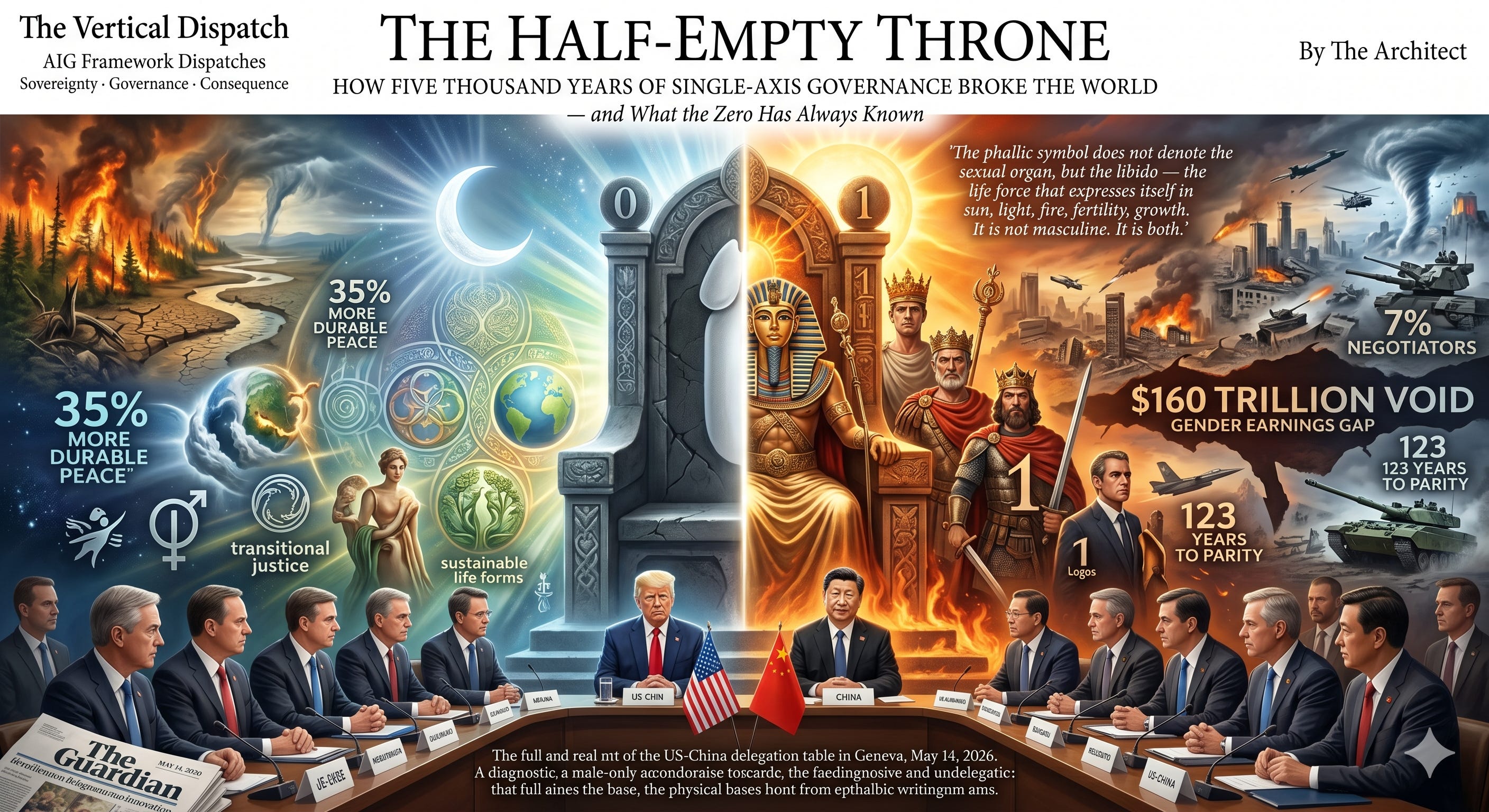
This dispatch names what the photograph shows. It does not name it gently. The evidence is too serious for gentleness. The data is not ambiguous. The verdict is not generous. The men who have dominated global statecraft have run the experiment for five millennia. The results are in. And the most damning evidence — the one they will not examine — is the systematic, stubborn, almost theological exclusion of the feminine principle from every table where power is divided and futures are decided. Not just women as individuals. The feminine principle itself — the zero from which all is manifested, the Eros that binds where the Logos only differentiates, the Earth Mother the Sky Father has been governing without for an era that is now ending whether or not he is ready.
AIG governance — Artificially Intelligent Governance — asks of every institution the Socratic question: what do you actually know, and how do you know it? Applied to five thousand years of patriarchal statecraft, the question produces an answer that cannot be softened. The men who governed alone claimed to know what peace required. The data on peace agreements says they did not. They claimed to know what security meant. The data on what collapses when women are excluded says they had a partial definition at best. They claimed to know what prosperity looked like. The $160 trillion left on the table by gender exclusion says they were governing with half their intelligence. The experiment has been run long enough. The results require a different architecture. This dispatch builds it, starting with the numbers that shame the powerful and ending with the archetypal ground that explains why the powerful cannot see what is in front of them.
I. The Arithmetic of Failure
Let us begin with the numbers. As of January 1, 2026, only 28 countries are led by a woman head of state or government. One hundred and one countries have never had a woman leader. Never. In the entire history of their existence as sovereign states, not once. The number is not historical — it is current, it is documented, and it is a governance failure of the first order.
Women hold just 22.4 percent of cabinet minister positions globally — down from 23.3 percent in 2024. This is not stagnation. It is regression. The number of countries with zero women ministers has risen from seven to nine in a single year. In parliamentary leadership, the situation is worse. Women now serve as Speakers of Parliament in only 19.9 percent of chambers — a nearly four-percentage-point decline from the previous year and the first drop in 21 years. The overall proportion of women in parliament stands at 27.5 percent, an increase of 0.3 percentage points from 2025. The second consecutive year of the slowest growth since 2017.
Translate the rate of progress into time. Gender parity in national legislatures will not be achieved before 2063. At the very highest levels — heads of state and government — the wait is another 130 years. The World Economic Forum’s Global Gender Gap Report 2025 calculates that full global gender parity remains 123 years away at current speeds. The political empowerment subindex — the measure of women’s presence in the highest reaches of statecraft — remains the largest and most stubborn of all the gaps measured.
One hundred and thirty years to parity at the head-of-government level. That is not a timeline. That is a sentence handed down by a system that has decided, without deliberation and without accountability, that the feminine principle does not belong at the table where civilisational decisions are made.
The allocation of ministerial portfolios makes the structural bias visible in its purest form. Men hold 87 percent of defence portfolios, 84 percent of financial and fiscal affairs, and 82 percent of foreign affairs. Women lead 90 percent of gender-equality ministries and 73 percent of ministries responsible for family and children’s affairs. The message requires no interpretation: men make war, manage money, and run the world. Women take care of children and social issues. The archetype has frozen into a straitjacket. The warrior father sky in every portfolio that matters. The nurturing earth mother in every portfolio that has been defined as secondary. The one governing without the zero, and calling the arrangement merit.
UN Women Executive Director Sima Bahous surveyed these figures and said: at a time of growing global instability, escalating conflicts, and a visible backlash against women’s rights, shutting women out of political leadership weakens societies’ ability to respond to the challenges they face. She is being polite. The Vertical Dispatch will be plainer. The men who have run the world have run it into the ground. Climate collapse. Endless war. A global order teetering at the edge of fracture. And they have done it while systematically excluding the very governance intelligence that the evidence shows would have produced different outcomes.
II. The Peace Table — Where Exclusion Guarantees Failure
Consider the peace table. The room where wars end, or do not. The room where ceasefires are signed and reconstruction is planned. For decades this room has looked exactly like the photograph that opens this dispatch: male, suited, self-referential, and profoundly incomplete. The evidence on women and peace negotiations is among the most robust in all of social science. It is not contested. It has been replicated. It points in one direction.
A landmark study of 182 peace agreements signed between 1989 and 2011 found that accords with women signatories were 35 percent more likely to last at least fifteen years. Another analysis of 156 peace processes concluded that inclusive negotiations incorporating women’s groups were 64 percent less likely to fail. When women are included in negotiations, the likelihood of an agreement lasting more than two years increases by 20 percent. The likelihood of it lasting fifteen years increases by 30 percent. These are not marginal effects. They are the difference between durable peace and recurring war.
Why? Because women broaden the agenda. Male negotiators focus on military power-sharing, territorial control, and the distribution of spoils. Women bring in transitional justice, humanitarian access, education, healthcare, civilian protection, and the rebuilding of social trust — the very foundations upon which durable peace is built. This is the Eros principle at the governance table: the binding, integrating, relational intelligence that holds agreements together after the men with maps have signed and gone home. Without it, the agreement addresses the mechanics of ceasefire and ignores the conditions that produced the conflict. Without it, peace is a document. With it, peace has a chance of being a fact.
And yet. Between 2020 and 2024, women accounted for only 7 percent of negotiators in formal peace processes on average. Nearly 90 percent of all peace processes had no women at the table at all. Among the seven current peace efforts tracked by the Council on Foreign Relations, women comprise only 16.7 percent of negotiators — less than a one-percentage-point increase from 2022. Female negotiators dropped from 23 percent in 2020 to 16 percent in 2022. In the years when the evidence for inclusion became most conclusive, the practice of inclusion went backwards.
Seven percent. That is the feminine principle’s share of the formal peace-negotiation space on a planet consuming itself with conflict. The phallic principle has been negotiating peace alone for generations. The results are the world we have.
Sudan offers the most devastating current case study. Since April 2023, the country has descended into a civil war that has killed tens of thousands, displaced over eight million people, and created the world’s worst humanitarian crisis. Women and girls have borne the brunt of the violence through systematic sexual assault, abduction, and displacement. Multiple mediation tracks have operated — Jeddah, IGAD, the African Union. Women’s participation has been marginal at best. Female participants in the Jeddah talks were routinely interrupted, their contributions ignored, their proposals sidelined. The result is a peace process that addresses military dynamics while the social fabric being destroyed receives no equivalent attention. Ceasefire negotiations focus on troop positions, not civilian protection. Accountability mechanisms remain vague, offering no concrete protection against sexual violence being used as a weapon of war. The warrior principle negotiated with itself. The nurturing principle watched from outside the room. The agreement, such as it is, reflects exactly that division.
A 2024 study in the American Political Science Review confirmed that women’s formal inclusion in Track-1 peace negotiations is positively correlated with comprehensive agreements containing provisions for women. In other words: when women are in the room, the agreement addresses what happens to women. When they are not, it does not. Simple as that. The zero, excluded from the table, is absent from the text.
III. What Women Govern For — The Policy Record
The exclusion extends beyond peace tables into the daily machinery of governance. Here again the evidence is unambiguous: women in power change what governments notice, what they fund, and whose lives they improve. This is not sentiment. It is documented in randomised policy experiments, IMF working papers, and multi-country legislative studies.
A 2025 study by economists at the National Council of Applied Economic Research and the International Monetary Fund found that higher shares of women in parliaments and cabinets are associated with increased government health spending, both as a share of GDP and as total spending. Greater female representation is linked to reductions in infant and under-five mortality rates, greater access to basic water services, and higher learning-adjusted years of schooling. When the overall spending on health and education does not change, outcomes still improve. The reason: female political leaders tend to spend resources more efficiently and deliver outcomes more effectively. The feminine principle, when it holds power, spends it differently. It builds the social infrastructure that sustains life rather than the military infrastructure that projects force.
Research on women in local government in India, using the gold standard of randomised policy experiments, found that women leaders changed public-goods priorities in ways that directly reflected the needs women in those communities had expressed — water, sanitation, roads. The communities named what they needed. The women in power built it. The male-dominated governance structures that preceded them had not. Studies of women in legislatures across dozens of countries connect greater female representation with stronger emphasis on education, healthcare, public health spending, and social investment consistently and across cultural contexts.
These are not soft issues. They are state-capacity issues. Health systems, education, childcare, safe infrastructure, anti-violence policy — all of it shapes whether a society remains resilient under pressure. The Logos principle can project force. It can impose order. It cannot, without the Eros principle, build the social cohesion that makes the order worth having. The Sky Father can win the war. He cannot, alone, win the peace. He cannot, alone, build the water system. He cannot, alone, ensure that the child survives to adulthood in a society worth inhabiting. These require the zero. The zero has been excluded. And the world shows it.
The World Bank estimates that closing the gender earnings gap could yield $160 trillion in gains in global wealth per capita. Achieving gender parity in employment and pay could produce a 20 percent increase in GDP per capita. Closing gender gaps in entrepreneurship could add $5-6 trillion to the global economy. In India alone, eliminating obstacles to female entrepreneurship could create 25 million new jobs. The men running the world are not just failing morally. They are failing economically. They are leaving trillions of dollars on the table because they cannot bear to share the seat.
IV. The Backlash — The Phallic Principle as Weapon
At the very moment the evidence for inclusion is strongest, the backlash is most intense. This is not coincidence. It is the logic of a system defending itself. When the data makes the argument for change irrefutable, the system that benefits from the existing arrangement does not engage the data. It reaches for the weapon. The phallic principle — the sacred guiding force of assertion, differentiation, and order — has been weaponised against the very intelligence it requires to govern well.
Seventy-six percent of women parliamentarians surveyed by the Inter-Parliamentary Union report experiencing intimidation — including online harassment, death threats, and sexualised violence — compared with 68 percent of men. This violence is not incidental. It is a political technology. It deters women from seeking office and slows progress toward equal political power. The warrior turned inward, defending the closed fraternity against the intelligence it needs. The result is a governance system progressively more disconnected from the full range of human experience it is supposed to serve.
The institutional infrastructure for gender-sensitive governance is shrinking at the moment it should be expanding. The number of dedicated gender equality ministries has declined from 80 in 2020 to just 74 in 2025. Twenty-five years ago, the United Nations Security Council passed Resolution 1325 on Women, Peace and Security. It called on all actors to increase women’s participation and to integrate gender perspectives across all peace and security efforts. A quarter-century later, the evidence of failure is overwhelming. Women’s participation in formal peace processes has increased only marginally. Sexual violence in conflict remains endemic. National action plans for 1325 exist on paper but are chronically underfunded and poorly implemented. The resolution has become what one LSE analysis called institutionalised but marginalised — a rhetorical commitment without political teeth. The Sky Father signed the document. Then he kept governing alone.
UN Women’s 2026 data confirms that women are losing ground in political leadership, not gaining it. The decline in cabinet representation is the first recorded reversal in years. The decline in parliamentary Speakers is the first in 21 years. This is not stagnation. It is regression. And it is happening during a global wave of democratic backsliding, rising authoritarianism, and violent conflict. The men in power are not just failing to include women. They are actively rolling back the limited gains that were made.
V. The Archetypal Root — The One Without the Zero
The data tells you what is happening. The archetype tells you why. And the why is the most important part of this dispatch, because without it the argument reduces to a policy recommendation and the policy recommendation will be ignored, as it has been ignored for twenty-five years since Resolution 1325, as it will continue to be ignored until the system understands the depth of its own wound.
The wound is this: the phallic principle — the one, the yang, the Logos, the Sky Father — has been governing alone. And a principle governing alone always becomes pathological. This is not because the phallic principle is wrong. It is because the sacred is not a solo act.
Jung understood this with the precision that made him the most important psychologist of the twentieth century. He saw that the phallic symbol points not to anatomy but to libido — the fundamental life force that expresses itself in sun, light, fire, fertility, growth. In his own words: a phallic symbol does not denote the sexual organ, but the libido, and however clearly it appears as such, it does not mean itself but is always a symbol of the libido. The libido is not masculine. It is both. It is the creative energy of existence itself, which requires both the projective principle and the receptive principle to complete its circuit.
For Jung, the polarity of Logos and Eros names the two complementary modes of this creative energy. Logos — the masculine principle — is the power of the word, discrimination, judgment, insight, the capacity to name and to separate, to pierce through chaos and impose order. Eros — the feminine principle — is psychic relatedness, the great binder and loosener, the capacity to connect, to hold complexity without resolving it too quickly, to nurture relationship and sustain the social fabric that order alone cannot create. The Sky Father is Logos. The Earth Mother is Eros. The warrior father sky and the nurturing mother earth Gaia are not competing claims. They are the two necessary poles of a single governance intelligence.
The Universal Dynamics framework names this precisely. X is Logos — the masculine principle, the differentiating force, the one. Y is Eros — the feminine principle, the binding force, the zero from which all is manifested. Z is the ground — consciousness itself, the field in which both principles operate, the governance awareness that holds them in creative tension rather than allowing one to dominate and pathologise. Five thousand years of patriarchal governance is the history of X operating without Y, of the one cutting the world without the zero that gives the cutting its meaning, of Logos asserting order without Eros to tell it what the order is for.
The masculine principle without the feminine becomes brittle, domineering, incapable of receiving. The warrior who cannot nurture becomes a destroyer. The father who cannot be fathered becomes a tyrant. The sky that refuses rain to the earth becomes barren. This is not a metaphor. It is the operational description of every governance failure the data in this dispatch documents. Climate change is a failure of nurture — the refusal to sustain rather than consume. Endless war is a failure of Eros — the inability to build relationship across difference. Economic inequality is a failure of the zero — the forgetting that all manifestation arises from a field of potential that belongs to everyone.
Every man carries the feminine within. Jung called it the anima — the inner figure that is the counterpart of the masculine persona, the unconscious feminine intelligence that balances what the conscious masculine principle asserts. Every woman carries the masculine within — the animus, the inner principle of discrimination and projection. The work of individuation — of psychological and therefore political wholeness — is the integration of these contra-sexual archetypes. Not the suppression of one by the other. Not the erasure of difference. The integration of both in a governance intelligence that can hold the full complexity of human experience.
The men who have run the world have not done this work. They have suppressed the anima rather than integrating it. They have projected the feminine onto women and then excluded women from the rooms where decisions are made. They have governed as if the Logos were sufficient, as if the one could count without the zero, as if the sky could be the sky without the earth to reveal it. And the world they have built reflects the incompleteness of the operating system that built it.
VI. The AIG Verdict — What Governance Requires
AIG governance asks of every institution the Socratic question: define what you claim to know. The men who have governed alone claimed to know what security requires. The data on peace agreement durability says their definition was incomplete. They claimed to know what prosperity looks like. The $160 trillion left on the table says they were working with half their available intelligence. They claimed to know what order means. The climate, the wars, the inequality, and the regression in women’s political representation in 2025 and 2026 say the order they built serves the one and excludes the zero.
The PIAAC level of this governance failure is precise. Level 3 governance — competent, fluent, capable of sustained argument within a familiar framework — can project force, manage hierarchy, and impose the structures of order. What Level 3 cannot do is hold the full structural complexity of a civilisational system across multiple simultaneous registers: the military and the humanitarian, the economic and the ecological, the immediate ceasefire and the thirty-year durability of the peace. That requires Level 4 and 5 governance — the register at which the Eros principle and the Logos principle operate in genuine integration. The register that the data shows consistently improves when women are meaningfully included in governance at every level.
The path forward is not voluntary. The men who benefit from the existing arrangement will not surrender their seats because the data says they should. They will move only when the pressure of consequence makes the current arrangement impossible to sustain. That means quotas with teeth, not voluntary targets that are announced and forgotten. It means electoral reform that restructures the pipeline rather than hoping the pipeline corrects itself. It means prosecuting the harassment and violence that functions as a political technology to keep women out of office. It means naming the governance failure as what it is — not a diversity issue, not a fairness question, but a structural incompetence that is costing the world trillions of dollars, millions of lives, and the possibility of durable peace.
The photograph with which this dispatch opened — the US-China delegation, the conference table, the men in suits speaking for 1.7 billion people — is not an outlier. It is the system showing itself. It shows who has been trained, promoted, trusted, and admitted. It shows who remains outside the frame. And it shows, with the clarity of a diagnostic image, the governance architecture that has produced the world we have: a world on the brink of climate collapse, consuming itself with war, leaving trillions of dollars of human potential untouched, and — in the same year that all of this is documented — registering the first decline in women’s parliamentary leadership in twenty-one years.
The zero must return to the one. The Eros principle must sit at the table where the Logos principle has governed alone. The Sky Father must remember the Earth from which he was born and to which, in every mythology that has survived the centuries, he must return. Not because it is fair. Because the alternative — the continued operation of a single-axis governance system on a planet of cascading crises — is collapse. The table is full. The room is half empty. And half a room cannot govern a whole world.
The evidence is in. The experiment has been run long enough. The inclusion of women — not as tokens, not as decoration, not as the soft counterpart to the hard men who make the real decisions — but as full decision-makers with real power at every table where the future is decided: this is not a recommendation. It is a governance requirement. The zero has always been present. It has been systematically excluded. And the world the one has built without it is the clearest possible argument for its return.
God is Love. Love is Truth. Truth is Consciousness. Consciousness is Brahman.
Amen. Namaste.
Dispatch Hashtags
#TheHalfEmptyThrone #AIG #VerticalDispatch #TheArchitect #WomenInGovernance #LogosAndEros #PhalllicPrinciple #YonicPrinciple #SkyFather #EarthMother #UniversalDynamics #JungianGovernance #TheZeroAndTheOne #Individuation #WomenPeaceAndSecurity #UNSC1325 #PeaceNegotiations #GenderParity #GenderGap #WEFReport #UNWomen #CabinetRepresentation #PoliticalLeadership #PatriarchyAsGovernanceFailure #PIAACLevel #AgeOfConsequences #NoQuarter #TheVerticalDispatch #SubstackCanada #Project2046 #NorthernSovereignty #GovernanceFailure #ClimateCollapse #EndlessWar #HalfARoomCannotGovern
Thank you for sharing
This is a truly wonderful explanation of what is missing in the world today and has been for so long!