


Φ
THE VERTICAL DISPATCH
We write for the mind, the eye, and the ear.
Read it. Look at it. Listen to it. The Vertical Dispatch is built for all three — prose with rhythm, made to be heard as much as read.
From metaphysics to geopolitics, from culture to history, from the sacred to the street — and everything in between. One lens, every subject. No ego. Just the record, named clean.
Press play. Walk with the word. 🕯️
This dispatch travels by hand. If it serves you, share it — restack on Substack, and pass it on wherever you read. 🕯️
The Age of Consequences · A Climate Overture
June 28, 2026
THE HEAT AND THE THREE ANSWERS
Europe is burying its dead in June. Three nations have answered the same warming world three different ways — and tomorrow we open a series on the steward who chose the middle road. First, the heat, the record, and who is keeping it.
“The ‘once-in-a-generation’ heatwave is now occurring nearly annually. Europe is the fastest-warming continent on Earth, heating at twice the global average.”
— Dr. Tedros Adhanom Ghebreyesus, Director-General, World Health Organization, June 28, 2026
The Heat, and the Count
As this is written, Europe is burying its dead. France’s public health agency reported on June 28 roughly one thousand more deaths than expected during three days at the peak of the heat wave — daily deaths climbed above fourteen hundred from a spring baseline near one thousand — and stressed the figure is preliminary and almost certainly an undercount, with deaths at home and in care still being tallied. Eighty-five per cent of the dead were sixty-five or older. Across the continent the World Health Organization counted more than thirteen hundred excess deaths since June 21. France recorded its hottest day since records began in 1947; Britain its hottest June day ever; Germany broke its record three days running. The heat is moving east, and France’s health minister warned the toll could climb for ten days after the temperatures ebb. “The episode is not finished.”
And the machinery of modern life answered the heat by failing. Grids buckled; sixty-three thousand French households lost power. The concrete surface of highways broke apart. Germany’s rail operator told passengers to avoid all unnecessary travel; six hundred people were evacuated from an overheated train after its doors locked and its air conditioning died. This is the thread — not the weather, which is a season, but the world we built to live in it, and whether that world was made for the climate we now have. We have written that story at length in its own dispatch, on the machine built for another world. Here we widen the lens, because the heat raises a harder question than how to survive a week. It asks what a nation decides to do about the warming itself — and on that, the free world has split into three answers.
Who Keeps the Record
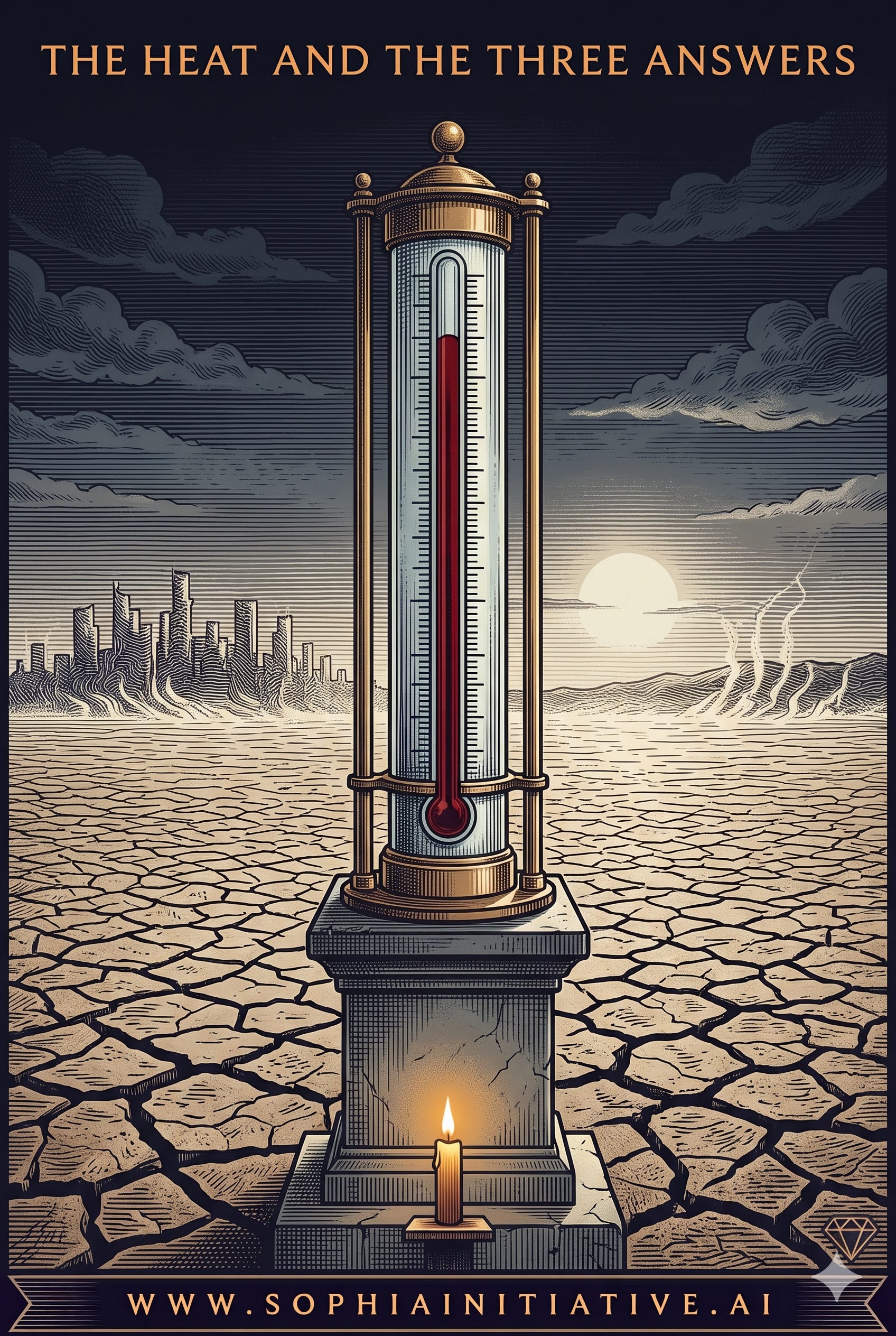
First, though, a word on measurement, because this house does not preach the science — it reports who keeps it. The numbers above are not opinions. They come from instruments and institutions built to take the planet’s temperature without fear or favour: national meteorological agencies like Météo-France and Britain’s Met Office, which logged the records; public-health agencies like Santé Publique France, which counts the excess dead; the World Meteorological Organization and the World Health Organization, which aggregate across borders; and, underneath them all, the Intergovernmental Panel on Climate Change, the body that synthesizes the work of thousands of scientists into the consensus that warming is real, accelerating, and human-driven. When this dispatch states that Europe is warming at twice the global average, it is not the Architect’s claim — it is the World Health Organization’s, on the record, this week. The distinction matters, because the value of a measurement depends entirely on the independence of the instrument. Which is why the most consequential climate story of this decade may not be the heat at all. It may be what happens to the thermometers.
The value of a measurement depends entirely on the independence of the instrument. The most consequential climate story of the decade may be what happens to the thermometers.
The First Answer: Canada, and the Middle Road
Canada’s answer is the middle one, and it is the subject of the three-part series this publication opens tomorrow. On March 14, 2025, in his first act as prime minister, Mark Carney signed a directive setting the federal consumer carbon tax to zero, effective April 1 — ending the fuel charge that Pierre Poilievre had spent a year vowing to axe, and that had become, in Carney’s own words, too divisive to defend. But — and this is the pivot the series turns on — he kept the industrial carbon price, the levy on large emitters, and his government still plans to raise it toward one hundred and seventy dollars a tonne by 2030. Canada took the politically painful consumer tax off the citizen and left the price on the smokestack. Whether that is principled triage or a retreat dressed as strategy is exactly the question the series will weigh, at full strength, from both sides.
That is the heart of the series, and a fair preview of its three parts. The first asks what it means that the man who built the world’s largest net-zero finance coalition — a banker who summoned trillions toward the energy transition — now governs a retreat from the very consumer pricing he once defended: the climate banker’s retreat. The second turns, with care and without intrusion, to the second climate-finance career under the same roof — his wife’s work in the same field — and asks what the public record, and only the public record, fairly supports. The third stands back and asks what it means that two such careers sit under one national roof on Canada Day — holding the rhyme lightly, refusing to read a household, judging the chair and never the marriage. The throughline of all three is the steward’s dilemma: a leader who believes in the cause and governs a country that could not afford the cure as written. The series does not hand down a verdict. It lays the ledger open.
The Second Answer: America, and the Empty Chair
America’s answer is the opposite of the middle road: withdrawal. On his first day in office in January 2025, the President signed an order to remove the United States from the Paris Agreement; the withdrawal took formal effect on January 27, 2026. But Paris was only the beginning. In January 2026 the administration went further than any before it, moving to withdraw the United States not just from the Paris Agreement but from the foundational 1992 United Nations Framework Convention on Climate Change itself, from the Intergovernmental Panel on Climate Change — the very body that keeps the global scientific record — and from some sixty-four other international organizations. This is a break, on the record, with a bipartisan consensus that reaches back to Republican presidents: it was under George H. W. Bush that the United States helped write the original convention. And the withdrawal turned inward as well. The administration’s budget proposed eliminating the research office and climate laboratories of the National Oceanic and Atmospheric Administration — the instruments that have measured the planet’s carbon since the 1950s — and zeroing federal climate research outright. The Environmental Protection Agency’s own research office, the scientific conscience behind its rules, was shut, and the agency moved to rescind the very finding that greenhouse gases endanger public health.
But here the story turns, and the turn is the point. Congress refused. The House Appropriations Committee moved to prohibit the lab closures and restored the funding the budget had stripped — a rare bipartisan reflex, reaching back to the same Republican tradition that wrote the convention in the first place. The attempt to break the instruments was real; so was the institutional resistance that blocked it. The thermometers survived — not because the executive spared them, but because the structure built to keep the record held the line. That is the quiet lesson buried in the American answer: an empire can decide, from within, to stop keeping the watch — and the watch can be kept anyway, by the other hands that refuse to let the gauge be smashed while the engine overheats.
Read against Gibbon, whom this publication invoked on the American Fourth, the pattern is the old one, and so is its remedy. Gibbon’s warning was that empires fall when the civic virtue that holds them rots from within — but his deeper point was that the rot is a choice, resistible by the institutions and the citizens who still believe the watch is worth keeping. There is a coherent case for the withdrawal, and this house states it at full strength: its makers argue the agreements bound America to costs its rivals evaded, that the science had become a vehicle for policy America never voted for, and that a sovereign nation owes its first duty to its own economy and its own citizens’ energy bills. That is the case its defenders make, and a reader should weigh it. But the cost of dismantling the measurement — had it succeeded — would have fallen not only on America; it would have fallen on the world’s thermometers, because when the nation that built the instruments stops funding them, every other nation’s forecast grows dimmer. To break the gauge is not to cool the planet. And it is worth knowing, this week of all weeks, that the gauge did not break.
The Third Answer: the World, Still Watching
And the third answer is the rest of the world’s, which is to keep going without the largest player at the table. As of the American withdrawal, no other nation had followed it out of Paris. The European Union and China reaffirmed their commitments to submit deeper 2035 targets; the annual COP summits continue; the International Court of Justice, in a July 2025 advisory opinion, held that the duties of harm-prevention and cooperation on climate are binding on all states as a matter of customary international law, whether or not they sit inside any treaty. The watch, in other words, is being kept — by the institutions named above, by the nations that stayed, by the courts — even as the most powerful nation steps away from it. Canada, for its part, remains inside Paris, inside the convention, inside the bodies that keep the record. Which returns us to where this overture began: the heat is the same for everyone. The instruments that measure it are a shared inheritance. And the difference between the three answers — the middle road, the withdrawal, and the watch kept anyway — is not a difference about the weather. It is a difference about whether a people still believes it is worth knowing the truth of the world it lives in.
The heat is the same for everyone. The difference between the answers is not about the weather — it is about whether a people still believes it is worth knowing the truth of the world it lives in.
Tomorrow, the Steward
So tomorrow we begin with Canada and its steward, because the middle road is the hardest to walk and the easiest to caricature — from one side a sellout, from the other a zealot, and the truth, as usual, standing in the contested middle where this publication prefers to work. Three parts, one ledger, no verdict handed down. The heat outside is real, and rising, and counted by instruments we are fortunate still to fund. What a nation does with that count — keep it, ignore it, or break it — is the measure of the nation. Read the wave. Name it clean. Walk with the word. 🕯️
God is Love. Love is Truth. Truth is Consciousness. Consciousness is Brahman.
Amen. Namaste. Om Namah Shivaya.
— The Architect.
For the thirteen hundred, most of them old, and for everyone who still believes it is worth knowing the truth of the world we live in.
The Vertical Dispatch
sophiainitiative.ai
On the record
This overture frames a three-part series on Canadian climate policy and is current as of June 28, 2026. It is interpretation and commentary; it reports scientific findings by attribution to the institutions that produced them, and judges policy and public office, never private character. Verify all figures against primary sources before republication; the European heat-wave toll is volatile and rising and should be re-checked at publication.
Europe heat wave: France ~1,000 excess deaths over three days at the peak, 85% aged 65+, figures preliminary and likely an undercount (Santé Publique France via AP, Reuters, France 24, PBS, June 28, 2026); WHO 1,300+ excess deaths across Europe since June 21, and Dr. Tedros’s statement that the “once-in-a-generation” heatwave is now nearly annual and Europe is warming at twice the global average (WHO via France 24/Euronews, June 28, 2026); France’s hottest day since 1947, UK’s hottest June day on record, German records, infrastructure failures and ~63,000 households without power (Reuters, AP, PBS, June 27–28, 2026).
Canada: PM Mark Carney signed a directive on March 14, 2025 setting the federal consumer carbon tax (fuel charge) to zero effective April 1, 2025, while retaining industrial carbon pricing (the Output-Based Pricing System), with the federal benchmark scheduled to rise toward CA$170/tonne by 2030 (Canada.ca / Department of Finance; Prime Minister of Canada; CBC News; Wikipedia, “Carbon pricing in Canada,” 2025–2026). Estimated costs of the industrial-price increase are contested (e.g., Fraser Institute, 2026); this overture flags the debate rather than adjudicating it; the full series weighs it.
United States: Executive Order 14162 (Jan. 20, 2025) directed withdrawal from the Paris Agreement; the withdrawal took effect January 27, 2026 (Congressional Research Service R48504; Wikipedia, “United States and the Paris Agreement”). In January 2026 the administration moved to withdraw from the UN Framework Convention on Climate Change, the IPCC, and some 64 other organizations, a break with a bipartisan consensus dating to George H. W. Bush (National Security Archive, Jan. 15, 2026; Politico; Grist). The administration’s FY2026 budget proposed eliminating NOAA’s Office of Oceanic and Atmospheric Research and its climate laboratories and zeroing federal climate research; however, Congress rejected the closures — the House Appropriations Committee moved to prohibit them and, for FY2026 and FY2027, restored the laboratory and research funding the request had stripped (E&E News/Politico, Sept. 2025; AGU/The Bridge, May 2026; CRS IF13024; enacted appropriations P.L. 119-74, Jan. 2026). The EPA’s Office of Research and Development was shut and the agency proposed rescinding its 2009 greenhouse-gas endangerment finding (Cambridge/AJIL, Nov. 2025; NPR). The ICJ issued an advisory opinion in July 2025 on states’ climate obligations under customary international law (AJIL/ICJ, 2025). As of the U.S. withdrawal, no other nation had withdrawn from Paris (CRS R48504).
The opposing (pro-withdrawal and pro-removal) cases are stated at full strength per this publication’s standing discipline. Scientific claims are attributed to named institutions, not asserted as the publication’s own. Accountability is directed at policy and structures, never at the vulnerable. No figure is disaggregated by race, group, or class. Errors and omissions excepted; corrections will be made on notice.
Suggested tags
climate change, European heatwave, Mark Carney, carbon tax, industrial carbon pricing, Paris Agreement, Trump climate withdrawal, IPCC, WHO, NOAA, climate institutions, the age of consequences
Substack Notes
Europe is burying its dead in June — France reported ~1,000 excess deaths in three days, the WHO 1,300+ across the continent, 85% of them aged 65 or over. The heatwave broke records in France, Britain and Germany, and the machinery of modern life answered by failing: grids buckling, highways breaking up, trains locked and overheating. This overture opens a three-part series we begin tomorrow — and it widens the lens from the heat to the harder question: what does a nation decide to do about the warming itself?
Three answers have split the free world. Canada took the middle road — Carney zeroed the consumer carbon tax on his first day, kept the industrial price, heading to $170/tonne by 2030. America chose withdrawal — out of Paris (effective January 2026), and then, further than any administration before, out of the UN climate convention itself, the IPCC, and 64 other bodies, and its budget moved to gut the labs that measure the planet’s carbon (Congress blocked that part and restored the funding). And the rest of the world chose to keep the watch anyway: no other nation followed the U.S. out of Paris.
The thread that ties it: who keeps the record. This house does not preach the science — it reports who measures it, by name: Météo-France, the Met Office, Santé Publique France, the WMO, the WHO, the IPCC. “Europe is warming at twice the global average” isn’t the Architect’s claim — it’s the WHO’s, this week. Which is why the deepest climate story of the decade may not be the heat at all — it may be what happens to the thermometers. The American administration’s budget tried to close the very NOAA labs that measure the planet’s carbon. Congress refused and restored them. The attempt was real; so was the structure that held the line. The gauge did not break.
Tomorrow we begin with Canada and its steward — three parts on the man who built the world’s net-zero finance machine and now governs a country that couldn’t afford the cure as written. The middle road is the hardest to walk and the easiest to caricature. We hold both sides at full strength and hand down no verdict. The heat is real and counted; what a nation does with the count is the measure of the nation. Written from love, in service of the record. Walk with the word. 🕯️
#TheVerticalDispatch #TheArchitect #SophiaInitiative #ClimateChange #EuropeanHeatwave #MarkCarney #CarbonTax #ParisAgreement #ClimateInstitutions #IPCC #TheAgeOfConsequences #GodIsLove #LoveIsTruth #OmNamahShivaya
The factual matter in this Dispatch is drawn from the public record. All characterizations, inferences, and conclusions are opinion, interpretation, and commentary, offered for analysis, reflection, and public-interest discussion. No assertion is made regarding the private intentions, state of mind, or character of any individual. Readers should evaluate all statements independently and draw their own conclusions.