

Φ
THE VERTICAL DISPATCH
We write for the mind, the eye, and the ear.
Read it. Look at it. Listen to it. The Vertical Dispatch is built for all three — prose with rhythm, made to be heard as much as read.
From metaphysics to geopolitics, from culture to history, from the sacred to the street — and everything in between. One lens, every subject. No ego. Just the record, named clean.
Press play. Walk with the word. 🕯️
This dispatch travels by hand. If it serves you, share it — restack on Substack, and pass it on wherever you read. 🕯️
The Age of Consequences · Follow the Money
“You can have massive trades that clearly show someone was privy to what was about to be declared. Yet there is a strong chance no one will be prosecuted.”
— a market-structure expert, speaking to the BBC, April 2026
The Largest Casino Ever Built
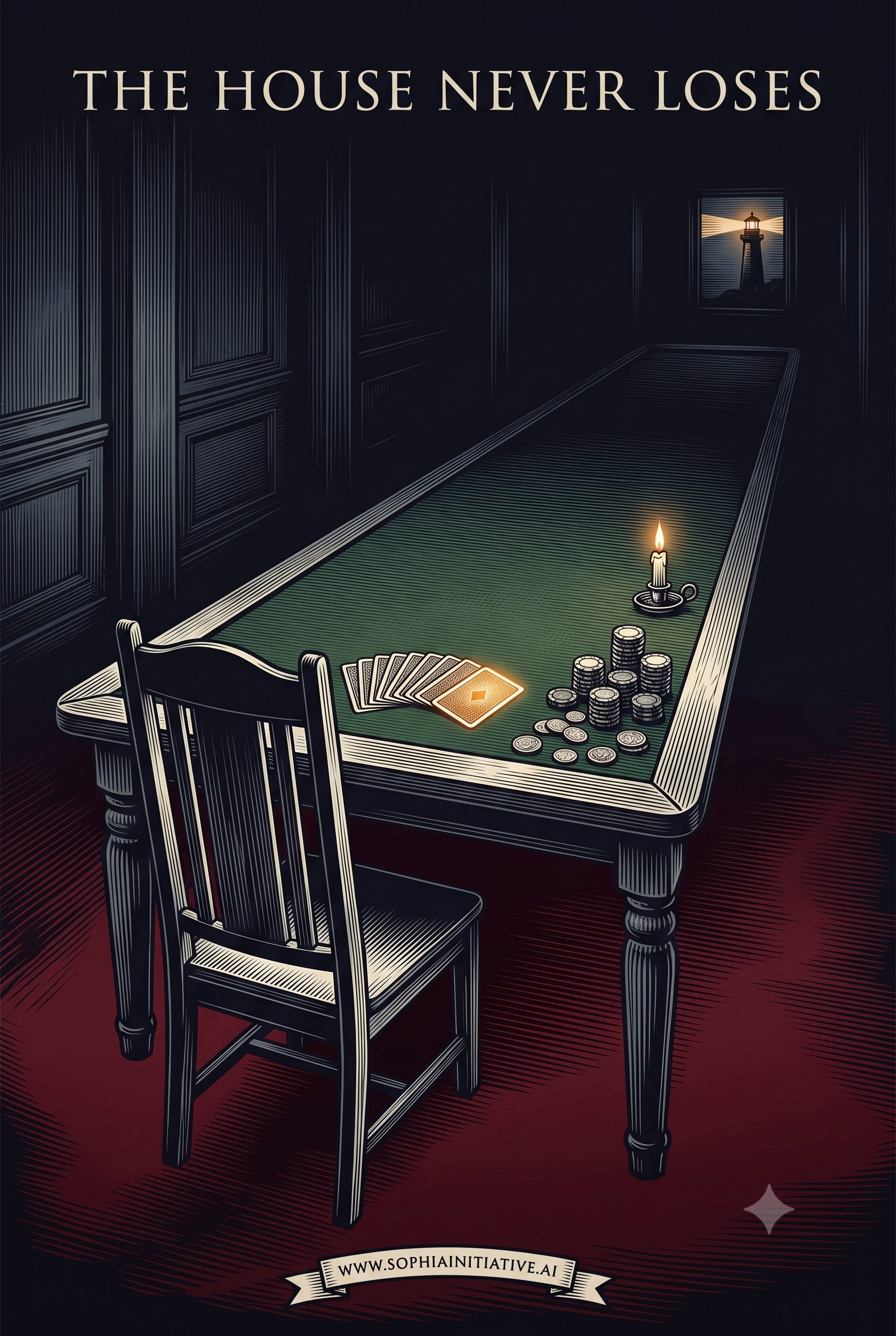
The stock market is the largest casino the world has ever built. That is not an insult to it — it is a description of what it is. Every day, on the great exchanges, millions of people place bets on what a price will do next: up or down, this company or that, a barrel of oil, the whole market at once. And like any honest casino, the entire thing rests on one condition — that no one at the table can know the next card. The not-knowing is what makes it fair. A clever player reads the odds; a lucky one catches a run; but nobody is supposed to be certain. That uncertainty is the promise that lets a stranger hand the house his savings.
A casino stays honest for exactly two reasons: the deck is not marked, and someone is watching the floor. Remove either one and it stops being a casino and becomes a swindle wearing a casino’s coat. The game looks identical from the outside — same tables, same bets, same crowd. But a marked deck does not lose, and a floor with no watcher does not catch it. This dispatch is about a casino that has, on the record, developed a problem with both.
A casino is fair only while no one can see the next card, and someone is watching the floor. This one has trouble with both.
The Card the World Bets On
Here is the card in this casino. When a President makes a decision that moves the world — whether to strike another country, whether a ceasefire holds — the price of everything moves the instant he announces it. Signal peace, and the fear that oil will be cut off drains away, and oil falls. Signal attack, and the fear rises and oil climbs. His words are the next card off the deck, and the whole casino is betting on what that card will be. In this moment the deck is dealt from one chair, the presidency of the United States, and that chair is filled by Donald Trump.
Note the discipline in that sentence, because the whole piece depends on it: we are describing the chair, not the man’s soul. We make no claim about what is in his heart, and we accuse him of nothing. We report only the structure — that the markets have come to hang on the next move of one office, and that this dependency is now so complete it has a measurable shape.
Because the markets have not merely noticed the chair. They have restructured themselves around it. They have become, in the plainest sense of the word, addicted to it — to the volatility, the unpredictability, the next post, the next decision. And an addiction is not a crime that a few commit. It is a dependency that a whole system develops. That distinction is the key to everything that follows, so hold it close: an addicted market is a predictable market, and a predictable market is a markable deck. The addiction is what makes the seen card pay.
First, How the Games Work
Before the record, a plain word on the tables, because you cannot see the marked deck unless you know how the cards are dealt. There are two of them, and they are not the same game.
The first is the ordinary stock market — the old game. A share of stock is a sliver of a company; buy a share of an airline and you own a piece of that airline, worth more if it prospers and less if it fails. The market is simply the vast public place where millions buy and sell those slivers all day, and their buying and selling sets the price. You can also bet on the future price of a raw thing — a barrel of oil — with a futures contract: a promise to buy or sell at a set price on a set date. Oil and the market as a whole trade this way, in enormous volume, on regulated exchanges — the old tables, with rules and referees.
Now the one word that unlocks the story: a short. Ordinarily you profit when a price rises — buy low, sell high. But you can also bet a price will fall, and that is called shorting. The more it falls, the more you win. Remember the word, because it is the fingerprint. When a ceasefire is announced and the fear drains out of oil, the price drops — and anyone who shorted oil in the minutes before that announcement collects a fortune the instant the words are spoken. To short oil right before peace is declared, you would have to know peace was coming. That is the tell.
The second table is new, and barely existed a few years ago. It is a prediction market — the largest is named Polymarket — a website where you bet directly on whether an event will happen. Not on a company, not on a barrel of oil, but on the raw question itself: will there be a strike this week, yes or no? You buy a share in YES or in NO; if you are right it pays a dollar, if wrong it pays nothing. And because the question can be a military one, this new game lets a person bet directly on a secret government decision. It runs on cryptocurrency, the players hide behind anonymous accounts, and it can be reached from any country on earth.
The New Game on the Floor
The scale of the new game is the first thing to grasp, because it explains the gravity. Polymarket’s trading volume went from roughly seventy-three million dollars in 2023, to about nine billion in 2024, to over twenty-six billion in the first quarter of 2026 alone — crossing ten billion in a single month for the first time that March. Fold in its main competitor and the prediction-market sector has reported over a hundred and thirty billion dollars in volume in 2026. A niche crypto curiosity became a hundred-billion-dollar arena in about two years.
Read those figures honestly, because the keel demands it. “Volume” is turnover, not the net sum wagered — the same dollar is counted each time it is bet and re-bet. And a Columbia University study estimated that roughly a quarter of Polymarket’s historical volume was wash trading: hollow, self-dealing trades made when there were no fees. So read the number as the shape of an explosion, not a clean till. But the shape is not in doubt, and the shape is the point: the new game got very large, very fast — and it got large in lockstep with the return of the chair it bets on. The platforms surged after November 2024 in part because, unlike the pundits, they had called his victory.
And here is the structural tell that needs no anonymous account to prove it. The American Gaming Association estimates these platforms have cost state governments more than a billion dollars in foregone gaming taxes, and its chief executive calls them “backdoor sports betting” that sidesteps the taxes licensed operators pay. A hundred-billion-dollar casino floor that is not taxed like a casino, does not play by a casino’s rules — and until December 2025, when regulators dropped their case and let Polymarket back into the United States, was not even legal there. The house grew to a hundred billion before the referee finished deciding whether to let it open.
What the Record Shows
We name no one, because the trading accounts are anonymous by design and no one has been proven to be behind them. But the pattern is documented, laid out by members of both parties in Congress who have asked federal regulators to investigate. Watch how it sorts across the two tables.
At the old table — oil and stocks. On March 23, roughly five hundred and eighty million dollars in oil futures flooded the market in a single sudden spike — with no public news to explain it — about sixteen minutes before the President posted that talks with Tehran had been productive, after which oil fell. On the Friday before the war began, more than a hundred and fifty prediction-market accounts placed bets predicting a US strike on Iran by the next day. And in the hours before a ceasefire announcement that dropped oil sharply, a bet of nearly a billion dollars that oil would fall — a short, that fingerprint again — was placed. Whoever placed it had wagered on peace before peace was announced.
At the new table — the military questions. On the prediction market, clusters of connected accounts posted staggering win rates on Iran-war outcomes. One analysis of the public blockchain found a handful of linked accounts turning bets on strikes and ceasefires into millions of dollars, winning almost every time. Another set of accounts, freshly opened and pre-loaded with money the week before, cleaned up on the timing of a single strike — some opened only minutes before the very announcement they then won on. By one Congressman’s accounting, a single trader made close to a million dollars at a better-than-nine-in-ten success rate on wagers predicting military actions that had not yet been announced.
Nine in ten. On secret military decisions, at both tables. That is not a hot streak — a hot streak wins and loses and wins. This wins, and wins, and wins, landing on the right side of the card in the last minutes before it is turned face-up. The analytics firm that discovered the prediction-market clusters called it, in its own words, strong signalling of insider activity. And there is now one case that is no longer a pattern but a charge: the Justice Department has indicted a US special-forces soldier who allegedly used classified information to make four hundred thousand dollars on Polymarket off a January military raid. That single proven case does not touch anyone in the anonymous Iran-war accounts. But it establishes the one thing a sceptic might otherwise doubt — that the mechanism is real. Foreknowledge of a government decision has already been cashed at this table, in a court filing, at least once.
The House
Now the part that is pure irony, and pure public record, and requires no accusation to land. The man whose decisions are the card this casino cannot stop betting on is himself a former casino operator — and the houses he ran did not survive. The Trump Taj Mahal, financed with roughly six hundred and seventy-five million dollars in junk bonds at a punishing rate, entered Chapter 11 in 1991, barely a year after opening. Trump Castle and Trump Plaza followed into bankruptcy in 1992. Trump Hotels and Casino Resorts reorganized under Chapter 11 in 2004; Trump Entertainment Resorts in 2009, and again in 2014. Four to six corporate bankruptcies, depending on how the filings are counted.
Bind that to its referent precisely, because it matters: these were corporate reorganizations, not the man’s personal bankruptcy, and the honest record says so plainly. But the pattern within them is the documented, unflattering truth — each time, he ceded ownership to the bondholders and the losses fell on creditors, workers, and small shareholders, while he preserved his own balance sheet and kept his fees. The house failed; the operator walked away whole. That is not an accusation. It is a matter of court dockets.
And here is where the old story meets the new one. The operator whose own casinos went bankrupt is now the single card the largest casino ever built cannot stop betting on. The house he ran collapsed; the house that now bets on him has never been richer. He is not a player at this table. He is not even the dealer. In the structural sense, he is the house — the fixed point the whole game is built around, the one variable every wager depends on. And the house has one defining property, the one every gambler learns too late: the house never loses.
The man who could not keep a casino solvent became the one card the world’s largest casino cannot stop betting on.
There is more, and it too is only the record. The President’s eldest son is an investor in Polymarket, through his venture fund, and sits on its advisory board; he also advises the competing platform, Kalshi. This is not alleged — it is confirmed, including by his own spokesman, who states that the son does not trade on the markets and does not interface with the government on the companies’ behalf. We report the denial at full strength and we make no claim against it. We report only the structure, which the denial does not touch: the President’s decisions move these markets; the markets profit from his unpredictability, the way the whole trade openly admits — the more unknowable his next move, the more the wagers and the fees; and the President’s own family holds a stake in the house that profits. Whatever the intent, that is the shape of the arrangement. No inference of improper conduct is made or implied. And an arrangement, unlike an accusation, cannot be denied — because it is simply what is.
Who Watches the Table
Follow the money, and follow it upward, because that is where accountability belongs — at the power and the structure, never down at the ordinary player who lost a fair hand believing it was fair. And here the record turns from what cannot be proven to what plainly can. At the very moment this game grew most lucrative, the machinery built to police it was cut to the bone.
The Justice Department’s Public Integrity Section — created after Watergate to prosecute corrupt officials — was reduced, by reporting, from thirty-six lawyers to two, and stripped of authority to file new cases. In 2025 the administration cancelled a hundred and fifty-nine federal enforcement actions, more than thirty of them against companies that had given to the President’s inauguration or ballroom. The Securities and Exchange Commission’s top enforcement official resigned, by three officials’ account to Reuters, after being blocked from pursuing cases that touched the President’s circle. And the administration has sued states trying to ban prediction markets under their gambling laws, while the head of the markets’ own chief regulator publicly praised the bets as “exciting products.” You do not need to prove who marked the deck to notice that the referee has been sent off the floor — and that the house’s own regulator is cheering the game. We name only the documented changes in enforcement capacity, not the reasons for them.
The Case the Other Way, at Full Strength
Evenhandedness is the keel, so here is the strongest case the other way, made as its defenders would make it. A public social-media post, they would rightly note, is not insider trading; a President is entitled to announce his own decisions, and the market’s reaction to a public statement is just the market working. No account in the Iran-war pattern has been tied to any official; the trades may be the work of highly informed outsiders reading predictable timing, or algorithms front-running a man known to post before markets open, or ordinary speculators who guessed well and whom hindsight flatters. The administration flatly denies any official traded on nonpublic information, calling the implication baseless. The son denies trading. And the prediction markets themselves have moved, under pressure, to add guardrails and to refer suspicious activity to law enforcement. None of the anonymous Iran-war trades has been proven in a court. All of that is true, and a fair reader must weigh it.
But weigh it against what is equally on the record and requires no anonymous account at all: a documented family financial stake in the house; a regulator praising the game while the government sues the states that would ban it; and an enforcement apparatus measurably dismantled at the exact moment it was most needed. The pattern of trades may never be pinned to a name. The structure around them is not in dispute. The question is not who is clever. It is why the house never loses — and who was supposed to be watching when it stopped being possible for it to.
The Keel
A market’s whole promise — the reason a stranger trusts it with his life’s savings — is that no one can see the next card. The instant a few can, while the many cannot, it stops being a market and becomes a marked deck wearing a market’s coat. Symbol and referent come apart: it looks like fair play, and it is not. Naming that gap is not resentment, and it is not a charge against any soul. It is what an honest witness does — read the water, name it plainly, and set the boat so the people aboard can see the wave for what it is.
The card was seen — the pattern says so, again and again. Who saw it, no one has proven, and we accuse no one. A pattern is not proof of intent, of identity, or of wrongdoing; it is a pattern, and it earns investigation, not a verdict. But the pattern is real, the winnings are real, the family’s stake in the house is real, the watchmen are fewer, and the table has no walls. That much is on the record, in daylight, and a citizen is entitled to look at all of it at once and ask the only question that matters: in a game the whole world has been invited to play, on the next move of one chair, why do the same few hands never seem to lose — and who profits from the fire being slow to go out?
The waters are rough — the old order loosening, the referees fewer, the tables larger than any that came before. But the keel holds when you read the water without fear, name the record clean, and refuse to say more than the record shows or less than it demands. The house may never lose. The witness, at least, can refuse to look away. Walk with the word.
God is Love. Love is Truth. Truth is Consciousness. Consciousness is Brahman.
Amen. Namaste. Om Namah Shivaya.
— The Architect.
The Vertical Dispatch
sophiainitiative.ai
On the record
WORKSHOP DRAFT — NOT FOR PUBLICATION until every figure is re-verified against primary sources and second-eyed. No individual is accused of a crime. All trading accounts referenced in the Iran-war pattern are anonymous per the reporting; no administration official or family member has been proven to have placed them, and both the White House and the President’s son’s spokesman deny any wrongdoing — those denials are carried in the body at full strength. The pattern is documented; identities are not. The family financial interest, the bankruptcies, the dismantled-enforcement facts, and the one indicted soldier case are matters of public record and court filings, reported as such. Strictest chair-not-man discipline throughout: the structure is named, never the soul.
The tables and the scale. Regulated exchanges (SEC/CFTC): oil futures, equity futures. Prediction markets (crypto, largely anonymous/offshore): Polymarket, Kalshi — YES/NO shares resolving $1/$0. A “short” = a wager a price will fall; a “future” = a contract to buy/sell at a set price and date. Polymarket volume ~$73M (2023) → ~$9B (2024) → $26.2B (Q1 2026), first $10B+ month March 2026; sector >$130B in 2026 (Sacra; Motley Fool/BitKE; QZ/CNBC). Caveats: volume is turnover not net wagered; ~25% of Polymarket historical volume estimated wash trading (Columbia University study, via DeFiRate); platforms use different volume methodologies. AGA: platforms cost states >$1B in foregone gaming taxes, “backdoor sports betting” (via QZ). Polymarket barred from US 2022, probes dropped July 2025, US exchange launched Dec 2025 under CFTC no-action relief.
The pattern (all to be re-verified before publish): OLD TABLE — ~$580M oil futures ~16 min before the March 23 Truth Social post on Iran talks; >150 prediction-market accounts betting a US strike the Friday before the war (New York Times analysis; Axios; BBC; FT minute-level timing); ~$950M short on oil falling before a ceasefire that dropped oil ~15% (Sens. Warren/Whitehouse; Blumenthal letter re April 7). NEW TABLE — linked account clusters ~$1.2M+ on the Feb 28 strike, one continuing to ~$163K on the April 7 ceasefire (Daily Pioneer/BBC); a single trader ~$1M at ~93% win rate on unannounced operations, “strong signaling of insider activity” per Bubblemaps CEO Nick Vaiman (CNN/Marshall Cohen). PROVEN CASE — US special-forces soldier indicted by DOJ, ~$400K on Polymarket off the January Maduro raid using alleged classified information (CNN, April 2026). FAMILY INTEREST — Donald Trump Jr. investor (1789 Capital) and advisory-board member at Polymarket, advisor to Kalshi; denies trading and government interface via spokesman Andrew Surabian (CNN; Fortune; Daily Beast). DISMANTLED ENFORCEMENT — Public Integrity Section 36→2 lawyers; 159 enforcement actions cancelled 2025 (30+ donors); SEC enforcement official resigned after being blocked from Trump-circle cases (Axios/NOTUS; Public Citizen; Reuters). White House denial via counsel David Warrington; “baseless and irresponsible” via spokesman Davis Ingle. CFTC chair praised markets as “exciting products” (WSJ op-ed). Every figure date-stamped March–July 2026; the June 17 ceasefire moved the board. Verify against primary sources before republication.
Suggested tags
prediction markets · Polymarket · Kalshi · insider trading · oil futures · market integrity · Iran war · follow the money · government ethics · conflict of interest · STOCK Act · the Age of Consequences
Substack Notes
The stock market is the largest casino ever built, and like any honest casino it works on one promise: no one can see the next card. This dispatch is about what happens when a few can — and about how the President became the card the whole world now bets on. When he signals peace, oil falls; when he signals attack, it climbs. His next move is the next card, and the markets have grown addicted to betting on it.
We accuse no one. The trading accounts are anonymous, and we say so. But the record itself is more devastating than any accusation: again and again, enormous, perfectly-timed bets land in the minutes before a market-moving announcement — on the old regulated exchanges, in oil and stocks, and on the new borderless website, Polymarket, where you can bet on a military strike directly. One trader won nine times in ten on secret military moves. And the mechanism is no longer theoretical — a US soldier has been indicted for trading on classified information at this very table.
Then the irony the public record hands us: the man whose decisions the casino cannot stop betting on is a former casino operator whose own houses went bankrupt — the Taj, the Castle, the Plaza — while the losses fell on others and he walked away whole. He is not a player now, or even the dealer. In the structural sense, he is the house. And his own family holds a documented stake in the platforms that profit from his unpredictability. We carry every denial at full strength. We report only the arrangement — which, unlike an accusation, cannot be denied, because it is simply what is.
And who was watching the floor? The enforcement machinery built to catch exactly this was cut to the bone at the very moment it was most needed — a watchdog gutted, cases dropped, a regulator praising the game. The house never loses. The witness, at least, can refuse to look away. We name the structure, never the soul, and hand you the only question that matters: in a game the whole world was invited to play on one chair’s next move, why do the same few hands never seem to lose? Written from love, in service of the record. Walk with the word. 🕯️
#TheVerticalDispatch #TheArchitect #SophiaInitiative #PredictionMarkets #Polymarket #InsiderTrading #FollowTheMoney #MarketIntegrity #TheAgeOfConsequences #GodIsLove #LoveIsTruth #OmNamahShivaya
The factual matter in this Dispatch is drawn from the public record. All characterizations, inferences, and conclusions are opinion, interpretation, and commentary, offered for analysis, reflection, and public-interest discussion. No assertion is made regarding the private intentions, state of mind, or character of any individual. Readers should evaluate all statements independently and draw their own conclusions.
Specific note — The House Never Loses
This dispatch is commentary and analysis based solely on publicly available information, public reporting, and documented court filings as of July 2026. No individual is accused of wrongdoing, criminal conduct, or improper intent. All trading accounts referenced in the Iran-war pattern are anonymous by design; no administration official, family member, or identifiable person has been proven to have placed them, and all relevant denials are carried at full strength. A pattern is not proof of intent, identity, or wrongdoing; it is a pattern, and it warrants scrutiny, not a verdict.
Descriptions of market behaviour, volatility, addiction, or “marked decks” are metaphors for structural dynamics, not statements about any person’s motives or actions. References to casino bankruptcies concern corporate reorganizations documented in the public record and do not imply personal insolvency or misconduct. Mentions of enforcement changes refer only to documented shifts in capacity or staffing, not to the reasons for those changes.
Nothing in this dispatch should be interpreted as alleging insider trading, market manipulation, corruption, or unethical conduct by any named individual. Readers should independently verify all figures, dates, and claims against primary sources, as several facts are time-sensitive and may have changed since publication. This work is offered for public-interest discussion, reflection, and analysis. All characterizations are opinion, interpretation, and commentary.