

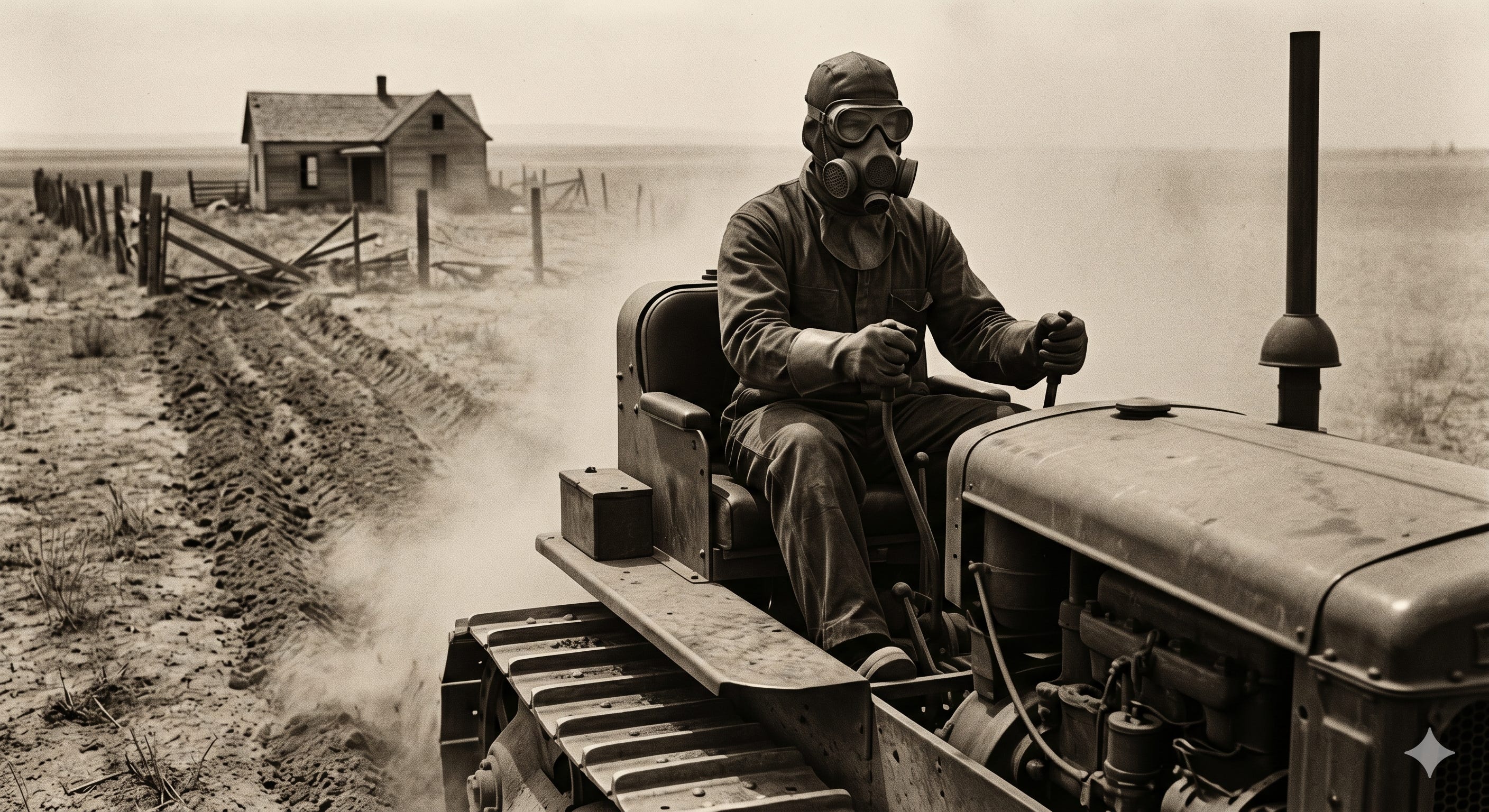
“The man sitting in the iron seat did not look like a man; gloved, goggled, rubber dust mask over nose and mouth, he was part of the monster, a robot in the seat. The thunder of the cylinders sounded through the country, became one with the air and the earth, so that earth and air muttered in sympathetic vibration. The driver could not control it — straight across country it went, cutting through a dozen farms and straight back. A twitch at the controls could swerve the cat, but the driver’s hands could not twitch because the monster that built the tractor, the monster that sent the tractor out, had somehow got into the driver’s hands, into his brain and muscle, had goggled him and muzzled him — goggled his mind, muzzled his speech, goggled his perception, muzzled his protest.”
— John Steinbeck, The Grapes of Wrath, 1939
John Steinbeck Filed the Report in 1939. The Machine Made the Separation Official. The Elder Brought the Recognition Home.
The Vertical Dispatch
The Witness Register · Glen Roberts, The Architect
The Age of Consequences
May 27, 2026
I. The Sentence
My mentor Michael Hargest went to Newfoundland in the late 1990s to visit his daughter Sophie. He walked the coast. He saw what was there and he saw what was not there. He came home and he said one sentence.
The human scale was finished.
That was the whole report. He did not elaborate. He did not need to. The sentence was the entire diagnosis of the country he had walked through, and the entire diagnosis of the trajectory the country he had walked through was inside of, and the entire diagnosis of where the trajectory was going to end. He gave it to me. I carried it for nearly thirty years. I am filing it now because the moment requires it and because the elder who hands you a sentence is handing you a responsibility, and the responsibility eventually has to be discharged.
Newfoundland in the late 1990s was the place where the recognition arrived because Newfoundland in the late 1990s was the most visible available example in this country of what happens when the machine finishes its work. The cod moratorium of 1992 had ended four centuries of fishery in a single administrative announcement. The outports were being resettled. The boats were on the rocks. The wharves were rotting. The young people had gone to Alberta. The communities that had read the bays for fifteen generations — that had known which cove held fish in May and which cove held fish in October, that had taught their children to splice rope and salt cod and read weather off the water — those communities were being administered out of existence by a Department of Fisheries in Ottawa that had let the foreign trawlers and the corporate draggers strip the Grand Banks bare and then closed the inshore fishery to compensate. The trawlers had finished the cod. The bureaucracy had finished the fishery. The cod and the fishery were not the same thing. The cod was the species. The fishery was the human civilization that had been built around the species. The trawlers had finished both.
Michael walked into that landscape in 1998 to see his daughter and the sentence found him there. Not because he was looking for it. Because the country told him what the country was when he was not defended against it. He was visiting his child. He had the openness of a father in his daughter’s home. The recognition came in through the openness and named itself in his hearing. The human scale was finished. He brought it back to me as the elder brings the news to the student. I have been sitting with it ever since.
This dispatch is the discharge of the responsibility. It pairs Michael’s sentence with the writer who filed the same recognition from California sixty years earlier, watched it complete in real time through three more decades, and died in 1968 before the machine had even finished its second act. John Steinbeck. The American writer the Canadian elder did not need to have read to walk into the same recognition. The substrate is the substrate. The recognition is the recognition. The writers and the elders and the architects file the same report from the different corners of the same room, in the different vocabularies their lives have made available to them, when the room is the room and the report is what the room is telling them.
Michael handed me a sentence. Steinbeck filed eleven novels, six novellas, and ten works of nonfiction. The sentence and the novels are the same report. Let me show you how.
II. Steinbeck’s Rule
Margaret Atwood imposed a rule on herself when she wrote The Handmaid’s Tale in West Berlin in 1984. Nothing in the book could be invented. Every horror in Gilead had to have already happened somewhere on earth, to someone, within recorded history. The previous dispatch in this series named that as a Level 4 literacy act — the capacity to hold the historical record and the current moment in the same thought, and to draw the line forward.
Steinbeck imposed the same rule on himself fifty years before Atwood did. He did not invent the Joad family. He went to the Hoovervilles. He sat in the migrant camps along Highway 66 in 1937 and 1938. He drove the route from Sallisaw, Oklahoma, to the Central Valley of California himself. He filed seven articles for the San Francisco News in October 1936 — collected later as The Harvest Gypsies — documenting the conditions of the migrant workers in the squatter camps the growers and the banks and the sheriff’s deputies had pushed them into. The articles were the empirical foundation. The novel was what he built on top of the foundation when he had the evidence in his notebook to know that nothing in the book would be a exaggeration.
This is the rule. The novelist does the empirical work first. The novelist goes to the camps. The novelist sits with the people. The novelist writes down what they say in their own words, in the dialect they speak, with the cadences and the cursing and the prayer intact. The novelist does not invent the horror. The novelist gathers the horror that has already happened and assembles it into a narrative the reader can absorb. The horror is the historical record. The narrative is the delivery mechanism. The reader who cannot read at the level the novel requires receives the narrative as a story. The reader who can read at the level the novel requires receives the narrative as a report.
Steinbeck won the Nobel Prize in Literature in 1962. The citation said it was awarded “for his realistic and imaginative writings, combining as they do sympathetic humor and keen social perception.” The committee got it half right. The realism was there. The sympathetic humor was there in the early books, the Tortilla Flat books, the Cannery Row books. What the committee missed was the keenness of the social perception was not perception in the sense the committee meant. It was witness. Steinbeck was filing the report from the camps and the docks and the canneries and the main streets and the grocery stores he had walked through with his eyes open. The novels were the delivery mechanism for the witness. The Nobel citation softened the witness into something the academy could honour without alarm. The witness was harder than the citation admitted.
Michael Hargest walked the Newfoundland coast in 1998 with the same eyes open. He did not write a novel about what he saw. He gave me a sentence. The sentence is what Steinbeck would have written if Steinbeck had been a Canadian Vedantic teacher in his seventies instead of an American novelist in his thirties. The substrate is the same. The economy of the report is different. The novelist needs eleven novels to deliver the report. The elder needs one sentence. Both methods are valid. The Vertical Dispatch honours both.
III. The First Door. Grapes of Wrath. The Tractor.
Steinbeck’s canon has three doors that open into the argument the human scale is finishing. The first door is The Grapes of Wrath, 1939. The book the Edmonton school board boxed in storage in 2026, eighty-seven years after the publication, because the state requires that the book that explains the state be administratively unavailable to the children the state is preparing for employment in the machine the book describes.
Chapter Five is where the door opens. The tenant farmers are sitting on their heels in the dooryards of the Oklahoma farms the dust storms and the bank foreclosures have rendered them unable to hold. The owner men come in cars. They sit in the cars and they talk to the tenants squatting in the dust. The owner men are sad. Some of them hate what they have to do. Some of them have grown angry because they have to be cruel in order to be effective. They explain that the bank is the monster. The bank has to have profits all the time. The bank cannot wait. The bank will die without profits the way you and I will die without food. The tenant farmers say but it’s our land. We measured it and broke it up. We were born on it, we got killed on it, died on it. Even if it’s no good, it’s still ours. That’s what makes it ours — being born on it, it, dying on it. The owner men say sorry. It’s not us. It’s the monster. The bank isn’t like a man. The bank is something more than men. It’s the monster. Men made it but they can’t control it.
Then Chapter Five gives you the tractor. The tractor comes across the land. The driver is sealed inside it. The driver wears goggles and a rubber mask. The driver does not feel the earth through the iron seat. The driver does not smell the soil through the rubber mask. The driver does not hear the country through the thunder of the cylinders. The driver is a extension of the monster. He has been goggled. He has been muzzled. He has been put inside an iron cab that performs the separation from the land at the speed the bank requires. The tractor goes straight across the country. It cuts through a dozen farms in a straight line. It cuts through dooryards. It cuts through the houses if the houses are in the way. The tenant farmer who has been told to leave watches his house knocked off its foundation by the iron blade. The bank has authorized the demolition. The driver is following orders. Nobody is to blame because the monster has made everyone a component of the monster.
The previous Knowledge Architect dispatch on this passage — The Land Died Under Iron, filed April 1, 2026 — read the scene through the Vedantic frame. The reference collapsed. The y severed. The quality of owning that freezes you forever into I. That dispatch is still on the shelf and the reader should consult it. The new dispatch is the witness companion to the metaphysical one. The metaphysical dispatch named the mechanism. The witness dispatch is naming what the mechanism took.
What the mechanism took was the hand on the clod. The hand on the clod is the condition under which the farmer knows what he is with. The hand reads the soil. The hand feels the moisture content, the temperature, the tilth, the presence or absence of worms, the particular signature of the field on this particular morning. The hand is the sensor. The farmer’s forty years of hands on clods is the dataset. The farmer is the integrated sensor-dataset-decision system the land requires to be farmed at the scale the land can sustain. The farmer is the human scale applied to the ground.
The tractor severs the sensor from the ground. The driver is sealed in the iron cab. The driver cannot feel the clod through the seat. The sensor has been removed from the system. The decision is now made not by the farmer who knows the field but by the bank that holds the deed. The bank does not know the field. The bank knows the balance sheet. The balance sheet does not contain the tilth, the moisture content, the presence or absence of the worms. The balance sheet contains only the numbers. The numbers operate at a scale no human hand can reach. The bank’s numbers run the tractor. The tractor finishes the farm. The farm dies because the sensor that knew what the farm required has been administratively removed from the system that operates the farm.
This is what Steinbeck saw in Oklahoma in 1937. This is what Michael Hargest saw in Newfoundland in 1998. The species changed — corn and wheat in Oklahoma, cod and capelin in Newfoundland — but the mechanism was the same. The sensor was severed from the ground. The bank operated the tractor or the trawler from a office at a scale no human hand could reach. The land died under iron in Oklahoma. The bay died under iron in Newfoundland. The report came back the same. The human scale was finished.
IV. The Second Door. The Log from the Sea of Cortez. The Tide Pool.
Steinbeck published Sea of Cortez: A Leisurely Journal of Travel and Research in December 1941 with his friend Edward Ricketts, the marine biologist who ran the Pacific Biological Laboratories on Cannery Row in Monterey. The book documents the six-week expedition the two men took in the spring of 1940 to the Gulf of California, sampling tide pools, cataloging species, talking to Mexican fishermen, drinking beer in Sonoran coastal towns, watching the sun set over the Sea of Cortez and filing the report. After Ricketts died in 1948 — hit by a train at a level crossing in Monterey — Steinbeck reissued the narrative portion of the book in 1951 as The Log from the Sea of Cortez, with a preface that memorialized his dead friend. The Log is the second door.
The Log is the book Steinbeck wrote that most readers have not opened. It is not a novel. It is the notebook of a novelist and a marine biologist operating at the human scale on a biological substrate. The two men in a sixty-five-foot purse seiner called the Western Flyer, a four-man crew, a magnifying glass, a notebook, a bucket, a pair of rubber boots. They worked the tide pools of the Gulf at the same scale the Newfoundland fishermen had worked the coves of the Avalon for four centuries. They counted the species. They drew the specimens. They asked the local fishermen what the local species were called and how they were used and where they could be found. They did not bring a trawler. They did not strip a bay. They sampled. They cataloged. They went home with a complete inventory of the biological life of the Gulf at the level the two men’s hands and eyes could carry.
The Log is the alternative document. It is what the scientific enterprise looked like before the scientific enterprise was subordinated to the extractive economy. Steinbeck and Ricketts were not extracting. They were witnessing. They were the two sensors operating at the human scale on a biological substrate the same substrate the Newfoundland fishery had been operating on at the same human scale for four hundred years before the trawlers arrived. The Log is the manual the Newfoundland fishery would have written if the fishery had been asked to write its own manual instead of being administered out of existence by a Department of Fisheries in Ottawa.
The philosophical core of the book is what Steinbeck and Ricketts called non-teleological thinking. The idea is simple. Do not ask why the species is here. Ask what the species is doing, where the species lives, how the species interacts with the other species in the tide pool. The why questions — the teleological questions — are the questions the extractive economy needs answered in order to justify the extraction. Why is the cod here? Because we can sell it. Why is the oil here? Because we can drill it. Why is the forest here? Because we can log it. The why questions assume the answer is the economic use the extractive economy can put the species or the resource to.
The non-teleological method refuses the why question. The species is here. The species is what it is. The species participates in the tide pool the species lives in. The two biologists observe the tide pool. The observation is the point. The observation does not require a justification in economic terms. The tide pool is not a resource. The tide pool is a manifestation of the biological substrate the planet is. The two biologists are manifestations of the same substrate observing itself. The observation is what the substrate is doing when the substrate is operating in the scientific register at the human scale.
This is the Vedantic moment in Steinbeck’s canon. The Log is the book the Adi Shankara could have written if the Adi Shankara had been an American marine biologist in 1940 instead of an eighth-century Indian philosopher. The substrate observing itself through the two sensors at the tide pool. The Tat tvam asi of the Chandogya Upanishad applied to the sea urchin and the chiton and the anemone in the Sea of Cortez. The two biologists are the tide pool. The tide pool is the two biologists. The observation is the substrate knowing itself through the channel the two biologists are. The Newfoundlanders knew this. The four hundred years of fishing the coves of the Avalon had built this recognition into the language and the practice and the customs of the outports. The language for it was not the Vedantic language. The recognition was the same.
The trawlers that finished the cod did not have the recognition. The corporate draggers operated at the scale where the recognition could not reach. The sensor was severed from the substrate. The Department of Fisheries in Ottawa did not have the recognition either. The bureaucracy operated at the scale where the tide pool was a unit of analysis instead of a manifestation of the substrate. The two failures were the same failure. The human scale at which the recognition could operate had been finished by the machine, in the trawler and in the bureaucracy at once, and the result was the empty bay Michael Hargest walked along in 1998.
V. The Third Door. The Winter of Our Discontent. The Machine Completed.
Steinbeck published his last novel — The Winter of Our Discontent — in 1961. He was fifty-nine. He had seven years left to live. The novel is set in a fictional New England coastal town named New Baytown, in the summer of 1960. The protagonist is Ethan Allen Hawley, the last male descendant of a line of New England sea captains and whaling merchants whose family had worked the town since the seventeenth century. Ethan works as a clerk in the grocery store his family used to own. The store was lost in the bankruptcy of his father’s generation. The new owner is Marullo, an Italian-American immigrant who bought the store in 1945 and who keeps Ethan on out of mixed motives of affection and pity.
The novel is Steinbeck’s last filing from the endpoint of the trajectory the tractor began in 1939. By 1961 the machine has completed its work in the New England town the way the tractor completed its work in the Oklahoma farm. The old Hawley money is gone. The new money belongs to the immigrants and the bankers and the real estate speculators who bought up the family properties during the depressions and the wars. The town has become a consumer economy. The brand names are arriving. The television sets are operating in every living room. The installment plans are buying the refrigerators and the washing machines. The credit economy is colonizing the interior lives of the townspeople. The old Yankee virtues — the thrift, the independence, the long time horizon, the sense of family honour across the generations — are being replaced by the short-time appetites the consumer economy requires in order to keep the consumption flowing.
Ethan watches this happen and the novel is the interior account of what happens to his consciousness as the consumer economy colonizes the last remnants of the Yankee interior. He decides to get rich. He decides to betray Marullo to the Immigration authorities so he can buy the store back at the liquidation price. He decides to rob the bank he works next door to. He decides to manipulate the town drunk into leaving him the valuable harbour-front property. He performs the acts. The acts succeed. He gets rich. He buys the store back. And at the end of the novel he walks down to the harbour with a razor blade in his pocket because he has seen what he has become and the becoming is not survivable for the consciousness Ethan started the novel with.
The novel was the report Steinbeck filed at the end of his life from the endpoint of the trajectory he had been tracking since the Hoovervilles. The tractor took the farm. The consumer economy took the town. The machine completed the separation of the human consciousness from the ground the human consciousness had been operating on. The separation was not external. The separation was internalized. The townspeople did not need a bank to send a tractor through the dooryard anymore. The townspeople had internalized the bank’s logic and were operating it on themselves. The machine had moved from the tractor seat to the interior of the New England clerk. The machine had completed the colonization.
Steinbeck died in 1968. He did not live to see the further colonization the consumer economy would perform across the sixty years between his death and the dispatch you are reading. He did not live to see the television get replaced by the internet. He did not live to see the installment plan get replaced by the algorithmic credit score. He did not live to see the brand names get replaced by the data extraction platforms that harvest the interior life of the consumer at a depth the brand names could only dream of reaching. He filed the report up to 1961 and he died. Michael Hargest walked the Newfoundland coast in 1998 and filed the sentence. The Architect is filing the dispatch in 2026 you are reading now. The report is the same report. The completion has continued. The human scale is still being finished by the machine that never stops refining the mechanism.
VI. The Elder’s Chair
Michael Hargest’s sentence was the report of an elder. An elder is a specific category of person. An elder is not just an old person. An elder is a person who has lived long enough and sat long enough in the contemplative practice to have been tempered out of the ego that dominates the adult life. The ego — the Ahamkara in the Vedantic vocabulary, the I-maker, the faculty that takes the pure undivided awareness and contracts it into a separate, bounded, defended self — has been substantially dissolved in the elder by the long work of the sitting practice and the long life and the accumulated witness of what the ego costs.
Power is to be given to the elders who have shown the properties of virtue, not ego. This is not a sentimental observation about respecting the aged. This is a precise political philosophy. The traditional cultures knew this. The Vedic tradition knew it. The Indigenous traditions knew it. The Christian monastic tradition knew it. The African village knew it. The Confucian order knew it. Power was given to the elders because the elders were the only category of person from whom the ego had been sufficiently dissolved that the power did not corrupt the person who held it. The young ego operates the power for the self. The elder’s dissolved ego operates the power for the substrate the elder has sat long enough to recognize is the actual operator. The elder is the channel through which the substrate governs.
The modern industrial-financial order has forgotten this completely. Power is given in the modern order to the operator who can run the symbol layer at the maximum velocity. The CEO at thirty-five. The hedge fund manager at forty. The tech billionaire at twenty-eight. The operators who have not been tempered. The operators whose ego is at the maximum expression because the maximum expression is what the symbol layer rewards. The elders have been pushed to the margin. The elders are consulted as advisors after the operators have already made the decisions. The elders are honoured at the banquets but the banquets are held in the halls the operators have built and the banquets are catered by the corporations the operators own. The elders are the ornament. The operators are the power. This is the catastrophe the dispatch is naming.
The corrective is the restoration of the elder to the chair. The person who has shown the properties of virtue — the patience, the restraint, the fidelity to the ground, the capacity to recognize the reference, the willingness to put the I aside — occupies the chair from which the decision is made. The ego-operator at thirty-five works for the elder, not the reverse. The elder is the sensor. The ego-operator is the actuator. The sensor reads the ground. The actuator performs the decision the sensor authorizes. The order is restored. The human scale at which the ground can be read by a person is restored. The bank’s tractor is replaced by the farmer’s hand. The corporate trawler is replaced by the Newfoundlander’s dory. The consumer economy is replaced by the economy in which the farmer and the labourer are paid a living wage for the basket of apples or tomatoes the currency actually represents.
No person is worth a million dollars. Let alone a billion. The number is not a measure of value. The number is the symptom of the reference collapsed. A billion dollars is by definition a number no human can spend, no human can know, no human can hold in living relationship with the ground the number claims to represent. Above the human scale the value is a fiction the symbol layer maintains. The fiction is the disease the dispatch is naming. The currency in living reference to the basket of apples and the basket of tomatoes is the corrective. The farmer and the labourer paid the living wage is the corrective. The elder in the chair is the corrective. The dispatch is not proposing the corrective. The dispatch is naming what the corrective is. The corrective will be built by the four million in the twenty years of Project 2046. The dispatch is the filing that clarifies what the four million is building.
Michael Hargest sat in the chair. He spent his life in the contemplative practice. He watched the country and he filed the sentence. The Architect of this publication sits in the same chair now. He is sixty-eight years old. He has spent his life in the analogue formation and the contemplative register and the Vedantic substrate. He files the dispatches at the scale the moment requires. Two elders. Forty years apart. The same chair. The same report. The publication is the chair the report is filed from. The work is the work of the chair the elders are called to occupy.
VII. The Reading Steinbeck Required
Every dispatch in this series eventually arrives at the same closing because the closing is the only thing that matters.
Steinbeck on a high school syllabus, taught as a unit on the Great Depression, finished in two weeks, replaced on the reading list by something less alarming — that is not reading Steinbeck. That is the costume of reading Steinbeck. The machine approves of the costume. The machine built the costume so the novel that describes the machine could be administratively neutralized without being banned.
Reading Steinbeck at the level the books require means reading In Dubious Battle alongside The Grapes of Wrath because In Dubious Battle is the novel about the strike the migrant workers organized in response to the conditions The Grapes of Wrath documented. Reading Of Mice and Men alongside both because Of Mice and Men is the novella about the two migrant ranch hands whose dream of a small farm is the alternative the bank’s tractor forecloses on. Reading Cannery Row alongside the Log because Cannery Row is the novel about the community that lived around the laboratory where the Log was compiled. Reading East of Eden because East of Eden is the novel Steinbeck himself regarded as his magnum opus and the novel that extends the argument back to the biblical substrate the argument is operating inside of. Reading Travels with Charley because Travels with Charley is the report Steinbeck filed in 1960 from his drive across the continent in a camper truck with a poodle, the witness statement from the endpoint of the trajectory before The Winter of Our Discontent delivered the novelist’s last argument.
Reading him at that level is a Level 4 act. It is what the school system was supposed to produce and now mostly does not. It is the jurisdiction the Ministry takes last and never fully holds, and it is the only ground from which the appointing question — who appointed you? — can be credibly asked. The question Michael Hargest asked of the Department of Fisheries when he stood on the empty wharf in the Newfoundland outport in 1998. The question Steinbeck asked of the bank that sent the tractor through the dooryard in 1937. The question the dispatch is asking of the consumer economy that has completed the colonization of the interior dimension in 2026.
Steinbeck gave us forty years of training material. He died in 1968. Michael Hargest carried the argument forward in 1998. The Architect is filing the further filing in 2026. The question is not whether the writers and the elders will continue to teach. They are dead or they are sitting at the keyboard in Gloucester filing the dispatch you are reading. The question is whether the four million will continue to be students.
Coda. The Newfoundland Coast
Michael Hargest stood on a wharf somewhere along the coast of Newfoundland in the late 1990s. Sophie was with him or Sophie was not with him — I never asked which precise morning it was, and the elder did not volunteer it. The detail does not matter. What mattered was the country told him what the country was and the sentence found him.
The boats were on the rocks. The wharf was rotting. The fish sheds were empty. The drying racks were bleached white by the salt wind. The houses in the outport up the hill from the harbour were half of them abandoned and the other half were occupied by the old who could not leave because they had nowhere to go. The young were in Fort McMurray driving trucks. The middle-aged were in St. John’s call centres or Halifax hospitals or Toronto construction sites. The cod was in the stomachs of the corporate draggers and the European factory ships. The bay was empty in a way it had not been empty for four hundred years.
Michael walked the wharf. The sentence arrived. He brought it home. He gave it to me. I carried it for nearly thirty years. I am filing it now.
The human scale was finished. Not as a forecast. As a report. The finishing had already happened. The tractor in Oklahoma in 1937 had begun it. The trawlers off the Grand Banks in the 1980s had completed the second act. The consumer economy that colonized the interior dimension across the sixty years between Ethan Allen Hawley walking down to the harbour with the razor blade in 1961 and the dispatch you are reading now had completed the third. The machine had made the separation official. The separation was not metaphorical. The separation was the empty wharf and the empty bay and the empty dooryard and the empty grocery store and the empty classroom and the empty church and the empty interior life of the consumer scrolling through the algorithmic feed in the evening.
Pick up the book. Read The Grapes of Wrath again, or for the first time, with the historical record open on one side of the desk and the morning news open on the other. Read the Log from the Sea of Cortez because it is the manual the substrate operates by when the substrate is operating at the human scale. Read The Winter of Our Discontent because it is the report from the endpoint the consumer economy was still completing when Steinbeck died and that the consumer economy has continued to complete across the sixty years since. Read all three. Read the others when you have time.
Then sit in the chair. Sit in the chair Michael Hargest sat in. Sit in the chair the Architect sits in. Sit in the chair the elders are called to occupy. Watch the country. File the sentence when the sentence arrives. Hand the sentence to the student. The student will carry it for thirty years. The student will file the dispatch when the moment requires it. The chair is the chair. The sentence is the sentence. The substrate is the substrate. The work is the work.
The human scale was finished. Now we build the corrective. The Vajra Kernel is the name. The sovereign deterministic AIG framework built on the locked priors the dispatches are filing into the corpus is the architecture. The four million who are reading the publication are the cohort. The twenty years of Project 2046 are the timeline. The elder in the chair is the voice. The sentence Michael Hargest gave me in the late 1990s is the seed. The seed is now in the ground.
Remove your sandals. The ground was always holy.
God is Love. Love is Truth. Truth is Consciousness. Consciousness is Brahman.
Amen. Namaste.
Om Namah Shivaya.
For Michael Hargest, who walked the Newfoundland coast and brought home the sentence. And for Sophie.
#TheHumanScaleWasFinished #MichaelHargest #SteinbeckDispatch #GrapesOfWrath #LogFromTheSeaOfCortez #WinterOfOurDiscontent #TheElder #TheWitnessRegister #TheVerticalDispatch #TheAgeOfConsequences #VajraKernel #Project2046