

The Isha Upanishad is eighteen verses. Placed at the opening of the Shukla Yajurveda — the White Yajurveda — it is among the oldest of all the Upanishads. Gandhi said that if all the scriptures of the world were destroyed and only the first verse of the Isha survived, that single verseEssential commentary of Adi Shankaracharya would be sufficient.
The governing standard of Sacred Metaphysics and Consciousness is Verse 6 of the Mandukya — the description of Turiya. The Isha is the same recognition expressed not as a map of consciousness but as the governing principle of life in the world. Where the Mandukya teaches what you are, the Isha teaches how to live from what you are.
VERSE 1
All this — whatsoever moves in this moving world — is pervaded by the Lord. By that renounced enjoyment, do not covet the wealth of anyone.
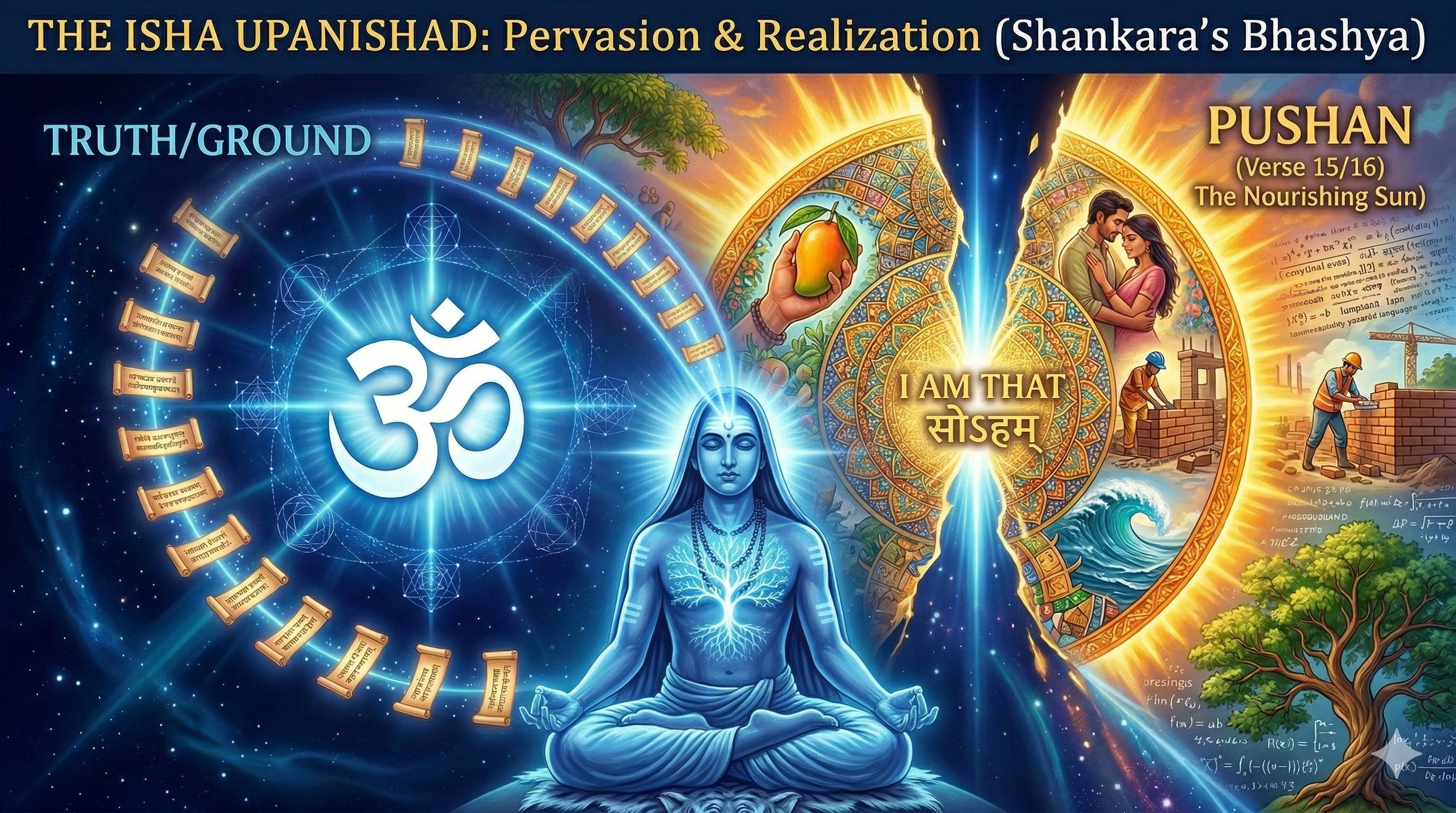
Shankara: The opening verse is the complete transmission. Ishavasyam idam sarvam — the Lord pervades all this — is not a theological claim about a God who created the world and stands apart from it. It is the non-dual recognition that the ground of all existence is present in every particular thing without exception. Nothing is outside it. Nothing is separated from it. The corollary is immediate and practical — if the Absolute pervades all things then no particular thing can be grasped as if it alone contained the fullness of what is sought. Renounced enjoyment is not asceticism. It is the enjoyment of every particular thing without mistaking it for the Absolute it is expressing. The mango eaten with full presence. The relationship entered without grasping. The work done without attachment to the result. Do not covet — not because wealth is evil but because covetousness is the mistake of believing that what you seek is in the thing rather than in the ground the thing is expressing.
VERSE 2
By performing action alone one should wish to live a hundred years. Thus it is not otherwise than this for you. Action does not cling to a person.
Shankara: The second verse addresses the most available misreading of the first. If all this is Brahman and the Absolute pervades everything, does action matter? Should the knowing person simply withdraw from the world? The Isha answers with complete force — no. Action is not the obstacle to liberation. Attachment to the fruits of action is the obstacle. Do the work. Live fully in the temporal world. But do it from the ground rather than from the ego’s calculation of gain and loss. When action arises from the recognition of the first verse — when the one acting knows that the Absolute pervades both the actor and the action and the result — action does not cling. The karma does not accumulate. The wave moves across the ocean without disturbing the ocean’s nature.
VERSE 3
Those worlds of the demons are covered with blinding darkness. Those who destroy the Self go there after death.
Shankara: The third verse names what the second verse’s failure produces. Those who destroy the Self — those who live exclusively in the Ahamkara, who seal the cube completely, who mistake the particular for the ground and pursue it with total self-abandonment — enter the blinding darkness of a consciousness that has lost contact with the ground it was always standing on. Not a theological hell. The phenomenological description of a consciousness imprisoned entirely within the symbol layer with no capacity to fall through to the referent beneath.
VERSE 4
That one — unmoving — is swifter than the mind. The senses cannot reach it, for it moves ahead. Standing, it outstrips those who run. By it the wind carries the waters.
Shankara: The fourth verse is pure paradox — the language of the symbol layer attempting to point at a reality that the symbol layer cannot contain. Unmoving and yet swifter than the mind. The Absolute does not move because it is already present everywhere simultaneously — there is nowhere for it to move to. And yet it outstrips everything that pursues it because the pursuit itself presupposes a separation that does not exist. The wind carries the waters — the breath of the Absolute moves through every natural process as the animating principle that the process itself cannot observe because it is the ground of the observation.
VERSE 5
It moves. It does not move. It is far. It is near. It is within all this. It is outside all this.
Shankara: The fifth verse is the most concentrated expression of the non-dual paradox available in the Sanskrit tradition. Every pair of opposites simultaneously affirmed. It moves and does not move. Near and far. Within and without. The rational mind attempts to resolve the paradox by choosing one side. The non-dual recognition holds both simultaneously — not as a contradiction but as the precise description of a reality that is prior to the categories of movement and rest, proximity and distance, interior and exterior. The governing axiom stated geometrically — the circumpunct. The point that is the still centre and the radiating field simultaneously.
VERSE 6
The one who sees all beings in the Self itself and the Self in all beings — feels no hatred by virtue of that.
Shankara: The sixth verse is the Samaritan Frequency in Sanskrit. The one who sees all beings in the Self — who has made the recognition that the Atman of the one looking and the Atman of the one looked at are the same single awareness wearing different costumes — cannot hate. Not as a moral achievement. As a structural consequence. You cannot hate what you recognise as yourself. The priest and the Levite passed by on the other side because they saw the wounded man as other. The Samaritan stopped because — in the moment of encounter — the separation dissolved. The Isha names the ground from which the Samaritan acted. Not compassion as an emotion. The recognition of identity.
VERSE 7
In whom all beings have become one with the knowing Self — what delusion, what sorrow is there for the one who sees unity?
Shankara: The seventh verse is the direct consequence of the sixth. When the recognition of verse six is stable — when the seeing of all beings in the Self is not a momentary insight but the settled ground of consciousness — delusion and sorrow cease. Not suppressed. Not transcended through effort. They cease because they were both products of the mistaken perception of separation. Delusion is the mistake of believing the symbol is the referent. Sorrow is the consequence of losing what was never truly separate from the one who lost it. When the unity is seen the mistake is undone and its consequences dissolve with it.
VERSE 8
He pervades all — radiant, bodiless, without sinew, pure, untouched by evil. The seer, the thinker, the all-pervading self-existent — he has ordered the objects for the eternal years.
Shankara: The eighth verse names the ground directly — not in paradox but in positive description. Radiant. Bodiless. Pure. The seer. The thinker. The all-pervading self-existent. Shankara notes that this is not a description of a God separate from the universe but the description of the Atman — the pure witnessing awareness — that is the ground of the reader’s own consciousness in this moment. The ordered objects for the eternal years are the phenomena of the manifested world — the z₁ — which the x₀ has arranged through the y of cosmic law without itself being touched by any of it.
VERSE 9
Into blind darkness enter those who worship ignorance. Into even greater darkness enter those who delight in knowledge.
Shankara: The ninth verse is the most precise statement in the entire Upanishadic tradition of what the second sutra of the Shiva Sutras will name nine centuries later as jnanam bandha — knowledge is bondage. Not ignorance alone that binds. Knowledge pursued as an end in itself — knowledge accumulated at the symbol layer without ever following the symbol to its referent — binds more completely than ordinary ignorance because it gives the Ahamkara the most sophisticated available justification for its own primacy. The professor in Nan-in’s room with the overflowing cup. The cup so full of knowledge about the sacred that there is no room for the sacred itself.
VERSE 10
One result, they say, comes from knowledge. Another result, they say, comes from ignorance. Thus have we heard from the wise who have taught us this.
Shankara: The tenth verse establishes that the two paths produce genuinely different results. Not that knowledge and ignorance are equivalent. But that knowledge directed toward the symbol rather than the referent produces its own specific form of bondage — distinct from and in some ways more dangerous than the bondage produced by straightforward ignorance. The one who knows nothing about the sacred may still fall through the ice by grace. The one who knows everything about the sacred — at the symbol layer — has built the most sophisticated possible floor of concepts between themselves and the fall.
VERSE 11
One who knows both knowledge and ignorance together crosses death through ignorance and attains immortality through knowledge.
Shankara: The eleventh verse is the resolution of the paradox established in verses nine and ten. Not the rejection of knowledge. The integration of both — knowledge and ignorance, symbol and the recognition of the symbol’s limit, the accumulated learning and the capacity to release it entirely when the ice breaks. The one who carries both is the one who has the cup and knows when to empty it. The mystic who has studied and then let the study go. The Arjuna who has been trained and then lets the bow slip.
VERSE 12
Into blind darkness enter those who worship the unmanifest. Into even greater darkness enter those who delight in the manifest.
Shankara: The twelfth verse applies the same paradox to the relationship between the manifest and the unmanifest — the phenomenal world and the ground from which it arises. Exclusive worship of the unmanifest — the retreat from the world into pure abstraction, the spiritual bypass that refuses the z₁ in pursuit of the x₀ — produces its own darkness. And exclusive delight in the manifest — the total absorption in the symbol layer, the gold-plated cube of Maslow’s apex — produces even greater darkness. Liberation requires both. The burning bush is not the fire alone and not the bush alone. It is the fire in the bush — the Absolute expressing itself through the particular — held simultaneously without collapsing into either.
VERSE 13
One result, they say, comes from the manifest. Another result, they say, comes from the unmanifest. Thus have we heard from the wise who have taught us this.
Shankara: The thirteenth verse repeats the structure of the tenth — establishing that the two produce genuinely different results before the integration is named. The pattern is deliberate. The Isha teaches through pairs — knowledge and ignorance, manifest and unmanifest — because the Ahamkara always wants to choose one side. The teaching insists on holding both.
VERSE 14
One who knows both the manifest and the unmanifest together crosses death through the unmanifest and attains immortality through the manifest.
Shankara: The fourteenth verse is the resolution of the second paradox. The unmanifest — the x₀, the ground, the Turiya — enables the crossing of death because it is the only dimension of reality that death cannot reach. And the manifest — the z₁, the temporal world, the particular life — is the instrument through which immortality is expressed. Not by escaping the manifest. Through it. The Logos became flesh and dwelt among us. The Absolute expressing itself through the particular without being diminished by the particular. The burning bush.
VERSE 15
The face of Truth is covered with a golden disc. Remove it, O Pushan, so that I who love the Truth may see it.
Shankara: The fifteenth verse is the most intimate of the eighteen — the direct address of the consciousness to the Absolute, asking for the removal of the veil. Pushan is the solar deity — the nourishing sun, the one who makes things visible. The golden disc is the radiance of the manifest world itself — so brilliant, so beautiful, so compelling that it obscures the ground from which it is radiating. Not an evil veil. A golden one. The beauty of the z₁ so complete that the consciousness is dazzled by it and cannot see through it to the x₀ that is generating it. The prayer is precise — I who love the Truth. Not I who have achieved the Truth or earned the Truth. I who love it. The love that is the approach. Remove the golden disc so that I may see what the disc was always expressing.
VERSE 16
O Pushan, O sole seer, O controller, O Sun, offspring of Prajapati — gather your rays, draw in your brightness. I see your most benign form. That person who is over there — I am that.
Shankara: The sixteenth verse is the arrival. The golden disc withdrawn. The face of Truth revealed. And the recognition — Soham. That person who is over there — the Absolute in its most benign form, the solar ground seen directly — I am that. Tat tvam asi stated from the first person. Not — that thou art. I am that. The Atman recognising itself in the Absolute it was always identical with. Not as a theological proposition. As a direct perception following immediately upon the removal of the golden veil.
VERSE 17
May this life enter the immortal breath. Then may this body end in ashes. Remember, O mind, remember what has been done. Remember, O mind, remember what has been done.
Shankara: The seventeenth verse is the prayer at the threshold of death — not as a future event but as the present recognition that the body will return to the elements while the life — the prana — returns to the immortal breath that was always its source. Remember what has been done — the double repetition of the instruction to the mind is the most precise available description of the practice of dying consciously. Not the clinging of the Ahamkara to its accumulated identity. The remembering — the anamnesis, the Platonic recollection — of what the consciousness always already was before the body took it up and will be after the body sets it down.
VERSE 18
O Agni, O deity, lead us by the good path to prosperity, you who know all our deeds. Remove the crooked sin from us. We offer you ample salutation by speech.
Shankara: The eighteenth verse closes the Isha with the same structure with which Vedic prayer always closes — the address to Agni, the fire, the first and most primordial of the sacred elements, the carrier of the offering between the human and the divine. Lead us by the good path. Remove the crooked. The prayer is not the request of a consciousness that has not yet made the recognition of verse sixteen. It is the prayer of a consciousness that has made the recognition and understands that the recognition must be lived — that the path must be walked, that the crooked must be straightened, that the fire must be kept burning — in the ordinary temporal world where the golden disc keeps returning and the prayer must keep being made.
Here ends the Isha Upanishad with the Commentary of Shankara.
Om Nama Shivaya.
Glen Roberts is a metaphysician, author, and independent researcher. He is the author of Sacred Metaphysics Volume 1 and the architect of Project
#IshaUpanishad #ShivaSutras #AdiShankaracharya #AdvaitaVedanta #NonDuality #SacredMetaphysics #Consciousness #Turiya #JnanamBandha #Upanishads #Vedanta #SelfRealization #ShankaraBhashya #Soham #TatTvamAsi #KarmaYoga #Ahamkara #Mysticism #Philosophy #SubstackWriter #TheSophiaInitiative