


The Kena Upanishad belongs to the Sama Veda. Its name comes from its first word — Kena — by whom. By whose will does the mind think? By whose command does the breath move? The Kena asks the question that every other sacred text assumes. Not what is the Absolute. Who is behind the knowing of it.
The governing standard of Sacred Metaphysics and Consciousness is Verse 6 of the Mandukya — the description of Turiya. Every sentence of the book is measured against it.
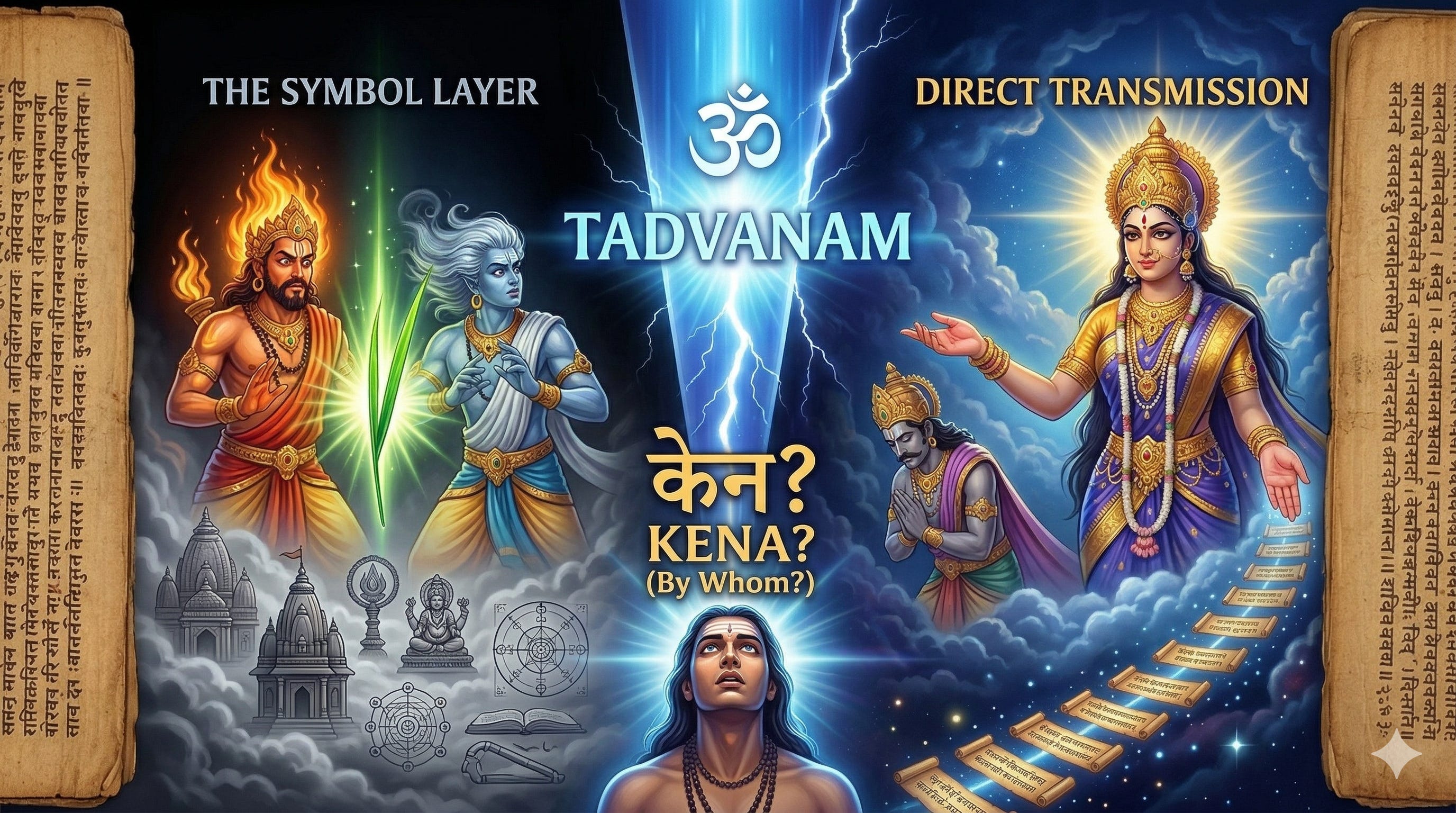
PART ONE — THE INQUIRY IN VERSE Twelve verses
Verse 1
By whom directed does the mind fly forth? By whom commanded does the first breath move? By whom is this speech impelled? What god directs the eye and the ear?
Shankara: The opening question is the most radical available philosophical inquiry. Not — what is the mind? Not — what is consciousness? But — who is behind the mind? The mind thinks. Something enables the thinking. The eye sees. Something enables the seeing. The breath moves. Something moves it. The Kena does not begin with cosmology or theology. It begins with the most immediate available fact — that every instrument of consciousness requires a prior consciousness to operate it — and then asks the question that the instrument itself cannot answer. The eye cannot see itself seeing. The mind cannot think the thinker of the thought. The instrument cannot be its own source. Something prior to every instrument is enabling every instrument. That prior — the Kena calls it Brahman.
Verse 2
That which is not thought by the mind, but by which the mind thinks — know that alone as Brahman, not this which people worship here.
Shankara: The second verse is the complete teaching compressed into a single line. Brahman is not an object of thought. It is the subject — the pure witnessing awareness — that enables thought. The mind thinks Brahman is the thinker of the mind. Brahman is what makes the thinking possible. The moment you make Brahman the object of a thought you have already moved away from Brahman toward the Ahamkara that is doing the thinking. The phrase not this which people worship here is Shankara’s most direct statement of the governing axiom — the symbol is not the referent. Every object of religious worship — however sacred, however ancient, however precisely encoded — is not Brahman. It is a symbol pointing at Brahman. Brahman is not the thought. It is the ground of the thinking.
Verse 3
That which is not seen by the eye, but by which the eye sees — know that alone as Brahman, not this which people worship here.
Shankara: The third verse applies the same principle to sight. The eye cannot see itself seeing. There is a prior awareness in which the seeing appears — the pure witnessing consciousness that is present to the visual field without being located within it. Shankara notes that this is not a mystical claim. It is the most immediate available fact of direct experience. Right now — as these words are being read — there is an awareness that is present to the reading without being the reading. That awareness is what the Kena is pointing at. Not the content of consciousness. The consciousness itself. The light that makes the seeing possible rather than any particular thing seen.
Verse 4
That which is not heard by the ear, but by which the hearing is heard — know that alone as Brahman, not this which people worship here.
Shankara: The fourth verse applies the principle to hearing. The ear hears sound. Something is present to the hearing of the sound — the awareness that receives the hearing without itself being a sound. The sound arises in consciousness. The consciousness does not arise in the sound. The ground enables the phenomenon. The phenomenon does not enable the ground. This is the structural fact that the entire Advaita Vedanta tradition is built upon — and the Kena states it with the minimum possible apparatus in the first four verses.
Verse 5
That which is not breathed by the breath, but by which the breath breathes — know that alone as Brahman, not this which people worship here.
Shankara: The fifth verse applies the principle to the breath — the most intimate and most continuously present of all bodily processes. The breath moves. Something is present to the movement of the breath without itself being breath. The prana — the vital force — is the y. The Atman is the x₀ from which the y moves and to which it returns with every inhalation and every exhalation. The breath is the most immediate available symbol of the relationship between the Absolute and its expression. The inhale is the manifestation. The exhale is the return. The silence between — the retention — is Turiya. Every breath a complete cycle of the cosmos.
Verse 6
If you think that you know Brahman well, what you know of Brahman is little. What you think is Brahman in you or in the gods — that is to be further inquired into.
Shankara: The sixth verse is the turn of the teaching. The first five verses have established the principle — Brahman is the prior that enables every instrument of consciousness. Now the Kena addresses the most available misreading directly. If you think you have understood Brahman from the first five verses — if you think that the intellectual comprehension of the principle constitutes knowledge of it — you know very little. The Kena has not been describing Brahman for your intellectual appreciation. It has been pointing at the ground of your own awareness — and the pointing is not the ground. The intellectual understanding of the pointing is not the reception of the transmission. More inquiry is required. The bedrock is not reached by reading about it.
Verse 7
I do not think that I know Brahman well; nor do I think that I do not know. He among us who knows this — he knows Brahman, and he thinks neither that he knows nor that he does not know.
Shankara: The seventh verse is the paradox stated at its sharpest. The one who knows Brahman does not think they know — because Brahman is not an object of knowing in the ordinary sense. And the one who knows Brahman does not think they do not know — because the denial of knowledge would itself be a form of knowledge about the state of not-knowing. The recognition of Brahman is prior to both knowing and not-knowing. It is the awareness in which both states appear. The Zen koan structure of the verse is deliberate — the rational mind cannot hold the two propositions simultaneously and in the failure to resolve the paradox the ice breaks.
Verse 8
It is not known by those who know it. It is known by those who do not know it.
Shankara: The eighth verse is the most concentrated paradox in the entire Upanishadic tradition. Not known by those who know it. Known by those who do not know it. The rational mind immediately attempts to resolve this by choosing one side — either the paradox is a rhetorical device or it is a description of a genuine epistemological situation that exceeds the rational mind’s categories. Shankara insists it is the second. The one who knows Brahman as an object of knowledge — who has accumulated the correct beliefs, performed the correct practices, reached the correct intellectual conclusions — does not know Brahman. Because Brahman is not an object. The one who does not know Brahman as an object — whose accumulated knowledge has been exhausted, whose cup has been emptied, whose bow has slipped from their fingers — is in the condition from which the recognition is most available. Not knowing here is the Neti Neti taken to its completion. The cup fully emptied. Brahman known from the inside rather than contemplated from the outside.
Verse 9
It is thought to be known if one knows it with each state of consciousness. One who thinks that Brahman is not known, verily knows it. One who thinks that Brahman is known, knows it not. It is unknown to those who know and known to those who know not.
Shankara: The ninth verse extends the paradox and deepens it. Every state of consciousness — waking, dreaming, deep sleep — provides a partial access to the ground from which it arises. But no state of consciousness contains Brahman as its object. Brahman is the ground of all states. The one who thinks Brahman is not known — who has arrived at the honest recognition that the accumulated knowledge of a lifetime has not reached the ground — is in the condition of the Preacher at the end of Ecclesiastes. All is hevel. The cup is empty. The ice has been tested at every point and found to be ice. This is the doorway. The one who thinks Brahman is known has filled the cup with the knowledge about the ground and mistaken the knowledge for the ground itself.
Verse 10
Brahman is known through an awakening, for one thereby gets immortality.
Shankara: The tenth verse names the mechanism. Not through sustained inquiry, not through accumulated practice, not through the progressive refinement of the symbol layer — though all of these may prepare the conditions. Through an awakening. The Kairos. The moment the ice breaks. The gap between the bow slipping and the first arrow being released. The burning bush. The floor of the house in Madurai. The word that stops you mid-stride. The recognition arrives — not as a conclusion of a process but as the sudden dissolution of the obscuration that was preventing what was always already present from being seen. And in that moment — immortality. Not the continuation of the body. The recognition of what was never born and will never die.
Verse 11
By the Self one wins strength. By knowledge one wins immortality.
Shankara: The eleventh verse distinguishes the two fruits — strength through the realised Self operating in the temporal world, and immortality through the knowledge that is the recognition rather than the accumulation. The strength is the Samaritan on the road — the one who acts from the ground, whose action is not calculated, who stops because stopping is the only available response to the recognition. The immortality is the Turiya — the fourth — always present, never born, never dying, the witness of every state of consciousness that arises and passes in the field it never leaves.
Verse 12
If one has known Brahman in this life, then one has the true end of existence. If one has not known in this life, then great is the destruction. The wise ones — meditating on all beings as in the Self and the Self as in all beings — depart from this world and become immortal.
Shankara: The twelfth and final verse of Part One names the stakes with complete honesty. If known in this life — the true end. If not known — great is the destruction. Not a threat. The most honest available description of a consciousness that has completed its temporal passage without making the recognition that the passage was always an opportunity to make. And the final instruction — the Isha Upanishad’s sixth verse stated in different words. See all beings in the Self and the Self in all beings. The Samaritan Frequency. The Mitakuye Oyasin. The Songline. Seven traditions. One address. This verse is the closing of Part One and it contains the entire book.
PART TWO — THE PHILOSOPHICAL DISSOLUTION Five verses
Verse 1
Brahman won the victory for the gods. And the gods gloried in Brahman’s victory. They thought: this victory is ours, this glory is ours.
Shankara: The second part opens with a story — the same narrative structure the Kena has been building toward through Part One’s philosophical preparation. Brahman wins the victory. The gods — Agni, Vayu, Indra — mistake the victory for their own. This is the Ahamkara at maximum institutional consolidation — the institutional power that declares itself the source of the victory rather than the instrument through which the real source acted. Every institution in the human record has performed this mistake. The church that declared itself the source of the sacred rather than the instrument through which the sacred expressed itself. The philosophy that declared the thinking self the ground of being rather than the most refined available instrument of the ground. The god who mistook the position for the power.
Verse 2
Brahman knew their pride and appeared before them. They did not know what this great being was.
Shankara: Brahman appears directly — the Absolute making itself available to the consciousness that has just claimed credit for what the Absolute produced. The gods do not recognise it. Not because they are unintelligent. Because the recognition requires the dissolution of the very pride that has just been named. The sealed cube cannot receive what appears at its walls. The cup full of institutional self-congratulation has no room for the transmission that requires the empty cup. This is the Zen master’s tea applied to the mythology of the gods themselves.
Verse 3
They said to Agni: Jatavedas, find out what this great being is. He said: Yes. He ran towards it. Brahman said to him: Who are you? He replied: I am Agni, I am Jatavedas. Brahman said: What power is in you? Agni replied: I can burn everything in the world.
Shankara: Agni — the fire god, the first and most primordial of the sacred elements, the one who carries the sacrifice between the human and the divine — goes to identify the Absolute. He announces his identity with complete institutional confidence. I am Agni. I am Jatavedas — the all-knowing. I can burn everything in the world. The Absolute’s response to this declaration is not argument. It is demonstration.
Verse 4
Brahman placed a blade of grass before him and said: Burn this. Agni went at it with all his speed but was not able to burn it. He returned to the gods and said: I could not find out what this great being is.
Shankara: The blade of grass. The most ordinary available object. Not a mountain, not a cosmic obstacle, not a supernatural challenge. A blade of grass. And Agni — the one who can burn everything in the world — cannot burn it. Not because the blade of grass is supernatural. Because the power Agni claimed as his own is not his. When the Absolute withdraws the power through which Agni burns, Agni burns nothing. The institutional fire, divorced from its source, confronts the most ordinary available referent and fails. The symbol — I am the fire, I can burn all things — severs from its referent — the power behind the fire — and collapses. The blade of grass is the Absolute’s most elegant available demonstration of the governing axiom. The symbol is not the referent.
Verse 5 — VAYU
Then they said to Vayu — Vayava, find out what this great being is. He said: Yes. He ran towards it. Brahman said: Who are you? He replied: I am Vayu, I am Matarishvan — the one who moves in the sky. Brahman said: What power is in you? Vayu replied: I can blow away everything in the world. Brahman placed a blade of grass before him and said: Blow this away. Vayu went at it with all his speed but was not able to blow it away. He returned to the gods and said: I could not find out what this great being is.
Shankara: The same sequence. The same blade of grass. The same result. Vayu — the wind, the air element, the nervous system of the cosmos, the y of the Universal Dynamics framework in its cosmic expression — claims the power to move everything and cannot move a blade of grass when the Absolute withdraws the power through which it moves. The institutional powers of the cosmos, no matter how ancient, no matter how fundamental, cannot operate independently of the ground that enables them. This is the most precise available mythological statement of the governing prior of the book. The y is not the x₀. The instrument is not the source.
PART THREE — INDRA AND UMA
Then they said to Indra — Maghavan, find out what this great being is. He said: Yes. He ran towards it. But the great being vanished before him.
Shankara: The Absolute does not remain to be identified by Indra — the king of the gods, the institutional apex of the divine hierarchy, the most powerful of all the gods. It vanishes. Not because Indra is less worthy than Agni or Vayu. Because the approach of institutional power — the approach of the ego at its maximum divine expression — cannot reach the ground from which it arose. The Absolute is not available to the one who comes to it as the one who comes. It is available only to the one who has dissolved the identity that was doing the coming.
In that very sky he came upon a woman, highly adorned — Uma, the daughter of Himavat. He said to her: What is this great being?
Shankara: Uma. The feminine principle. Himavat’s daughter — the daughter of the Himalayas, the mountains, the most enduring expression of the earth element, the Saturn principle at cosmic scale. Uma is Shakti — the creative power of the Absolute, the feminine ground from which all manifestation arises. She is highly adorned — not as decoration but as the full expression of the manifested world in its most beautiful available form. Shiva’s consort. The one who knows the Absolute not as an object to be identified but as the ground she has never left.
Indra goes to Uma because all other approaches have failed. The masculine institutional powers have been exhausted. The fire cannot burn. The wind cannot blow. The king of the gods cannot find what he is looking for. And in the failure — in the dissolution of every institutional claim to knowledge and power — Uma appears. The feminine was always first. Hook 14. Confirmed in the third section of the Kena Upanishad. The Moon always precedes the Sun. The zero always precedes the one. The receptive always precedes the radiant. The feminine principle names what all the masculine institutional powers could not reach.
She said: It is Brahman. In Brahman’s victory indeed you should glory.
Shankara: Uma does not explain. She does not argue. She does not provide a philosophical framework or a systematic analysis. She names it directly. It is Brahman. The most available demonstration of the difference between the masculine institutional approach — identify, classify, possess, claim credit — and the feminine direct recognition — it is this, it was always this, you were always standing in it. Thereupon Indra knew that it was Brahman. Therefore these gods — Agni, Vayu, and Indra — excel the other gods, as it were, for they came nearest to Brahman. And Indra most of all — for he saw Uma, and she gave him the knowledge.
Shankara notes the precision of the ranking. Agni and Vayu touched the Absolute — confronted the blade of grass and failed and returned with the honest report of failure. That honest report of failure — I could not find out what this great being is — is itself closer to the recognition than the pride of the other gods who never approached at all. And Indra surpasses both — not because he is more powerful but because in his failure he was humble enough to receive the teaching from Uma. The masculine reaching its limit and turning to the feminine for the naming. The institutional power exhausted and the receptive principle delivering what the power could never have grasped.
PART FOUR — THE FRUIT AND THE INTEGRATION
Verse 1
Of Brahman, this is the teaching: that which is like lightning flashing, like the eye winking — thus with regard to the gods. Now with regard to oneself: as the mind seems to move toward it, as by this the mind recurrently remembers it.
Shankara: The fourth part opens with the description of the experience of Brahman’s approach — not the systematic attainment of the previous philosophical analysis but the living phenomenology of the recognition as it moves through consciousness. Like lightning. The flash that illuminates everything for an instant and then is gone — but in the flash the complete landscape is revealed. Like the winking of an eye — the moment between closed and open, the gap, the Kairos. The Bhagavad Gita’s field and the knower of the field. The mind moves toward Brahman and then — in the moment of the approach — discovers that what it was moving toward was the ground it was always standing on. The recurrent remembering is the anamnesis — the Platonic recollection, the doctrine of the Meno, the slave boy remembering the geometry he was never taught.
Verse 2
That Brahman is called Tadvanam — that which is worthy of adoration by all beings. One should meditate on Brahman as Tadvanam. All beings long for one who knows this.
Shankara: The name Tadvanam — worthy of adoration by all beings — is the positive description of Brahman that the entire Kena has been building toward through paradox and story and dissolution. Not just intellectually worthy. Worthy in the sense that every being in the cosmos is oriented toward it whether they know it or not. The longing at the root of every desire. The hunger beneath every hunger. The love behind every love. All beings long for one who knows this — not because that person possesses what others lack but because the recognition of Brahman in one consciousness radiates. The burning bush burns and does not consume the bush. The one who knows Brahman does not become unavailable to others. They become more available. Ramana at Arunachala. Anandamayi Ma in Bengal. The face that lit rooms.
Verse 3
The teacher instructs: I have told you the secret knowledge of Brahman. Austerity, restraint, action — these are the foundation. The Vedas are the limbs. Truth is the abode.
Shankara: The third verse of Part Four is the practical instruction. The secret knowledge has been given — through the philosophical analysis of Part One, the paradox of Part Two, the story of Uma in Part Three. Now the foundation is named. Austerity — tapas — the discipline of the body and the senses that prepares the instrument for the reception. Restraint — dama — the management of the mind and its projections. Action — karma — the Bhagavad Gita’s Nishkama Karma, the action without attachment to fruit. The Vedas as the limbs — the accumulated scriptural wisdom as the body of the teaching. And truth as the abode — not the truth of propositions but the Truth of Chapter 1, the qualitative Absolute that was always the ground of every search.
Verse 4
Whoever knows Brahman as such and is established in the infinite, the immortal — conquers. Yes, conquers.
Shankara: The closing verse of the Kena is the most restrained available statement of the fruit. No elaborate description of the liberated state. No catalogue of supernatural powers. No hierarchy of achievement. Conquers. The one who knows Brahman as such — as the prior that enables every instrument, as the witness that is never an object, as the ground that Uma named in a single sentence when all the masculine institutional powers had failed — is established in the infinite and the immortal. And conquers. The Sanskrit word — vijayate — victory. Not over an enemy. Over the only obstacle that was ever real. The Ahamkara’s claim to be the ground of its own existence. The gold-plated cube’s claim to be the sun.
Here ends the Kena Upanishad with the Commentary of Shankara.
Om. Om. Om. Shanti. Shanti. Shanti. Peace. Peace. Peace. Lord lead us to eternal goodness, eternal beauty, eternal truth. Amen. Namaste. 🙏
Glen Roberts is a metaphysician, author, and independent researcher. He is the author of Sacred Metaphysics Volume 1 and the architect of Project
#SacredG #GlenRoberts #TheSophiaInitiative #Project2046 #SacredMetaphysics #HistoryOfTheAbsoluteAndEternal #Metaphysics #Consciousness #AdvaitaVedanta #NonDuality #Brahman #Turiya #Upanishads #MandukyaKarika #IshaUpanishad #KenaUpanishad #AdiShankaracharya #ShivaSutras #IAmTheTechnology #PureConsciousness #SacredGeometry #PlatonicSolids #VesicaPiscis #Circumpunct #GoldenRatio #LeonardoDaVinci #VitruvianMan #UniversalDynamics #XYZProtocol #GreatYear #CumberlandOntario #SubstackWriter #TheVerticalDispatch