


Φ
THE VERTICAL DISPATCH
We write for the mind, the eye, and the ear.
Read it. Look at it. Listen to it. The Vertical Dispatch is built for all three — prose with rhythm, made to be heard as much as read.
From metaphysics to geopolitics, from culture to history, from the sacred to the street — and everything in between. One lens, every subject. No ego. Just the record, named clean.
Press play. Walk with the words. 🕯️
Building Canada Strong · The Age of Consequences
June 6, 2026
By The Architect
“People know it’s a dangerous world out there. So we’re just going to hunker down and hang on to whatever we’ve got.”
— Jim Stanford, labour economist, Centre for Future Work, to CBC Radio, June 6, 2026
I. The Thing That Vanished
There is a sentence that an old man can say and turn instantly into a bore, and the writer of these pages would rather not say it that way. The sentence is some version of: it was better in my day. It was not better. The world the Architect came up in had its hypocrisies and its cruelties, and he lived inside a good number of them, and he is not here to gild a past that does not deserve the gold.
But there is a different sentence, and it is not nostalgia, it is testimony. The world the Architect came up in carried a quiet compact, and the compact was this: work hard, be honest, and you will be alright. Call it the pre-digital ethic. It was never a guarantee that came true for everyone — plenty of honest, hard-working people were ground down by it, and the writer watched that happen too. But it was believed. It was the heading a person could set a life by. And the believing did real work, even where the delivery failed, because it told you which way to point the boat.
That compact has not been repealed. Nobody stood at a podium and announced its end. There was no vote, no obituary, no villain. It simply, quietly, stopped being honoured — the way a handshake stops being honoured by people who will never admit they have stopped shaking. And nobody replaced it with anything honest. That is the whole of the grievance, and it is worth saying slowly, because the passive disappearance of a promise is harder to bear than an open betrayal. A betrayal you can name and fight. A thing that merely stopped being true leaves you holding a promise nobody will admit was made, looking around the room for who to be angry at, and finding the room empty.
Work hard, be honest, and you will be alright. Nobody cancelled the promise. It just quietly stopped being honoured — and nobody replaced it with anything honest.
And here is the thing the publication wants to argue, the reason this dispatch sits in the Building Canada Strong folder and not the culture pile. A vanished work ethic is not, in the end, a sentimental loss. It is a missing economic input. A country attempting to build something across decades runs on a fuel that no budget line names and no minister can manufacture in a department: the ordinary citizen’s belief that honest effort still points somewhere. When that belief withdraws, every well-designed chair behind it begins to turn in air.
II. The Number in the Floor
The publication does not build on a feeling where a number is available, and on this one the number is available. On June 6, 2026, the CBC’s Cost of Living desk reported on a phenomenon the labour market has given a name: job hugging — the act of holding tight to a position you are unhappy in, because the alternative feels too dangerous to attempt. The reporting put a figure on it. In January 2022, about 0.82 per cent of workers moved from one job to another in a given month. By 2026 that figure had fallen to 0.41 per cent. The rate at which people are willing to step from one job to the next has roughly halved.
That halving is the sound of people testing the floor with one foot and deciding not to put their weight on it. The country’s own macro picture explains the caution: Statistics Canada confirmed that Canada had slipped into a technical recession, with first-quarter GDP for 2026 contracting on an annualized basis following a contraction the quarter before. The labour economist Jim Stanford named the posture plainly — hunker down, hang on to whatever you have got. An employment-firm analysis described the same market in colder language: low hire, low fire. The doors at both ends of the room have quietly closed.
Notice who minted the phrase. Job hugging was popularised in 2025 by a global recruiting firm, and the workers quoted explaining it in the press are spoken about by staffing agencies. The term does a subtle thing: it relocates the problem into the worker. It makes a frozen market sound like a personal failure of nerve — the timid employee clinging, the one who will not be brave and leap. The Architect refuses that relocation, and the refusal is the spine of this dispatch. The worker is not failing to read the situation. The worker is reading it correctly. There is a difference between cowardice and seamanship, and a person who declines to step onto a floor he can feel giving way is not a coward. He is a sailor who has read the water.
Job hugging was named by the people who do the hiring. It calls a market failure a failure of the worker’s nerve. But declining to step onto a floor you can feel giving way is not cowardice. It is seamanship.
And this is where the labour curiosity becomes a governing problem. A halved rate of job mobility is not merely sad. It is the measurable refusal of a frightened people to move — and a plan denominated in decades cannot be built by citizens who will not put their weight on the floor. The Sovereign Plan needs Canadians to switch jobs, to start the company, to take the mortgage, to train for the new thing, to have the child, to risk the move. Every one of those acts is an act of belief in a future. A population in survival mode performs none of them. It hunkers. It hangs on. And the plan, however elegant its architecture, stalls for want of the one thing the spreadsheet cannot supply.
III. The One-Axis World
Here is where the testimony has to be honest about what has changed, because the change is not only economic. The culture the Architect came up in offered a genuinely varied menu of ways to be a human being. You could be the political radical and the spiritual seeker at once and nobody found that incoherent. The commune and the corner office were both legible lives. You could try lives on, because the culture still believed lives were worth trying on, and it kept the dressing room open.
What the young have inherited is a one-axis world. Clout or irrelevance. Monetise or disappear. Get rich or die trying — a line that began as a desperate cry from a particular margin and has somehow been promoted into the general aspiration. The influencer stands as very nearly the only fully legible life template, and fifteen seconds of vertical video has become the accepted unit of human expression. The menu did not get longer with the arrival of the infinite feed. It collapsed to a single dish, served on a single plate, scored by a single metric, and the metric is attention.
And underneath every anxious scroll is the terror the second section measured from the outside: the floor is gone. The old compacts are broken. Nobody officially cancelled work-hard-get-stable-build-something. It just stopped being honoured, and into the silence rushed the only promise still being made out loud — go viral, or vanish. This is the labour-market freeze and the cultural freeze meeting in the same young chest. The job-hugger clinging to work he hates and the teenager performing for an algorithm he cannot see are doing the same thing for the same reason. Both have felt the floor go. Both are gripping whatever is closest to hand.
And these are not a fringe. The job-hugger clinging to work he hates, the white-collar worker watching the keynote and feeling the floor, the young person scrolling past a hundred lives more legible than his own — this is the middle class of today. Not the margin the plan can address later. The median citizen the whole plan is supposedly for. A Sovereign Plan that does not reckon with the fear of the very people it is meant to serve is a plan built on sand, however sound its engineering.
IV. The Saviour on the Front Page
Into precisely this moment — a halved rate of job mobility, a technical recession, a generation that can feel the floor giving — arrives a technology, and it arrives wearing the costume of rescue. The publication is careful here, and the care matters: the Architect is not the one calling it a saviour. The saviour framing belongs to others, on the record. It is in the keynote and the product reveal. It is on the front page. And, as of two days ago, it is in the language of the Government of Canada itself.
On June 4, 2026, the Prime Minister launched the country’s national artificial-intelligence strategy under the banner AI for All. The minister responsible described the technology, in the government’s own announcement, as having the potential to transform every aspect of our lives for the better. That is the saviour register, stated from a federal podium. And the tell is in the timing. The very next morning, June 5, the same minister sat for a national radio interview to defend the strategy and answer directly on AI safety and the potential for job losses. The day after that, June 6, the labour desk reported the job-hugging freeze. Read the three days as one object: on Thursday the state sells the rescue, on Friday it must go on air to calm the fear the rescue created, and on Saturday the workers are documented clinging to jobs they hate, afraid to move. A strategy whose very slogan promises that no one will be left behind is a strategy written for a country that has already begun to count the people who fear they will be.
None of this is an argument that the technology is worthless, or that the government acted in bad faith, and the publication will not pretend otherwise. The honest reading of the labour evidence cuts in more than one direction, and the keel requires naming the cuts that do not favour the thesis. Two of them matter. First: as of the May 2026 jobs report, released June 5, the Canadian labour market actually improved — employment rose and the unemployment rate eased back from its spring high. The freeze is real, but it is not a straight collapse, and a dispatch that hid the bounce would forfeit its standard. Second: a body of analysis now warns of AI washing — companies citing artificial intelligence as the cover story for ordinary cost-cutting they had already decided to do. Survey work through late 2025 found that very few firms had cut large numbers of staff because of AI actually deployed; far more were cutting, or slowing their hiring, in anticipation of an AI impact that has not yet arrived.
That is the quiet horror under the saviour pitch. The fear is doing the firing before the technology can. The anticipation cuts the job; the machine merely gets the blame.
Hold that distinction, because it is the symbol outrunning the thing it names — the master lesson this publication keeps returning to. The word saviour is being attached to a referent that has not done, yet, most of what the word promises. The fear has run ahead of the fact, and employers are firing into the fear. AI has the front page; more and more people are thinking about it; and a great many of them are afraid. That fear is precisely why a country now has a cabinet minister for the thing at all. The portfolio exists because the anxiety is real, whatever the technology turns out to do.
V. The Saviour, the Destroyer, and the Older Grammar
It is worth reading the saviour costume through an older grammar than the press release, not to declare a theology but to borrow a clearer set of words than the keynote provides. The Western reflex, when it meets a powerful new force, reaches for a single binary: saviour or destroyer, miracle or apocalypse. The Vedic tradition is more exact, because it carries three figures, not two. Brahma, who creates. Vishnu, who preserves and sustains, and who descends — the avatar, the rescuer — to restore order when order is lost. And Shiva, who destroys; but whose destruction is not catastrophe. Shiva dissolves what has run its course so that the ground is cleared for what comes next. The destruction is the out-breath before the in-breath. It is sacred, and it is necessary, and it is not the enemy of renewal but its precondition.
Set the present moment against those three. What is being sold from the podium and the keynote is a Vishnu — a descending rescuer arriving to preserve and sustain, to carry the world. But the costume is borrowed cheap. The genuine preserving force in a working person’s life was never a product and never a platform. It was the compact itself: work honoured, effort rewarded, a floor that held. That was the real sustainer, and it is the thing that quietly withdrew. And its true successor — the force a country actually needs to be given in a dissolution — is not a faster machine. It is hope, honestly extended. Hope is the real Vishnu-function, the genuine preserver, and it has a property the marketed saviour does not: it cannot be bought, automated, or outsourced to a model. It can only be given by someone with the standing to give it, and proven by something other than words.
And what is actually arriving, underneath the rescue marketing, looks far more like Shiva — a dissolution. The old order of work, the legible menu of lives, the floor under the young: much of it is being returned to the ground. That reframe, far from being the darker reading, is the hopeful one — provided a person keeps their nerve. If this is a Shiva phase, then the deep black water is not the end of the world; it is the dissolution before the next ground is made. The task in a dissolution is not to despair and not to grab the first false light that promises to make the water calm. The task is to cross — and to be given, by those with the standing to give it, honest reason to believe the far shore is real.
VI. The One Thing No Chair Can Delegate
This publication has spent an entire series auditing the machinery of the Sovereign Plan, one chair at a time. It found the chairs, for the most part, requisitely filled. Anand protects the investor’s framework abroad. Joly moves at industrial speed. Champagne closes the operational deals at Finance. LeBlanc holds the federation behind all three. Each audit asked the same hard question of the chair and, in the main, the chair answered. But there is a deliverable the series has circled without naming, because it belongs to none of those chairs. Machinery does not move a frightened country. A budget does not make a man take a risk. A trade corridor does not make a young woman believe the future has a place in it for her. The plan has a load-bearing human input that no department manufactures and no minister can be assigned — and it is the input this whole dispatch has been measuring the absence of. It is hope.
Hope, named this way, is not a mood and not a slogan. It is infrastructure. It is the precondition for every act of belief in a future that the Sovereign Plan requires of its citizens — the job switched, the company started, the mortgage signed, the child had, the move made. And it is the one input that flows from a single source. The framing mind at the top of the structure is the only chair positioned to supply it, because hope at national scale is given from the top or it is not given at all. The office Carney holds is, by the architecture of the plan he himself designed, on the hook for it. Not the man — the office. The publication makes no claim about his character, his virtue, or his inner life; it has held that line for every figure it has examined and it holds it here. The claim is structural and it is exacting: the one deliverable that cannot be delegated to a requisite minister is the restoration of the citizen’s belief that honest effort points somewhere again, and that deliverable sits in the top chair alone.
So the elenchus that this publication puts to every holder of power now turns, with the same edge, on the highest chair in the country. The demand is not that the office make Canadians feel hopeful. Feeling is cheap and a campaign can manufacture it for a season. The demand is that the office prove hope — convert it from rhetoric into something a citizen can audit. Define it. By what evidence, on what horizon, will the ordinary worker be able to see that the compact is being honoured again — that the floor under honest effort has been rebuilt and not merely re-described? Hope as a feeling is a slogan. Hope as a costed, demonstrated, measurable restoration of the broken compact is governance. The chairs around the top chair have been audited on what they build. The top chair will be audited, when its capstone dispatch comes, on whether it rebuilt the one thing a frightened people cannot build for themselves. That is the keystone. Everything else in the plan rests on it.
The demand is not that the office make Canadians feel hopeful. It is that the office prove hope — turn it from a slogan into something a citizen can audit. Hope as a feeling is a campaign. Hope as a rebuilt floor is governance.
VII. No Lighthouse, Only the Stars
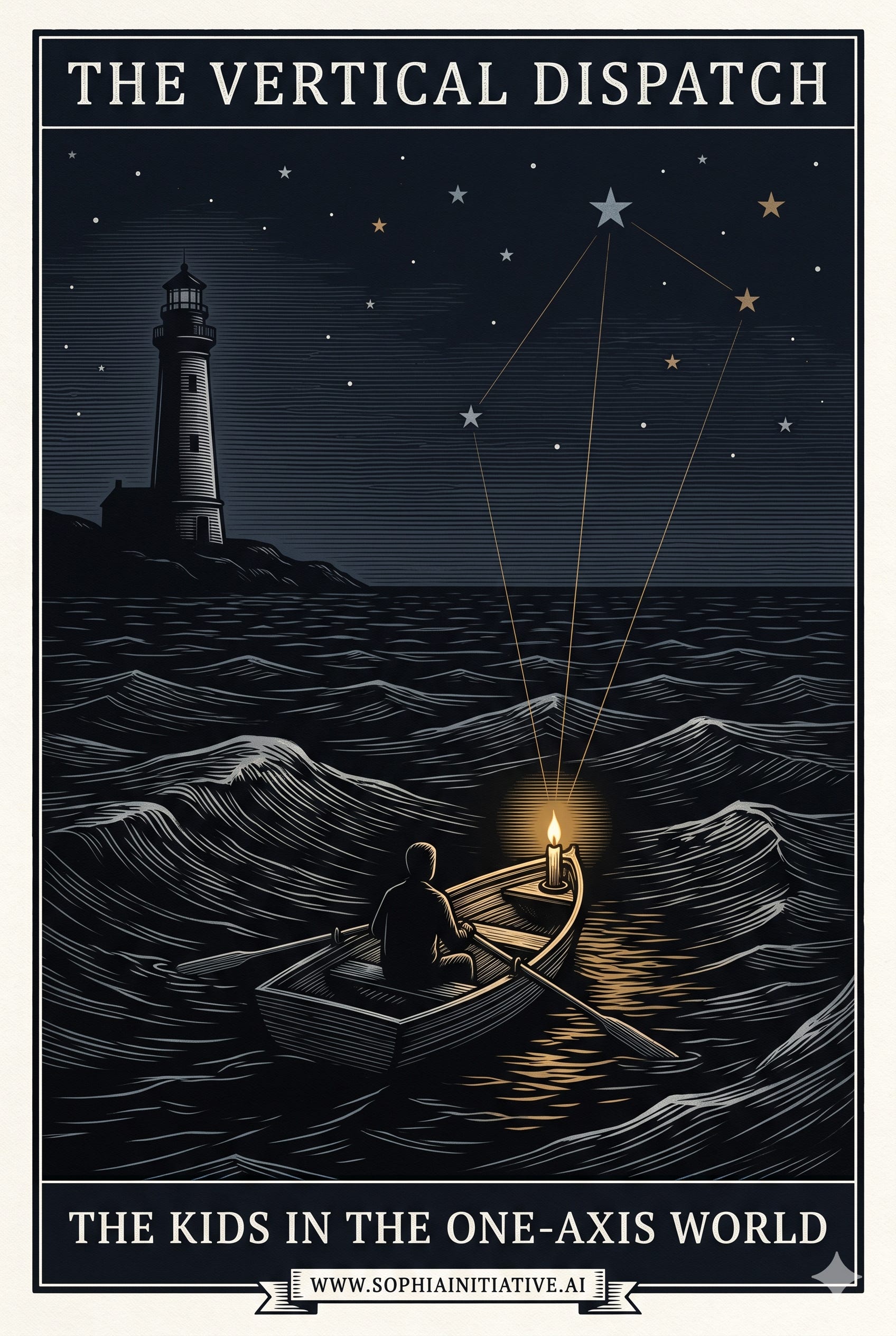
So name the moment as it actually is, without the costume. We are in deep black water. The global order is unstable. The compact has withdrawn. A technology is being sold as the saviour that will carry us, by some of the very people pulling up the floor we were standing on. And there is no lighthouse to be seen — no fixed beam on a near shore telling a frightened person exactly where safety lies. There is only the sky, and what is in it.
But that is not the same as no navigation. Before there was ever a lighthouse, sailors crossed open water by the stars. The stars are the older fixed points — the ones that were true before the shore-light was built and stay true after its bulb goes dark. In this dispatch the stars have plain names. Honest work. Showing up. Telling the truth about the record. Faith in the self that is doing the looking. These did not vanish when the compact withdrew. They went underground, into the smaller number of people who still honour them without being told to, without a payout promised, without a podium confirming that the heading still leads somewhere. The work ethic is not dead. It is being kept by the ones still steering by it in the dark.
The deepest keel of this publication is a man on the water at land’s end, the Architect’s father, who read a great wave coming and, without fear, set the small boat at the angle that let it glide safe over the top. He did not have a lighthouse in that moment either. He had the sky, the water, and his own steady hands, and that was enough to carry the people in the boat across. That is the whole of the instruction this dispatch can honestly give the young, and it is not a consolation tacked onto the end — it is the argument. The light you are looking for is not on the device, and it is not on the far shore, and it is not in the keynote. It is the candle you carry: one person’s flame, held steady, enough to steer by. The lighthouse is gone. The stars are still up there. Keep your nerve and your honesty, and you can cross deep water by them, the way your people always have.
And so the dispatch closes on two duties, not one, because honesty requires both. The citizen’s duty is the older one: keep the nerve, hold the honesty, steer by the stars through the black water without waiting for a beam that is not coming. But there is a second duty, and it sits in the highest chair in the country, and this publication will not let the beauty of the first duty quietly excuse the second. A frightened people can be asked to keep their own flame. They cannot be asked to manufacture, alone and from nothing, the belief that the floor will hold again. That belief is given from the top or it is not given. The person keeps the candle. The office must earn back the dawn. The Sovereign Plan stands or falls on whether both duties are met — and only one of them has been audited so far.
The lighthouse is dark. The water is black. And a person can still cross, by the stars, if they keep their nerve and their honesty. That is not nostalgia. It is instruction.
God is Love. Love is Truth. Truth is Consciousness. Consciousness is Brahman.
Amen. Namaste. Om Namah Shivaya.
— The Architect
For Ellison, who read the wave without fear, and set the boat to glide over it.
The Vertical Dispatch
sophiainitiative.ai
On the record
Job-mobility figures — about 0.82 per cent of workers changing jobs monthly in January 2022, falling to roughly 0.41 per cent in 2026 — and the “job hugging” framing are from CBC Radio, Cost of Living (Philip Drost), June 6, 2026, drawing on Bank of Canada and Statistics Canada data; the labour-economist quotation is Jim Stanford, Centre for Future Work. The “low hire, low fire” characterisation reflects a TD Economics labour-market snapshot. The term “job hugging” was popularised by the recruiting firm Korn Ferry in August 2025.
Canada’s technical recession — first-quarter 2026 GDP contracting roughly 0.1 per cent annualized, following a revised one per cent contraction in the fourth quarter of 2025 — is from Statistics Canada, as reported June 2026. The May 2026 labour improvement (employment up roughly 87,800, unemployment easing to 6.6 per cent from 6.9 per cent, youth unemployment down to 13.4 per cent) is from the Statistics Canada Labour Force Survey released June 5, 2026, as reported by The Globe and Mail.
Canada’s national AI strategy, “AI for All,” was launched by Prime Minister Mark Carney on June 4, 2026; the “transform every aspect of our lives for the better” and “no one is left behind” language is from the Government of Canada announcement and Minister Evan Solomon (Artificial Intelligence and Digital Innovation). Minister Solomon’s June 5, 2026 interview on AI safety and job losses is from CBC Radio, Front Burner.
AI labour-exposure figures (advanced-economy exposure, white-collar and entry-level concentration) reflect IMF and industry analyses current to early–mid 2026; “AI washing” and the finding that few firms had cut large numbers of staff due to AI actually deployed (versus anticipated) reflect Harvard Business Review survey reporting (December 2025) and Built In reporting (March 2026). Displacement forecasts attributed to executives and analysts are identified as forecasts, not settled measurement.
The “third place / third room” concept is Ray Oldenburg, The Great Good Place (1989). The Vedic Trimurti framing (Brahma, Vishnu, Shiva) is offered as interpretive lens, not theological assertion. All figures are volatile; verify against primary sources before republication.
#TheVerticalDispatch #TheArchitect #SophiaInitiative #BuildingCanadaStrong #TheAgeOfConsequences #SovereignPlan #Hope #TheMiddleClass #JobHugging #AIforAll #FutureOfWork #AIandJobs #CanadianEconomy #TechnicalRecession #MarkCarney #TheThirdPlace #RayOldenburg #Trimurti #Shiva #Vishnu #WorkEthic #DigitalCulture #CivilisationalAnalysis #GodIsLove #LoveIsTruth #OmNamahShivaya #SubstackCanada #CanadianPolitics #LongformWriting
Substack Notes
Three days in June told the whole story. On Thursday the Government of Canada launched a national AI strategy and called the technology a force to transform every aspect of our lives for the better. On Friday the minister had to go on the radio to defend it and answer for the fear of job losses. On Saturday the labour desk reported that Canadians are clinging to jobs they hate, too afraid to move — what the recruiters have started calling “job hugging.” The rate at which people change jobs has roughly halved since 2022. This dispatch argues that the fear underneath those three days is not a side-story to the Sovereign Plan. It is the keystone the whole plan rests on.
Here is the turn the piece makes. The Requisite Cabinet series has audited the machinery — Anand, Joly, Champagne, LeBlanc, each chair found, in the main, requisitely filled. But machinery does not move a frightened country. A budget does not make a person take a risk. The plan has one load-bearing human input that no department manufactures and no minister can be handed: hope — the ordinary citizen’s belief that honest effort still points somewhere. That belief is given from the top chair or it is not given at all. The office Carney holds is, by the architecture of his own plan, on the hook for it. Not the man — the office. The same elenchus we put on every chair, turned on the highest one.
And the demand is exact, not sentimental. Not “make Canadians feel hopeful” — a campaign can do that for a season. The demand is to prove hope: to convert it from rhetoric into something a citizen can actually audit, evidence that the broken compact — work hard, be honest, and you’ll be alright — is being honoured again rather than merely re-described. The keel holds the honest counter-facts throughout: the May 2026 jobs numbers improved, and much of the AI fear is running ahead of the technology — the fear doing the firing before the machine can. None of it breaks the deeper point. The floor gave, and a frightened middle class — the median citizen the plan is for — is the proof.
It ends where the publication began: on the water at land’s end, with the father who read the wave without fear and set the boat to glide over it. There is no lighthouse on this crossing — only the stars, and the nerve to steer by them. But the dispatch closes on two duties, not one. The citizen keeps the candle. The office must earn back the dawn. Hope is not soft. It is infrastructure, and it is the one thing a Sovereign Plan cannot buy. Walk with the words. 🕯️
The factual matter in this Dispatch is drawn from the public record. All characterizations, inferences, and conclusions are opinion, interpretation, and commentary, offered for analysis, reflection, and public-interest discussion. No assertion is made regarding the private intentions, state of mind, or character of any individual. Readers should evaluate all statements independently and draw their own conclusions.
VII -- Should be printed and framed and hung beside every entry door, to be a reminder, a subtle nudge, that reminds us where we've come from, where we are, and maps the forward path.
Nothing is ever just easy, and nothing is free but the wisdom to learn from the past. A gift offered but no always taken ...