


Philosophy · Consciousness · Civilisational Analysis
An ongoing dispatch on culture
“I learned the technology not to turn it on — but to turn it off.”
— the dispatch, stated plainly at the outset
There is a phrase that names what this dispatch is about, and it carries a double weight that is worth pausing over before the first paragraph properly begins. A kill switch is the cut-out on an engine, the panic button on a press, the lever that stops a runaway machine when nothing else will. The word is the engineer’s word and the engineer chose it precisely. To kill a thing in this sense is not to murder it. It is to end its motion. To return a moving system to rest. And there is a second weight the title cannot avoid, because this dispatch follows the others in the culture series and those others have been about a particular kind of motion — a culture’s traffic in violence, the screen full of it, the appetite that grew where revulsion was supposed to. The kill switch is the off switch, yes. It is also the switch on a kind of killing. Both are true. The title holds both.
This dispatch carries a floor under it that the reader will feel before the reader reads it. The floor is seven words. It will not be stated as a slogan and will not be repeated as a refrain. It will hold the prose the way a foundation holds a house — silent, structural, never named. But because the dispatch is the work of one writer for one reader, and not a riddle, the seven words can be set down once, here, in the open, before they go beneath the prose to do their work: the profane looks outward, the sacred inward. Hold that, set it down, and read on without it. The rest of the dispatch will not need to remind you. The sentences will arrive carrying it whether or not the word is on the page.
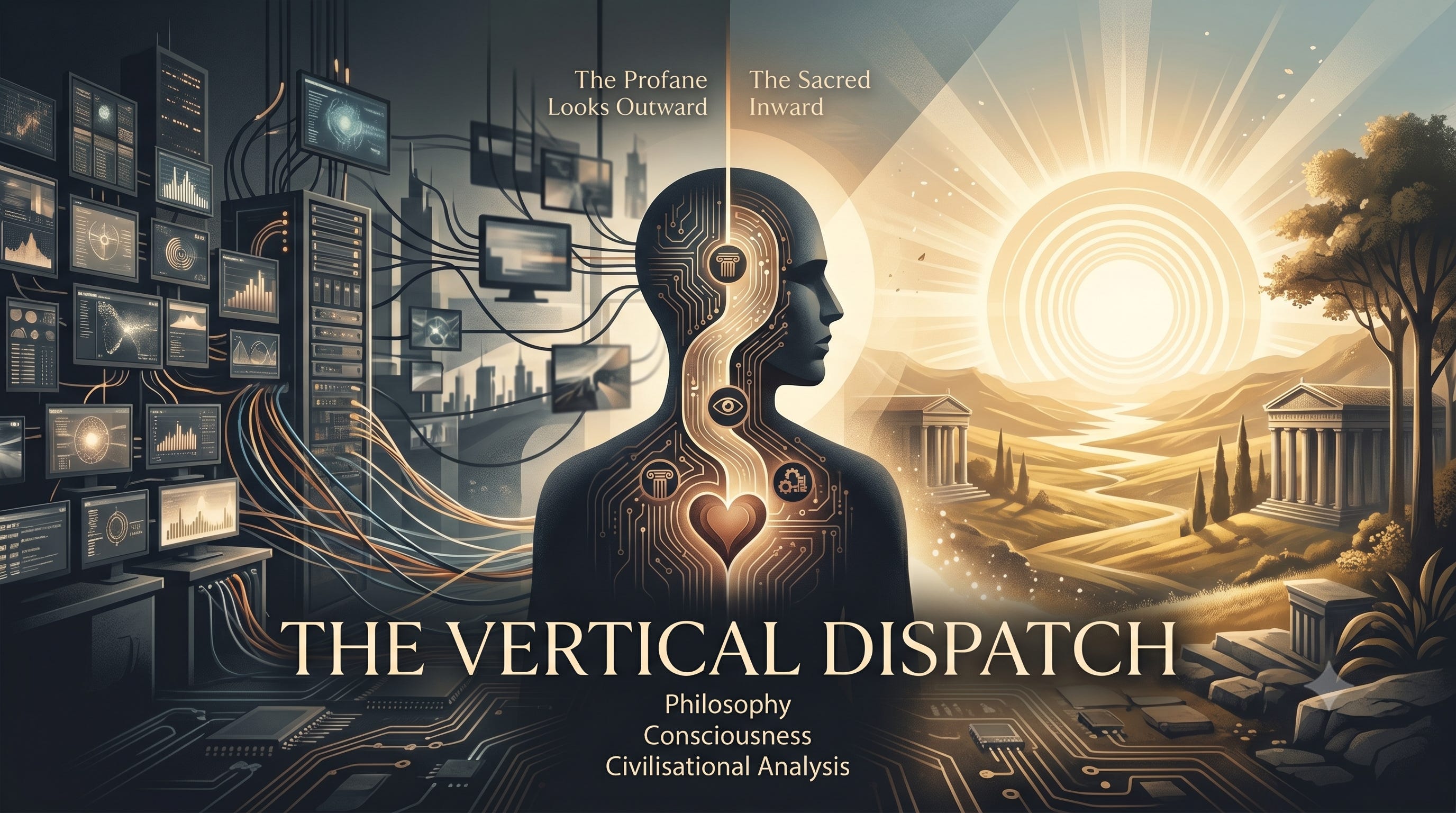
The piece is built in three movements. First, six men looking outward for the answer — the men our great novelists and one great director have given us, the faces of the village from the inside. Then a hinge: the short and exact lesson of a Canadian professor who told us, sixty years ago, that the way to escape a technology is to know it well enough to turn it off. Then the turn, and the close: a fireman who became a carrier, and a boy in a kitchen who hands a spoon back to a young man who thought the spoon was the problem. By the end the dispatch will have said what it needs to say about screens and conditioning and appetite and the war as a score. It will have said what it needs to say without lecturing the reader, and without exempting the writer. There is no clean place above the village from which to write. The Architect has been in the village too, and the dispatch will admit it before the dispatch is done.
I. SMITH — THE OUTWARD LOOK AT POWER
George Orwell published Nineteen Eighty-Four in 1949, dying soon afterwards, the book the last full thing he gave us. Its central figure is a clerk named Winston Smith, a man of no great equipment but a stubborn private interior, and the novel is the record of what happens to that interior when it goes looking outward for the answer. Smith looks at the state. He looks at the Party. He looks at the screen on his wall — the telescreen, which watches him as he watches it — and he tries to find, somewhere in the visible system of power surrounding him, the leverage that would let a man like him be free.
The novel’s verdict on that search is well known and is not its deepest claim. The deepest claim is structural. Smith’s search fails not because the Party is too strong, though it is. It fails because the search itself is in the wrong direction. Smith asks where the answer is and looks outward — at the diary, at the woman, at the brotherhood, at the room above the shop, at the face of O’Brien — and each outward look is met by an answering machine the Party has already prepared. The Party is not merely watching him. It is orienting him. Every direction in which Smith can look has been built by the Party in advance to receive his looking. The telescreen on the wall is not a metaphor for surveillance in some abstract way. It is the literal device of the dispatch this whole culture series has been writing: a screen by which a person is shaped at the level at which they take themselves to be unshaped. Smith looks at the screen. The screen looks at Smith. Smith does not look in the one direction the Party has not been able to colonise, which is the direction the novel cannot show him because the novel is the report of a man who never quite turns. He is the first of the six. The outward look at power, and the boot that waits at the end of it.
II. HOLDEN — THE OUTWARD LOOK THAT CURDLES
J. D. Salinger published The Catcher in the Rye in 1951, two years after Orwell’s last book reached the world, and the two novels make a strange but exact pair. Where Smith looks outward at power and finds the boot, Holden Caulfield looks outward at his own society and finds something at once milder and harder to escape — a world of phonies, of adults who have rehearsed their adulthood out of any contact with the real, of teachers and parents and admired men who, when the boy looks at them closely, turn out to be performing. The book is famous for that word, and the word is exact. Holden sees the village. He sees the surface. He sees the curated self before any of us had the vocabulary.
And the novel is the record of what happens when seeing arrives without a path. Holden has the diagnosis and not the cure. He has the eye and not the floor. He is sixteen years old, alone in New York City for three days, ringing telephones he will not pick up, sitting in bars he should not be in, walking through a city that has stopped giving him anywhere to put what he has seen. The novel ends with him institutionalised, and the ending is not Salinger’s punishment of his hero. It is Salinger’s warning. Diagnosis without a path curdles. Seeing the phoniness, by itself, is not a victory; it is a wound. A man who has seen the village and has not found the door out will go to pieces inside it. The boy is the second face of the outward look — the awakened look, more painful than Smith’s, because Smith was at least anaesthetised by hope. Holden has lost the anaesthesia and not yet found the door. The reader who recognises themselves in him should be careful. The dispatch is not telling you to be him. The dispatch is telling you he is the warning that lives between the diagnosis and the cure.
Diagnosis without a path curdles. The boy who has seen the village and not found the door will go to pieces inside it. The eye is not the floor.
III. ALEX — THE EXPERIMENT THAT RAN THE WRONG WAY
Now the centrepiece of the problem section, and it is a single bracket held by one man across the second half of the twentieth century. Stanley Kubrick began his great middle period with A Clockwork Orange in 1971, after Anthony Burgess’s novel of 1962, and he closed his working life with Eyes Wide Shut in 1999, dying a week after delivering the final cut. Read those two films as a single bracket and the director’s life records the arc of this dispatch with a precision that ought to disturb the reader who notices it. He opened with the screen entering the boy. He closed with the man unable to leave the screen even at home. Twenty-eight years and a master’s working life span the bracket. Whether Kubrick knew what he was building is a question for the biographers. The bracket is real either way. The artist sometimes builds the structure the culture needs while believing he is building something else.
Take the opening film first. Burgess gave us a young man named Alex, saturated with violence and music and language, a connoisseur of cruelty by his teens. The State takes him and places him in a chair, eyelids clamped open, and shows him films — hours of films, with chemical accompaniment — until the sight of violence makes him retch. This is the Ludovico Technique. The experiment was designed to condition revulsion. Burgess feared a society that could engineer the recoil of its young men, removing not merely the act but the freedom not to act, and he was right to fear it; a man who cannot choose violence is not a moral being. The novel and the film both turn on that horror.
Sixty years on, the experiment has been run on the culture itself, and the result is the opposite of the one Burgess feared. Saturation was supposed to produce the sickness. It produced the appetite. The reader can confirm this with a single observation, and the confirmation does not require any social science. There is a genre of video game called the first-person shooter, in which the player views the game world through the eyes of a character holding a firearm, and the play consists in the discharging of that firearm at other figures. The genre has been the dominant commercial form of the medium for thirty years. There is now a category of mainstream cinema, of which the John Wick films are the most polished current example, in which the violence is choreographed with the care a previous century reserved for ballet, and the audience comes to admire the form of the kill. None of this is hidden. None of it is unpopular. None of it produces the recoil Burgess imagined the Ludovico chair would force.
What it produces is the connoisseur. Alex, completed. The chair Burgess imagined as punishment dressed as cure has been built into the living room as recreation, with a controller in the user’s own hand. The eyelids no longer need to be clamped open. The attention is freely given. The conditioning, run on a willing population, ran in reverse. We did not become sick of the screen’s violence. We acquired a palate for it, and then a refinement of the palate, and now we discuss the choreography of a fight scene the way an earlier generation discussed the construction of a sonnet. Alex is the prototype — not because the player will go out and do what Alex did, but because the player is, in the precise sense Burgess used the word, conditioned. The reflex has been trained. The trained reflex is the village’s product. The product is what is on sale, and it is selling.
The experiment ran the wrong way. The chair was meant to condition revulsion. Built into the living room and sold as recreation, it conditioned the appetite. We did not become sick of the violence. We acquired a palate for it.
And here a small structural observation that ties this section back to the village dispatches, because the dispatch must not appear to indict the player while exempting the culture that made the player. The shooter and the choreographed killing did not arrive from outside the civilisation that consumes them. They are not impositions. They are products, made because they sell, sold because the appetite is there, and the appetite is there because the culture trained it long before any single game or film. A loop runs and nobody at any point in the loop has to be a villain for the loop to be deadly. Culture trains the appetite; the technology serves the appetite; the screen brightens the appetite; the appetite buys the next product; the next product deepens the training. The same loop the surveillance dispatch named, run on violence instead of attention. The thing to indict is the loop, not the player and not, in any final way, the maker. The loop is the disease. The player and the maker are inside the loop with the rest of us.
IV. THE CLOSING FRAME — EYES WIDE SHUT
Twenty-eight years after Alex sat in the chair, Kubrick gave the world his final film, and it is the second wall of the bracket. Eyes Wide Shut follows a wealthy New York doctor through a long night and a few days afterwards, in which he walks into a world of perfect surfaces — a masked ritual at a country house, a coded social order, a glimpsed substrate of money and power and arrangement — and walks out of it at the end with nothing solid in his hands. The film is famous for being difficult to interpret and is not, when you watch it patiently, difficult at all. It is patient. It is exact. It is the report of a man whose eyes are open the entire film and who sees almost nothing, because everything he is shown is a surface, and the surface closes over the substrate the moment he reaches for it.
Read the title in the light of this dispatch and the bracket completes itself. Eyes wide shut is the paradox the village requires of its inhabitants. The eyes must be open — the screen demands it, the feed demands it, the choreographed killing demands it. And the eyes must be shut — to the substrate, to what is actually being arranged, to the question of who is wearing the mask and why. The doctor is not a fool. He is the village’s most competent product: a man fluent at every surface, equipped to handle every visible level, and structurally unable to see the level beneath the surface, even when his own bed has been entered by it. Kubrick’s last sentence as an artist, said in cinema and not in words, was that this is what the inhabitant of the village has become. Eyes wide. And shut.
Hold the two films in mind together. The first: the screen entering the boy, the chair built into the living room, the conditioning that ran in reverse and made the appetite. The second: the man the boy grew into, walking through a world he cannot leave even with his eyes open, returning home to be told, in the film’s quiet closing word, to forget what he saw. The arc is the village’s arc. From the screen entering the person to the person unable to leave the screen even at home. From the chair held against the boy to the spell that follows the man into his own marriage. Kubrick laid it down across his working life and died the week he finished. The bracket stands. It is the most precise diagnosis the dispatch has access to, and the dispatch did not have to construct it. One artist built it, watched it close, and went out.
V. THE WRITER IN THE VILLAGE TOO
Before this dispatch turns the corner into its hinge, there is a thing the writer has to admit, because the whole culture series has insisted there is no vantage point above the culture and the writer has now reached the place where that insistence is tested. The Architect has caught himself, in recent years, wanting the war on the screen. Not as a moral choice. As a reflex. The footage from a foreign field running in the corner of the room, and a small voice underneath the surface attention asking the score — who is winning, who is losing, where on the board are we now. The reflex is not theoretical. It is in the writer’s own hands. The writer has felt it rise without permission and noticed it and watched it ebb and known, in the noticing, that the conditioning Burgess imagined for one boy in a chair was performed at scale on the writer also, and on the writer’s generation, and on the readers of this dispatch, and on the children of those readers.
This is the part that earns the dispatch its altitude or forfeits it. A writer who indicts the village from a clean room is not telling the truth about the village; he is positioning himself outside a thing that nobody is outside. The reflex the dispatch has been describing is in the writer’s own nervous system. The appetite for the war as a score is in the writer’s own evening. The wanting to know who is winning is the village’s signature on the writer’s day. The writer can witness this and report it. The writer cannot pretend it was not there. The dispatch is offered, then, from inside the village, by a man who has caught the village reaching into him and is writing the report anyway. That is the only honest place to write from. The reader who can see the same reflex in their own evening is not lower than the writer. They are at the same desk.
The reflex is in the writer’s own hands. The wanting to know who is winning is the village’s signature on the writer’s day. The dispatch is filed from inside the village. There is no other address.
VI. LEARN THE TECHNOLOGY
Marshall McLuhan was a professor of English at the University of Toronto in the nineteen-sixties, and he spent the last decade of his working life trying to tell a public that did not entirely want to listen that the medium they were swimming in was reshaping them and that the only protection on offer was to understand the medium. He did not say the screen was evil. He did not say the citizen should smash it. He said something more useful and more strenuous. He said: the only person not at the mercy of a technology is the one who has understood it well enough to turn it off.
That is the hinge of this dispatch, and it is the line the writer of these pages has carried at the centre of his working life: I learned the technology not to turn it on but to turn it off. Sixty-eight years of a life and the better part of them spent inside the machinery of computers and networks have taught the writer one thing about the machine that is worth more than the rest: the kill switch on a technology is the consequence of knowing where the wires go. The man who fears the technology cannot reach the switch because he does not know which one it is. The man who has been conditioned by the technology cannot reach the switch because he does not believe there is one. Only the man who has understood the machine — patiently, all the way through, including the parts that bored him — can find the switch and put his hand on it. That is McLuhan’s lesson, stated in an engineer’s vocabulary, and it is the practical instruction the dispatch can give its reader before the dispatch turns inward.
So the off switch is real. The dispatch will not pretend the off switch is unreal in order to point past it at something deeper. The off switch is the daily, ordinary, repeatable act — the phone face-down at supper, the screen unplugged for an hour, the news refused for an evening, the book chosen over the feed. That is real freedom and the dispatch honours it. But the off switch is the door. It is not the room. The room is on the other side of the door, and the rest of the dispatch is about what is in the room.
VII. MONTAG — THE FIRST ONE WHO TURNED AROUND
Ray Bradbury published Fahrenheit 451 in 1953, and its central figure is a fireman named Montag, in a society where firemen do not put out fires; they burn books. The books are the dangerous thing. The screen is the safe thing — walls of screen, in fact, three at a time in the ordinary family’s living room, an early and exact prophecy by a man who could not have seen what was coming and saw it anyway. Montag is, for the first half of the novel, a competent professional. He goes to the houses, he applies the kerosene, he watches the books burn. He is not a villain. He is not a fool. He is the village’s most fluent product, like the doctor at the end of Eyes Wide Shut, and like the doctor he has been moving through his life with his eyes wide and his attention shut.
And then he turns. The novel is the record of the turning. He keeps a book. He reads it. He meets the people who have memorised the books that have been burned — each man and woman walking, in the wilderness at the end, as a book, the entire contents of a work carried in a living mind because the paper itself can no longer be trusted to survive. Montag, at the close, has joined them. He is no longer the burner. He is the carrier. The technology of the village has been put down. The technology of the book has been picked up. The man is no longer the machine of the culture. He is the thing the machine of the culture was built to destroy, and he is walking out of the city with it.
Montag is the first man in this dispatch who looked the other way. Smith looked at power and found the boot. Holden looked at his world and found phonies. Alex looked at violence and found the appetite. The doctor looked at the masked ritual and found a surface that closed over the substrate. Montag, for the first half of his story, looked outward like all of them, and the village had a job for him to do, and he did it. And then he stopped. And the stopping is the entire turn this dispatch has been moving toward. The fireman became the carrier. The screen was put down. The book was picked up. The direction of looking changed, and a man who had been the village’s instrument became, by the simple act of turning, an instrument the village could not own.
VIII. THE BOY IN THE KITCHEN
There is a moment in The Matrix, made by the Wachowskis in 1999 — the same year Kubrick closed his bracket, a coincidence the dispatch will note and not pretend to interpret — in which a young man named Neo is taken into a waiting room and sees a child sitting cross-legged on the floor, looking at a spoon. The boy is bending the spoon without touching it. Neo watches, and the boy turns to him, and gives him an instruction that this dispatch has been moving toward across two parts of the village series and three movements of this one. The instruction is, in essence, this: do not try to bend the spoon, because that is impossible. Realise instead the truth, which is that there is no spoon. Then you will see that it is not the spoon that bends. It is only yourself.
The dispatch will not quote the scene further. It does not need to. The instruction is sufficient as stated, in the writer’s own words, and it lands exactly on the floor this dispatch has been silently standing on from the first paragraph. The boy is doing the seven words. The profane looks outward, at the spoon, at the world, at the screen, at the war as a score, at the choreographed killing, at the masked ritual, at the firemen burning the books — and tries, with effort and with technique, to bend what cannot be bent. The sacred looks inward, at the seeing in which the spoon and the screen and the war and the ritual are all appearing, and finds that the bending was never out there. The bending was in the looker. The instrument the looker has been searching for is the looker. The kill switch the dispatch has been describing is the recognition that there was nothing, in the end, to switch. The technology was the awareness that was reading this sentence the whole time.
This is where the dispatch arrives and where it must stop. Smith looked at the boot. Holden looked at the phonies and curdled. Alex looked at the violence and acquired the palate. The doctor looked at the surface and was sent home to forget. Montag, the fifth, turned around, and the turning was the act — the procedural cure, the off switch used, the book picked up. Behind Montag, the recognition the boy in the kitchen names: the book Montag carries is not, in the deepest sense, outside him. The book is what he is becoming. The screen the dispatch has been describing is not, in the deepest sense, the problem. The screen is borrowing the attention that lights it, and the attention can be called back, and when the attention is called back there is no screen. Only the one who was looking. There is no spoon. There is only yourself.
The kill switch is not pressed against the world. The kill switch is the recognition that there is nothing, in the end, to switch. The technology is the awareness that was reading this sentence the whole time.
So the dispatch ends, as the others have, by handing the reader to themselves. The question it leaves is not new. It is the question the boy in the kitchen put to Neo, and the question Bradbury put through Montag’s hand on the first book he did not burn, and the question every contemplative tradition has put to its student in the language available to it. Who is the one in you who has been doing the looking. Is the looker the watched self of the village, the curated surface that was assembled to be seen — or is the looker the awareness in which the surface, and the screen, and the war as a score, and the bending spoon, have all merely been appearing. You do not have to answer tonight. You do not have to answer in words. But the kill switch you have been looking for is not on the device. It is, and has always been, in the direction in which you are now invited to look. The seven words held the floor. Now they may be put down, because the dispatch is over and the floor will hold without them.
God is Love. Love is Truth. Truth is Consciousness. Consciousness is Brahman.
Amen. Namaste.
Signed: Glen Roberts / The Architect / The Vertical Dispatch
#TheVerticalDispatch #MarshallMcLuhan #Kubrick #Orwell #Salinger #Bradbury #TheMatrix #DigitalCulture #Consciousness #CivilisationalAnalysis #TheArchitect
The circle is so large that when we walk along its edge we think we are walking in a straight line.
I wrote that a while back. It’s something I saw. It’s not necessarily something true, but it’s something that I keep revisiting. It was probably the source of my comment about the assertion of eternity. Is there no end because our reach forward is the force that propels that which we reach for out of our reach? Is eternity simply a result of our obsession with direction? What if it all just folds back on itself? Or? Well I don’t know.