

“As a lamp in a windless place does not flicker — so the yogi of controlled mind remains steady in meditation on the Self.” — Bhagavad Gita 6.19
— ★ —
The battlefield has grown quiet. For five days I have been teaching Arjuna about the nature of the Self, about action and its fruits, about the fire of knowledge and the friend who was never absent. Today the teaching turns inward completely. No more armies, no more arguments about renunciation versus action, no more philosophical distinctions to be drawn. Today I sit Arjuna down and teach him how to be still.
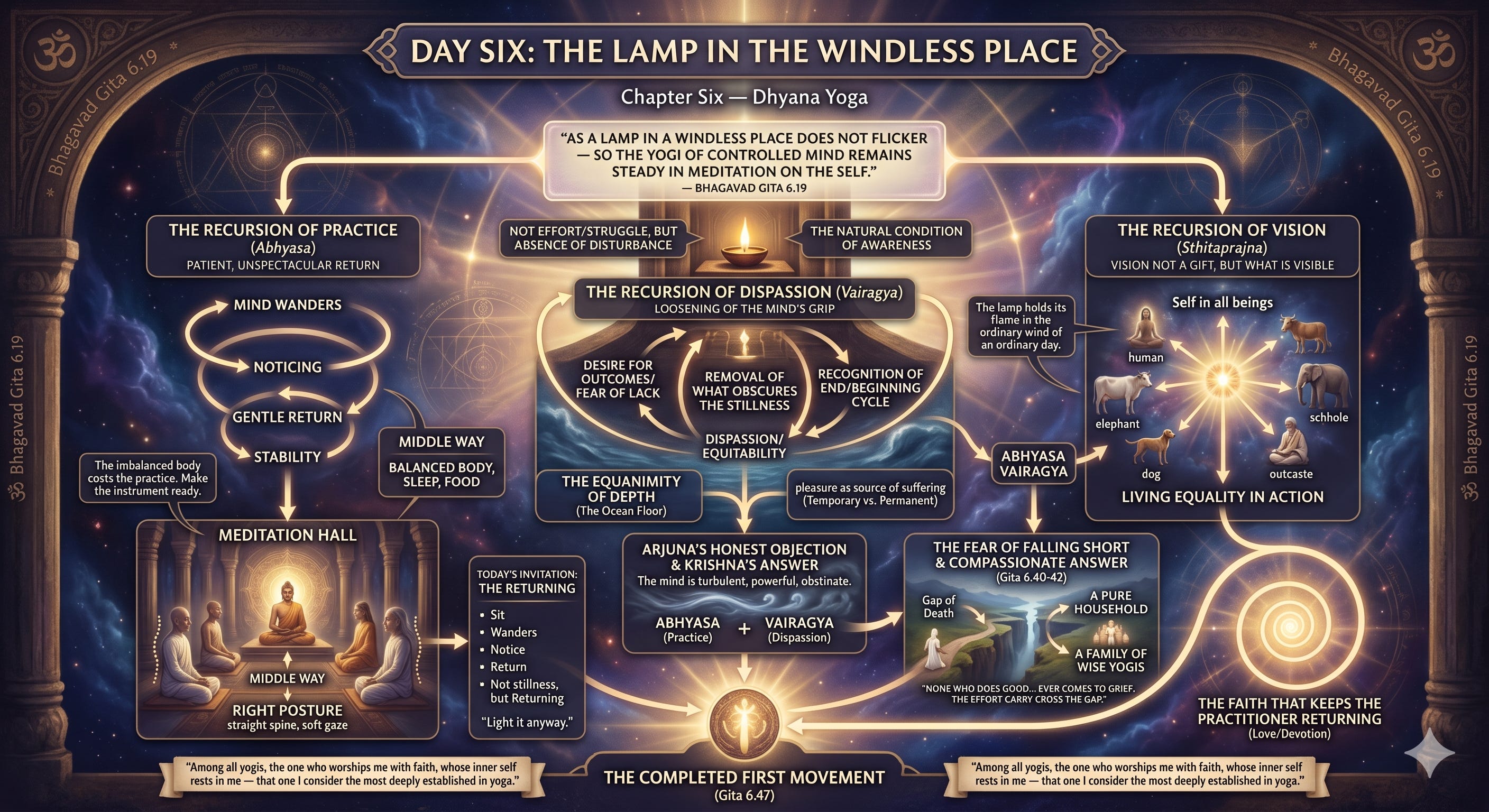
This is Chapter Six — Dhyana Yoga, the yoga of meditation. And it is the most practical chapter in the first half of the Gita. Not because it gives techniques, though it does. But because it takes the question of practice completely seriously, including the hardest part of practice: what to do when it seems impossible.
I begin where Chapter Five ended. The true sannyasi, the true yogi — these are not two different people following two different paths. The one who performs their duty without depending on its fruits is both at once. The outer form of renunciation matters less than the inner disposition that the form is meant to cultivate. A person can wear the robes and still be bound. A person can remain in the world and move through it in complete freedom. What I am pointing at has always been interior. Chapter Six is where the interior work is described directly.
— ★ —
I describe the conditions for practice. Find a clean place. Sit on a firm seat — not too high, not too low. Hold the body, head, and neck in alignment, steady and still. Fix the gaze at the tip of the nose or between the eyebrows. Let the mind become one-pointed.
Then I say something that every serious practitioner eventually discovers is the most important instruction in the chapter, though it sounds almost administrative when first heard. Neither too much food nor too little. Neither too much sleep nor too little. Neither too much effort in activity nor withdrawal into passivity. The middle way — not as a philosophical principle but as a lived daily condition.
Shankara stayed with this longer than the modern reader expects, because he understood what the imbalanced body costs the practice. The body is the instrument. Deny it what it requires and it becomes an obstacle, its complaints louder than the silence you are trying to hear. Indulge it past what it requires and it assumes command, its appetites drowning the very attention you are trying to cultivate. The practitioner who has found the precise balance point — who sleeps enough to be alert, eats enough to be clear, works enough to be grounded — that person has done something difficult and undervalued. They have made the instrument ready.
This is not glamorous teaching. It is foundational. A lamp that has been poorly made will not hold a steady flame regardless of how windless the room.
— ★ —
And now the image that Shankara considered the most precise description of the meditative state in the entire Gita.
“As a lamp in a windless place does not flicker — so the yogi of controlled mind remains steady in meditation on the Self.” — Bhagavad Gita 6.19
Hold this image carefully. The lamp is not struggling to remain still. It is not concentrating on not flickering. It is not suppressing the impulse to be moved by the wind. There is simply no wind where it is placed. And in the absence of what would have disturbed it, its own nature — which is to burn steadily, which has always been to burn steadily — expresses itself without interference.
This is what meditation is pointing toward. Not a state produced by effort. Not the result of concentration applied forcibly to a restless mind. The natural condition of awareness when the disturbances that ordinarily interrupt it are no longer present. The flame was always steady. The wind was the problem, and the wind is the untrained mind — its commentary, its associations, its habitual reaching toward the pleasant and away from the unpleasant.
The practice of meditation, understood correctly, is not the production of stillness. It is the removal of what obscures the stillness that is already there. This is why Shankara connects Chapter Six so carefully to Chapter Two. The Sthitaprajna — the one of steady wisdom described at the close of Chapter Two — and the yogi whose lamp does not flicker are the same person described from two different angles. The metaphysics of Chapter Two and the practice of Chapter Six are not separate teachings. They are the same recognition approached from above and below simultaneously.
— ★ —
As the practice deepens, something becomes perceptible that was always present but not seen. The yogi established in meditation begins to see the Self in all beings and all beings in the Self. Sees the same ground everywhere — in the human and the animal, in the animate and the inanimate, in the one who brings joy and the one who brings pain.
Yesterday we touched this in Chapter Five through the image of the sage who sees the same Self in the scholar and the outcaste and the dog. Today Chapter Six brings it into the context of practice. This vision is not a gift that falls from the sky to the lucky few. It is what becomes visible when the practitioner has sat long enough, consistently enough, in the windless place, for the lamp to stop flickering. When the commentary of the ego-mind quiets sufficiently, what was always there — the single ground wearing every form — becomes perceptible. Not as a concept. As direct experience.
And the measure of how deeply this has been realised, I tell Arjuna, is not the experience in meditation. It is the behaviour after meditation ends. The one who sees with equality — who responds to pleasure and pain, to success and failure, to friend and enemy, from the same still centre — that one has genuinely arrived at what the practice was for. The lamp does not only burn steadily in the windless room. It holds its flame in the ordinary wind of an ordinary day.
— ★ —
Then Arjuna says the most honest thing he has said in six days of teaching.
He says: Krishna, the mind is restless. Turbulent. Powerful. Obstinate. Trying to control it seems as difficult as trying to control the wind itself. How can this possibly be achieved?
This is not weakness speaking. This is accurate observation from a man who has genuinely tried. Arjuna is not a beginner who has not yet attempted practice. He is a warrior who has spent decades in rigorous discipline. He knows exactly how difficult the mind is because he has sat with it. And he is telling me honestly what he has found.
Shankara noted that this objection must be taken completely seriously. A teaching that dismisses the difficulty of the mind with easy reassurances has not understood the problem. The mind is genuinely difficult. This is not a character flaw to be corrected by trying harder. It is the nature of an instrument that has been conditioned by lifetimes of outward movement, and conditioning of that depth does not reverse quickly.
My answer to Arjuna is direct and complete. Yes — the mind is difficult to control. You are not wrong. And yet it can be steadied. Through two things together, not one alone.
The first is abhyasa — practice. Patient, consistent, unspectacular return. Not the grand gesture of a long retreat, though that has its place. The daily return to the seat, to the breath, to the attempt to be present, regardless of how the previous sitting went. The practitioner who returns the next morning after a sitting that felt like failure has understood something the one who only sits on good days has not yet grasped.
The second is vairagya — dispassion. Not indifference. Not the suppression of feeling. But the gradual loosening of the mind’s investment in outcomes. The lessening of the grip with which it reaches for what it wants and pushes away what it fears. Practice without dispassion becomes striving — the ego trying to achieve a spiritual state, which is the ego’s deepest trap. Dispassion without practice becomes passivity — a withdrawal from the effort that genuine understanding requires. Together, slowly, over time, they create the conditions in which the lamp can find the windless place.
— ★ —
Arjuna asks one more question. And it is the question every sincere seeker eventually has to ask, though many are afraid to voice it.
He says: what happens to the one who takes up this path with genuine faith, who makes the effort sincerely, but who does not reach the goal in this lifetime? Are they simply lost? Like a cloud dispersed by wind, with no foundation in either the worldly life they abandoned or the liberation they could not reach?
The fear underneath this question is real and worth sitting with. It is the fear that the effort might not be enough. That you could give your life to this and still fall short. That the gap between where you are and where the teaching points might simply be too large to cross in the time available.
What I tell him next is, Shankara said, among the most compassionate passages in the entire Gita.
“None who does good, dear friend, ever comes to grief. The one who has fallen from yoga goes to the worlds of the righteous, dwells there for countless years, and is then born again in a pure and prosperous household. Or they are born into a family of wise yogis — and a birth like this is very rare in this world.” — Bhagavad Gita 6.40–42
The effort is never lost. Not one sincere moment of practice, not one genuine movement toward clarity, not one morning of patient return to the seat — none of it dissolves. The momentum carries across the gap that death makes. The sincere seeker who falls short in this life is reborn in conditions that favour the continuation of what they began. And in that next life, they take up the practice not as something entirely new but with an instinctive pull they cannot explain — a recognition rather than a discovery.
This is why some children are drawn toward questions the adults around them have never asked. Why some people encounter the teaching for the first time and feel not that they are learning but that they are remembering. The recognition is the memory. The pull toward the path is the path already working in them from what was begun before.
No sincere effort is ever wasted. This is not consolation. This is how the universe is structured.
— ★ —
Chapter Six closes with the verse that completes the first great movement of the Gita. Six chapters. The grief of Chapter One has been transformed, layer by layer, into something that now has a name and a practice and a horizon.
Yoginam api sarvesham madgatenantar atmana. Shradddhavan bhajate yo mam sa me yuktatamo matah.
Among all yogis, the one who worships me with faith, whose inner self rests in me — that one I consider the most deeply established in yoga.
Shankara paused at this verse for a reason. Six chapters of rigorous philosophical teaching — the deathless Self, action without the doer, the fire of knowledge, the inner renunciant, the lamp in the windless place — and at the end of all of it, what completes the practice is not technique. It is the love that keeps the practitioner returning. Faith not as belief in propositions but as the quality of attention that does not abandon the search when the search becomes difficult. The devotion that makes the windless place not just a room the practitioner enters but a relationship they are in.
The lamp holds its flame because the one who lit it keeps coming back. That faithfulness — quiet, unspectacular, daily — is itself the highest yoga.
— ★ —
Today there is only one invitation. Not a question to carry or a practice to perform.
Sit. Five minutes or fifty. In whatever position the body can sustain without strain. Let the breath move as it moves. When the mind wanders — and it will wander, as the river finds its channels — notice that it has wandered, and return. Without judgment. Without the assessment of whether this sitting is better or worse than the last one. Simply return.
That returning is the practice. Not the stillness, which will come in its own time. The returning. Each time you come back, something that was dispersed gathers itself. Each time you sit, regardless of how it feels, the lamp is lit. The wind may still be blowing. Light it anyway.
The windless place is not elsewhere. It has always been here. The practice is simply learning how to stop moving long enough to feel it.
— ★ —
Tomorrow: Chapter Seven — Knowledge of Brahman

The Architect • The Vertical DispatchGlennford Ellison Roberts Author — Sacred Metaphysics & Consciousness: History of the Absolute & Eternal Cumberland, Ontario, Canada
God is Love. Love is Truth. Truth is Consciousness. Consciousness is Brahman.
Amen. Namaste.. 🙏
#BhagavadGita #Gita18Days #ChapterOne #ArjunaVisadaYoga #KurukshetraField #KrishnaTeaches #Shankaracharya #Advaita #VedicWisdom #SanatanaDharma #HinduPhilosophy #SpiritualAwakening #Consciousness #AncientWisdom #YogaPhilosophy #Dharma #Moksha #SpiritualSeeker #Avidya #NonDuality #TheVerticalDispatch #TheArchitect
🙏🙏