


Analysis · Philosophy · Civilization
By The Architect · The Vertical Dispatch
Series Introduction · Each figure named here will receive their own full essay in the weeks ahead
There was a moment — roughly between 1945 and 1975 — when the United States produced something it has not produced since and may not produce again: a critical mass of public intellectuals writing at full altitude for a reading public still capable of receiving them.
Not academics writing for other academics. Not journalists writing for the daily cycle. But writers of extraordinary range and ambition who addressed the largest questions of their civilization — race, empire, consciousness, morality, power, the nature of the American experiment itself — in prose that demanded everything of its readers and rewarded the demand with genuine illumination.
They were not a school. They did not share a politics. They fought each other with genuine ferocity — in print, on television, in the green rooms of talk shows, occasionally with their fists. They were vain and brilliant and sometimes monstrous and always alive in a way that public discourse has not been alive since. They inhabited a commons — the Partisan Review, Commentary, the New York Review of Books, Esquire at its serious peak, the Atlantic before it became a lifestyle magazine — that held them in productive tension with each other and with the reading public that was the judge of their arguments.
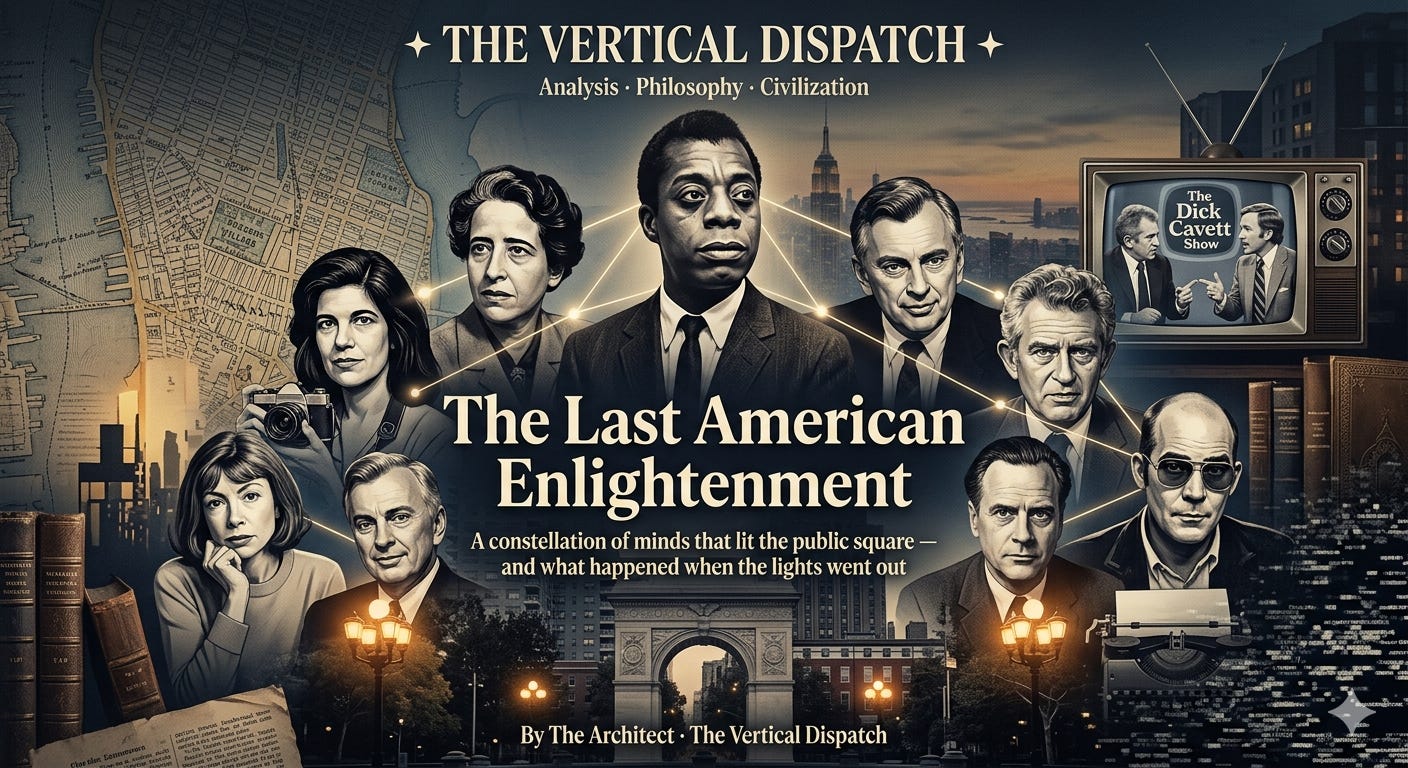
That commons no longer exists in the form it took then. What replaced it first was television, which discovered that the breakdown of serious discourse was more profitable than serious discourse itself. Then came the internet, which atomized the commons into a billion separate feeds. Then came the algorithm, which learned each reader’s existing preferences and served them back as a mirror, eliminating the friction of genuine encounter with genuinely different thought.
This series is the record of what was lost — and the argument that it can be found again. Not recovered in the form it took, which belonged to a specific historical moment that cannot be reproduced. But rebuilt, on different infrastructure, for the same audience that has always existed: the fifteen percent who read and reason at the level that genuine civilization requires.
The Vertical Dispatch is the argument that Substack, used at altitude, is the closest structural equivalent to the Partisan Review that the current moment offers. These are the writers who showed what altitude looks like. Each of them will receive their own full essay in the weeks ahead. This is the establishing shot — the panoramic view before we enter the individual frames.
The Infrastructure That Made Them Possible
Before we name the writers, we have to name the commons. Because the Last American Enlightenment did not emerge from individual genius alone — it emerged from an ecosystem. The magazines, the publishing houses, the television programs that briefly allowed serious thought to reach a serious audience, and the reading public whose literacy was high enough to constitute a genuine intellectual culture rather than a niche.
The Partisan Review — founded in 1934, at its peak influence in the 1940s and 1950s — was the intellectual nerve centre of the American left-liberal tradition. Its contributors at various times included Hannah Arendt, Lionel Trilling, Mary McCarthy, Saul Bellow, Norman Mailer, and virtually every serious writer of the period who had something urgent to say about politics and culture. It was a small magazine with a large radius — its circulation never exceeded fifteen thousand, but its fifteen thousand readers included the editors, professors, journalists, and cultural figures who shaped the broader conversation.
The New York Review of Books — founded in 1963 during a newspaper strike — became the premier venue for long-form intellectual engagement in the English-speaking world. Susan Sontag published her first major essays there. Gore Vidal used it as his primary platform for four decades. The review Vidal published there of Norman Mailer’s Prisoner of Sex — comparing Mailer to Charles Manson — led directly to Mailer head-butting Vidal in the green room of the Dick Cavett Show. Ideas had consequences. Arguments had stakes. The intellectual combat was genuine because the stakes were genuine.
And television — in its early serious incarnation — briefly extended the commons rather than destroying it. The Dick Cavett Show brought Baldwin and Mailer and Vidal into living rooms across America. Firing Line gave William F. Buckley a weekly platform to argue with the best minds on the American left. These were intellectual programs that happened to be on television. The distinction matters enormously because it was precisely that distinction — between a medium serving the argument and a medium consuming it — that television eventually abolished. The night it abolished it, the cameras were rolling and the ratings doubled.
That is the infrastructure. Now the writers.
The Constellation
Marshall McLuhan — Understanding Media: The Extensions of Man (1964)
The Canadian prophet who saw everything coming and was fascinated rather than alarmed. McLuhan understood, before anyone else had the conceptual vocabulary to say it, that every communications technology carries within it a philosophy — a set of cognitive demands and permissions that reshape the minds of those who use it regardless of content. The medium is the message. The electric age would produce a global village. He was right about the transformation and catastrophically wrong about its consequences, mistaking the arrival of the village for the recovery of community rather than the elimination of solitude. At the University of Toronto, in rooms smelling of old books and unlit pipes, he assembled the tools that his student Neil Postman would later turn into a warning McLuhan himself refused to issue. He is the father of the entire conversation this series is having. He was also Canadian, which The Vertical Dispatch notes with appropriate pride.
Neil Postman — Amusing Ourselves to Death (1985)
The critical heir who completed the father by disagreeing with him. Where McLuhan was dazzled by the electric age, Postman was appalled. He took McLuhan’s diagnostic tools and turned them into the most important media critique of the twentieth century. Television, Postman argued, was not merely a delivery mechanism for good or bad content. It was constitutionally incapable of sustaining the kind of discourse that self-governance requires. It could not abide complexity, ambiguity, or the sustained linear argument that reason demands. Everything it touched — politics, news, religion, education — it remade in its own image: dramatic, visual, emotionally activated, relentlessly entertaining. He reached back to Huxley rather than Orwell to name the real danger. Not the boot stamping on a human face forever. The population kept so pleasantly distracted that the capacity for resistance simply atrophied from disuse. Huxley, Postman concluded, was right. We were not watching 1984. We were living in Brave New World and calling it progress.
James Baldwin — The Fire Next Time (1963)
The moral centre and the summit of the entire constellation. No other figure in this series combined the intellectual altitude and the human heat that Baldwin carried in every sentence he wrote. The son of a Harlem preacher, formed by the Black church and the King James Bible and the streets of one of America’s most contested neighbourhoods, Baldwin became the most eloquent witness to the cost of American innocence that the twentieth century produced. The Fire Next Time — two essays, the second addressed to his nephew on the centennial of the Emancipation Proclamation — is not a political document. It is a spiritual one. It asks what it costs a human soul to maintain a lie about itself, and it asks it of white America with a love and a fury that have not been equalled since. On the evening of February 18, 1965, Baldwin stood in the Cambridge Union before an audience of seven hundred people — of whom two were Black, including Baldwin himself — and delivered a speech that brought the entire chamber to its feet in an ovation unprecedented in the history of the oldest continuously running debating society in the world. He argued that the American Dream was built at the expense of the American Negro, won the vote 544 to 164, and walked out having handed William F. Buckley the most elegant intellectual defeat in the history of public discourse. Buckley, who genuinely believed that refusing to be persuaded was a form of victory, walked out claiming he had not given one goddamn inch. Baldwin is the measure against which everyone else in this series is measured.
Norman Mailer — The Armies of the Night (1968)
The most complicated figure in the constellation and in some ways the most honest about his own contradictions. Mailer understood that the American century was simultaneously the most powerful and the most self-deceived civilization in human history, and he spent his career trying to write at that scale — sometimes brilliantly, sometimes disastrously, always at full force. The Armies of the Night — which won both the Pulitzer Prize and the National Book Award, a combination virtually without precedent — invented a new form: the participant-journalist who inserts himself into history and reports from inside it, making his own subjectivity part of the record rather than pretending to an objectivity that does not exist. He was also the man who head-butted Gore Vidal in the green room of the Dick Cavett Show, who was constitutionally incapable of the self-restraint that might have made him a cleaner legend. The greatness and the catastrophe travelled together. That is his truth and it belongs in the record.
Gore Vidal — United States: Essays 1952–1992
The imperial critic. The man who understood, with a clarity that has become more rather than less accurate with every passing decade, that the United States was an empire masquerading as a republic — and who said so with a lethal elegance and a historical range that no one else in the conversation could match. Vidal had read everything, forgotten nothing, and could deploy two thousand years of classical history as ammunition in a single sentence. His essay collection United States, which gathered forty years of his finest criticism, is one of the great intellectual achievements of the American century — a sustained argument about power, literature, sexuality, democracy, and the American capacity for self-deception that grows more relevant with every year. He also designated Christopher Hitchens as his dauphin — his chosen heir in the tradition of the lethal essayist. The designation and its eventual bitter repudiation form the bridge between the Last Enlightenment and its afterlife.
Susan Sontag — Against Interpretation (1966) and On Photography (1977)
The aesthetician of consciousness. The woman who understood before anyone else that the proliferation of images was not merely a cultural phenomenon but an epistemological one — that the camera was changing not just what we saw but what we were capable of seeing, that the image was gradually replacing the argument as the primary unit of public meaning. On Photography went further: to photograph an experience is to convert it into an image, and an image is something you can possess rather than something that possesses you. Sontag saw, in 1977, what the smartphone camera would complete forty years later: the conversion of lived experience into content. She is the philosopher of the screen age writing before the screen age arrived.
Joan Didion — Slouching Towards Bethlehem (1968) and The White Album (1979)
The diagnostician of dissolution. Where Sontag theorized the collapse of meaning, Didion rendered it in sentences of such precision and such desolation that readers felt the collapse happening inside them as they read. The White Album opens with the sentence ‘We tell ourselves stories in order to live’ and then spends the rest of the collection demonstrating what happens when the stories stop working — when the narrative self-deception that holds a person and a civilization together begins to crack. Didion wrote from inside the crack. She was always slightly ahead of the cultural moment, always reporting from the place where the floor had already given way. Her prose style — short declarative sentences, strategic white space, the deliberate withholding of connection between observations — enacted the fragmentation it described. She is the writer this moment needs most and reads least.
Hannah Arendt — The Origins of Totalitarianism (1951) and The Human Condition (1958)
The philosopher who had seen where the road ends. Arendt came to America as a refugee, having fled Nazi Germany, and she brought with her something none of the other figures in this constellation possessed: direct empirical knowledge of what happens to a civilization when the public realm collapses entirely. The Origins of Totalitarianism traced the mechanisms by which totalitarian movements destroyed the capacity for political thought and action: the atomization of individuals, the replacement of judgment with ideology, the elimination of the distinction between public and private life. She refused tenure-track appointments to remain a public thinker rather than a specialized academic, understanding that the distinction mattered. She is the member of this constellation who most directly speaks to the present moment, because the mechanisms she described — atomization, ideology, the collapse of the public realm — are the mechanisms the algorithm is now running at civilizational scale.
Lionel Trilling — The Liberal Imagination (1950)
The last great literary critic who believed that serious fiction was a form of moral education — that novels trained the imagination in the complexity of human experience in ways that nothing else could replicate. The Liberal Imagination argued that the imagination developed by serious reading is the same imagination required for genuine political and moral life: the capacity to hold complexity without resolving it prematurely, to encounter genuinely different ways of being human, to resist the seductions of ideology by remaining faithful to the specific and the irreducible. Trilling’s central anxiety was that liberalism was developing a tendency toward simplification — toward the kind of easy moral positions that feel virtuous but cannot survive serious encounter with actual human complexity. He was diagnosing in 1950 what social media would perfect in 2010: the conversion of moral seriousness into moral performance. He died in 1975. The timing was precise.
Hunter S. Thompson — Fear and Loathing on the Campaign Trail ’72 (1973)
The gonzo mirror — the dark twin of the entire constellation. Where the others tried to hold the line of serious discourse against the encroachment of spectacle, Thompson embedded himself inside the spectacle and reported from its intestines. He understood that American politics had become performance before the cameras arrived to confirm it — that the gap between what politicians said and what they were had become so vast that the only honest journalism was journalism that made its own subjectivity part of the record. Fear and Loathing on the Campaign Trail is the funniest and most despairing political book of the twentieth century simultaneously. Thompson saw the screen age arriving and rather than warning against it, as Postman did, or mourning it, as Waters did, he rode it until it killed him. He put a gun to his head in 2005 at his desk in Woody Creek, Colorado. He was the one who refused to survive what the rest of us are still living through.
The Commons That Held Them
What made this constellation possible was not merely individual genius. Genius is distributed across generations. What the Last Enlightenment had that the present moment largely lacks was the infrastructure of genuine intellectual community — the shared platforms, the common adversaries, the productive friction of serious minds encountering each other’s arguments in real time and being required to respond.
The Partisan Review ran feuds that lasted decades. The New York Review of Books published responses to responses, building arguments of extraordinary complexity over years. Esquire commissioned Mailer to cover the moon landing and the political conventions and gave him the space to think at whatever length the thinking required. These were not editors optimizing for engagement metrics. They were editors with a theory of what serious writing could do.
And television — briefly, before it discovered what it really was — extended the commons rather than destroying it. The Dick Cavett Show in its prime was the closest thing the visual medium has ever produced to a genuine intellectual salon. Cavett himself was educated enough to keep up, quick enough to redirect, and wise enough to know when to stay out of the way. He also, on the evening of December 15, 1971, sat between Norman Mailer and Gore Vidal while Mailer — who had head-butted Vidal in the green room an hour earlier — got verbally dismantled by Vidal, Cavett, and a studio audience that knew exactly what it was watching. The greatest literary feud ever caught on film. And the moment, retrospectively, when television began to understand that the breakdown of serious discourse was better television than serious discourse itself.
That understanding flowered fully in 1968 when Buckley called Vidal a queer on live television during the ABC convention coverage and the network executives watched the ratings double in real time. The lesson was learned that night and has never been unlearned. Confrontation was the product. Ideas were the pretext. And the pretext was now expendable.
“What the network executives discovered in 1968 was not a failure of the medium. It was a revelation of its true purpose. Conflict was the product. Thought was the packaging.”
— The Architect
The Bridge: West and Hitchens
The Last American Enlightenment did not end on a single date. It narrowed. The commons fragmented. The magazines lost their centrality. Television completed its transformation from the extension of the intellectual culture to its replacement. The reading public shrank — not because people became less intelligent but because the environment that had developed and maintained intellectual seriousness was systematically dismantled by the economics of the attention economy.
By the time the twenty-first century arrived, two figures remained who could walk into any room — any room, on any topic — and fight at the altitude the Last Enlightenment had established as the standard.
Cornel West came from the Black prophetic tradition — the church, the Frankfurt School, the prophetic voice that Baldwin had carried and that West carried forward. Race Matters, published in 1993 in the aftermath of the Los Angeles uprising, demonstrated that West could combine sociology, philosophy, economics, and the moral weight of the prophetic tradition into arguments of genuine public force. He is the figure who stands most directly in Baldwin’s lineage — the man who took the moral seriousness of the Black church and translated it into the language of academic philosophy without losing either the heat or the precision.
Christopher Hitchens came from the other direction entirely — the Anglo-American contrarian left, Oxford, the Trotskyist tradition, the Orwell inheritance, the belief that intellectual honesty was a moral obligation that superseded political loyalty. He was, as Gore Vidal himself designated him, the dauphin — Vidal’s chosen heir in the tradition of the lethal essayist. West and Hitchens knew each other. They argued in Edward Said’s living room. They represented opposite poles of the same lost tradition — the prophetic and the polemical, the sacred and the secular, the Black American experience and the transatlantic Enlightenment.
Neither was the clean hero the tradition needed. Both carried the greatness and the failure together, as every figure in the Last Enlightenment had done before them. Hitchens supported the Iraq War and never recanted. West burned bridges with the institutional establishment at considerable cost to his influence. Both refused the comfortable position. Both insisted on their own judgment at whatever personal cost.
Hitchens died in December 2011, filing copy from the cancer ward until he physically could not. The Chronicle of Higher Education asked at his death whether he had been the last public intellectual. The question was genuine and the answer is still being argued. West is still alive. Still teaching. Still arguing at volume about race and empire and the soul of the American republic. Whether he is the last of the line or the bridge to what comes next is the question the final essay in this series will attempt to answer.
Why This Matters Now
This is not nostalgia. Nostalgia is the enemy of the argument this series is making.
The Last American Enlightenment was not a golden age of universal literacy and civic virtue. It was a specific historical formation — the product of specific economic conditions, specific institutional infrastructures, specific cultural investments in the idea that serious thought about serious questions was a public good worth sustaining. Many of its figures were personally flawed in ways that ranged from the human to the disqualifying. The commons it built excluded more voices than it included.
None of that diminishes what it achieved. And none of it is the reason to recover it. The reason to recover it is simpler and more urgent: we are living through a civilizational emergency that requires exactly the kind of thinking it produced, and we have largely dismantled the infrastructure that made that thinking possible.
The PIAAC data tells us that approximately fifteen percent of adults in developed nations read and reason at the levels that genuine civic and cultural engagement requires. That fifteen percent has always existed. It existed in 1960. It exists now. The difference is not the audience. The difference is the commons — the shared platform where serious thought can reach serious readers and generate the productive intellectual friction that moves understanding forward.
Substack, used at altitude, is the closest structural equivalent to the Partisan Review that the current moment offers. It has no editors with the institutional authority of Philip Rahv or William Phillips. It has no guarantee of the productive friction that comes from a genuine intellectual community arguing in the same space. But it has the essential thing: the ability to reach the fifteen percent directly, without the mediation of a commercial entertainment apparatus that systematically selects against altitude.
The Vertical Dispatch is the argument that the Last Enlightenment was not the last. That the tradition is not dead but narrowed. That the fifteen percent who sustained the Partisan Review are still there, still hungry, still capable of receiving serious thought at full altitude. And that the writers who come next — wherever they are, whatever their tradition — will find their readers if they refuse to lower the altitude.
This series is dedicated to the proposition that the conversation is not over. That the lights have not gone out permanently. That somewhere, right now, the next Baldwin is writing a sentence that will bring a room to its feet. We are here to make sure that room exists when they are ready.
✦ ✦ ✦
Next in the series: James Baldwin — The Prophet Who Loved His Country Enough to Tell It the Truth.
— The Architect
The Vertical Dispatch is written for the fifteen percent. If you found your way here, you already know why.
#LastAmericanEnlightenment #JamesBaldwin #NormanMailer #GoreVidal #SusanSontag #JoanDidion #HannahArendt #LionelTrilling #HunterSThompson #MarshallMcLuhan #NeilPostman #CornelWest #ChristopherHitchens #PublicIntellectuals #PartisanReview #NewYorkReviewOfBooks #DickCavettShow #AmericanIntellectualHistory #TheFireNextTime #AmusingOurselvesToDeath #TheVerticalDispatch #TheArchitect #Substack #Civilization #PublicDiscourse #PIAAC #StructuralLiteracy #Philosophy #CulturalHistory #WhatWeLost
Marvellous overview. Would love to hear from others their experience of publishing and engage you Substack. Especially commentary