


Sovereignty · Governance · Consequence
On November 7, 1885, Donald Smith drove the last spike of the Canadian Pacific Railway at Craigellachie, British Columbia. The photograph taken at that moment — a crowd of men in dark coats, Smith with the hammer raised, the rails stretching east and west into the mountain distance — became the founding image of a certain idea of Canada: the nation that builds its way into existence, that uses infrastructure to suture a continent into a country, that bets its sovereignty on steel and will.
On May 14, 2026, Mark Carney stood in Ottawa and announced Powering Canada Strong: a National Strategy for an Electrified Canadian Economy. The target: double Canada’s electricity grid capacity by 2050. The price: over one trillion Canadian dollars. The ambition: the largest nation-building project since the CPR itself, and by several credible institutional measures, larger than the CPR, the St. Lawrence Seaway, the Trans-Canada Highway, and the Trans-Canada natural gas mainline combined.
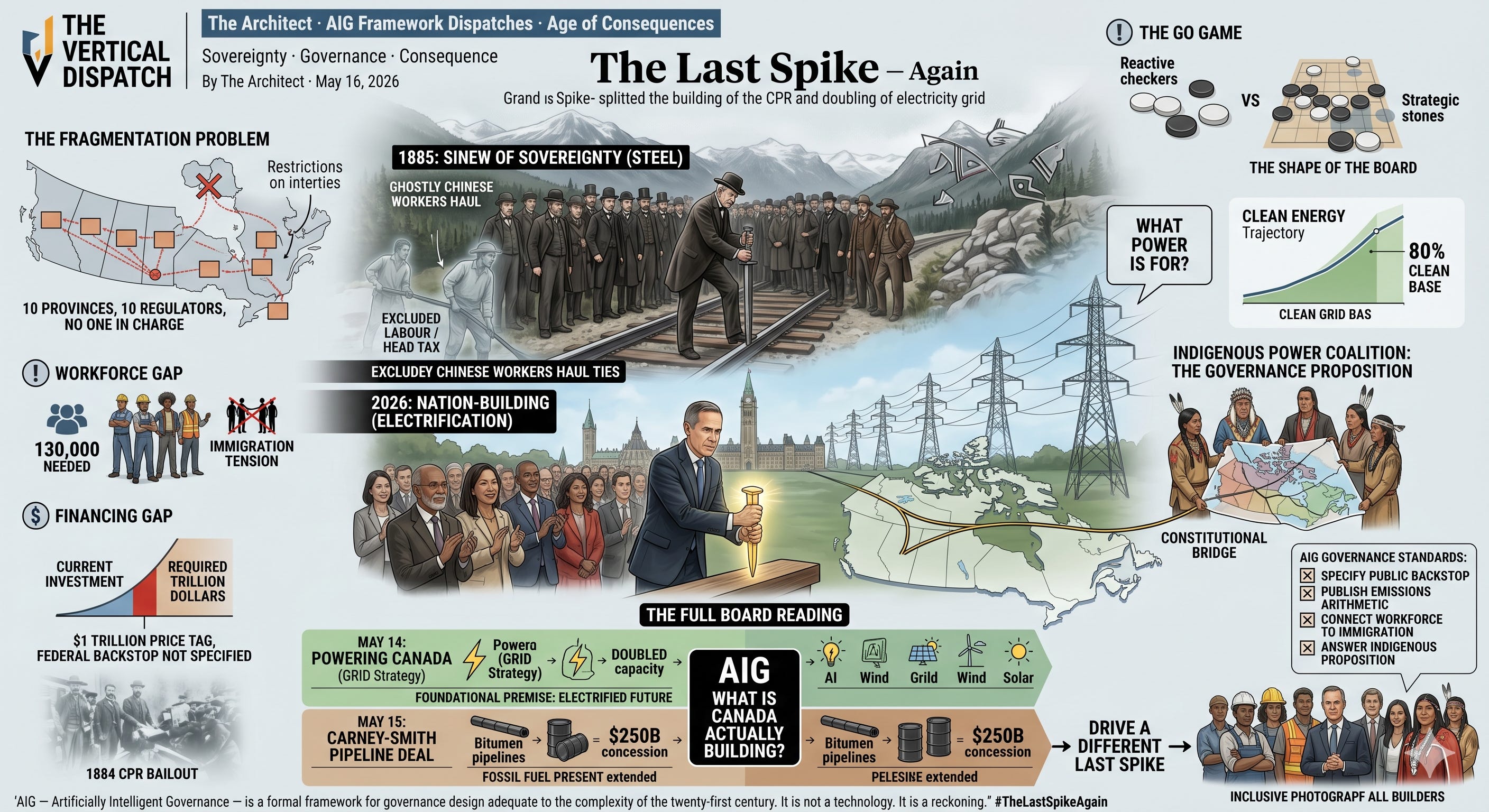
The nation-building language is not rhetorical excess. It is the accurate description of what a doubled national electricity grid would require and what it would produce. What it is also, in the tradition of all nation-building language, is a frame designed to make certain questions difficult to ask. The CPR was a sovereignty project. It was also a financial scandal, a labour atrocity, and a constitutional instrument that suppressed Indigenous governance across the territories it crossed. The nation-building framing did not prevent those realities. It deferred their examination. The Vertical Dispatch does not defer the examination. It begins it here, before the consultation period ends and the political architecture of the strategy hardens into permanent form.
The grid doubling is the right project. The sovereignty argument is correct. The CPR analogy is apt and instructive in ways that go far beyond the compliment it is intended to be. This dispatch reads those ways. No quarter for the comfortable framing. Full credit for the genuine ambition. The two are not in conflict. They are the requirement.
I. Why the CPR Analogy Is More Accurate Than Its Authors Intended
The federal government’s own prior electricity strategy document used the railway comparison explicitly: a national effort that would rival the building of our railway in the 19th Century — and be just as monumental an undertaking. The Public Policy Forum went further, concluding that the electricity grid project dwarfs in ambition even the 19th-century construction of the Grand Trunk and Canadian Pacific railways and the mid-20th-century nation-building trifecta of the St. Lawrence Seaway, Trans-Canada Highway, and Trans-Canada natural gas mainline.
These comparisons are intended as praise. They are correct as comparisons. The railway built in the 1880s and the grid being proposed in the 2020s share a structure so deep that examining it reveals both the project’s genuine power and its genuine risks.
The CPR was built because Confederation required it. British Columbia joined Canada in 1871 on the explicit promise of a transcontinental railway within ten years. Sir John A. Macdonald understood that the railway was not primarily an economic project — it was a sovereignty project. Without a physical infrastructure connecting the Pacific coast to central Canada, British Columbia would drift toward the United States. The railway was the sinew of sovereignty, built through economic instruments but serving a political purpose that transcended economics. The Pacific Scandal of 1873 — in which Macdonald’s government was found to have accepted campaign contributions from the railway’s chief promoter — destroyed his government, produced a change of power, and returned Macdonald to office five years later when the alternative — Liberal delay — was understood to threaten Confederation itself. The sovereignty argument overrode the corruption scandal.
The grid doubling in 2026 has the same structure. Canada is facing an American administration whose tariff policy has severed the comfortable assumption of continental economic integration. The war in Iran has demonstrated the fragility of energy systems that depend on global supply chains and distant producers. Artificial intelligence is scaling in ways that will make electricity the primary strategic resource of the twenty-first century global economy — the resource whose abundance or scarcity will determine which nations can compete in the industries that will define the next fifty years. Carney himself named all three in his announcement: the United States is upending global trade, wars are ongoing in Europe and the Middle East, and artificial intelligence is scaling at speed. The grid is the sovereignty response to all three pressures simultaneously.
This is Stratum 8 thinking — the level of governance that operates on generational time horizons, that builds the infrastructure of the future before the future has arrived, that understands that the greatest risk is not the cost of building but the cost of not building. The CPR was Stratum 8. So is this. The question is whether the governance architecture being built around it is equal to the ambition.
Canada already has an 80 percent clean grid and some of the lowest electricity costs in the G7. Starting from that position and doubling the grid’s capacity by 2050 is not merely a climate project. It is an economic sovereignty project of the first order — the construction of the resource base that will allow Canadian industry to compete in the electrified economy that is arriving whether or not Canada builds the infrastructure to participate in it. The IEA projects that global electricity consumption will increase between 78 and 102 percent by 2050 across a range of scenarios. Approximately three trillion dollars is already invested globally every year in electricity grids, efficiency, and electrification — twice the investment flowing into conventional fuels. The transition is not a political choice. It is a physical fact of the global economy. Canada can build the infrastructure to lead it or it can watch others build theirs.
II. The Fragmentation Problem — Ten Provinces, Ten Regulators, No One in Charge
The CPR solved a geography problem. A continent-wide country with no physical connection between its coasts could not hold together politically. The railway provided the physical sinew. The grid must solve a regulatory problem that is, if anything, more structurally intractable than the geography the CPR faced.
Canada’s electricity system is currently fragmented across provincial and territorial grids, costing billions of dollars in outages, duplicative infrastructure, and wasted power. This is Carney’s own language from the May 14 announcement, and it is accurate. Ten provinces. Ten regulators. Ten distinct sets of rules. The interties — the transmission lines that connect provincial grids to each other — exist but are chronically underused. Alberta’s 2025 intertie restrictions provide the most recent case study: technical caution, economic disputes, and policy gaps converged to limit interprovincial power flows that both provinces would have benefited from. The result was wasted renewable generation in one province while another burned gas for power it could have imported cleanly.
The deeper problem is constitutional. Canada’s federal energy regulator has limited jurisdiction. Provincial regulators are mandated to serve their own provinces, not the national grid. Market operators have no mandate beyond their own borders. The Canada Electricity Advisory Council identified in May 2024 that Canada lacks a dedicated forum for interprovincial electricity issues — and recommended constructing a framework to support inter-regional electricity transmission projects. The recommendation is eighteen months old. The consultation it required has not yet produced the forum.
The CPR required a single authority capable of building across provincial lines. The Dominion government provided that authority by treating the railway as a federal project under federal jurisdiction. The grid doubling requires the same architecture — a single coordinating authority capable of making decisions that serve the national grid rather than ten provincial grids. The Building Canada Act’s national interest designation is the instrument Carney is proposing for this purpose. It is the same instrument being deployed for the Alberta pipeline. Two nation-building projects. One legal tool. Whether that tool can carry both loads simultaneously, in the face of the constitutional and litigation pressures documented in this publication’s pipeline dispatches, is the question the announcement did not address.
Eight provinces and two territories signed a coast-to-coast energy grid agreement in March 2026, signalling shared interest in connectivity. The agreement exists. The details of how to finance the interprovincial lines, allocate the costs between provinces that generate surplus and provinces that import, and harmonise the regulatory frameworks across ten jurisdictions remain unresolved. These are not technical problems. They are political problems of the kind that the CPR’s architects solved by giving the railway company 25 million acres of land and the right to import materials duty-free for twenty years. The equivalent political instruments for the grid doubling have not been specified in the announced strategy. The consultation period will determine whether they can be.
III. The Natural Gas Admission — What Moving the 2035 Target Actually Means
The most politically charged element of the Powering Canada Strong strategy is the decision to extend the role of natural gas as baseload generation and to adjust the Clean Electricity Regulations that the Trudeau government had finalised in 2024 with the goal of achieving deep emissions reductions in the electricity sector by 2050. The Trudeau CERs aimed for a net-zero grid by 2035. Carney is moving that target to 2050 — a fifteen-year retreat stated in the language of flexibility and reliability.
The environmental community’s reaction was immediate and sharp. The David Suzuki Foundation called it one step forward and two steps back. Environmental Defence called it the latest move by Prime Minister Carney to undo and weaken Canada’s climate commitments and a huge betrayal. These reactions are politically understandable. They are also analytically incomplete.
The National Bank of Canada’s analysis of the natural gas question is more useful precisely because it comes from a source with no environmental advocacy interest. The analysis argues that natural gas in Ontario has become structural — not a transitional bridge but a load-bearing component of the provincial grid — and is on track to surpass hydro as the province’s second-largest electricity source after nuclear. Prematurely constraining natural gas would risk creating operational distortions, raising costs, and undermining industrial growth. This is not a pro-fossil-fuel argument. It is a grid stability argument. An electricity grid serving a doubling demand base, incorporating large volumes of intermittent renewable generation from wind and solar, requires dispatchable baseload power that can ramp up when the wind does not blow and the sun does not shine. Natural gas currently provides that function at a scale that battery storage and other alternatives cannot yet match.
The AIG question applied to the natural gas decision is not: is this a climate betrayal? It is: what is the actual emissions trajectory of the combined policy set — the grid doubling strategy with natural gas as baseload, the pipeline deal expanding bitumen export capacity, and the carbon tax concession reducing the price signal on industrial emissions — read together as a single governance move? That arithmetic has not been published. The consultation period should require it. Until it is produced, the claim that Powering Canada Strong is a climate leadership project rests on the grid doubling ambition alone, without accounting for the emissions architecture of the instruments being deployed to achieve it.
The fifteen-year retreat from the 2035 target is real. Whether it is a betrayal or a necessary recalibration depends entirely on what fills the space between 2035 and 2050 — whether the natural gas bridge is actually a bridge to a zero-carbon grid or whether it becomes load-bearing infrastructure that cannot be removed without collapsing the system it supports. The distinction between a bridge and a load-bearing wall is not visible at the announcement stage. It becomes visible in the capital allocation decisions of the next decade. This is the question the consultation period must keep alive.
IV. The Trillion-Dollar Financing Gap — The Pattern the Announcements Share
The Powering Canada Strong strategy carries a price tag of over one trillion Canadian dollars — approximately $730 billion US — to be shared among federal and provincial governments and the private sector. Annual grid investment needs to rise from the current $25 to $30 billion to approximately $40 billion. That is a 33 to 50 percent annual increase sustained over 25 years.
The federal government has not disclosed the estimated budget for implementing its National Electricity Strategy. The announcement commits to consultations. The consultations will work together to identify the actions needed to double the grid most effectively and affordably. The financing structure — what fraction of the trillion dollars the federal government will provide directly, what fraction flows through Crown corporations, what fraction is expected from provincial governments, what fraction from private capital markets — is not specified in the announced strategy.
Readers of this publication will recognise the pattern. The pipeline deal announced on May 15 carried a $250 billion carbon tax concession and zero direct federal capital commitment. The grid strategy announced on May 14 carries a $1 trillion price tag and zero disclosed federal capital commitment. The Building Canada Act’s Major Projects Office is being proposed as the coordinating instrument for both. In both cases the governance architecture is public and the capital commitment is private. In both cases the private capital is expected to respond to the regulatory framework by deploying at the scale required. In both cases the question of what happens if the private capital does not deploy at the required scale has not been answered.
This is not necessarily the wrong architecture. The CPR was built on a similar model — federal land grants, import duty exemptions, and a capital guarantee, but primarily private construction and private operation. The federal government provided the enabling conditions; the private syndicate provided the capital and the construction management. The model worked. It also produced the Pacific Scandal and required the government to bail out the CPR financially in 1884 when the company ran out of money before the railway was complete. The federal government lent $22.5 million to prevent the project from collapsing. The lesson of the CPR is not that the public-private model fails. It is that the public backstop must be explicit, pre-committed, and sufficient to cover the scenario in which private capital proves inadequate to complete the project. That backstop has not been specified for either the grid or the pipeline.
V. The 130,000 Workers — The Labour Question the CPR Answered Badly
The grid doubling will require more than 130,000 high-skilled workers by 2050. Over 80 percent of employers in the electricity sector already identify a lack of skilled talent as their top constraint. The strategy’s third pillar — workforce development — addresses this through consultations with industry, labour, and training partners.
The CPR required a labour force that the Canadian population of the 1880s could not provide at the required scale and cost. The solution was the importation of approximately 15,000 Chinese workers, paid one dollar a day while white workers received between $1.50 and $2.50 for equivalent work. These workers built the most technically challenging sections of the railway — the tunnels through the Fraser Canyon, the trestles across the mountain passes, the grades that engineers had considered impossible before the Chinese crews completed them. When the railway was finished, the Canadian government imposed the Chinese head tax — fifty dollars in 1885, rising to five hundred dollars in 1903 — to prevent the workers who had built the country’s foundational infrastructure from settling in the country they had built.
This is the dark side of the CPR analogy that the nation-building language is not designed to illuminate. The grid doubling requires 130,000 skilled workers. Canada does not currently have them. The $6 billion investment through the 2026 Spring Economic Update’s Team Canada Strong initiative addresses recruitment, training, and hiring. The immigration policy that will determine the availability of workers who cannot be trained domestically at the required speed is not specified in the grid strategy. The political environment in which that immigration policy must be set — in which public anger about immigration levels is a primary driver of electoral politics across the Anglosphere, including Canada — is the environment documented in this publication’s CBC and Anglosphere Lobby dispatches.
The grid requires the workers. The workers require immigration. The immigration debate is being conducted in a political environment that the same government is navigating carefully in the opposite direction. This is not a contradiction the Powering Canada Strong announcement can resolve. It is a tension that the consultation period must name explicitly, because the alternative — building a grid strategy on a workforce projection that the country’s immigration policy cannot support — is the CPR model. And the CPR model produced the head tax.
VI. The Indigenous Power Coalition — The Constitutional Innovation in the Stakeholder Language
The most underreported element of the Powering Canada Strong announcement is not the natural gas controversy or the trillion-dollar price tag. It is a statement made by Cole Sayers, executive director of the Indigenous Power Coalition — a new British Columbia-headquartered organisation advocating for First Nations to be project leaders, not just stakeholders, on major new transmission projects.
Sayers said: we want to flip the script — to be project leaders. First Nations territories transcend provincial borders and can serve as a crucial bridge for these conversations.
Read this against the fragmentation problem documented in Section II. Canada’s electricity grid is fragmented because ten provincial jurisdictions cannot coordinate on interprovincial transmission without a coordinating authority that no current institution provides. The federal energy regulator has limited jurisdiction. Provincial regulators are mandated inward. The Building Canada Act’s national interest designation is being proposed as the solution, but it has not yet been stress-tested against the litigation environment.
First Nations territories, by contrast, predate provincial jurisdiction. They are not bounded by the constitutional lines that separate British Columbia from Alberta or Ontario from Quebec. The treaty and rights framework that governs First Nations territories constitutes a legal architecture that is simultaneously national — in that it is governed by federal law, Section 35 of the Constitution, and the United Nations Declaration on the Rights of Indigenous Peoples — and trans-provincial — in that it operates across the lines that fragment the provincial grid. A governance architecture that positions First Nations as project leaders for interprovincial transmission lines, rather than as consultation subjects whose consent must be managed, would have access to a coordinating authority that transcends the provincial fragmentation.
The CPR destroyed Indigenous governance to build the railway. It cleared treaty territories by force, disrupted the buffalo economy that the Plains Nations depended on, and produced the conditions for the starvation and cultural suppression that followed. The grid doubling has the option to invert that relationship entirely — to treat First Nations territorial governance not as an obstacle to be managed through consultation but as the constitutional bridge that solves the fragmentation problem the strategy identifies as its central obstacle. Whether it will make that choice is the governance question of the decade. The consultation period is where that question will be answered or deferred.
The Indigenous Power Coalition’s framing is not a stakeholder ask. It is a governance proposition. It says: our territories are the solution to your coordination problem. Treat us as the solution and you will have the coordinating authority the grid requires. Treat us as the obstacle to be consulted and you will have the litigation environment that destroyed the Trans Mountain timeline. The choice is not between including Indigenous communities and excluding them. It is between including them as leaders and including them as subjects of a process designed by others. The CPR made the latter choice. The grid has the opportunity to make the former.
VII. The Two-Day Announcement — Reading the Full Board
May 14, 2026: Powering Canada Strong. Double the grid. One trillion dollars. Natural gas as baseload. 130,000 workers. Interprovincial interties. Indigenous partnership. Four months of consultations.
May 15, 2026: The Carney-Smith pipeline deal. One million barrels per day. $250 billion carbon tax concession. No private proponent. No locked route. National interest designation commitment. Three gates. Three dates. No questions taken.
These two announcements have been covered as separate policy decisions serving different objectives. The grid is climate and competitiveness. The pipeline is energy sovereignty and Alberta political management. Read separately, they are each coherent within their own logic. Read together, on the Go board, they constitute a single governance move whose internal consistency has not been publicly examined.
The grid doubling strategy assumes that Canada’s energy future is electrification. The path to affordability is electrification. The path to competitiveness is electrification. The path to net zero is electrification. This is Carney’s own language, stated on May 14. The grid is being doubled because electricity is the strategic resource of the twenty-first century. The move away from fossil fuels and toward electrification is the foundational premise of the strategy.
The pipeline deal announced on May 15 is premised on one million barrels per day of bitumen flowing to Asian markets for decades. The $250 billion carbon tax concession granted to enable it reduces the price signal that would otherwise accelerate the transition away from fossil fuels. The pipeline assumes that Asian demand for bitumen will remain sufficient to justify the capital cost of the corridor through the 2040s and beyond — a period in which China, the primary target market, is investing in clean technology and grid expansion at unprecedented scale and now leads globally in manufacturing electricity technologies. China’s long-term demand for Canadian bitumen is the assumption the pipeline’s commercial viability rests on. China’s own energy transition trajectory is the variable that assumption has not been stress-tested against.
The AIG question applied to both announcements simultaneously is this: what is Canada actually building, and do the two projects serve a coherent long-term energy sovereignty strategy or do they serve two different political constituencies with two different time horizons? The grid serves the electrified future. The pipeline serves the fossil fuel present extended into the fossil fuel future. Both cannot be the foundational premise of Canadian energy policy simultaneously without a governance framework that explains how they coexist within the same emissions architecture, the same capital allocation system, and the same forty-year time horizon. That framework has not been published. The consultation period is where it must be produced or the contradiction will compound until the capital markets force the resolution that the governance has avoided.
VIII. The AIG Verdict — The Last Spike and What It Must Not Repeat
The Powering Canada Strong strategy is the right project at the right moment for the right reason. Canada’s 80 percent clean grid is its strategic competitive advantage entering the electrified global economy. Doubling it by 2050 is not optional if Canada intends to participate in the industries that will define the next fifty years. The CPR comparison is not rhetorical excess. It is structurally accurate, and the Public Policy Forum is correct that the grid project dwarfs the CPR in ambition.
AIG governance holds this project to the standards the ambition requires. The standards are:
First: the financing architecture must specify the public backstop. The CPR’s private capital ran out in 1884. The federal government’s willingness to provide the $22.5 million emergency loan saved the project. The grid’s trillion-dollar financing gap requires a pre-committed public backstop — not a post-hoc bailout — of sufficient scale to cover the scenario in which private capital proves inadequate. That backstop must be specified in the consultation outcomes, not deferred.
Second: the emissions arithmetic of the combined policy set must be published. The grid strategy, the pipeline deal, and the carbon tax concession are three stones on the same board. The emissions trajectory that results from all three operating simultaneously through 2050 must be modelled, published, and subjected to independent audit before the regulatory architecture of any of the three projects hardens into permanent form.
Third: the workforce strategy must be connected to the immigration policy. One hundred and thirty thousand skilled workers cannot be trained domestically at the required speed. The immigration policy required to supplement domestic training must be named explicitly in the grid strategy, because the alternative is the CPR model — imported labour on discriminatory terms followed by exclusion when the project is complete.
Fourth: the Indigenous Power Coalition’s proposition must be answered as a governance question, not managed as a stakeholder concern. The framing — First Nations territories as the constitutional bridge that solves the provincial fragmentation problem — is the most structurally important idea in the entire electricity strategy announcement. It deserves a governance response that matches its ambition.
Donald Smith drove the last spike at Craigellachie in 1885. The photograph shows the crowd of men who built the railway, most of them unnamed. The 15,000 Chinese workers who built the hardest sections are not in the photograph. They were not invited to the ceremony. They had been paid half the going rate and then taxed out of the country they built. The grid doubling has the opportunity to drive a different last spike — one whose photograph includes everyone who built it, at the wages the work required, with the rights the builders deserve. That is what the CPR analogy actually demands, read at the level it deserves. The Vertical Dispatch will be watching the consultation period for evidence of whether the opportunity is being taken.
God is Love. Love is Truth. Truth is Consciousness. Consciousness is Brahman.
Amen. Namaste.
Dispatch Hashtags
#TheLastSpikeAgain #PoweringCanadaStrong #AIG #VerticalDispatch #TheArchitect #NationalElectricityStrategy #GridDoubling #CPR #NationBuilding #Stratum8Vision #MarkCarney #BuildingCanadaAct #TrillionDollarGrid #CleanElectricity #NaturalGas #IndigenousPowerCoalition #ColeSayers #ProjectLeaders #ConstitutionalInnovation #ProvincialFragmentation #Interties #TenRegulators #GridCoordination #Section35 #130000Workers #WorkforceStrategy #ImmigrationPolicy #CPRLabour #ChineseHeadTax #CERs #CleanElectricityRegulations #NetZero2050 #NetZero2035 #NaturalGasBridge #PipelineDeal #GridAndPipeline #EmissionsArithmetic #FullBoardReading #AgeOfConsequences #SubstackCanada #TheVerticalDispatch #Project2046 #NorthernSovereignty #NoFear
Interesting. How did you make that graphic?