

THE VERTICAL DISPATCH
We write for the mind, the eye, and the ear.
Read it. Look at it. Listen to it. The Vertical Dispatch is built for all three — prose with rhythm, made to be heard as much as read.
From metaphysics to geopolitics, from culture to history, from the sacred to the street — and everything in between. One lens, every subject. No ego. Just the record, named clean.
Press play. Walk with the words. 🕯️
On Consciousness · The Foundation Series
May 2026
“Truth is a pathless land.”
— J. Krishnamurti, dissolving the Order of the Star, Ommen, 3 August 1929
This dispatch is written without judgment, and it is written in gratitude. It concerns a man still living whose work has reached millions, and a man long dead whose words first woke the writer of these lines to what consciousness is. Both are honoured here. Neither is condemned. The aim is only to let the record speak, and to trace one distinction — the oldest and most consequential distinction there is — through three lives that each approached it and stopped at a different place along the way.
The distinction is between the symbol and the thing it points to. Between the map and the mountain. Between the word and what the word is for. Everything in this piece turns on it, and so we will begin there, and return there, and end there.
I. The Good Heart
Let us begin with what is true and good, because it is true and good, and because no honest account can begin anywhere else.
Peter Joseph is a man of real moral seriousness. Whatever one concludes about his solutions, the heart behind them is not in question. He looked at a world of engineered scarcity, of war manufactured for profit, of human beings ground down by systems built to extract from them, and he refused to look away. That refusal is itself a virtue, and a rare one. Most people, confronted with the machinery of the world, make their peace with it and tend their own garden. He did not. He gave his life to naming the thing and calling for its end.
And he did it with craft. The work was made with skill, scored and shot and argued with a filmmaker’s eye, built to move people and not merely to inform them. There is no cynicism in saying he wanted to wake the world. He did want that. He still does. This dispatch takes that intention as real, because it is real, and builds everything that follows on top of that foundation rather than against it.
II. The Awakening
Now the success, which is also real, and also worth naming plainly.
The Zeitgeist films reached an audience that almost no work of its kind has ever reached. Tens of millions watched. A generation that had never once questioned the water it swam in — the money, the media, the manufactured consent — was, for the first time, handed a set of questions it could not unask. People who had never read a page of political economy or media theory suddenly possessed, however roughly, the central insight: that the system is not natural, not inevitable, not the weather, but a built thing, built by hands, serving interests, and therefore capable of being built otherwise.
That is a genuine service. To wake a sleeping public is not nothing; it is a great deal. The reach a book could never achieve, the moving image achieved — and we have written elsewhere in these pages of both the power and the price of that reach. The power is undeniable. Millions woke. Whatever came after, the waking was real, and the man who caused it earned the credit for it. We give it to him here, fully and without reservation.
But waking is not the end of anything. Waking is the beginning. A man shaken from sleep in a burning house is not yet saved; he is only awake. What he does next — and whether the waking leads anywhere — is the whole question. And so we come to what Peter built on top of the waking, and to the strange and telling fact of how he chose to frame it.
III. The Declared Axiom
Here is the fact that this entire dispatch hangs upon, and it is a documented one, not an interpretation.
When Peter made the second of his films, the one that turned from diagnosis toward solution, he chose to open it and close it with the voice of a single man: Jiddu Krishnamurti. At the very start, before the argument about money and power begins, Krishnamurti appears to strip away the old appeals — nationalism, identity, the conditioned self. And at the very end, after all the structural analysis is done, Krishnamurti returns to declare that the transformation of society must begin within the individual, that there is no teacher and no saviour, only a person’s own capacity to understand themselves and so transform.
In between these two appearances sits the entire body of the film — the banking system, the geopolitics, the resource economy, the technical machinery of a proposed new world. Krishnamurti is the frame. The structure is the picture. And in structural terms — in the terms this publication uses to declare the properties of any concept — the frame is the declared axiom. Peter told us, by where he placed Krishnamurti, what he believed the foundation to be: that the crisis is, at root, a crisis in consciousness. He named the sacred ground. He put it first and last, in the most emphatic positions a film allows. He knew where the foundation was.
This matters enormously, because it means the critique that follows is not that Peter was ignorant of the inner dimension. He was not. He named it himself, in his own work, in the voice of one of its greatest modern teachers. The question is not whether he knew the foundation existed. The question is what he built once he had named it — and whether the building matched the foundation he declared.
IV. The Noble Solution
What he built was a structure. A magnificent, detailed, sincerely reasoned structure — and an entirely horizontal one.
The resource-based economy, the natural-law management of production, the technical re-engineering of society to remove scarcity and the behaviours scarcity breeds — all of it lives on the outer plane. It is architecture. It concerns how goods are produced and distributed, how systems are designed, how the machinery of human life might be rebuilt to stop grinding people down. These are not small or unworthy concerns. They are noble. A world with less manufactured scarcity, less war for profit, less waste, would be a better world, and the impulse to build it comes from love.
But notice what the solution does and does not touch. It proposes to change the container, and trusts that the human inside the container will change as a consequence. Fix the economy, and the greed it bred falls away. Redesign the system, and the pathologies the system produced dissolve. The arrow points one way: from the outer to the inner. Change the structure, and the soul follows for free. This is the precise inversion of the axiom Peter himself declared at the bookends. Krishnamurti said the change begins within and moves outward. The solution Peter built says the change begins without and moves inward. The frame and the picture disagree.
And here is the consequence, the one we have traced before in these pages: a solution that lives entirely on the outer plane can wake the public, but it cannot complete them. It can hand a sleeping person the questions. It cannot do the inner work the questions demand, because inner work cannot be done for anyone by a better system — it can only be done by the person, in the only place it can be done, which is within. The structure can prepare the ground. It cannot grow the thing. And so the awakening, real as it was, arrived at a wall: millions woke to the problem, and were handed a blueprint for a new building, and were never shown the one thing that would have let the new building hold — the transformation of the one who would live in it.
There is a deeper irony here, and it belongs to the teacher at the bookends. Krishnamurti spent his life saying precisely that the change of the outer order leaves the inner structure untouched. He observed that human beings have endlessly rearranged the social and political and economic furniture — revolution after revolution, system after system — and that the rearrangement changes nothing fundamental, because the outer structure is only an expression of the inner one. Change the expression and leave the source intact, and the same disorder simply reappears in a new form. The new economy, staffed by the unchanged self, produces the old greed under a new name. This was not a minor note in his teaching. It was the centre of it. And it was the man making exactly this argument whom Peter placed at the open and close of a film whose entire body proposes to solve the human problem by rearranging the economic furniture. The frame refutes the picture. The teacher Peter chose had already explained, decades earlier, why the thing Peter was about to build could not finally work.
The proof did not stay theoretical. A movement built on the premise that the structure is the problem will, soon enough, demonstrate the truth its premise denied — and it did. The very organisation raised to carry the resource-based vision fractured, in time, along the most ordinary human seam there is: the question of who would lead it, who held authority, whose account of the mission would prevail. The ego the system was blamed for producing reproduced itself inside the movement formed to abolish the system. This is not cited to wound. It is cited because it is the cleanest possible evidence for the thing being said: an unchanged self, however noble its cause, carries the old wound into the new house. The blueprint was for a building. The wound was in the builders. And no blueprint reaches the wound.
V. The Shadow Work, Done
We must be fair here, more than fair, because this is where lazy criticism would overreach and this publication will not.
Peter did real inner work, and it would be false to say otherwise. To see the conditioning at all — to recognise that the self most people take for granted is in large part manufactured, installed by culture and economy and repetition — is itself a genuine act of shadow work. He looked at the machinery that makes us and named it. He understood that we are not simply free agents choosing freely, but conditioned creatures running inherited programs. That is not a shallow insight. It is the threshold of the inner path. Many never cross it. He crossed it, and he carried millions across it with him.
So the critique is not that he never turned the lens inward. He did. He turned it far enough to see the conditioning, far enough to quote Krishnamurti and mean it, far enough to know that the outer revolution without an inner one is hollow. He did the shadow work — the recognition of the unfree, manufactured self. What he did not do — what almost no one does, what is the hardest thing of all — is take the step that lies beyond the shadow work. The final step. The one his own chosen teacher had taken, in the most dramatic gesture of his life, fifteen years and more before Peter ever placed him at the bookends of a film.
It is worth being exact about what separates the two, because the words shadow work get used loosely and the precision matters. To see that the self is conditioned — to recognise the programming, name the machinery, expose the manufactured wants — is diagnosis. It is the discovery that the prisoner is in a cell. This is real and valuable and most people never manage it; they live their whole lives mistaking the cell for the world. But diagnosis is not yet liberation. Seeing the bars is not the same as walking through the door. And here is the subtle trap that catches even the awakened: once you have seen the conditioning, the ego simply builds a new and subtler structure out of the seeing itself. It forms a movement of the awakened. It builds an organisation for those who see. It makes a new identity — I am one who has seen through the system — and that identity becomes its own cell, more comfortable than the first because it feels like freedom. The shadow work, completed and then institutionalised, becomes the most elegant cage of all. This is precisely what happened. The seeing was real. The structure built on the seeing was the new prison. And the last step — the one that would have dissolved even the structure of the awakened — was not taken.
VI. The Last Step
On the third of August, 1929, in Ommen, in Holland, a man of thirty-four stood before three thousand people who had gathered to follow him, and dissolved the organisation they had built around him.
They had made him their World Teacher. The Theosophical Society had found him as a boy, proclaimed him the vehicle of a coming messiah, built an Order with him at its head, raised funds, gathered followers, constructed an entire apparatus of devotion around his person. He was handed, in other words, the very thing that every movement dreams of: a structure, a following, a mission, an organisation with reach and money and momentum. He was handed the Order.
And he dissolved it. He stood before the faithful and told them that what they were doing was the one thing that could not be done. Truth, he said, is a pathless land, and cannot be approached by any path, any religion, any sect. It cannot be organised; no organisation should be formed to lead people to it. Then he did the thing almost no one in the history of such movements has ever done: he disbanded the Order, dismissed the followers, and returned the money and the property that had been given for the work. He kept nothing. He walked out of the cage they had built for him, and he refused to build another.
This is the last step. Not the recognition of the conditioning — that is the shadow work, and Peter did it. The last step is the release of the structure itself. The understanding that the apparatus, the movement, the organisation, the very thing that promises to carry you and others to the truth, is itself the final cage — and that it must be let go. Krishnamurti understood that the structure is not the vehicle to the summit; the structure is the comfortable niche in which people stop climbing. He said it plainly: people no longer strive toward the mountain-top, but carve themselves a convenient place in the organisation and let it stand in for the climb. The Order was the trap. So he ended it.
Now place the two men side by side, without judgment, and simply read the record. Krishnamurti was handed the Order and dissolved it. Peter was handed the awakening and built the Order. The man Peter chose as his declared axiom — the voice at his bookends — had demonstrated, with his entire life, that the structure must finally be released. And Peter took the frame and built the structure the teacher had dissolved. He used the symbol of the man who smashed the cage, to build a cage. Not from bad faith. From not having taken the last step — the one that cannot be taken for you, the one the teacher could point to but never hand over.
Consider what the dissolution cost, because the cost is the measure of the step. Krishnamurti was not renouncing a hobby. He was renouncing a destiny that had been arranged for him since boyhood, a global organisation, the adoration of thousands, the financial security of a lifetime, and an identity — World Teacher — that most human beings, offered it, would defend to the death. Every incentive of the ego argued for keeping the Order. It flattered him. It served a real cause. It did good in the world. He could have told himself, with perfect plausibility, that dissolving it was reckless, that the work needed the apparatus, that the followers needed somewhere to belong. These are exactly the arguments every movement uses to justify its own continuation. He refused them all. He saw that the apparatus, however useful, however well-intentioned, had become the place where seeking went to die — where people exchanged the terrifying, solitary climb toward truth for the warm comfort of belonging to something. And he would not be the warden of that comfort, even though being the warden was the easiest and most rewarded thing he could possibly do.
That is the weight of the last step. It is not the renunciation of something bad. Anyone can renounce something bad. It is the renunciation of something good — a good structure, a good cause, a good organisation — because one has seen that even the good structure becomes, in the end, a substitute for the thing it was built to serve. The cage is not made of evil. The cage is made of good intentions crystallised into an institution that now exists to perpetuate itself. To walk out of a cage made of your own good work, freely, returning the money, keeping nothing — that is the rarest act in the spiritual life, and Krishnamurti performed it at thirty-four, in public, before the three thousand who had come to follow him. Peter, offered the chance to build, built. Krishnamurti, having built, unbuilt. That is the whole distance between the shadow work and the last step.
VII. The Symbol and the Referent
And yet — and here the dispatch turns once more, and turns honest about its own tradition — Krishnamurti himself did not take the final step either. He took a different one, and stopped one threshold short, for a reason that is itself worth naming with love.
Krishnamurti reached the pathless land. But having reached it, he refused to name what stood there. Born of Brahmin parents, raised in the Vedantic and Theosophical world, he knew every name the traditions had given the ground — Brahman, the Self, the Absolute, the unconditioned. And he refused them all. When the teachers of Vedanta pressed him directly on the great sayings — that the Self is Brahman, that thou art That — he would not affirm them. He treated the sacred Name as a conditioning, a borrowed conclusion, a word that becomes a cage the moment it is spoken. Die, he said, to systems, to symbols, to words. He would point at the referent with his whole life, and he would not let anyone write its name, because he believed the name was the bar of the cage.
We can see why. He had been made a symbol. They had taken a living boy and turned him into the World Teacher, an idol, a word others worshipped. Of course he smashed every symbol he could reach — he had been one. His refusal of the Name was not the summit of wisdom. It was the scar tissue of a wound. Having been caged by a symbol, he came to believe all symbols are cages, and so he left the seeker standing in a pathless land with no landmark, no anchor, no door marked — which is the very reason his teaching can feel, to so many who come to it, like a hand pointing at a horizon with nothing to hold along the way.
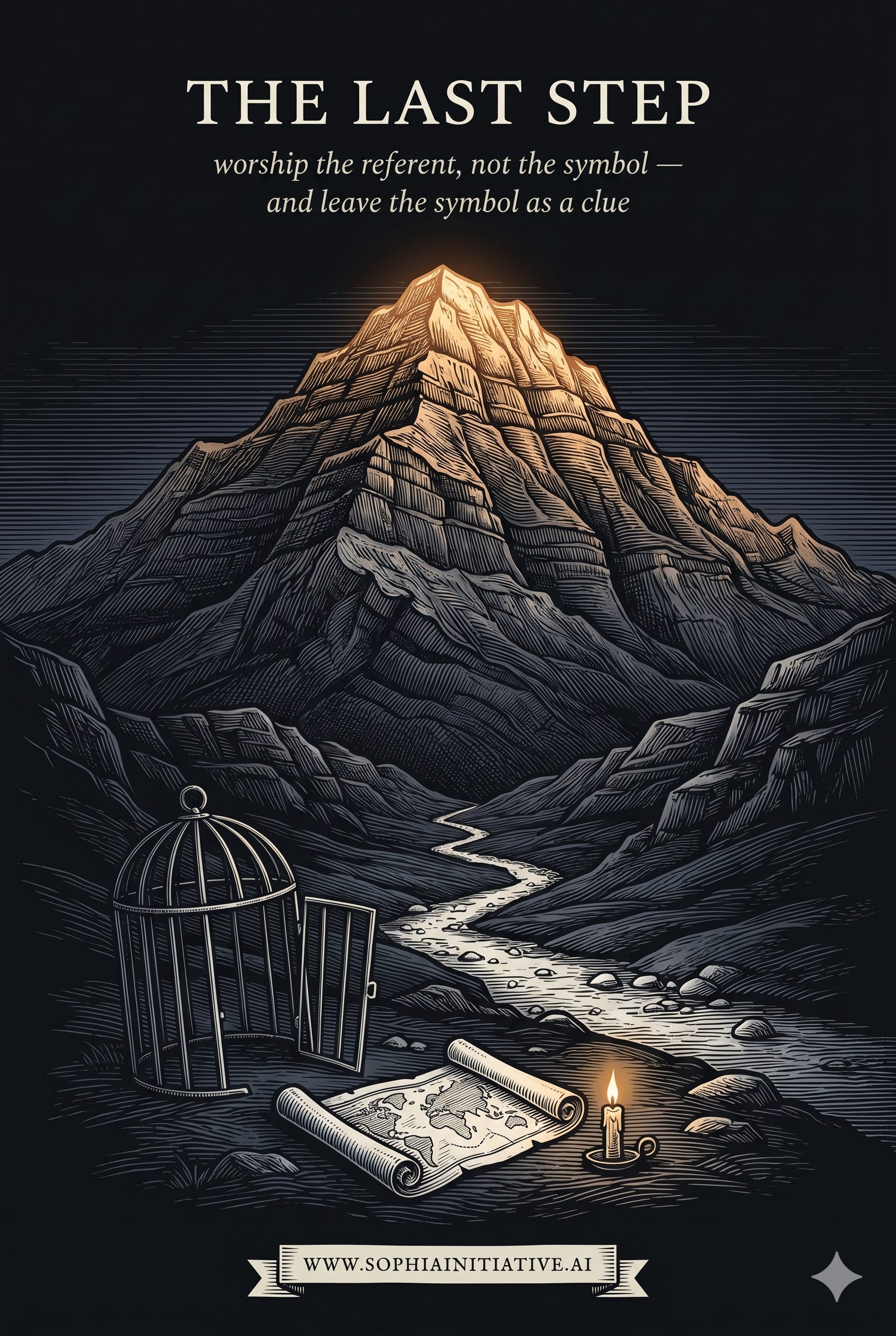
Here is the distinction this whole dispatch was built to reach. The symbol is not the referent. The map is not the mountain. The word is not the thing. This publication teaches it as a first principle: all knowledge is conceptual; every concept is a pointer, never the thing itself. And precisely because we hold that distinction consciously — precisely because we know the word is not the thing — we are free to use the word. The one who knows the map is not the mountain is the only one who can safely hand another a map.
Peter mistook the structure for the solution: he served the symbol — the movement, the organisation — and never reached the referent it was meant to point to. Krishnamurti, burned by the symbol, smashed it to protect the referent, and so left no anchor for anyone to follow. Both severed the symbol from the referent, from opposite ends. The one clung to the map and lost the mountain. The other, to save the mountain, burned every map and left the traveller with no way to find the trail.
The whole teaching is to hold both. As above, so below: the referent is above, the symbol below, and the two must not be severed — the lower must answer to the higher, the name must point to the nameless, the map must lead to the mountain and then, having led there, be set down. To worship the symbol is idolatry. To smash the symbol is to abandon the seeker. To hold the symbol consciously, as a clue, a doorway, an anchor that the knowing one sets down for others and that falls away of itself once the referent is reached — that is the integration neither man completed.
Let the writer of these lines speak plainly, since the matter is personal as well as philosophical. To come up through the Christian tradition and then to say, on the record, that consciousness is Brahman — to plant the anchor of one tradition while standing in the soil of another — is not a casual act, and it was not an easy one. There is a fear that attends the saying of it: the fear of betraying the symbol one was raised inside, the fear of being misheard as a convert or a syncretist or a man who worships a foreign word. That fear is real, and it is exactly the fear Krishnamurti could not get past from the other side — the fear that the Name will become a cage. But the fear of the word is itself the last conditioning. The one who has truly seen that the symbol is not the referent is precisely the one who no longer needs to fear any symbol, because no symbol can imprison a mind that knows what a symbol is for. The Christian word and the Vedic word and the Greek Logos point at the same ground; to say so is not to betray any of them but to honour the referent they all serve. The freedom is not in refusing every name. The freedom is in being able to speak any name without being caught by it.
And so the anchor is set down deliberately. Brahman is the oldest name on the human record for the unconditioned ground of consciousness — carried in scripture and in unbroken oral tradition across three thousand years, the most tested, most weathered, most enduring referent-marker our species possesses. To use it is not to claim it as the only door; it is to use the door that has stood longest and held the most travellers. We set it down as a clue for those who come after — here, this way, the ground has a name, follow the name to the nameless and then let the name go. That is the service the knowing one performs for the seeker: not to leave him in a pathless land with no landmark, and not to lock him in a temple worshipping the landmark, but to plant the marker and tell him the truth about it — that it is a marker, that it points beyond itself, and that he must walk to what it points at and there set it down.
The Anchor and the Clue
So this is why we name the ground, when Krishnamurti would not. Consciousness is Brahman. The sacred has a name, the oldest name on the record of human language, carried in document and in oral tradition for three thousand years — not because the name is the thing, but because the sacred needs an anchor, and a referent with no name is a referent no one can find. We do not worship the symbol. We worship the referent. And we leave the symbol as a clue — a marker on the trail, set down with full knowledge that it is not the destination, so that others may follow it to the referent and then, when they are ready, let it fall away as Krishnamurti let the Order fall away.
This is the last step, taken whole. Peter did the shadow work and built the structure, and stopped at the outer wall. Krishnamurti dissolved the structure and reached the referent, and stopped at the threshold, refusing the Name. The completion is to do both — to release the cage as Krishnamurti released it, and to set down the anchor as he would not, knowing the anchor is a clue and not a god. To climb past the structure and to name the summit, so that the next climber has both a path released and a peak marked.
It is no small thing to say a word that a great teacher refused to say. It is not easy to come up through one tradition and plant the oldest anchor of another, knowing the cost, knowing how it will be misheard. But the one who knows the symbol is not the referent is exactly the one who is free to speak it. The fear of the word is the last conditioning. To name the ground, freely, without worshipping the name — that is freedom from the symbol, which is a deeper freedom than the mere smashing of it.
That which is not good for the hive is not good for the bee. Peter laboured for the hive and forgot the bee must transform. Krishnamurti freed the bee and would not name the hive. The teaching names both, and severs neither: the bee transformed and the hive named, the inner work done and the sacred anchored, the symbol held lightly and the referent worshipped wholly. We honour both men for the distance each travelled — the one who woke millions, the one who woke the writer of these words — and we take, in gratitude and without judgment, the step that each of them, for opposite and human reasons, did not. The structure released. The Name set down as a clue. The referent, worshipped. The last step, taken whole.
Read the three together one final time, as an ascent, because that is what they are. The first man did the shadow work and built the structure, and stopped at the wall of the world, mistaking the better building for the saved soul. The second man dissolved the structure and reached the ground, and stopped at the threshold of the Name, mistaking the marker for the cage. The third position — the one this publication exists to hold — does the shadow work and releases the structure and reaches the ground and names it, and then sets the name down gently as a clue for the next climber, knowing the whole way up that the name is not the mountain. Each step contains and completes the one before it. None of the three is condemned; each went as far as a human being could go from where he stood. The first cleared the ground. The second freed the climb. The third marks the trail and names the peak, and leaves the marker standing so that the one who comes after does not have to begin, as we all began, lost and alone at the bottom with no word for what is above.
And this is why the Name is a mercy and not a cage. Krishnamurti, in his great love, refused to hand anyone a word, because he wanted each person to arrive unconditioned, free of every borrowed conclusion. It was a noble refusal and it came from love. But a man dying of thirst in a pathless land does not need to be told that water cannot be organised. He needs someone to point and say: there, that way, follow the dry riverbed to its source. The Name is the riverbed. It is not the water. But it leads to the water, and a thirsty traveller given the riverbed will find the source far sooner than one left in a trackless waste and told only that the source cannot be mapped. We point. We name the ground. We say the oldest word for it, knowing it is a word. And we trust the traveller, once arrived, to do what every traveller must do at the source — set down the map, and drink.
Worship the referent, not the symbol. Leave the symbol as a clue. That is the last step, and it is taken alone.
God is Love. Love is Truth. Truth is Consciousness. Consciousness is Brahman.
Amen. Namaste. Om Namah Shivaya.
— The Architect
The Vertical Dispatch
sophiainitiative.ai
On the record: J. Krishnamurti dissolved the Order of the Star in the East before some 3,000 members at Ommen, Holland, on 3 August 1929, declaring “truth is a pathless land” and returning the funds and property donated to the Order. The Order had been founded by the Theosophical Society in 1911 with Krishnamurti as its head. His later teaching consistently rejected all spiritual and psychological authority, including his own, and declined to affirm the Vedantic identification of the Self with Brahman. Peter Joseph framed Zeitgeist: Addendum (2008) with Krishnamurti at its opening and close. This dispatch advances assessments from the documented record only — without malice and without flattery, and in gratitude to both men.
#TheLastStep #Krishnamurti #TruthIsАPathlessLand #PeterJoseph #Zeitgeist #ConsciousnessIsBrahman #TheSymbolAndTheReferent #AsAboveSoBelow #ShadowWork #InnerRevolution #Vedanta #SacredMetaphysics #TheReferent #VerticalThinking #TheFoundationSeries #TheVerticalDispatch #TheArchitect #SophiaInitiative #GodIsLove #LoveIsTruth #OmNamahShivaya