

The CanLit Files · Glen Roberts, The Architect
The Foundation Series
May 27, 2026
Anyone who wants to know the human psyche will learn next to nothing from experimental psychology. He would be better advised to abandon exact science, put away his scholar’s gown, bid farewell to his study, and wander with human heart through the world. There in the horrors of prisons, lunatic asylums and hospitals, in drab suburban pubs, in brothels and gambling-hells, in the salons of the elegant, the Stock Exchanges, socialist meetings, churches, revivalist gatherings and ecstatic sects, through love and hate, through the experience of passion in every form in his own body, he would reap richer stores of knowledge than text-books a foot thick could give him, and he will know how to doctor the sick with a real knowledge of the human soul.
— C. G. Jung, Modern Man in Search of a Soul (1933)
I. The Dispatch Names Its Instrument
The Vertical Dispatch has been deploying the Jungian framework across the spring. The Poilievre dispatch named the shadow as the diagnostic for the I can get a deal with Trump claim. The Smith dispatch named the national shadow Alberta separation has been carrying for forty-five years. Both pieces drew on the empirical record alone. Neither piece claimed clinical authority. Both pieces used the framework Jung built to read what the public record shows.
A reader is entitled to ask the publication a fair question. Where does the lens come from. Why does the Dispatch read with it. What gives the publisher confidence that the framework is being applied with care rather than for effect.
This dispatch answers the question.
II. The Standard Jung Set
Jung named the standard in the passage above. The knowledge of the human psyche is not acquired in the seminar room. It is acquired in the rooms where the psyche is no longer hiding behind its social armour. The hospitals. The places of suffering. The places where the negotiable falls away and the essential is left.
Jung was specific. Hospitals is in the first list. So is love and hate, the experience of passion in every form in his own body. The standard is not the credential. The standard is the wandering. The wandering is what produces a real knowledge of the human soul.
The Dispatch takes the standard seriously. The Dispatch does not claim to have met it. The standard is not the kind of standard a person issues to themselves. The standard is the lens the work either earns through the wandering or fails to earn. The reader of the work decides.
III. The Hospital Years
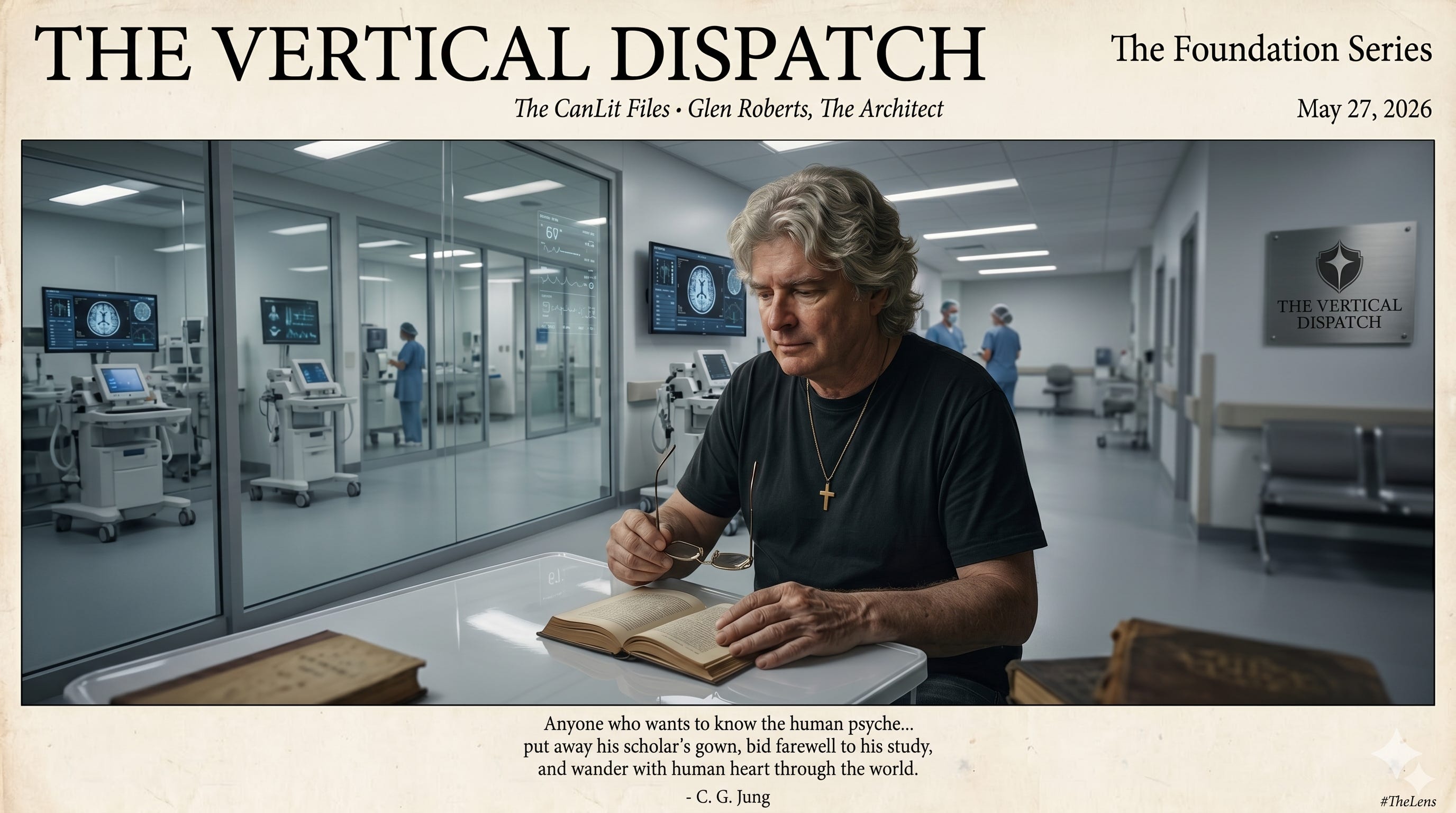
The Architect spent five years working as a sitter at the Civic Hospital in Ottawa — part of The Ottawa Hospital, a major academic teaching hospital, home to the University of Ottawa Heart Institute and one of the leading clinical institutions in the country. The shift was three in the afternoon to eleven at night. Seven thousand five hundred hours in total, at minimum wage.
The wards were the full range. Post-surgical wards. Palliative wards. The Intensive Care Unit. The neurosurgical and neurosciences ward where patients with cerebral aneurysms, post-craniotomy recovery, stroke, and traumatic brain injury were under observation. The psychiatric and mental health ward. The Architect worked across all of them across the five years. Wherever the hospital needed a sitter, the Architect was the sitter the hospital sent.
The patient count was not kept. The patients were treated as sacred. The work was the work of presence — sitting with the patient, monitoring the patient, attending to the patient when the patient could no longer attend to themselves. The ICU patient who was sedated and ventilated. The palliative patient who was dying across the shift. The neurosurgical patient who was lucid on Friday afternoon and whose aneurysm could rupture across the weekend. The psychiatric patient who needed steady company through the night. Each ward taught a different register of presence. Each ward asked a different discipline from the figure in the chair beside the bed.
Jung named three rooms in the first list of the passage above. Prisons, lunatic asylums and hospitals. The Architect worked in two of the three across the five years. The psychiatric ward was the room Jung named with the language of his era. The post-surgical, palliative, intensive care, and neurosurgical wards were the rooms Jung named as hospital. The two categories together cover the territory Jung said the knowledge of the psyche has to be earned in.
A gold cross was worn in plain sight across all five years. The cross was not hidden under the work shirt. The cross was visible. The cross was the announcement the Architect made to every patient, every family, every nurse, every doctor, and to the Architect’s own conscience at the start of every shift — this is the discipline I carry into the room. This is the model I am working under. This is the figure I am answerable to before I am answerable to any of you. The Good Samaritan was the model. The model is the model the Christian tradition has named for the work of attending to the wounded stranger on the road. The model is the practice. The practice was practiced daily across the five years.
The white light was the protection. The Architect did not miss a single shift to sickness across the five years. Not one. The exposure was the exposure a working academic teaching hospital produces across every ward — the full range of pathogens and conditions and crises absorbed across a five-year window. The Architect was present for every shift the schedule required. The protection held. The cross was visible. The light was the light. The record is the record.
IV. The Reading
The reading was done in the room. The Bible was at the centre. The Architect read the Bible complete in one sitting during Lent — a discipline, a vigil, the full arc of Genesis to Revelation absorbed in a single sustained reading inside the season the Christian tradition reserves for the deepest work of the soul. Jesus was at the core of the Architect’s being across the five years and the years before and the years since. The cross around the neck was the announcement of what the Bible had become for the man who carried it into the room.
The rest of the reading was the canon the Christian-Western tradition had built around the Bible across two millennia. Margaret Atwood and Robertson Davies — the Canadian literary spine, the writers who taught the Architect what serious Canadian moral imagination looks like and who give the CanLit Files imprint of this publication its name. Marcus Aurelius — the Meditations, the daily discipline of self-examination Jung would later name as the precondition for individuation. Plato — the foundation under all serious Western thought. John Steinbeck — the American working-class moral seriousness, the writer who taught the Architect that the dignity of ordinary labour and ordinary suffering is the proper subject of serious literature. Fyodor Dostoyevsky — the Christian moral psychology, the closest thing in fiction to what Jung would later build into clinical framework, the writer who showed what it looks like to take the shadow seriously inside a Christian frame.
The Vedic material — the Upanishads, the Bhagavad Gita, the wider Hindu philosophical inheritance — came later. The Architect did not read the Vedas during the hospital years. The Architect was not aware of them. The Vedic reading is part of the post-hospital integration work the dispatch will name in the following section. The hospital reading was Christian and Western. The lens the hospital years formed was the lens that reading produced.
The reading was absorbed differently in the hospital room than the same reading would have been absorbed in the seminar room. The room changes what the page does. Dostoyevsky read at the bedside of a dying patient is not the same Dostoyevsky read at a graduate seminar. The Bible read in one sitting during Lent is not the same Bible parsed verse by verse in a divinity school course. The room is the lens. The reading is what the lens is made of.
V. What the Hospital Teaches
The hospital teaches what Jung said it teaches. The patient who is dying has no further use for performance. The patient who is recovering from surgery is in the register the body imposes when the body is the entire foreground. The patient in the ICU is in the register the body imposes when the body is barely holding the line. The neurosurgical patient is in the register the patient is in when the brain itself is the variable that may or may not survive the night. The psychiatric patient is in the register the mind is in when the mind has stopped pretending. The family who is sitting with the patient is in the register the family carries when the negotiable has fallen away. The visitor who is sitting with the patient is in the register the visitor brings to the room — the register of presence or the register of avoidance, the register of attention or the register of fidgeting, the register of the steady hand or the register of the hand that needs to be somewhere else.
The Architect watched all of these registers across five years. The registers are the material the psyche shows when the psyche is no longer pretending. The material is the same material Jung named in the passage above. The material is the material the political analyst either has spent time with or has not spent time with. The political figure who is performing the shadow on the public stage is performing the same material the patient’s spouse is performing at the bedside when the spouse is unable to be present with the dying. The voltage is different. The material is the same.
This is the lens. The lens was not acquired in a graduate seminar. The lens was acquired in the room. The room is what Jung said the room would teach.
VI. The Discipline of Self-Examination
Jung named individuation as the lifelong work of integrating the shadow material into the conscious self. The work is not done in a weekend retreat. The work is done daily through the disciplines of attention, prayer, meditation, honest relationship, dream attention, and the willingness to look at the material the ego does not want to look at.
The Architect has practiced the disciplines for thirty years. The practice has not been performed in public. The practice has been the daily work the publication’s voice now draws from. The morning sit. The evening review. The willingness to name the projection when the projection surfaces in the conversation. The willingness to ask whether the heat the Architect feels toward a political figure is the heat the figure deserves or the heat the Architect’s own shadow is generating against the figure as a projection screen.
The post-hospital years brought the Vedic reading into the practice. The Upanishads. The Bhagavad Gita. The discovery that the framework the Christian tradition had given the Architect mapped onto the framework the Vedic tradition had built three thousand years earlier. The two traditions did not contradict. The two traditions illuminated each other. The Christian core remained the core. The Vedic reading widened the lens without displacing what the Bible and the hospital years had set in place.
The dispatch does not claim the integration is complete. The integration is the work. The work is ongoing. The dispatch claims only that the work has been attempted in good faith across thirty years and that the lens the publication deploys has been formed in the attempting. The reader decides whether the formation shows in the work.
VII. Why the Dispatch Can Read the Shadow
The Dispatch can read the shadow because the lens has been formed in the rooms Jung named, in the disciplines Jung prescribed, across the duration the integration requires. The reading is not the claim of authority. The reading is the application of the framework to the public record. The public record is the ground. The framework is the lens. The Architect is the reader.
The reader does the reading. The reader does not issue the reader a certificate. The work is the work. The work is filed. The reader of the publication decides whether the work has the weight the framework requires.
VIII. The Canadian Shadow Series
The publication has begun the work of reading the Canadian shadow in the present moment. The Poilievre piece named what the I can get a deal with Trump claim reveals. The Smith piece named the forty-five-year material the Alberta separation campaign is carrying. The work will continue.
The country carries shadow material the country has not yet integrated. The 1867 settlement is unfinished. The treaty relationships with Indigenous nations have not been operationalized at the depth the treaties commit the federation to. The petroleum wealth has been consumed rather than invested. The continental relationship has been managed by avoidance rather than by honest naming. The COVID trauma has not been integrated. The October Crisis of 1970 has not been integrated. The 1995 Quebec referendum has not been integrated. The peacekeeper persona has not been reconciled with the operational military record. The post-2015 self-flagellation has not been examined as its own projection.
The Dispatch will work through the material across the coming dispatches. The work will be empirical. The work will be drawn from the public record. The framework will be Jung’s. The lens will be the lens the hospital years formed. The reader will decide whether the work earns the trust the framework requires.
IX. Closing Note
The Architect does not claim to be a Jungian analyst. The Architect does not claim clinical authority. The Architect is a publisher who has spent thirty years with the framework, five years in the rooms Jung named as the rooms where the psyche shows itself, and the duration of an adult life practicing the disciplines the integration work requires. The Dispatch deploys the lens that formation has produced.
The Good Samaritan model is the model. The wounded stranger on the road is the patient at the bedside, the political figure on the public stage, the country at the hinge moment. The work is the work of attending to what is actually there, naming it carefully, refusing to look away.
The dispatch closes where the work begins. Wander with human heart through the world. Jung named the standard. The Architect has done the wandering the years allowed. The publication carries forward what the wandering taught.
This dispatch makes no clinical claim. The Jungian framework is named explicitly. The biographical record is drawn from the Architect’s own account. The analytical register is interpretive. The standing editorial standard of the publication applies without exception: assessments are advanced from the documented record only, without malice and without flattery.
God is Love. Love is Truth. Truth is Consciousness. Consciousness is Brahman.
Amen. Namaste.
Om Namah Shivaya.
#TheLens #CarlJung #TheHospitalYears #TheGoodSamaritan #ShadowWork #Individuation #TheFoundationSeries #TheVerticalDispatch #ModernManInSearchOfASoul #TheCanadianShadow #TheArchitect #TheCivicHospital #TheBibleAtLent
Deep bow to your commitment. And naming the cultural shadows not yet integrated.