


There’s a concept from organizational theory that almost nobody in Canadian political journalism uses, and it explains more about the Carney government in five minutes than a year of Hill commentary will. It comes from Elliott Jaques, the Canadian-born psychoanalyst and management theorist who spent decades studying what actually distinguishes leaders at different scales of responsibility. Jaques argued that human cognitive capacity sorts itself into discrete strata — Stratum I through Stratum VIII — defined by time horizon. Not intelligence in the IQ sense. Not eloquence. Not charisma. Time horizon: the longest stretch of future a person can actually hold in their head, plan against, and execute toward without losing the thread.
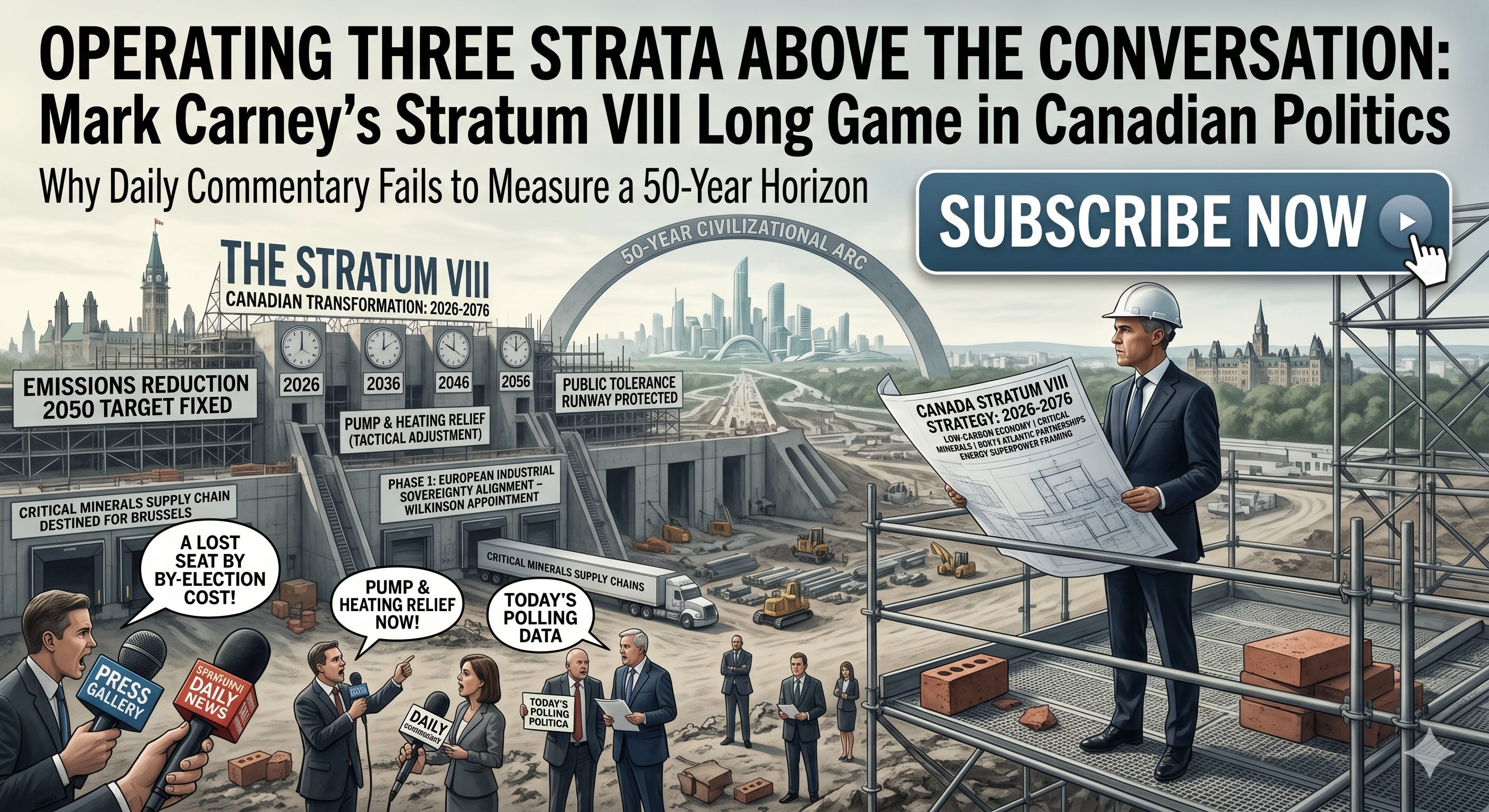
A Stratum I worker handles tasks measured in days. A Stratum IV manager runs a business unit on a two-year horizon. A Stratum VII CEO of a major multinational works in twenty-year arcs. A Stratum VIII mind — and Jaques estimated there are only ever a handful of these operating in the world at any given time — thinks in fifty-year civilizational arcs. They are building, restructuring, or repositioning entire systems against horizons most people cannot even perceive, let alone plan for.
Mark Carney is a Stratum VIII operator. And almost nobody covering him is equipped to see it.
This is not flattery. It’s a structural observation about why so much of the daily commentary on this Prime Minister reads as bewildered, slightly irritated, and persistently off-target. A press gallery trained to cover politics on a 24-hour news cycle — Stratum II thinking, charitably — is being asked to evaluate decisions that only make sense on a 20- to 50-year horizon. The mismatch isn’t ideological. It’s cognitive. They are using the wrong instrument to measure the wrong thing, and the instrument keeps reading “boring” or “risky” or “off-message” when the actual signal is “this person is operating three strata above the conversation.”
Thursday’s appointment of Jonathan Wilkinson as Canada’s next Ambassador to the European Union is a small, almost mundane example. And precisely because it’s small, it’s perfect for showing what’s actually going on.
The move itself
Wilkinson — sitting MP for North Vancouver–Capilano, former Minister of Environment and Climate Change, former Minister of Energy and Natural Resources — will take up the EU posting this summer. He replaces Stéphane Dion in a chair that has sat empty since last fall. The appointment shrinks the Liberal caucus to 172 seats, the bare minimum for a majority, and it will eventually trigger a by-election in a riding that, while reliably Liberal, is never a guaranteed hold once the seat is open.
A Stratum IV mind looks at this and sees risk: why give the opposition a free shot? A Stratum V or VI mind sees the trade: a competent envoy in exchange for a manageable parliamentary squeeze. A Stratum VIII mind isn’t really making either of those calculations. It’s looking at the configuration of the next thirty years of the North Atlantic — the unwinding of the post-1945 American security guarantee, the European scramble for industrial sovereignty, the critical minerals race, the redrawing of energy markets, the emergence of a genuinely multipolar world — and asking: who do I need in Brussels to position Canada inside that future?
The answer is not a retired diplomat. The answer is somebody who has personally held the climate file, the energy file, and the natural resources file, who knows the industrial base from the inside, and who can walk into a room with a German economy minister or a French foreign minister and speak with the authority of someone who’s actually run the equivalent portfolios. The answer, in other words, is Wilkinson.
The lost seat is not a cost Carney is reluctantly absorbing. On a 30-year horizon, it’s not really a cost at all.
Why the pragmatism keeps getting misread
The same cognitive mismatch explains the persistent confusion about Carney’s pragmatism. The consumer carbon tax — gone. Aggressive emissions targets — moderated. Pump and heating relief — delivered. The “energy superpower” framing that embraces both conventional and clean energy — fully leaned into. Critics on the left read this as betrayal. Critics on the right read it as evidence the climate agenda was never serious. Both are reading the moves on a two-year horizon and finding them incoherent.
On a thirty-year horizon, they are perfectly coherent. The destination — a Canadian economy structurally repositioned for a low-carbon, critical-minerals, energy-secure future — has not moved an inch. What’s changed is the route, because the terrain changed. The American relationship is not what it was. European demand for non-American, non-Russian, non-Chinese supply is real and durable in a way it wasn’t five years ago. Public tolerance for cost-of-living pressure has a ceiling, and you cannot drag a country across a thirty-year transition if you’ve already exhausted its patience in year two. So you adjust the tools, you protect the political runway, and you keep the destination fixed.
This is not flip-flopping. It’s not capitulation. It’s what Jaques would have recognized instantly as the signature behaviour of a high-stratum operator: hold the long arc, adapt the short and medium tactics, never confuse the two.
The reason this looks like “moderation” or “pivoting” in daily coverage is that the coverage cannot see the long arc. The arc is invisible to instruments calibrated for the news cycle. So the moves register as a sequence of disconnected reversals rather than a single coherent campaign — which is exactly what high-stratum work looks like to a low-stratum observer. Always has.
The Armenia tell
If you want to see the time horizon directly, look at this weekend. Carney is travelling to Yerevan for the European Political Community summit — and he is the first non-European leader ever invited to attend. The agenda is collective security, critical minerals, energy, defence industrial cooperation, and the question of where European capital is going to flow over the next two decades now that the old assumptions are gone.
That invitation did not arrive by accident. It is the visible surface of months of positioning that the Canadian press corps largely did not cover, because the moves didn’t generate daily news. A central banker turned Prime Minister — one of the very small number of people on earth who has run both monetary policy at G7 scale and global climate finance architecture — is being treated by European capitals as something Canada has not had in living memory: a peer-level interlocutor on the future of the transatlantic order.
The Wilkinson appointment is the operational follow-through. You send your strongest possible domestic file-holder to Brussels at exactly the moment Canada is being invited into the inner conversation about what comes next. You absorb the by-election cost without flinching, because on the timescale that actually matters, the by-election is noise.
What this asks of the rest of us
There’s a slightly uncomfortable corollary to all of this, which is that a Stratum VIII Prime Minister is genuinely difficult to evaluate in real time. You cannot fairly judge a thirty-year repositioning by quarterly polling, by question period exchanges, or by the day’s hot take. The feedback loop is too short. Most of the evidence that the strategy is working, or failing, will not arrive for years. This is precisely the situation Jaques warned about: organizations and electorates routinely punish high-stratum leaders during the lag between decision and visible result, and routinely reward low-stratum leaders for the dopamine hit of immediate, legible action — even when the action is strategically incoherent.
Canada is, at this moment, being governed by someone whose cognitive horizon is genuinely unusual for a sitting head of government anywhere in the democratic world. Not unique — there are perhaps a handful of his peers globally — but rare enough that the country’s political-media ecosystem does not have the vocabulary for it. The default frame is “technocrat,” which is patronizing and wrong. The accurate frame is closer to: a person whose internal planning horizon exceeds the institutional planning horizon of every body that surrounds him.
That is a hard thing to cover. It is a harder thing to give the benefit of the doubt to, especially when the benefit of the doubt has to be extended across years rather than news cycles. But it is, I think, the only honest frame for what is actually happening.
The small move, one more time
Which brings us back to Wilkinson. A single ambassadorial appointment. A summer start date. A by-election somewhere down the road. A press release most readers will scroll past.
And underneath it: a Prime Minister who looked at the next thirty years of the North Atlantic, identified the exact human being he wanted in Brussels for the work ahead, and made the trade without apparent hesitation. That is not the behaviour of a government playing defence, or hoarding seats, or managing optics. It is the behaviour of a government that knows where it is going on a horizon almost no one around it can see, and is quietly, methodically, putting the right people in the right rooms to get there.
Most of the commentary will miss this. That’s fine. Stratum VIII work usually only becomes legible in retrospect. The interesting question is whether enough of us can give it the time and the patience to become legible at all — and whether, in an era addicted to the transaction of the moment, we can still recognize the shape of a long game when one is being played on our behalf.
I think we can. I think this one is worth watching closely.
Glen Roberts is the author of Sacred Metaphysics and Consciousness: The History of the Absolute and Eternal and the developer of Universal Dynamics and the Vajra sovereign AI architecture.
#MarkCarney #StratumVIII #ElliottJaques #CanadianPolitics #TheLongGame #CivilizationalArcs #CdnPoli #StrategicLeadership #OrganizationalTheory #Project2046 #TheVerticalDispatch #HillTimes #MacroStrategy #TransatlanticOrder #EnergyTransition #CriticalMinerals #PoliticalAnalysis #FutureOfCanada #UniversalDynamics #BionicSage #LogicOverOptics #ThirtyYearHorizon
Finally, someone is articulating what I’ve been seeing since the beginning. You’re quite right, and I wish I were going to be around long enough to see the results. I am, however, extraordinarily grateful to be living in this time with this man leading us into that future. Walt Whitman said it well, “…to be alive in such an age, when miracles are everywhere, and every inch of common air throbs a tremendous prophecy, of greater marvels yet to be.”
I’ve worked extensively with Requisite Org. And agree with your assessment. Stratum 7 or 8. Vision. Honesty in communication. “Come the time, cometh the man/ person. I think most canadians are fundamentally jolted enough to trust the longer term nature of the results. Your article helps us see past the short time reporting.