

I. THE CONDITION NOBODY NAMES
Every piece this publication has written about Mark Carney, the European Political Community, and the emerging post-American order rests on a prior condition that almost no commentary makes explicit.
Europe cannot lose to Russia.
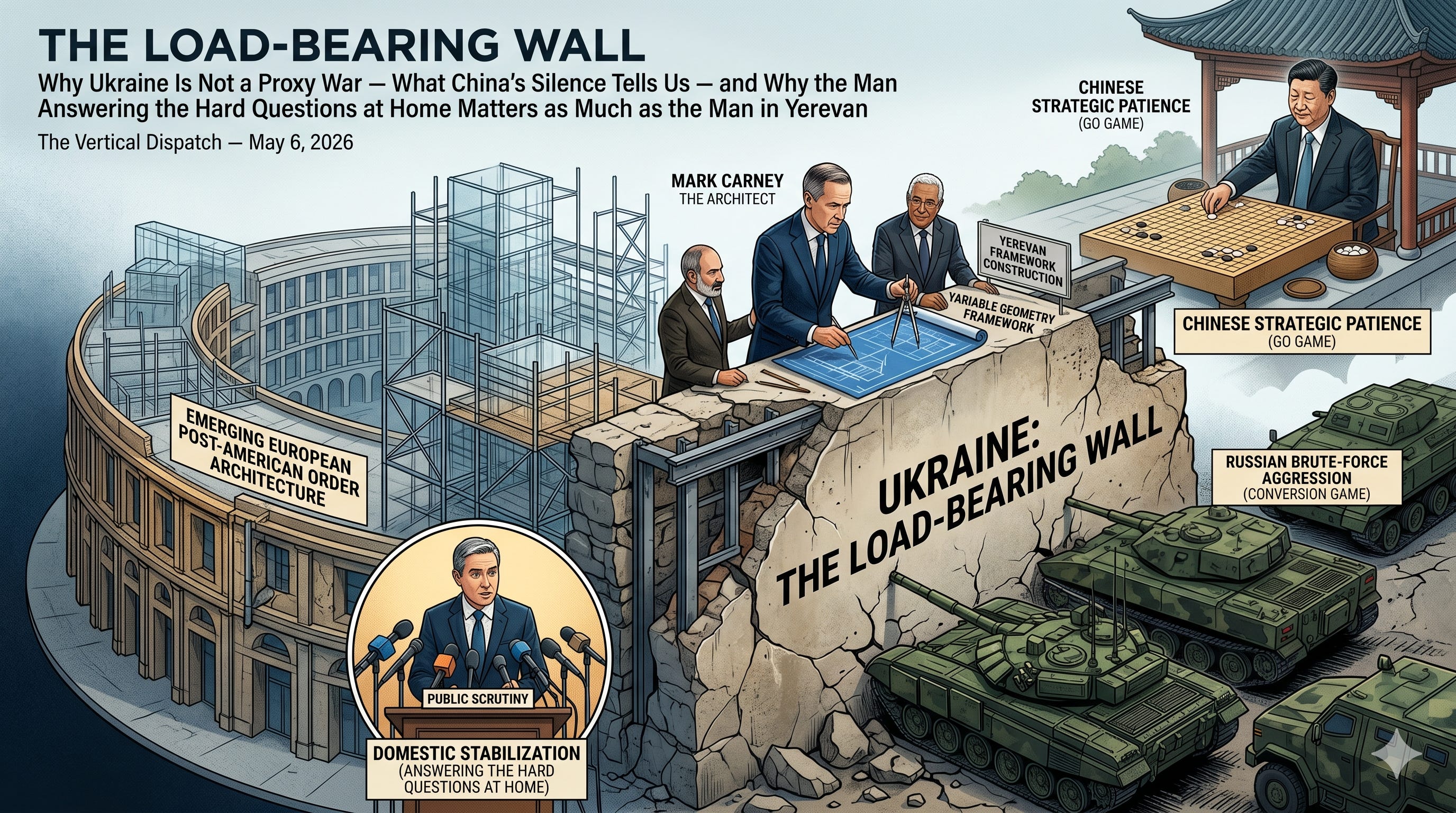
Not “should not.” Not “it would be unfortunate if.” Cannot — in the structural, architectural sense that a building cannot lose its load-bearing wall and remain standing. The entire framework being constructed in Yerevan, in the daily texts between Carney and Stubb, in the bilateral circuit, in the European Parliament invitation, in the Eurovision signal from the unnamed EU diplomat — all of it is weight-bearing on that single condition.
If Putin consolidates Ukraine, the post-American normative architecture does not get delayed. It collapses. Not because Carney’s thinking is wrong. Not because the variable geometry framework is flawed. But because the Europe he is positioning Canada inside will have failed its first and most fundamental existential test. A Europe that cannot defend its eastern border cannot credibly offer itself as the generative source of a new world order. The Yerevan photographs become a historical record of a conversation that happened before the framework proved insufficient to the moment that tested it.
This is the load-bearing wall. Everything else in the construction sits on top of it.
Which means the $270 million Carney committed to Ukraine’s defence in Yerevan is not foreign aid in any conventional sense. It is a structural investment in the precondition for everything else he is building. A Stratum VIII mind does not make that commitment for optics. It makes it because the horizon is thirty years and the wall has to hold.
II. THE CHAMPAGNE QUESTION — AND WHY IT DESERVES A PRECISE ANSWER
In the same week that Carney committed $270 million to Ukraine’s defence in Yerevan, Finance Minister François-Philippe Champagne was fielding a version of the same question in scrums, in public appearances, and in the comment threads of every major Canadian outlet: why are we sending money abroad when Canadians have real needs at home?
It is a legitimate question. It deserves a precise answer rather than a political one.
Canada’s total support for Ukraine since 2022 now stands at $25.8 billion. That is a large number. It becomes a different number when disaggregated. Spread across 41.6 million Canadians over four years, it amounts to approximately $620 per person — roughly $155 per Canadian per year, or $13 per month. That is not nothing. But for context: Canada’s annual interest payments on its public debt run approximately $50 billion — nearly ten times the annualized pace of total Ukraine support. The housing crisis, the healthcare gap, the infrastructure deficit — none of these are caused by Ukraine spending. They are the accumulated consequence of decisions made over decades that have nothing to do with Kyiv.
The question, in other words, is not really about Ukraine. It is about thirty years of deferred domestic investment dressed in the language of foreign policy concern. Ukraine is a legible target for that frustration. It is not its cause.
But there is a deeper answer — one that requires holding the thirty-year horizon — that neither the political press nor the daily news cycle has the instrument to articulate. The $13 per Canadian per month is not charity. It is the cheapest available premium on a thirty-year insurance policy. The alternative — a Russia that consolidates Ukraine, a Europe that fractures under the weight of a failed first test, a post-American order written by the players who remained rather than the players who helped build it — costs Canada orders of magnitude more. Not in aid budgets. In sovereignty, in trade architecture, in the kind of world the next generation will inherit.
Champagne’s job is to hold that answer under sustained political fire while Carney is in Yerevan placing stones on the board. That is not a secondary role. It is the domestic architecture of the same project.
Which brings us to who Champagne actually is — because the appointment tells us something about how Carney builds.
III. THE ARCHITECT AND HIS FINANCE MINISTER — A STRATUM READING
A Stratum VIII Prime Minister does not appoint a Finance Minister for political balance or regional calculation. He appoints the person whose formation matches the moment.
François-Philippe Champagne’s biographical record is worth reading at stratum rather than at résumé length.
Before entering politics, Champagne spent over twenty years inside large multinational corporations operating across Europe — as Vice-President and Senior Counsel of ABB Group, a technology company operating in more than 100 countries, and as Strategic Development Director, acting General Counsel, and Chief Ethics Officer at AMEC Foster Wheeler, a world leader in the energy sector. He was named a Young Global Leader by the World Economic Forum in 2009. He holds a law degree from the Université de Montréal and a Master of Laws in American law from Case Western Reserve University.
He entered politics in 2015 and moved through portfolios in a sequence that is not accidental when read at stratum: Parliamentary Secretary to Finance, then International Trade, then Infrastructure, then Foreign Affairs, then Innovation, Science and Industry — five portfolios across a decade, each one adding a layer of institutional knowledge to the one before it. He was the minister who watched the Canada-EU Comprehensive Economic and Trade Agreement enter into force. He was the minister who lured Volkswagen’s first gigafactory outside Europe to Canadian soil. He was the minister who, at the G7 Finance Ministers meeting in 2025, stood beside Ukraine’s Finance Minister and publicly pledged Canada’s continued support — not as a diplomatic gesture but as a co-chair of the Group of Creditors of Ukraine.
What Carney recognized in Champagne is the same thing the Wilkinson appointment to Brussels revealed: a Prime Minister who looks at a thirty-year repositioning and asks, who has actually held these files, carried this institutional knowledge, and built these relationships? Not who is politically convenient. Who is genuinely equipped?
Champagne is equipped. He spent two decades inside the energy and technology sectors that are now the terrain of the new geopolitical contest — critical minerals, clean technology, digital sovereignty, supply chain resilience. He knows CETA not as a policy document but as a negotiated reality he watched enter into force. He knows European counterparts not from briefing notes but from rooms he sat in before most Canadian commentators knew those rooms existed.
And he is, at this moment, standing at the podium in Toronto answering the hard domestic question — why Ukraine, why now, why this much — while Carney is in Yerevan placing the stones that the answer funds.
That is a partnership, not a hierarchy. Two minds, different strata, different functions, the same thirty-year horizon.
IV. THREE PLAYERS, THREE GAMES — AND WHY ONLY ONE IS PLAYING GO
Western commentary has spent four years treating the conflict in Ukraine as a binary: Russia versus the West, with China hovering ambiguously in the background. That frame is inadequate. There are three distinct civilizational logics operating simultaneously on the same board, and confusing them produces analysis that cannot generate predictions.
Russia is playing a conversion game.
This is the oldest form of imperial logic: territory acquired through force, populations subordinated to a civilizational claim, borders redrawn to reflect the will of the stronger power. Putin’s framework is not subtle. It does not require sophisticated analysis. It requires only the recognition that conversion-by-force is a Stratum III strategic logic — reactive, sequential, legible — and that its weakness is identical to its strength: it is entirely visible. You always know where Russia is going because Russia always goes in the same direction.
The United States, at its worst, is playing a dominance game.
American imperial logic is more sophisticated but structurally similar in its assumption: that the world should eventually become American — in its values, its institutional arrangements, its economic architecture, its cultural reflexes. Where Russia converts through force, America converts through dependency: economic penetration, military presence, cultural saturation, and the implicit offer that integration into the American system is integration into modernity itself. Trump’s version strips the offer down to its transactional skeleton — pay or be abandoned — which is, paradoxically, more honest than the version it replaced.
China is playing Go.
This is the distinction that almost no Western commentary makes cleanly, and it is analytically decisive. China is not an imperial project in either the Russian or American sense. At its civilizational core — beneath the Belt and Road, beneath the South China Sea positioning, beneath the “Community of Common Destiny” language — China is a tribal project. Not tribal in the pejorative sense. Tribal in the precise sense that its deepest orientation is inward. The Middle Kingdom concept is not about converting the world to Chinese values. It never has been. It is about maintaining the conditions under which Chinese civilization can flourish on its own terms, undisturbed by the external pressure that produced the Century of Humiliation.
The Belt and Road is not a conversion project. It is a periphery-securing project. The South China Sea positioning is not Western-style imperialism. It is the enclosure of the approaches to the center. The debt dependency dynamics — whatever their moral complexity — are instruments of strategic insulation, not vehicles for civilizational export.
China plays Go because Go is structurally isomorphic with how Chinese civilization has always understood its relationship to the world beyond its borders. You do not need to capture every stone. You do not need to convert every population. You need to surround enough territory that the approaches to your center are secure and the shape of the game reflects your long-term advantage. Then you wait.
The waiting is the strategy.
V. WHAT CHINA’S SILENCE ACTUALLY TELLS US
China has not supported Russia militarily in any way that materially changes the outcome on the ground. It has not provided weapons. It has maintained plausible deniability on dual-use goods. It has continued to purchase Russian energy at discounted rates — which benefits China economically and keeps Russia financially viable — while simultaneously maintaining trade relationships with Europe and refusing to openly endorse the invasion. It has called, repeatedly and in carefully calibrated language, for negotiations and a political settlement.
Western commentary reads this as cynical fence-sitting. That reading is too simple.
What China is actually doing is watching. It is running the thirty-year calculation: what does a Russian victory produce, and what does a Russian defeat produce, and which outcome better serves the conditions under which Chinese civilization can flourish?
A Russian victory produces an emboldened revisionist power on China’s western flank — one that has demonstrated that force works, that the rules-based order can be broken without terminal consequence. That is not obviously good for China. An emboldened Russia is not a stable partner. It is a precedent that cuts in multiple directions.
A Russian defeat — or a negotiated settlement that leaves Russia diminished — produces a different problem: a West that has demonstrated institutional coherence, that has held together under pressure, and that is now constructing precisely the kind of multilateral architecture that reduces China’s room for maneuver in ways that matter over the long arc.
China does not want either outcome cleanly. What it wants is the condition that follows exhaustion — a prolonged contest that drains Western resources, weakens Russia as a potential rival, and leaves the field open for Chinese patient capital and long-arc positioning. The waiting is not indecision. It is the Go move.
VI. THE THIRTY-YEAR TEST — AND WHY IT CANNOT BE RUSHED
This publication has argued across multiple dispatches that a Stratum VIII framework operates on thirty-year horizons and does not permit verdicts that the evidence cannot yet support. That discipline applies here with particular force.
The question that matters for the next order is not whether China is an adversary. It is whether China’s relational language — Community of Common Destiny, mutual recognition, win-win cooperation — is oriented toward something genuinely mutual, or whether it is sophisticated horizontal competition dressed in vertical language. Whether the words point toward something real or whether they are, in the precise philosophical sense, a simulacrum: a copy of multilateralism with no multilateral original behind it.
The empirical record is genuinely mixed. Belt and Road debt structures that produce strategic dependency rather than mutual development. The erasure of Uyghur cultural identity. Maritime boundaries that expand regardless of international rulings. These are not footnotes. They are data points the thirty-year test must weigh.
But the thirty-year test has not concluded. And intellectual discipline requires holding the question open rather than closing it prematurely with the outrage of the current moment.
The test is simple in its structure: does China’s behavior, over time, move toward genuine mutual recognition — outcomes that are actually win-win on the ground — or does it move toward win-lose outcomes with win-win branding? That question will be answered by fruit, not by declarations. It will be answered in the lived experience of the populations whose countries enter China’s relational field and emerge, years later, more or less sovereign than when they entered.
We are not yet thirty years in. The verdict is not available. Intellectual honesty requires saying so.
VII. WHERE THIS LEAVES THE CARNEY FRAMEWORK
Return to the load-bearing wall.
The Carney framework — variable geometry, middle power coalition, Canada as the transatlantic voice of the post-American order — requires three conditions to manifest.
The first is that Ukraine holds. The $270 million, the Latvia commitment, the digital sovereignty agreements, the Spring Economic Update’s $2 billion over three years to Operation UNIFIER — these are investments in that condition. Necessary but not sufficient. The wall requires European military capacity, European political will, and Ukrainian endurance on terms that Carney can support but cannot control.
The second is that the European institutional class successfully translates its long-arc vision downward into the vernacular of populations that have not yet been persuaded. The far-right surge is not a terminal diagnosis. It is a readout of a translation gap that can be closed — but only by political leaders willing to carry Stratum VII thinking into the lived experience of people whose immediate horizon is the next heating bill.
The third is that China’s thirty-year calculation does not produce an outcome that forecloses the multilateral architecture before it can establish itself. What Carney can do — and what the Yerevan positioning suggests he is doing — is build the architecture robust enough that it does not require China’s cooperation to function, while leaving the door open for China’s eventual participation if its thirty-year fruit demonstrates genuine orientation toward the mutual rather than the merely strategic.
That is not naivety. It is the only intellectually honest position available to a Stratum VIII mind in 2026.
VIII. THE SHAPE OF THE BOARD
Zelensky said in Yerevan: “This summer will be a moment when Putin decides what to do next — expand the war or move to diplomacy, and we must push him toward diplomacy.”
That sentence contains the immediate horizon inside the long one. Summer 2026 is a decision point. What happens on the eastern front in the next three months will either reinforce the Yerevan architecture or reveal its contingency.
The board from thirty thousand feet:
Russia is exhausted but not defeated. It is testing whether Western resolve will hold through another cycle of attrition. The answer to that test will determine whether Putin moves toward diplomacy or calculates that one more push breaks the coalition.
China is watching both — Russia’s exhaustion and Western resolve — and running the calculation described above. It will not intervene to save Russia. It will not intervene to accelerate Russia’s defeat. It will wait for the shape of the board to clarify.
Europe is building — faster than at any point since 1945 — the military, industrial, and institutional capacity to make its eastern border defensible without American guarantee. The pace is real. The political will, in the core coalition, is real. The question is whether it arrives before the wall is tested beyond what current capacity can hold.
And Canada is doing something none of the other players can do. Carney is in Yerevan writing the normative framework of the order that comes after the current contest resolves. Champagne is in Toronto answering the question that framework has to answer at home before it can answer it abroad: is this worth it, and why?
The answer is yes. The wall has to hold. And $13 a month per Canadian is what holding it costs.
The load-bearing wall has to stand. Everything written with that pen in Yerevan depends on it.
Glen Roberts publishes The Vertical Dispatch on Substack. He is the author of Sacred Metaphysics and Consciousness: History of the Absolute & Eternal, and the developer of the Universal Dynamics framework and AIG — Artificially Intelligent Governance.
#TheVerticalDispatch #TheArchitect #MarkCarney #Champagne #Ukraine #Russia #China #LoadBearingWall #ThirtyYearTest #GoNotChess #StrategicPatience #CdnPoli #Canada #Europe #Multilateralism #PostAmericanOrder #VariableGeometry #StratumVIII #ElliottJaques #CommunityOfCommonDestiny #NormativeArchitecture #Yerevan #NATO #BeltAndRoad #CivilizationalAnalysis #SpringEconomicUpdate #OperationUNIFIER #UniversalDynamics #AIG #13DollarsAMonth
Brilliant summation.
Fantastic article with a solid explanation of the strategy media can't see! Well done!