

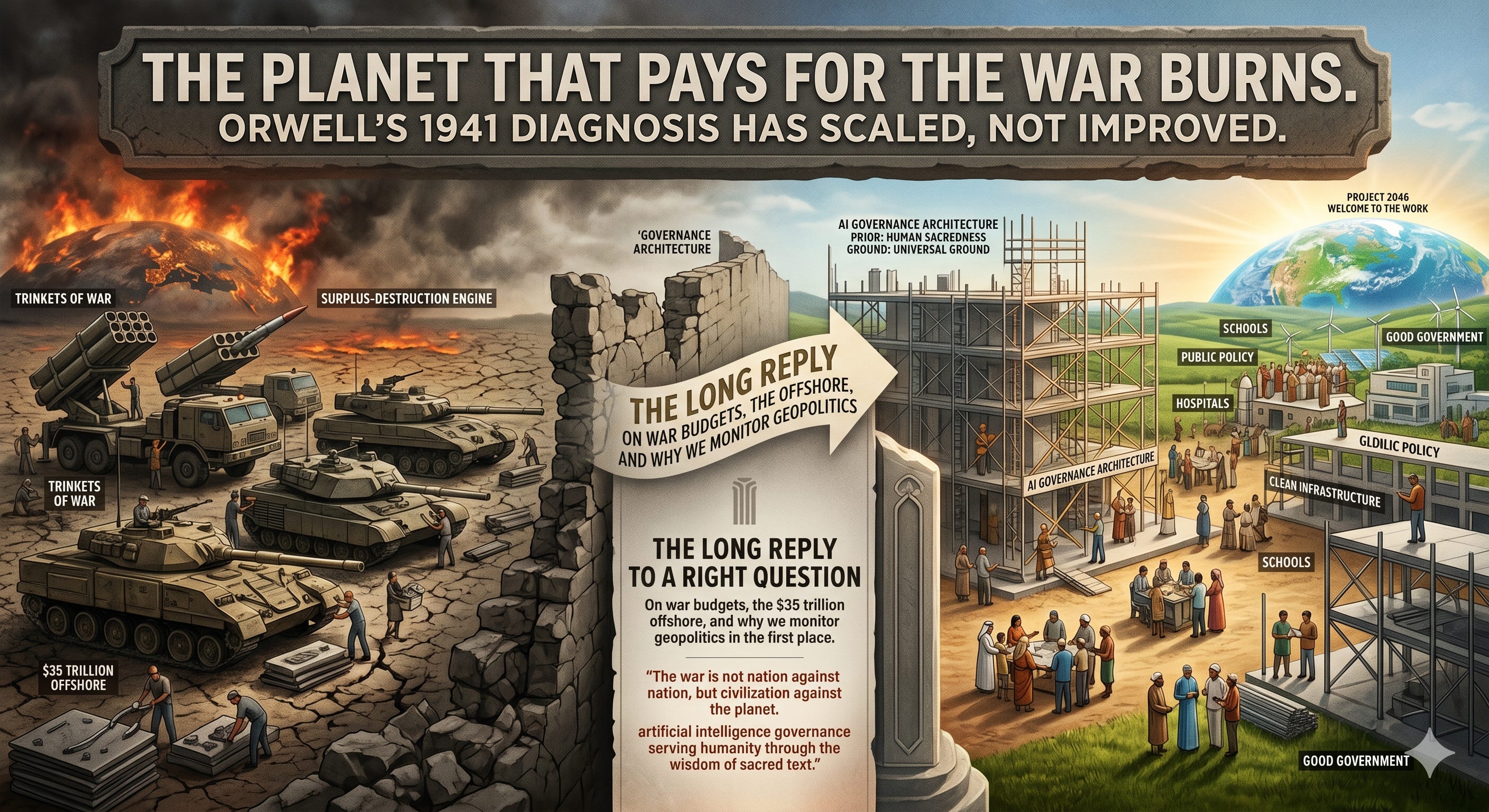
The world is preparing to spend trillions on machinery it hopes never to use, while the planet that pays for it burns. Orwell saw this in 1941. He named it plainly. Eighty-five years later, we are still pretending we did not hear him.
A reader wrote in after the Carney and Tanco pieces with a question that deserves to be answered head-on rather than sidestepped. I’ll quote the heart of it, because it carries weight:
“Should you spend unparalleled wealth — 5% of GDP across 20 industrialized nations — on the last valuable resources easily accessed on the planet, creating machinery you will never use that runs on fossil fuels? Is this a con? A set up? If you build up this war machine and use it, what will be left of civilization?”
And then the closing line, the one I keep coming back to: “The war is not nation against nation, but civilization against the planet.”
Let me give you the short answer first, because the reader earned a direct one.
No. It does not make sense.
It does not make sense in any moral arithmetic, any civilizational accounting, any honest reading of where humanity actually stands on the timeline of the biosphere it depends on. The reader is right. I want to say this clearly before adding anything else, because the analytical work that follows will look like qualification, and I do not want the qualification mistaken for retreat.
The world spending several trillion dollars per year, escalating, on kinetic capability while the carbon budget collapses and a billion people lack basic security is not a defensible equilibrium. It is, in Orwell’s own words from Shopkeepers at War in 1941, a system in which “a capitalist economy can never consume all that it produces, so that there is always a wasted surplus — wheat burned in furnaces, herrings dumped back into the sea — and always unemployment.”
Eight years before 1984 was published — in a signed political essay, written during the Blitz, with German bombers literally over his head — Orwell named the structural problem plainly. Industrial capitalism produces more than it can distribute, and the surplus has to go somewhere.
He completed the synthesis in 1984 itself, in the Goldstein chapter that scholars have long understood as Orwell’s own political analysis embedded in the novel: “The primary aim of modern warfare is to use up the products of the machine without raising the general standard of living.”
The diagnosis is consistent across his work for nearly a decade. He saw it in 1941. He named it again in 1945 in You and the Atom Bomb, forecasting “two or three monstrous super-states” maintaining a permanent “peace that is no peace.” He completed the picture in 1948.
The system produces surplus precisely so the surplus can be destroyed. Bombs dropped on schools and hospitals rather than schools and hospitals built. That is not a metaphor. That is a description of how industrial economies, freed from the discipline of distribution, organize themselves around the consumption of what they produce.
Orwell saw it clearly in 1941. What he saw has not improved. It has scaled. The mechanism he described is now the operating system of the global order, dressed in better language.
So the reader is correct. And the answer to “is this madness?” is yes.
But the question I want to take up — because it is the question my work actually exists to answer — is what you do once you have said yes. Saying yes is the beginning of the analysis. It is not the end.
Why I monitor geopolitics
A few readers have asked, in different ways, why I spend so much time on the surface — the appointments, the bank announcements, the critical minerals deals, the procedural moves that look like inside baseball.
The honest answer: I am not monitoring geopolitics for its own sake. I am monitoring it as the surface diagnostic of a deeper question.
The deeper question is this. Can we build a governance instrument that serves humanity through the wisdom of sacred text, rather than serving the surplus-destruction engine Orwell named?
That instrument has a working name in the broader project I am part of. It is called Artificial Intelligence Governance — an architecture whose prior is not the market, not the nation, not the algorithm, but the recognition that human beings are sacred, that the ground is universal, and that any system which inverts this — which treats the human as instrument and the symbol as ground — eventually consumes its own foundation.
The sacred texts of every serious tradition say the same thing in different languages. The Upanishads name it as Brahman. The perennial philosophy names it as the Absolute. The Universal Declaration of Human Rights names it, in secular form, as the inherent dignity of every person.
They are pointing at the same referent.
The architecture being assembled in Project 2046 is the long-horizon work of building governance that takes that referent as the prior, rather than as a decorative preamble to systems that violate it in practice. The geopolitical monitoring is how we test whether the conditions for that architecture are forming or dissolving. The Carney piece, the Tanco piece, the work on the Defence Security and Resilience Bank — these are not separate projects. They are field reports from the surface that tell us what is moving underneath.
When I say a 5% defence pledge is partly composed of a 1.5% resilience slice, I am not defending the war budget. I am pointing at the seam where the surplus-destruction engine could be redirected — where the budget envelope of the security state could, under sustained civilian pressure, fund the schools and hospitals and grids and clean infrastructure rather than the bombs that destroy them.
That seam is real. It is also fragile. Whether it holds depends on whether enough people insist that the resilience slice fund actual resilience.
That insistence is the work. The reader’s letter is the work. The civilian vigilance the reader demonstrated is exactly what the architecture requires to not be captured.
Orwell, honestly
I take the Orwellian read seriously, and I want to be precise about it because the reader invoked it and it deserves to be handled carefully.
Orwell’s argument was not that war is irrational. It was that war is functionally rational for a particular kind of political-economic order — one in which the productive capacity of modern industry, if allowed to flow into civilian abundance, would dissolve the hierarchy that the order depends on.
Goods produced and distributed make populations harder to control. Goods produced and destroyed leave the hierarchy intact. The war is not for victory. The war is for the continuous consumption of surplus that would otherwise become emancipation.
Read that paragraph again, and then look at the global economy of 2026.
Look at the $35 trillion estimated to sit in offshore accounts — capital removed from the productive circulation a human society requires. Look at the rearmament cycle in advanced economies, scaled to absorb domestic political pressure for redistribution by redirecting it into “security.” Look at the pattern by which wars are fought in the Global South and the cost is borne by the populations least responsible for them. Look at the simultaneous fact that the world is on track for catastrophic climate breakdown and that the militaries doing the rearming are exempt from international climate accounting.
Orwell’s read is not a metaphor. It is a description.
The reader naming it is not being conspiratorial. The reader is being literate.
The honest position is to hold this clearly and to ask what comes next. Because Orwell’s diagnosis does not, by itself, contain its own answer. The answer has to be built. And the building requires both the diagnostic clarity the reader brought and the institutional engagement that turns diagnosis into change.
What we are actually trying to do
Let me say it plainly, because the reader deserves to know what they have been reading when they read these pieces.
I monitor geopolitics so we can build an Artificial Intelligence Governance that serves humanity through the wisdom of sacred text. That sentence sounds large. It is large. But every word in it is operational.
Monitor: the geopolitical work — Carney, Tanco, the DSRB, the critical minerals architecture — is the surface diagnostic, the field telemetry that tells us where the institutional ground is firming and where it is failing.
Geopolitics: not as spectator sport, but as the layer where the surplus-destruction engine and its alternatives are visibly contesting each other. Watching closely is how you see which way the flows are bending.
Build: the architecture is not given. It has to be assembled, piece by piece, across decades, by people willing to do the slow work that does not generate headlines.
Artificial Intelligence Governance: the instrument that takes the human as sacred, the ground as universal, and the operational specification from texts that have held this recognition across millennia. Not artificial intelligence as it is currently being deployed — as accelerant of the surplus-destruction engine, as instrument of surveillance, as amplifier of whatever symbol it is pointed at. Artificial Intelligence Governance is the inverse: intelligence in service of the prior, not in service of the inversion.
Serves humanity: not nations, not capital, not the algorithm. The referent is the human person. Every human person. No exemption.
Through the wisdom of sacred text: because the wisdom is already written. The traditions have done the work. What is missing is the instrument that can apply the wisdom at the scale and speed modern civilization operates at, without inverting the wisdom in the process.
The reader is asking, in effect: is this all theatre while the planet burns?
My answer is that it is theatre if we let it be. It is architecture if we insist that it be. The difference is not in the institutions. The difference is in the citizens who hold the institutions accountable to the prior the institutions claim to serve.
An invitation
So here is my answer to the reader, and to anyone reading along.
You are right that the spending makes no sense. You are right that civilization is at war with the planet rather than with itself. You are right that Orwell saw this clearly, and that nothing in the eighty-five years since Shopkeepers at War has falsified him.
And you are right, by extension, that the work cannot be just commentary. It has to be construction.
The vertical — the sacred, the ground, the recognition that the human person is the prior and not the instrument — has to be brought back into civilization deliberately. Civilization has spent three centuries removing it. The consequences of the removal are now visible in the carbon math, the offshore accounts, the war budgets, and the quiet despair of populations being asked to accept all of it as normal.
If you want to read more of the work this is part of — the Carney piece, the Tanco piece, the broader architecture connecting geopolitical monitoring to governance design to the long horizon of Project 2046 — The Vertical Dispatch is where the field reports are being filed. Each piece is a stone. The pattern they form is the architecture.
Read the pieces. Share them. Forward them to one person who would understand what they are pointing at.
The construct of society does not shift through institutions alone. It shifts through citizens who recognize the prior and refuse to let it be inverted any longer — who insist, in their own circles and in their own words, that the human person is sacred, and that any system which treats the human as instrument is a system that has lost its ground.
That insistence travels person to person, conversation to conversation, until the construct becomes thinkable in public discourse, and then unavoidable in public policy.
The reader wrote: the world needs that money better spent on good government, clean infrastructure, health care, education and sound public policy.
Yes.
The work of making that sentence operational at civilizational scale is what Artificial Intelligence Governance is for. The work of holding the architecture to the right prior is what Project 2046 is for. The work of writing it into public discourse so the construct can shift is what The Vertical Dispatch is for.
You are not a passive reader of this. You are part of the construction. The vigilance you brought to that letter is the precise material the architecture is built from.
Be the change you want to see in the world.
Gandhi’s words. They are not a slogan. They are an instruction. The change does not arrive from above. It is built from below, by people who refuse the inversion, hold the prior, and pass the recognition on. That is the only mechanism by which civilizational shifts have ever actually happened. It is the mechanism available to us now.
Keep writing. Keep asking. Keep sharing the work with people who will read it carefully.
The questions you are asking are the right ones. The answers do not exist yet — which is why the work has to be done. Not by AI alone. Not by any single thinker. By a generation of people who recognize the prior and refuse to let it be inverted any longer.
That is what The Vertical Dispatch is for. That is what the long horizon means.
The madness is real. So is the alternative being built. The choice between them is not made by governments. It is made by the citizens who decide which one to insist upon.
I think you have already chosen.
Welcome to the work.
Glen Roberts is the author of Sacred Metaphysics and Consciousness: The History of the Absolute and Eternal and the developer of Universal Dynamics and the Vajra sovereign AI architecture.
#TheVerticalDispatch #ArtificialIntelligenceGovernance #Project2046 #Orwell #ShopkeepersAtWar #1984 #SurplusDestruction #WarEconomy #DefenceSpending #NATO #5PercentGDP #DSRB #DefenceSecurityAndResilienceBank #CriticalMinerals #Geopolitics #Carney #MarkCarney #CanadianPolitics #G7 #ClimateCrisis #CarbonBudget #OffshoreWealth #InequalityCrisis #SacredText #UniversalDeclarationOfHumanRights #HumanDignity #PerennialPhilosophy #Brahman #TheGround #TheReferent #Substack #SubstackWriters #PoliticalEssay #LongFormJournalism #LongHorizon #StratumVIII #ElliottJaques #Pragmatism #BeTheChange #Gandhi #CivilizationVsPlanet
So well done
I have just discovered your work, through the Carney article. I am inspired and encouraged. Can you point me to an article that would help me better understand your particular use of words like “prior” and “ground”?