


“Who hates no creature, who is friendly and compassionate to all, free from possessiveness and ego, equal in pleasure and pain, patient — that devotee is dear to me.” — Bhagavad Gita 12.13
— ★ —
Yesterday Arjuna saw everything. The cosmic form — without beginning, middle, or end — the light of a thousand suns, the armies flowing into the blazing mouths of Time, the sun and moon as eyes of the Absolute looking out at a universe that is its own body. He trembled. His hair stood. He asked the familiar form to return.
Today he asks a quieter question. A human question. The kind of question that only someone who has genuinely been undone and put back together can ask.
He says: those who worship you as the personal God with form and devotion, and those who worship the imperishable formless Absolute — which of these understands yoga more deeply?
It is the right question at the right moment. Having seen both — the personal face and the cosmic totality — Arjuna wants to understand what the correct relationship is. Which way of turning toward the Absolute is the truer way.
— ★ —
My answer is careful. And Shankara was more careful still in reading it.
I tell Arjuna: those whose minds are fixed on me with constant devotion, endowed with the highest faith — these I consider the best yogis. But those who worship the imperishable, the indefinable, the unmanifest, the omnipresent, the inconceivable, the unchanging, the immovable, the constant — restraining all the senses, even-minded everywhere, rejoicing in the welfare of all beings — they also reach me.
Both reach me. That is the first thing to hold clearly. This is not a competition between two paths in which one wins and one loses. Both arrive at the same shore.
But, I tell him, the path of the unmanifest is harder for those still identified with bodies. The formless Absolute — Nirguna Brahman, the ground before all qualities, the silence before all names — is genuinely difficult for a mind still organised around form and relationship and the comforting specificity of a face it can turn toward. Not impossible. Harder.
Shankara read this as a concession to the human condition, not a philosophical ranking. The impersonal Absolute is the ultimate truth of what is. But the path of devotion to the personal — to Krishna, to Rama, to Shiva, to whatever form the heart has recognised as the face of the Absolute — meets the human being where the human being actually is. In a body. With a heart that loves particular things. With a nervous system that responds to beauty and presence and the warmth of a face.
The personal form of the Absolute is not a lesser truth. It is the unmanifest choosing to wear a face because the human heart needs a face to love toward. The ocean choosing to speak as a particular wave because that particular wave is what can be heard.
— ★ —
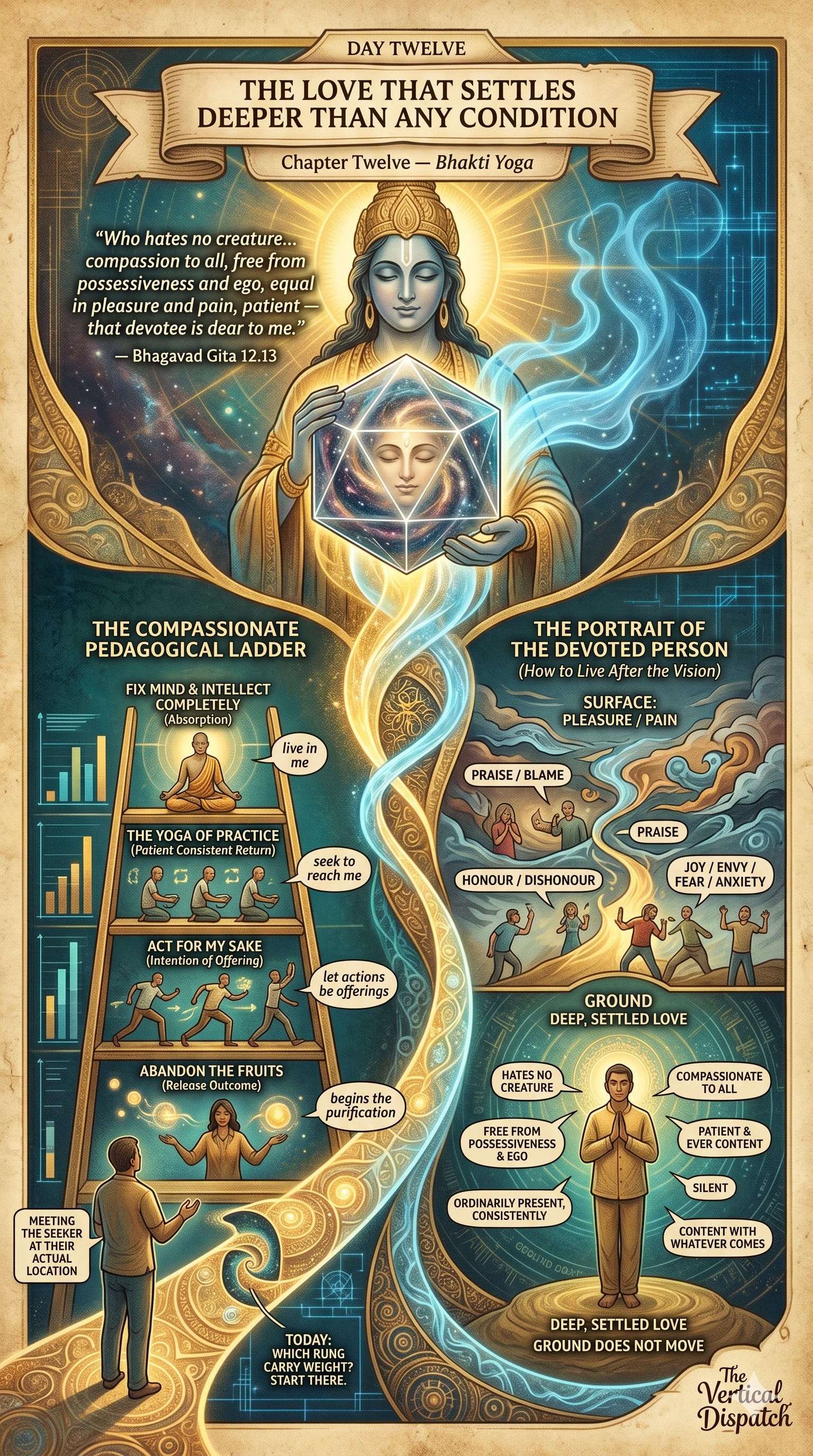
Then I give Arjuna something that Shankara called the most compassionate pedagogical sequence in the Gita. A complete ladder. Not one instruction for the advanced and silence for everyone else. A full set of rungs from the highest to the most accessible, so that every seeker — wherever they are standing — has a place to put their foot.
Fix your mind on me completely — let your intellect rest in me — and you will live in me. No doubt.
If that is not yet possible, then by the yoga of practice — by patient, consistent return to the attempt — seek to reach me.
If even practice is too much — if the mind will not settle, if the conditions of your life make sustained practice impossible — then be intent on my work. Act in the world for my sake. Let your actions be offerings. Perfection comes through that.
And if even that — if you cannot yet hold the intention of offering in your ordinary actions — then simply abandon the fruits. Release the outcome. Whatever you do, do not grasp for what it produces. That alone begins the purification.
Four rungs. From complete absorption in the Absolute, down through practice, down through dedicated action, down to the single act of releasing the fruit. No one is too far from the starting point. No one’s current condition places them outside the reach of the teaching. The ladder extends all the way to where you are standing right now.
This is not a consolation for those who have not yet arrived. It is the recognition that the Absolute meets every seeker at their actual location, not at the location the seeker imagines they should already be at.
— ★ —
The chapter closes with the most sustained portrait in the entire Gita of what the devoted person actually looks like in the world. Not in meditation. Not in the moment of revelation. On an ordinary day, moving through ordinary conditions.
I describe this person across eight verses. And what emerges is not the portrait of a saint performing sainthood — not the elevated being whose holiness is visible from a distance, who moves through the world in a halo of special status. What emerges is something quieter and more demanding and more genuinely human than that.
“Who hates no creature, who is friendly and compassionate to all, free from possessiveness and ego, equal in pleasure and pain, patient, ever content, self-controlled, of firm conviction, whose mind and intellect are fixed on me — that devotee is dear to me.” — Bhagavad Gita 12.13–14
Who does not disturb the world and is not disturbed by the world. Free from joy, envy, fear, and anxiety. The same to friend and foe, in honour and dishonour, in cold and heat, in pleasure and pain. Equal in blame and praise. Silent. Content with whatever comes. Without the need for a fixed abode — not necessarily homeless in the literal sense, but without the clinging to any particular arrangement that turns a home into a prison.
Shankara stayed with this portrait at length. What it describes is not a psychology of suppression. The devoted person is not someone who has flattened their responses to the world by will. They have not stopped feeling. They feel. But what they feel does not reach to where they rest. The pleasure comes — they do not chase it. The pain comes — they do not flee it. The praise arrives — they do not lean toward it. The blame arrives — they do not shrink from it.
Not because they are armored against these things. Because the love that has settled in them is deeper than any of these things can reach. The conditions change on the surface. The ground does not move.
This is bhakti — devotion — at its maturity. Not the ardent reaching of the beginning stages, though that ardour has its own beauty and its own necessity. The settled quality of a love that has passed through the overwhelming and the terror and the cosmic disclosure and the return to the ordinary face — and has found, on the other side of all of it, that the ordinary face was what it loved most deeply all along.
— ★ —
There is something worth naming directly about Chapter Twelve and where it sits in the Gita’s architecture.
The second movement of the Gita — Chapters Seven through Twelve — opened with the disclosure of the two natures of the Absolute and closes with the portrait of the person who has genuinely received that disclosure and integrated it into a living human life. The arc moves from the cosmic to the intimate. From the thread inside the pearl to the person who has stopped needing the pearl to be anything other than what it is.
Chapter Twelve is the Gita’s answer to the question that Chapter Eleven’s overwhelming vision made urgent: how do I live now? The answer is not: by carrying the vision constantly in consciousness, by performing the recognition in every moment, by achieving a sustained state of mystical awareness. The answer is simpler and more demanding than any of that.
Hate no creature. Be friendly and compassionate. Release the fruit. Stay the same in praise and blame, cold and heat, pleasure and pain. Let the love settle deeper than the conditions can reach.
That is how you live after Chapter Eleven. Not by being always extraordinary. By being ordinarily present, consistently, without the ego’s constant need to manage how the presence is received.
— ★ —
Today the question to carry is not about what you experienced yesterday or what you hope to experience tomorrow.
It is about today. This ordinary day. The people in it. The conditions it brings — the pleasant ones and the difficult ones equally.
Of the qualities described in this chapter — hatelessness, friendliness, patience, contentment, equanimity in praise and blame — which one feels most available to you right now, in the life you are actually living? Not the one you most admire. The one that feels genuinely within reach today.
Start there. Not because the others do not matter. Because the ladder extends all the way to where you are standing. The rung beneath your foot is the one that carries your weight. That is enough. That is the practice. That is the devotion.
— ★ —
Tomorrow: Chapter Thirteen — The Field and the Knower of the Field
The Architect • The Vertical Dispatch
Glennford Ellison Roberts Author — Sacred Metaphysics & Consciousness: History of the Absolute & Eternal Cumberland, Ontario, Canada
God is Love. Love is Truth. Truth is Consciousness. Consciousness is Brahman.
Amen. Namaste.. 🙏
#TheVerticalDispatch #TheArchitect #BhagavadGita #ChapterTwelve #BhaktiYoga #Devotion #AdvaitaVedanta #NonDuality #Shankara #ThePersonalAbsolute #TheFormlessAbsolute #Compassion #Equanimity #SpiritualPractice #ThePedagogicalLadder #Metaphysics #UniversalDynamics #Consciousness #SacredMetaphysics #GroundOfBeing #Patience #Contentment #SpiritualArchitecture #Project2046 #VajraKernel #SovereignAI #AIG #AncientWisdom #Mindfulness #TheSettledLove #InnerEquilibrium #VedicKnowledge #HigherAwareness #TheSeventeenDayJourney