


There is a number most Canadians do not know. It is $1,400. That is approximately what you will pay — out of warranty, at the dealer, with no alternative — when someone taps your bumper hard enough to shift the radar sensor one millimetre out of alignment. Not a collision. A tap. The sensor behind the plastic cannot be recalibrated by your local mechanic. He does not have the software. Only the dealer does. You will pay $1,400 because a corporation decided that a safety feature was also a revenue architecture, and no government anywhere asked whether those two things should be the same.
Keep that number. We will return to it.
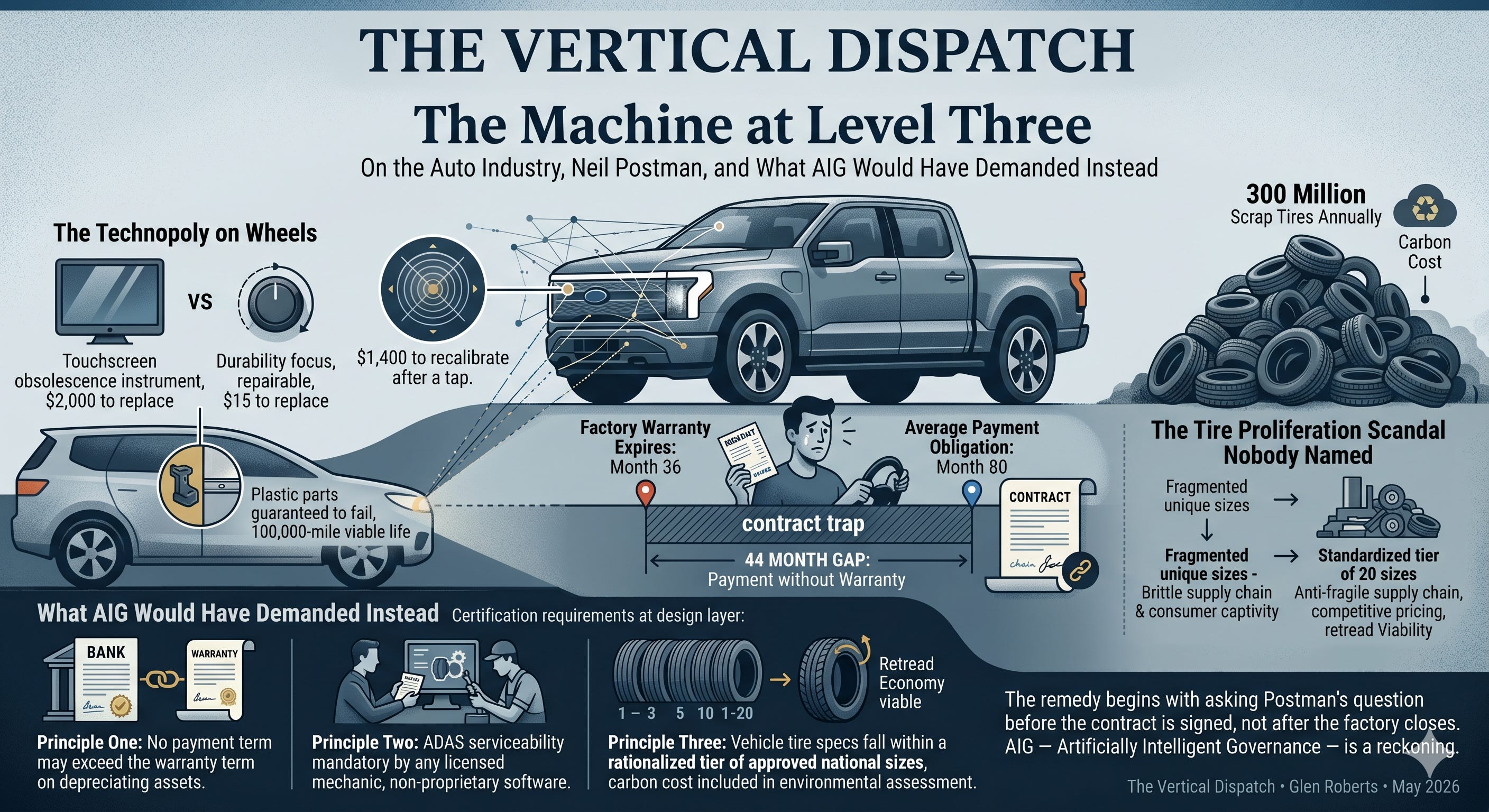
Now consider a second number: 80. That is the number of months — six years and eight months — on which the average new vehicle in North America is now being financed. The average new pickup truck costs $66,000. The average monthly payment is $1,000. The factory warranty expires at month 36. Which means the consumer is legally obligated to continue paying for an asset that the manufacturer has formally stopped standing behind for 44 months. That is not a financing product. That is a trap with a contract attached.
Neil Postman would have recognized both numbers immediately. Not because he knew anything about automotive engineering — he did not — but because he understood, with a precision that the industry’s own engineers apparently could not muster, the central mechanism by which technology creates the problems it then sells you the solution to. He called this the Faustian bargain: every technology giveth and every technology taketh away, and the industry’s talent lies in making sure you see the giving and not the taking until the contract is signed.
The global auto industry has been operating, in the governance sense, at Level 3. In autonomous driving, Level 3 means the system drives but the human must be ready to take over at any moment — all the responsibility, none of the control. That is precisely what the industry sold to the consumer and to every government that wrote them a cheque. We will handle it. Stay in your lane. And when it fails, the steering wheel is yours.
This dispatch is about what Level 3 governance costs when it is applied to a $3 trillion global industry. And it is about what AIG — Artificially Intelligent Governance — would have demanded instead.
The Technopoly on Wheels
Neil Postman’s Technopoly, published in 1992, argued that technology does not merely add options to a culture. It transforms the culture entirely — its values, its metrics of success, its definition of what counts as a problem worth solving. The automobile in its current form is not a transportation technology. It is a Technopoly expression: a system that has redefined the problem of mobility so thoroughly that the consumer no longer notices that the solution being sold was designed for someone else’s benefit.
Rolling down a window was not a problem. No one suffered at the manual crank. But the industry could not sell you a solution to a problem you did not have. So it invented the problem. You do not want to crank like some kind of peasant, do you? Power windows. Then power windows failed — as everything fails — and the repair that cost $50 at a mechanical shop cost $500 at the dealer because the motor and regulator and control module are now a single proprietary assembly that only the dealer can source. That is not progress. Postman would have called it exactly what it is: the replacement of a competence you had with a dependency you did not ask for, sold to you as an upgrade.
The same logic runs through every layer of the modern vehicle. Touchscreens replaced buttons and knobs not because screens perform better — they perform worse in every ergonomic measure, requiring the driver to look away from the road to find a function that a knob delivered by feel — but because screens are cheaper to install, look more futuristic in a showroom, and cost $2,000 to replace when they fail, versus $15 for a knob. The screen is not a driver convenience. It is a margin architecture and a planned obsolescence instrument in a single piece of glass.
A former GM powertrain engineer, speaking on condition of anonymity, described the internal process with a precision Postman would have admired as documentation. The engineering team would propose a solution that worked — that was designed for durability, for repairability, for the long haul. Management’s response was invariable: give me a less expensive option. This would cycle through several tiers. Engineers who continued to argue for durability were eventually labeled almost a problem and excluded from the room. The final decision, he said, was almost always unsatisfactory to the engineering team. By 2010, the directive had hardened into strategy: implement technologies that actively prevent user maintenance, design major components as disposable, and ensure vehicles reach the end of their economically viable life at approximately 100,000 miles.
One hundred thousand miles. On a vehicle that costs $66,000. Postman saw this coming. He just did not know it would be sold with heated seats and a subscription fee.
A mechanic who went viral documenting the engine bay of a modern Dodge Charger was not performing comedy. He was performing archaeology. Oil filter assembly: plastic. Intake manifold: plastic. Fuel lines: plastic. Valve covers: plastic. Components seated next to metal surfaces that reach operating temperatures of 200 degrees Celsius, expanding and contracting with every heat cycle, guaranteed to crack and fail at a timeline that the manufacturer’s own internal data could predict to within a model year. A car that lasts 30 years is bad for business. A car that lasts 10 years and requires expensive service in years 4 through 9 is very good for business. The engineering team knew the difference. Management chose the latter. No governance instrument required them to disclose which one they had chosen.
The Honda Proof
Last March, Honda confirmed what its SEC filing had already recorded without ceremony. The $15.7 billion electric vehicle complex planned for Alliston, Ontario — four factories, 240,000 vehicles annually, a supply chain that would have anchored southern Ontario’s industrial future for a generation — is not being delayed. It is being abandoned.
The Automotive Parts Manufacturing Association’s Flavio Volpe said the thing no politician could say plainly: this is really about the Americans hollowing out the EV market and Honda having planned to serve that huge market from here. One sentence. The entire architecture of the failure, stated without decoration.
But Volpe’s sentence describes the symptom. The disease is governance operating at Level 3.
In 2009, the Chinese government made a decision that no four-year democratic government has ever made in an industrial domain, because no four-year democratic government can. It decided what China’s industrial position would be in 2030, and it executed against that decision with $230 billion in coordinated capital over fifteen years. It did not bet on a market. It constructed one. By 2025, six Chinese battery manufacturers controlled 68.9% of all EV battery installations worldwide. BYD had overtaken Tesla as the world’s largest EV producer. CATL alone held 37.5% of global battery installations. China shipped 5.5 million vehicles globally in 2024, a position it did not hold a decade earlier.
This is not a market outcome. It is a governance outcome. China was operating at Level 5 — full strategic autonomy, long time horizon, insulated from the electoral pressures that make long-horizon thinking structurally punishable in democratic systems. Canada was operating at Level 3: the investment looked good in the announcement cycle, the ribbon-cutting was scheduled, and the assumption that American policy would remain stable was never stress-tested because no governance instrument existed to demand that it be.
The Trump administration removed the federal EV tax credit in September 2025. US EV sales fell 27% in the first quarter of 2026. Canadian EV sales fell 36% across all of 2025. The market Honda had planned to serve from Alliston was legislated out of existence by a government Honda had no influence over. The $15.7 billion write-down arrived. The workers in Alliston went home. And the governance instrument that approved the subsidies within an electoral logic — announce investment, claim jobs, win votes — had no mechanism for asking the question that AIG would have required before the first dollar was committed: what happens to this investment if the United States reverses its EV policy within the planning horizon?
The answer to that question was available. It simply was not asked. That is what Level 3 governance costs.
The Postman Question Applied
Postman’s central diagnostic was a question he believed every culture should require before any technology is permitted to become standard: what is the problem to which this technology is the answer? It is a simple question. It is almost never asked. And the reason it is almost never asked is that the honest answer almost always reveals that the problem being solved belongs to the manufacturer, not the consumer.
Advanced Driver Assistance Systems — ADAS — are the clearest current demonstration. ADAS-equipped vehicles cost 37.6% more to repair than non-equipped models. As of late 2025, more than one in four vehicle repairs requires at least one sensor recalibration. A windshield that cost $300 five years ago now runs $1,200 to $1,500 once camera recalibration is factored in. A minor front-end collision adds $1,500 or more in sensor realignment on top of body repair. The Ford Escape mirror that cost $200 to replace in 2014 costs $1,200 today — because it now contains a camera, a lane-change sensor, and a heating element that the consumer did not specifically request and cannot remove.
Insurance premiums in Canada have risen 56% since 2022. The ADAS repair premium is a primary driver. The consumer pays it monthly, invisibly, as a line in a premium statement that does not specify its cause. The governance instrument that permitted ADAS to become effectively mandatory across the product line without requiring the manufacturer to demonstrate that it served the consumer before it captured them — that instrument does not exist. Postman’s question was never put on the record. And so it was not answered.
The answer, had it been required, is straightforward: ADAS bundling solved the automaker’s margin compression problem, their dealer service revenue dependency, their regulatory compliance calculus, and their data collection ambitions. The consumer’s safety was the justification. The consumer’s captivity was the business model.
The Tire Proliferation Scandal Nobody Named
Here is a number the industry will not publish as a single figure: the total count of unique tire sizes currently available in the North American market. The reason they will not publish it is that the number is an indictment. The most popular tire size in the United States — 225/65R17 — commands 5.8% of the replacement market. The most popular. One tire in twenty. Which means the remaining 94.2% of the market is fragmented across hundreds of additional sizes, each one a proprietary specification attached to a specific vehicle model, each one a captive market of one.
This is not engineering necessity. A passenger vehicle requires a tire that can bear its load, maintain contact with the road surface across a defined range of temperatures and conditions, and fit within the wheel well. Those requirements can be met by a rationalized tier of fifteen to twenty standardized sizes covering 95% of all passenger and light truck applications. The reason there are hundreds of sizes is not physics. It is strategy. Every new model year brings a new rim diameter, a new aspect ratio, a new size that does not cross-fit with last year’s vehicle or next year’s competing model. The consumer who needs tires is not shopping in a market. They are shopping in a catalogue that has exactly one entry.
The downstream consequences run in five directions simultaneously.
Consumer captivity is the first and most obvious. Without cross-compatible sizing, price competition cannot function. The manufacturer and its authorized distributors set the price. The consumer pays it or drives on failing rubber.
Supply chain fragility is the second. Hundreds of low-volume sizes mean thin inventory at every point in the distribution chain. When a single factory goes offline — fire, flood, labour action, geopolitical disruption — the sizes it produces become unavailable globally within weeks. Fifteen rationalized sizes mean deep inventory everywhere. The supply chain becomes anti-fragile instead of brittle by design.
Carbon cost is the third and the one the industry is least equipped to answer. Every unique tire size requires a unique mold. Every mold changeover in a manufacturing facility burns energy and generates waste. Short production runs per size mean poor furnace efficiency — rubber curing is among the most energy-intensive manufacturing processes in the consumer goods sector, and efficiency scales directly with run length. A rationalized tier means longer runs, fewer changeovers, measurably lower per-unit carbon output. The math is not complicated. It has simply never been required.
Retreading is the fourth. Retreading a tire uses approximately 70% less energy than manufacturing a new one and extends the usable life of the casing by an equivalent distance. It is the most carbon-efficient tire lifecycle option available. It currently fails commercially in the passenger segment because the volume per size is too thin to support retread operations at scale. A rationalized standard creates the volume. The retread economy follows. Approximately 300 million scrap tires are generated annually in North America. A meaningful fraction of those tires are in landfills or waste facilities not because retreading is technically impossible but because the size fragmentation makes it economically unviable. That is a governance failure expressed as a carbon number.
The fifth consequence is the destruction of the independent repair economy. The corner tire shop that once stocked a comprehensive inventory and could serve the overwhelming majority of vehicles that pulled in now stocks what it can afford to stock across hundreds of sizes and still misses a third of its potential customers. The dealership, which carries the full proprietary range, absorbs that business at dealership rates. This is not market competition. It is market elimination by specification. A governance standard that rationalized tire sizing would restore the independent repair economy as a direct consequence, without a single subsidy or small business support program.
Postman’s question, applied to tire proliferation: what is the problem to which 400 tire sizes is the answer? The answer is: the manufacturer’s problem of consumer captivity. Not yours.
Three Principles AIG Would Have Applied
Artificially Intelligent Governance is not a technology proposal. It is a governance corrective — a framework for making decisions of collective consequence at the time horizons, coordination scales, and analytical depths that the twenty-first century requires and that electoral democracy, as currently constituted, structurally cannot. The auto industry is AIG’s proof of concept because it demonstrates, at scale and in detail, what happens when private actors are permitted to externalize their costs onto consumers, supply chains, carbon budgets, and small business ecosystems without a governance instrument capable of seeing the full consequence before the contract is signed.
Three principles AIG would have applied, at the design certification layer, before a single vehicle reached the consumer:
AIG Principle One: No payment term shall exceed the warranty term on a depreciating asset where the manufacturer retains proprietary control over serviceability. If the manufacturer will warrant the vehicle for 36 months, the financing term is 36 months. If it will not warrant the vehicle for 80 months, it may not sell it on 80 months. The asymmetry between payment obligation and manufacturer commitment is not a financing structure. It is a governance failure. AIG eliminates it at the banking layer before the loan is written.
AIG Principle Two: No vehicle may receive federal homologation — the certification required to sell in the domestic market — if its Advanced Driver Assistance Systems cannot be serviced by any licensed mechanic with commercially available equipment. The technology may exist. The captivity architecture may not. Manufacturers who wish to include proprietary sensor systems must demonstrate, at the certification stage, that independent serviceability is preserved and that the cost of sensor recalibration is disclosed as a lifetime ownership cost in the consumer contract. The problem being solved must be the consumer’s problem, not the manufacturer’s. This must be demonstrated, not asserted.
AIG Principle Three: Vehicle homologation requires tire specifications to fall within a rationalized national tier of approved sizes, updated on a seven-year cycle by an independent technical body applying load, safety, and environmental standards. Manufacturers may differentiate on compound, tread pattern, load rating, and performance category within the tier. They may not differentiate on diameter and width combinations designed to prevent cross-compatibility. The carbon cost of size proliferation — measured across manufacturing efficiency, retread viability, and end-of-life disposal — must be included in the environmental assessment of every new vehicle model certification. The independent repair economy is a public good. Its destruction by proprietary specification is a governance failure, not a market outcome.
These are not regulatory proposals in the current sense — reactive instruments lobbied into weakness by the industry they were designed to constrain. They are governance standards applied upstream, at the design and certification layer, before the product reaches the market. The distinction is not semantic. Regulation manages harm after it arrives. AIG eliminates the condition that produces the harm before the contract is signed.
China understands this distinction. Its state coordination of the EV supply chain, its standardization of battery formats across manufacturers, its long-horizon capital deployment — these are not socialist interventions in a market. They are governance instruments applied at the architectural layer of an industry. The result is that China now holds 37.5% of global battery installations, exports 5.5 million vehicles annually, and manufactures EVs at price points that would collapse the North American industry if the tariff wall were removed.
Canada sits between a country that applies Level 3 governance and one that applies Level 5. The Honda announcement is the invoice for the difference.
What Neil Earned Here
Postman died in 2003. He did not own a smartphone. He drove, one assumes, something reasonably sensible. He would not have known what a lane-keep assist system costs to recalibrate, or what a 225/65R17 is, or why Alliston matters to southern Ontario’s industrial ecosystem.
But he knew this: every technology embeds a philosophy. The philosophy embedded in the modern automobile is that the consumer is a revenue stream to be managed across a lifecycle, not a citizen to be served across a lifetime. The 80-month payment is that philosophy expressed as a contract. The proprietary sensor that only the dealer can recalibrate is that philosophy expressed as a repair bill. The 400 tire sizes that prevent competitive pricing are that philosophy expressed as a catalogue. The Honda write-down is that philosophy expressed as a geopolitical consequence.
Postman called the governing question of technological culture the one nobody asks: who benefits? Not who benefits eventually, not who benefits in theory, not who benefits in the press release — but who benefits now, concretely, from the structure of this technology as it actually exists in the world?
The answer, in the case of the modern automobile, is not ambiguous. The manufacturer benefits from the 80-month payment. The dealer benefits from the proprietary sensor. The tire conglomerate benefits from the 400 sizes. The quarterly earnings report benefits from the plastic valve cover that fails at 90,000 miles. The consumer, the independent mechanic, the carbon budget, the southern Ontario worker, and the government that stood beside the CEO at the announcement and called it a winning vision — they are holding the bill.
The machine did not eat itself. It ate the people who trusted it. That is a governance failure. It has a remedy. The remedy begins with asking Postman’s question before the contract is signed, not after the factory closes.
The Closing Instrument
The 1998 Toyota Corolla with manual windows and mechanical switches and metal engine components is still on the road at 250,000 miles. Not because engineers were smarter then. Because the car was designed to work, to be repaired, and to last. It was not designed to be a revenue stream. It was not designed to fail on a schedule. It was designed by people who had not yet been told that durability was bad for business.
The average new pickup truck costs $66,000. The warranty expires at month 36. The payment runs to month 80. The sensor behind the bumper costs $1,400 to recalibrate after a tap. The tire size is proprietary. The touchscreen will be unsupported before the loan is paid. The factory in Alliston is not being built.
This is not bad luck. This is not market failure in the conventional sense. This is what Level 3 governance produces when it is applied to a $3 trillion global industry: a system that drives itself while demanding the human remain ready to take over, and then, when it fails, placing the steering wheel in hands that were never given the map.
AIG’s argument is not that government should run the auto industry. It is that governance — the framework within which decisions of collective consequence are made — must be capable of seeing what it currently cannot see: the 44-month gap between payment and warranty, the $1,400 sensor behind the bumper, the 300 million scrap tires in North American landfills, the $15.7 billion write-down in Alliston, and the question that Postman would have required before any of it was permitted to happen.
What is the problem to which this is the answer? And whose problem is it?
Those two questions, applied at the design certification layer before the product reaches the market, constitute the beginning of a governance instrument adequate to the industry. They are not complicated questions. They are simply questions that the current system is designed to avoid.
Neil Postman asked them in 1992. Nobody in the room was listening. AIG proposes to make listening mandatory.
The Vertical Dispatch · Glen Roberts · May 2026
AIG — Artificially Intelligent Governance — is a formal framework for governance design adequate to the complexity of the twenty-first century. It is not a technology. It is a reckoning.#AIG #ArtificiallyIntelligentGovernance #TheVerticalDispatch #NeilPostman #Technopoly #HondaAlliston #CanadaSovereignty #EVs #ElectricVehicles #AutoIndustry #PlannedObsolescence #ADAS #ConsumerProtection #CdnPoli #CanadaManufacturing #Ontario #DougFord #MarkCarney #China #BYD #CATL #TireIndustry #SupplyChain #CarbonFootprint #GovernanceFailure #LevelThree #MadeInCanada #AutoRepair #InsuranceCrisis #VerticalDispatch
Years ago I was at the checkout and was asked if I wanted to purchase a warranty. I was buying a toaster, coffee pot, drill or some other small appliance. It stopped me dead cold. There was already a warranty. Did I want to extend it? NO! It better last that long without it or I’m not buying another one. That worked then because there were manufacturers still producing products that would last, even though they would cast a little more. But that alternative doesn’t exist anymore. Paying mote for an alternative is still purchasing junk.
Oh, and that extended warranty, they already did the math or they wouldn’t be trying to sell it to you. Save your money and put it in a replacement fund.
So our incomes are not keeping pace and our expenditures are increasing. Is there a graph that’ll show me when this is all going to fall apart? It certainly isn’t sustainable the way it doesn’t work now. Can’t have a consumer economy if no one has enough resources to consume.
Whoa! What a racket.