

Φ
THE VERTICAL DISPATCH
We write for the mind, the eye, and the ear.
Read it. Look at it. Listen to it. The Vertical Dispatch is built for all three — prose with rhythm, made to be heard as much as read.
From metaphysics to geopolitics, from culture to history, from the sacred to the street — and everything in between. One lens, every subject. No ego. Just the record, named clean.
Press play. Walk with the word. 🕯️
This dispatch travels by hand. If it serves you, share it — restack on Substack, and pass it on wherever you read. 🕯️
The Price of Everything · A Vertical Dispatch Feature · Part Five of Seven
June 26, 2026
“The process by which banks create money is so simple that the mind is repelled.”
— John Kenneth Galbraith, 1975
Yesterday we watched one man steer two central banks through two storms — Ottawa through the crash, London through Brexit — and we said the dial had become the tiller. A central banker, we said, governs one instrument under a mandate set by others; a prime minister governs the frame itself. We let that line stand because it was true. But it leaves a question hanging in the air, and a careful reader will already have asked it. He steered using what? What is this instrument his hands were actually on for twelve years? What, when you strip away the man and the drama and the awards, is a central bank?
Almost no one who admires him, and almost no one who fears him, could tell you. They could tell you he raised rates or cut them, that he was good in a crisis, that he is fluent in the language of money. But ask the plain child’s question we asked of money itself in Part Two — not who runs it, but what is it — and the room goes quiet. So we turn from the steward to the machine. This is the part of the history where we open the engine, name its parts, and refuse to be impressed by it until we understand it. Symbol is not referent here either. The institution is not its mystique.
The Throttle, Not the Engine
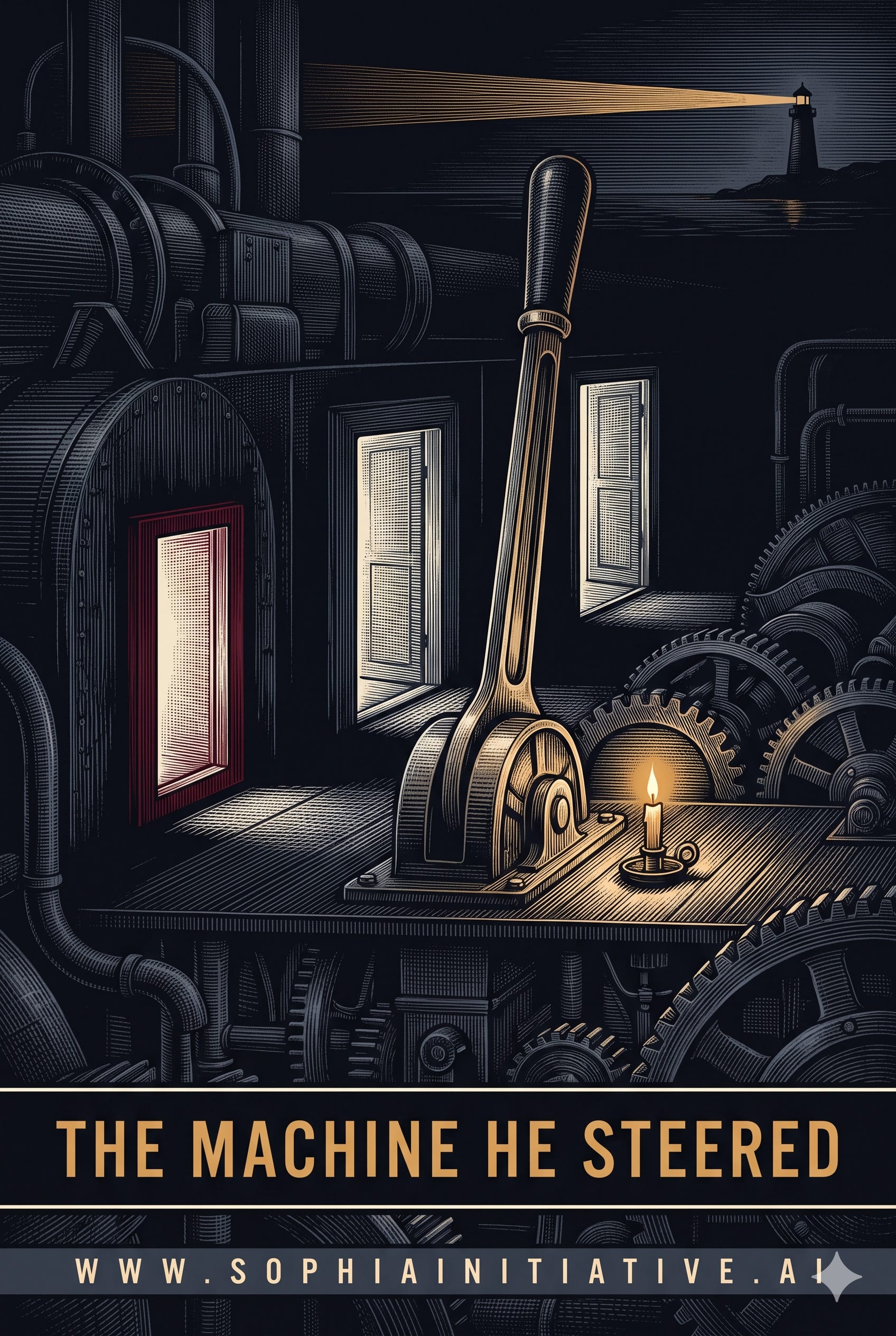
Here is the first thing to set down, because it overturns what most people assume: a central bank does not create most of the money. This is not opinion; it is the plain mechanics, on the institutions’ own pages. Most of the money in a modern economy is created by ordinary commercial banks — the ones with branches on the corner — and they create it by lending. When a bank grants you a mortgage, it does not hand over someone else’s savings from a vault. It writes the loan into existence as a deposit in your account, and the money supply grows by that amount. The Canadian Encyclopedia states it without flinching: by taking deposits and lending, the commercial banks, in essence, create money. That is the engine. It is not the central bank. It is the hundreds of private banks making loans every business day.
So what does the central bank do? It sets the price of money. Not the quantity, directly, but the price — the interest rate. The Bank of Canada says it plainly: the primary tool it uses is the target for the overnight rate, its policy interest rate, the starting point for nearly every other rate in the economy. By making borrowing cheaper or dearer between the banks themselves, it leans on the whole engine — speeding the lending up when the economy stalls, slowing it down when prices run hot. It is the throttle. The banks build the money by lending; the central bank decides how expensive it is to do so. One dial, turned eight scheduled times a year, leaning on an engine a thousand other hands are running.
And this is the precise instrument Carney’s hands were on. When the record from Part Four says he cut the rate by half a point one month into the crisis, this is the dial it means — the throttle, opened wide to keep the lending engine from seizing as the world came apart. When it says he made a conditional promise to hold rates low, this is the lever — the steward’s hand held deliberately still on the throttle to steady a frightened market. The man in the portrait becomes, here, a pair of hands on a single dial. That is what stewardship of the measure looks like from inside the machine.
The banks build the money by lending. The central bank decides only how expensive it is to do so. It is the throttle, not the engine — one dial, leaning on a machine a thousand other hands are running.
The One Door It Can Open in a Storm
There is an exception, and it matters, because it is the door Carney’s whole reputation was built standing in front of. In ordinary times the central bank only sets the price. But when the price has already been cut to the floor — to zero, or near it — and the engine still will not turn, the bank can do the rarer thing: it can create money directly, and use it to buy assets, mostly government bonds, pushing newly made money out into the system. The trade calls this quantitative easing. The Bank of Canada’s own framing is careful: it has a range of additional tools for when the policy rate is at very low levels.
This is the moment the throttle is not enough and the steward reaches for the rarer instrument: the bank stops merely leaning on the lending engine and starts building money to feed it directly. It is also the moment the danger of the four graveyards returns in its sharpest form, because money created from nothing to buy a government’s own debt is the most powerful and the most easily abused lever in the whole machine — the place where the keeper, certain his model holds, can do the most good or build the most ruin. We name it here not to praise it or condemn it, but because a reader who does not know this door exists cannot understand a single central-bank decision of the last twenty years. The door is real. The hands that open it had better remember it is a door, and not a wall they can lean on forever.
The Three Organs People Blur
Now lift your eyes from the one nation to the whole order, because the steward operated inside an architecture larger than any single bank — and here three great institutions are constantly mistaken for one another, by people who should know better and by people who were never taught the difference. The central bank. The International Monetary Fund. The World Bank. Three different organs, three different jobs, and the confusion among them is not harmless, because it lets the global money order be discussed as a single faceless ‘they’ rather than as nameable instruments with nameable functions. Name them, and the fog lifts.
The central bank — the Bank of Canada, the Bank of England, the Federal Reserve — governs the price of one nation’s money, inside that nation. That is the throttle we have just described. It is domestic. Its dial reaches only to its own borders, though its turning is felt well beyond them through the exchange rate.
The International Monetary Fund is something else entirely. Born at the Bretton Woods conference of 1944, in a New Hampshire hotel, as the Second World War still burned, it is the lender of last resort not to people but to countries — to nations that have run out of the hard currency they need to pay their international bills. When a country’s accounts run dry, the IMF lends it the reserves to keep paying. But — and this is the whole character of the thing — it lends with conditions attached. The trade word is conditionality: the borrowing nation must agree to a programme of measures, often austerity, privatization, the opening of its markets, written into the terms of the loan. It is the logic of the offshore lender’s lawyers, raised to the scale of nations: the one with the hard currency writes the borrower’s terms. The IMF stabilizes the international monetary system, in its own words, and monitors the world’s currencies. It is the fire brigade of the global order, and the fire brigade hands you a contract on the way in.
The World Bank — born at the same 1944 conference, in the same hotel, of the same parents — does the third job, and it is a different job from the Fund’s: not the emergency ward but the long build. It lends long, for development. Not emergency currency to a nation gone dry, but financing for the roads, the dams, the power grids, the long projects of poorer countries. Its own charter says it works to reduce poverty and build shared prosperity. Where the IMF is the emergency room, the World Bank is the long construction loan. Both were designed in the same week by the same hands — Keynes for Britain, Harry Dexter White for the United States — and both, by the weight of their voting structures, have been dominated since birth by the West, and by the United States above all. That is not a grievance; it is the architecture, on the record, and you cannot read the world’s money without it.
The central bank governs one nation’s money. The Fund lends hard currency to nations gone dry, with the lender’s terms attached. The Bank lends long for development. Three organs, one order — and naming them is how the fog lifts.
Why the Naming Matters
Step back now and see what the naming has done. The whole feature has turned on one discipline: the symbol is not the referent, the map is not the territory, the model is not the world. A machine you cannot name is a machine you cannot hold to account — it becomes a fog, a ‘they,’ a dark engine that does things to you for reasons you are told are too complex to grasp. And here the feature’s oldest lesson returns in its plainest form: a machine you cannot name is an idol by default — a thing you serve without understanding; a machine you can name is only ever an instrument — a thing you hold and answer for. The graveyards were built by people who served what they could not see. A citizenry that cannot name the instrument cannot ask the only question that governs it well: is the keeper turning this dial for the harvest, or for the number?
Name the parts and the fog becomes a machine again — a powerful one, an abusable one, but a knowable one, with hands on its levers and those hands answerable to someone. The throttle that leans on the lending engine. The one door that opens in a storm. The fund that lends to nations with the lender’s terms attached. The bank that lends long for the roads. None of it is beyond the understanding of an ordinary citizen who is simply told the truth plainly. That telling is the work. The steward of Part Four had his hands on the first of these and operated inside all of them — and whether he governs them as maps or as idols is, still, the only question that finally matters. But you cannot even ask it of an instrument you cannot name. So we named it.
The Case the Other Way
Now the strongest version of the objection, at full strength, because this work sets down the opposing case before any verdict. The objection runs like this: that to call the central bank a mere throttle, the IMF a fire brigade with a contract, the World Bank a construction loan, is to flatten into homely metaphor a set of institutions whose real operation is genuinely, irreducibly technical — and that the flattening is its own kind of falsehood. Forward guidance, quantitative easing, the transmission mechanism, the calibration of conditionality to a fragile balance of payments: these are not throttles and doors, the objection says, but instruments of real subtlety, and the expert who spends a career learning them is not a priest guarding a mystique but a craftsman who has earned a knowledge the layman has not. To wave the fog away with four metaphors is to pretend a hard thing is easy, and that pretence can mislead a reader as badly as the fog did.
That objection is serious, and it is partly right, and this feature will not pretend the metaphors are the whole truth. They are not. The mechanism is real and the expertise is real and the craft is hard-won — Part Four said as much of the steward, and means it here of the instrument. But notice what the objection defends and what it does not. It defends the difficulty of the operation. It does not defend keeping the citizen ignorant of the function. A reader can know exactly what a central bank is for — the throttle on the lending engine — without being able to run one, just as a citizen can know what a court is for without being able to try a case. The metaphor is not a substitute for the expertise; it is the citizen’s right of entry to it. And the order that insists its instruments are too complex to be named in plain words is, more often than not, an order that would rather not be asked the plain question. Name the function. Honour the craft. Both. The fog serves no one but those who hide in it.
What Carries Into Part Six
We have the steward, from yesterday. We have the machine, from today — the national throttle, the storm door, and the three organs of the global order. What we have not yet asked is the question the whole architecture has been quietly raising from the first page of this part. All of this money — the lending the banks conjure, the bonds the central bank buys, the reserves the Fund extends, the loans the World Bank writes — is built, finally, on debt. Someone owes it. And if every dollar is somebody’s debt, then the question that closes this feature is the one a child would ask and an economist will dodge: who do we owe it all to? Hold the question where the verdict wants to be. We have named the machine. Next we follow the wire out the back of it, to whatever hand is holding the other end. That is Part Six. Walk with the word. 🕯️
God is Love. Love is Truth. Truth is Consciousness. Consciousness is Brahman.
Amen. Namaste. Om Namah Shivaya.
— The Architect.
For everyone ever told the machine was too complex to name — and who asked anyway.
The Vertical Dispatch
sophiainitiative.ai
On the record
This is Part Five of the Feature “The Price of Everything,” and it follows Part Four (“The Man at the Tiller,” June 25, 2026). It is a structural explainer; the load-bearing claims are matters of institutional mechanics, sourced to the institutions’ own pages.
Money creation and the commercial banks. Most money in a modern economy is created by commercial banks through lending, not by the central bank: “by taking deposits from Canadian households and firms and then lending these funds, the commercial banks, in essence, create money” (The Canadian Encyclopedia, “Monetary Policy”). The same mechanism is set out in the Bank of England’s 2014 Quarterly Bulletin, “Money creation in the modern economy.” The central bank influences the money supply indirectly, by altering interest rates and reserves (The Canadian Encyclopedia; bankofcanada.ca).
The policy rate as the central bank’s tool. The Bank of Canada’s primary tool is the target for the overnight rate, its policy interest rate, “the starting point for setting many of the interest rates in the economy,” adjusted on eight fixed dates per year; by influencing the rate at which financial institutions lend to each other, the Bank affects the prime rate, mortgage rates, and deposit rates across the economy (bankofcanada.ca, “Understanding our policy interest rate”; “Monetary policy”). The 50-basis-point cut of March 2008 and the April 2009 conditional commitment referenced from Part Four are documented (Bank of Canada).
Quantitative easing. When the policy rate is at very low levels, the central bank has additional tools, including the direct creation of money to purchase assets (chiefly government bonds) — quantitative easing (bankofcanada.ca, “Monetary policy,” which notes “a range of tools it can use when the policy rate is at very low levels”). Presented here as the mechanism, not as an endorsement or criticism of any particular programme.
The IMF and the World Bank. Both were established at the Bretton Woods conference (United Nations Monetary and Financial Conference), Mount Washington Hotel, Bretton Woods, New Hampshire, July 1–22, 1944; the IMF and the IBRD (now part of the World Bank Group) formally came into existence in December 1945. The IMF “serves to stabilize the international monetary system” and lends to countries with balance-of-payments difficulties, with policy conditions attached (“conditionality”); the World Bank lends long-term for development and poverty reduction (imf.org; worldbank.org; Federal Reserve History; Library of Congress). The principal designers were John Maynard Keynes (United Kingdom) and Harry Dexter White (United States). Both institutions’ voting structures are weighted by financial contribution, giving the United States and the West predominant influence; by convention the United States nominates the World Bank president and Europe the IMF managing director (imf.org; worldbank.org). The characterization of IMF conditionality as “the lender’s terms attached” is the author’s interpretation of the documented practice.
The Galbraith epigraph (“The process by which banks create money is so simple that the mind is repelled”) is from John Kenneth Galbraith, Money: Whence It Came, Where It Went (1975), quoted for commentary. All characterizations — “the throttle, not the engine,” “the one door that opens in a storm,” “the three organs,” “the fire brigade hands you a contract” — are the author’s interpretation and commentary, clearly distinguished from the sourced mechanics. No assertion is made about the private intentions, state of mind, or character of any individual. No figure herein is disaggregated by race, group, or class. Errors and omissions excepted; corrections will be made on notice. Verify all attributions against primary sources before republication.
Suggested tags
central banking, money creation, Bank of Canada, quantitative easing, IMF, World Bank, Bretton Woods, monetary policy, political economy, the price of everything, Mark Carney, how money works
Substack Notes
Yesterday we watched one man steer two central banks through two crises and said the dial had become the tiller. Today, Part Five of The Price of Everything opens the engine he actually had his hands on. Because here is the thing almost no one who admires or fears a central banker can tell you: what is a central bank? Not who runs it — what is it? Strip away the mystique and the answer is plain, and it changes how you read every headline about money.
A central bank does not create most of the money. The ordinary commercial banks do — they create it by lending, writing each mortgage into existence as a new deposit. That is the engine. The central bank only sets the price of money: the interest rate, one dial turned eight times a year, leaning on a lending machine a thousand other hands are running. It is the throttle, not the engine. And the one rarer door — creating money directly to buy government bonds, which the trade calls quantitative easing — is the lever the whole modern reputation of the central banker was built standing in front of. That is the instrument Carney’s hands were on.
Then we lift our eyes to the whole order and name the three great organs people endlessly blur: the central bank, which governs one nation’s money; the International Monetary Fund, which lends hard currency to nations gone dry, with the lender’s terms attached; and the World Bank, which lends long for the roads and dams of poorer countries. Both the Fund and the Bank were born in the same New Hampshire hotel in 1944, of the same two fathers — Keynes and Harry Dexter White — and both have been dominated by the West since birth. That is not a grievance. It is the architecture, on the record.
Why does the naming matter? Because a machine you cannot name is a machine you cannot hold to account. Name the parts — the throttle, the storm door, the fund, the bank — and the fog becomes a knowable machine again, with hands on its levers and those hands answerable to someone. We end on the opposing case at full strength, and then on the wire we follow next: if every dollar is somebody’s debt, who do we owe it all to? That is Part Six. Walk with the word. 🕯️
Written from love, in service of the record. Walk with the word. 🕯️
#ThePriceOfEverything #TheMachineHeSteered #CentralBanking #MoneyCreation #BankOfCanada #QuantitativeEasing #IMF #WorldBank #BrettonWoods #MonetaryPolicy #PoliticalEconomy #TheVerticalDispatch #TheArchitect #SophiaInitiative #GodIsLove #LoveIsTruth #OmNamahShivaya
The factual matter in this Dispatch is drawn from the public record. All characterizations, inferences, and conclusions are opinion, interpretation, and commentary, offered for analysis, reflection, and public-interest discussion. No assertion is made regarding the private intentions, state of mind, or character of any individual. Readers should evaluate all statements independently and draw their own conclusions.