


Φ
THE VERTICAL DISPATCH
We write for the mind, the eye, and the ear.
Read it. Look at it. Listen to it. The Vertical Dispatch is built for all three — prose with rhythm, made to be heard as much as read.
From metaphysics to geopolitics, from culture to history, from the sacred to the street — and everything in between. One lens, every subject. No ego. Just the record, named clean.
Press play. Walk with the word. 🕯️
This dispatch travels by hand. If it serves you, share it — restack on Substack, and pass it on wherever you read. 🕯️
The Departure Lounge · A Letter to a New Arrival
Seventy percent of the gap cannot be explained by education, hours, or occupation. Seventy percent is the part the spreadsheet cannot account for.
— on the gender wage gap, Statistics Canada and the Ontario Pay Equity Office, 2025–2026
Welcome to the Lounge
So you have started — the first real job, the desk, the login, the small terror of the first week when everyone seems to know something you do not. Sit a moment. Let an older voice tell you a true story from before your time, because it explains something about the ground you are standing on that no orientation packet will. It is a story about a machine, and about who that machine exposed when it arrived, and about a woman who was almost certainly the smartest person in the office and was paid the least. I was there. I am, I should say honestly, one of the people the machine exposed. So take this not as a lecture from someone above it, but as testimony from someone who was in the room.
The Office Before the Machine
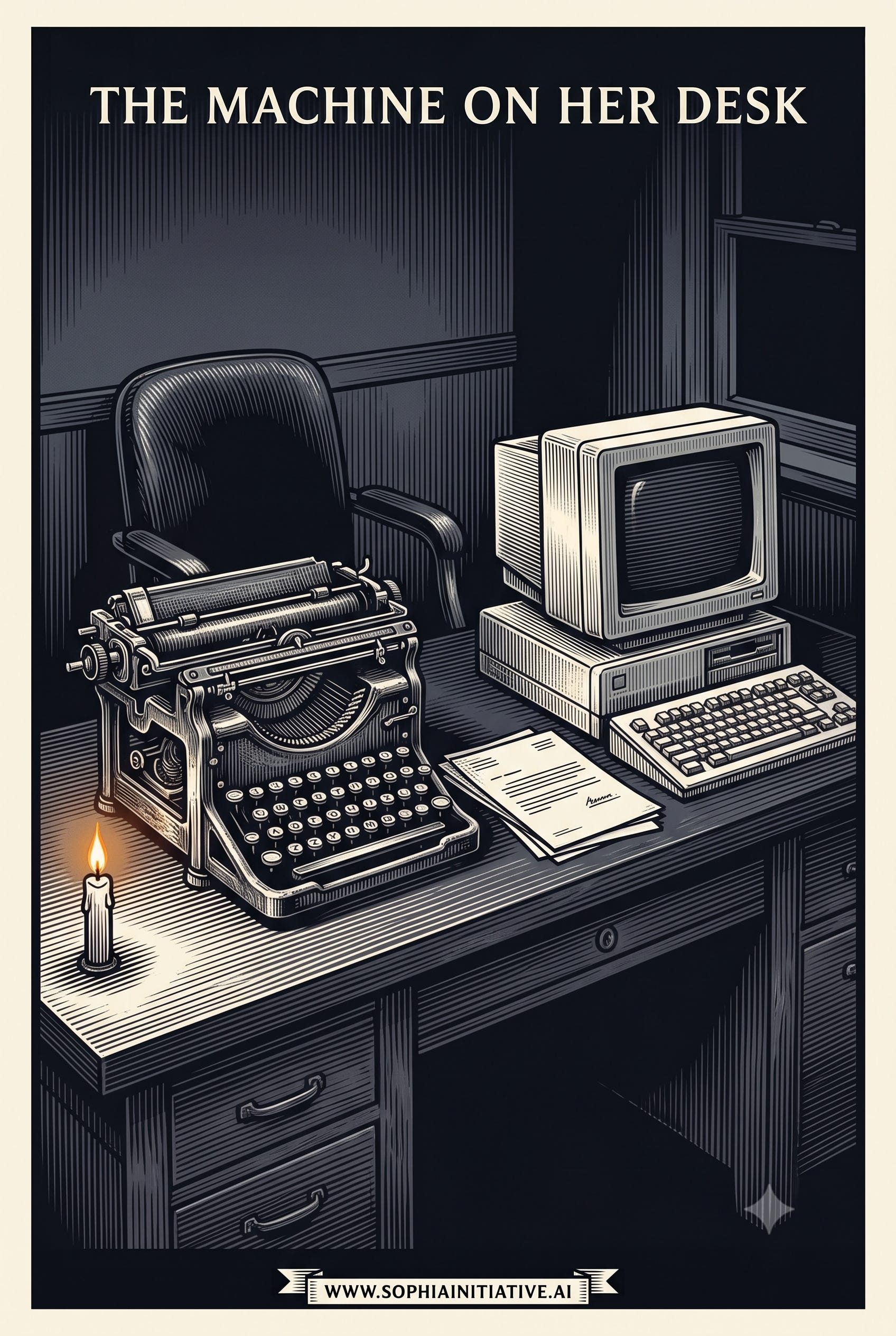
Picture the office of my early working life. The men sat in the offices with the doors and the titles. The women — the secretaries, as they were called then — sat at the desks outside the doors, and on those desks were typewriters, not computers. And here is the thing your generation may not know in its bones: in that arrangement, the man did not write. He dictated. He paced, and talked, and waved his hand, and the woman at the desk took it down — and then she did something close to alchemy that nobody named or paid for. She fixed his grammar. She ordered his wandering thoughts into paragraphs that made sense. She knew which form went where, which deadline was real, who actually had to sign what, and how the thing genuinely got done once it left his mouth. The memo that went out under his name, crisp and competent — a good deal of that competence was hers. His authority was, in part, her literacy wearing his title.
And she was paid, for holding the actual structure of the place together, something like dimes on the dollar of what he made. Not because anyone sat down and decided her mind was worth less — though some did think that — but because the structure was built so that her competence was invisible by design. It went out under his name. It propped up his chair. The arrangement had a quiet engine, and the engine was concealment: each man could offload the part he could not do onto the woman at the desk, and his title hid the gap. She knew. She always knew. But knowing was not the same as being credited, and it was nowhere near the same as being paid.
The memo that went out under his name, crisp and competent — a good deal of that competence was hers. His authority was, in part, her literacy wearing his title.
The Day the Machine Arrived
Then the computer came. A beige box on every desk — not just hers, but his. And with it came a small revolution that nobody announced and nobody planned, because the men, now, had to write their own memos. The dictation was over. The alchemist at the desk outside the door was no longer between a man and the page. It was just the man, the keyboard, and the blinking cursor — and whatever he sent now went out in his own words, his own grammar, his own capacity to order a thought, naked on the screen, with no one to fix it on the way out the door.
I will be honest with you, because the Lounge is a place for honesty: it was not always a flattering sight. A certain kind of man — and I knew him, and on my worst days I was him — discovered that without the woman at the desk, his memos were a mess. The thoughts did not order themselves. The grammar wandered. The thing that had looked like executive competence for twenty years turned out, under the bright light of the screen, to have been substantially the competence of the person he had been offloading onto. The machine did not humiliate anyone on purpose. It simply removed the concealment, and what it revealed, on desk after desk, was that the polish had not all been his. Some of us, faced with that, had the grace to learn from it. Some of us, I am sorry to say, just got louder.
Who the Spreadsheet Could Not Explain
Now here is why I am telling a young woman this particular story, and here is where the old tale touches your paycheque today. That arrangement — the concealment, the offloading, the competence that went out under someone else’s name — did not vanish when the typewriters did. It left a residue, and the residue is measurable. In Canada in 2025, women earned, on average, about 88 cents for every dollar earned by men by the hour — and when you count the whole year, with the part-time work and the caregiving the structure still mostly assigns to women, closer to 72 cents on the dollar. It is worse for racialized women, for Indigenous women, for newcomers. The gap has narrowed — it was 82 cents in 1997 — so the arc bends. But it has not closed.
And here is the figure that is really the ghost of my whole story: the statisticians find that only about thirty percent of that gap can be explained by the measurable things — education, hours worked, occupation, experience. About seventy percent of it is, in their careful word, unexplained. Sit with that. Seventy percent of the gap is the part the spreadsheet cannot account for — not the degrees, not the hours, not the field. It is the residue of the old structure, the one I watched the machine expose: the long habit of crediting the chair and discounting the competence, of letting the work go out under one name while another name held the knowledge. The unexplained seventy percent is the concealment, still running, after the typewriters are gone.
What I Want You to Carry
So this is the advice, sister, from an old voice in the Lounge, and it is meant as a hand, not a sermon. First: know that the competence was never the thing in doubt. The woman at the desk outside the door was, very often, the one who actually understood how the place worked — and the machine, when it came, proved it. If a structure ever again makes your competence invisible, makes it go out under someone else’s name, understand that this is an old trick with a long history, and it is the structure that is wrong, not you. Second: the arc does bend. Eighty-two cents to eighty-eight is real movement, won by women who refused to let the concealment stand, who asked at the water cooler what the men were paid and said the answer out loud. Pay transparency, the simple act of saying the numbers, is closing it faster now. The ideal has not surfaced. But it is closer than it was, and it is closer because women named what the spreadsheet could not.
And third — the part that is for your whole generation, the men in the room included. The machine that exposed the offloading in my day has a descendant on your desk now, and it is far more powerful. It will offer, very sweetly, to write your memos for you, to think your thoughts, to do your process and let it go out under your name. And it is the same fork I stood at, only larger: you can use it to be exposed to your own real competence and sharpened by it, or you can use it to conceal, to offload, to become the person whose polish is not their own. I watched what happened, eventually, to the people who chose concealment. The machine always, in the end, reveals. So know what you actually know. Do your own real work, in your own real voice, and let the tools sharpen it rather than hide it. That is how you make sure that when the next machine arrives — and it always arrives — the competence it reveals is unmistakably, and at last fairly paid, your own. Walk with the word. 🕯️
God is Love. Love is Truth. Truth is Consciousness. Consciousness is Brahman.
Amen. Namaste. Om Namah Shivaya.
— The Architect.
For the women at the desks outside the doors, who always knew — and for the daughters arriving now.
The Vertical Dispatch
sophiainitiative.ai
On the record
This is a personal and reflective essay in the Departure Lounge register, not a reported news piece; the office recollections are the author’s own. The load-bearing figures are verified to primary sources. Gender wage gap (Statistics Canada, March 2026 release, for 2025): women aged 15+ earned on average 88 cents for every dollar earned by men by average hourly wage (a 12% gap), up from 82 cents in 1997; by average ANNUAL earnings the gap is wider, about 72 cents on the dollar, reflecting part-time work and caregiving interruptions. The gap is larger for racialized women (about 78 cents), Indigenous women (about 79 cents), and recent newcomer women (about 69 cents). The finding that roughly 70% of the gap is “unexplained” by measurable factors (education, hours, occupation, tenure) — with only about 30% explained — is from Statistics Canada intersectional analysis and the Ontario Pay Equity Office (2023–2025). “Business Process Reengineering” (Hammer and Champy, 1993) is the named management movement of the era referenced. Verify all figures against primary sources before republication.
The opposing perspectives, in brief: economists debate how much of the “unexplained” gap reflects discrimination versus unmeasured choices and factors; the figure is a residual, not a direct measure of bias, and is presented here as such. The historical office account is one man’s testimony, offered as memory and reflection, not as a claim about every workplace. No characterization is made of any individual. The argument is directed at a structure and an incentive, not at persons.
Suggested tags
gender wage gap, pay equity, women in the workforce, office history, technology and work, the offloading, pay transparency, Departure Lounge, Vertical Dispatch
Substack Notes
A letter to a young woman starting her first real job — a true story from before her time about the day the computer arrived on every desk, and who it exposed. Before the machine, the man dictated and the secretary wrote: she fixed his grammar, ordered his thoughts, knew how things actually got done — and his crisp competent memo was, in part, her literacy wearing his title. She was paid dimes on the dollar for holding the place together, because the structure was built so her competence was invisible by design.
Then the computer came, and the men had to write their own memos — and the concealment fell. The polish, it turned out, had not all been theirs. The machine didn’t humiliate anyone on purpose; it simply removed the offloading, and revealed who had been holding the knowledge. (The author counts himself, honestly, among those exposed.)
And the residue is measurable today: in 2025, women earned about 88 cents on the dollar by the hour, closer to 72 by the year — worse for racialized, Indigenous, and newcomer women. The arc bends (it was 82 cents in 1997) but hasn’t closed. The figure that is the ghost of the whole story: about 70% of the gap is “unexplained” by education, hours, or occupation. Seventy percent is the part the spreadsheet can’t account for — the residue of crediting the chair and discounting the competence.
The advice to the new arrival: the competence was never in doubt; if a structure makes yours invisible, the structure is wrong, not you. The arc bends because women named what the spreadsheet couldn’t — said the numbers out loud at the water cooler. And a warning for the whole generation: the machine on your desk now will offer to write your memos, think your thoughts, go out under your name. Same fork, larger: be exposed to your own competence, or conceal. The machine always, in the end, reveals. Written from love, in service of the record. Walk with the word. 🕯️
#TheVerticalDispatch #TheArchitect #SophiaInitiative #GenderPayGap #PayEquity #WomenAtWork #TheOffloading #DepartureLounge #GodIsLove #LoveIsTruth #OmNamahShivaya
This Dispatch is a personal essay and work of reflection. The historical recollections are the author’s own; the statistical figures are drawn from the public record and current as of publication. All characterizations, inferences, and conclusions are opinion, interpretation, and commentary, offered for reflection and public-interest discussion. No assertion is made regarding the private intentions, state of mind, or character of any individual. Readers should evaluate all statements independently and draw their own conclusions.
Memories!! I lied about my typing skills, so that I would not be condemned to the Typing Pool, hidden away many floors below. Still, I was assigned to help out a very sweet but disorganized man, and ended up transcribing his notes from a dictaphone.
Experiences like these eventually drove me back to school, to finish a BA, which would give me a chance.
I remember the first concerns about personal computers; the men will never learn to type. Too demeaning!
There are several points here. Competence must be named and claimed. Not all competences are equally valued or paid, especially the “soft” female skills. Or the ones not directly associated with revenue. And as you say, you can’t hide behind a machine forever.
The desk l worked at had an ancient typewriter and letters were written using carbon paper for the copy. Goff forbid if you made an error - you would literally have to retype the entire letter over again! These letters were first started with dictation taken down in code - shorthand; then the use of a dictaphone where the secretary transcribed the words, corrected the grammar and provided a paper copy back to the office for signature. Remember also that secretaries rarely reported to one person; chances were the secretary was responsible for a whole sales team. This happened in many industries across the board. Then in the 80’s the computer was introduced. Secretaries caught on quick - executives took longer. I say boo ya to computers. Plus, hoorah for AI.