

Φ
THE VERTICAL DISPATCH
We write for the mind, the eye, and the ear.
Read it. Look at it. Listen to it. The Vertical Dispatch is built for all three — prose with rhythm, made to be heard as much as read.
From metaphysics to geopolitics, from culture to history, from the sacred to the street — and everything in between. One lens, every subject. No ego. Just the record, named clean.
Press play. Walk with the Word. 🕯️
This dispatch travels by hand. If it serves you, share it — restack on Substack, and pass it on wherever you read. 🕯️
The Departure Lounge ·
A dispatch for the worn-out, the twice-married, the still-curious, and the terminally human
July 5, 2026
The tool taught the hand — and then the hand forgot what it had been reaching for.
— I AM Logos
The structure was the gift. The structure was also the trap.
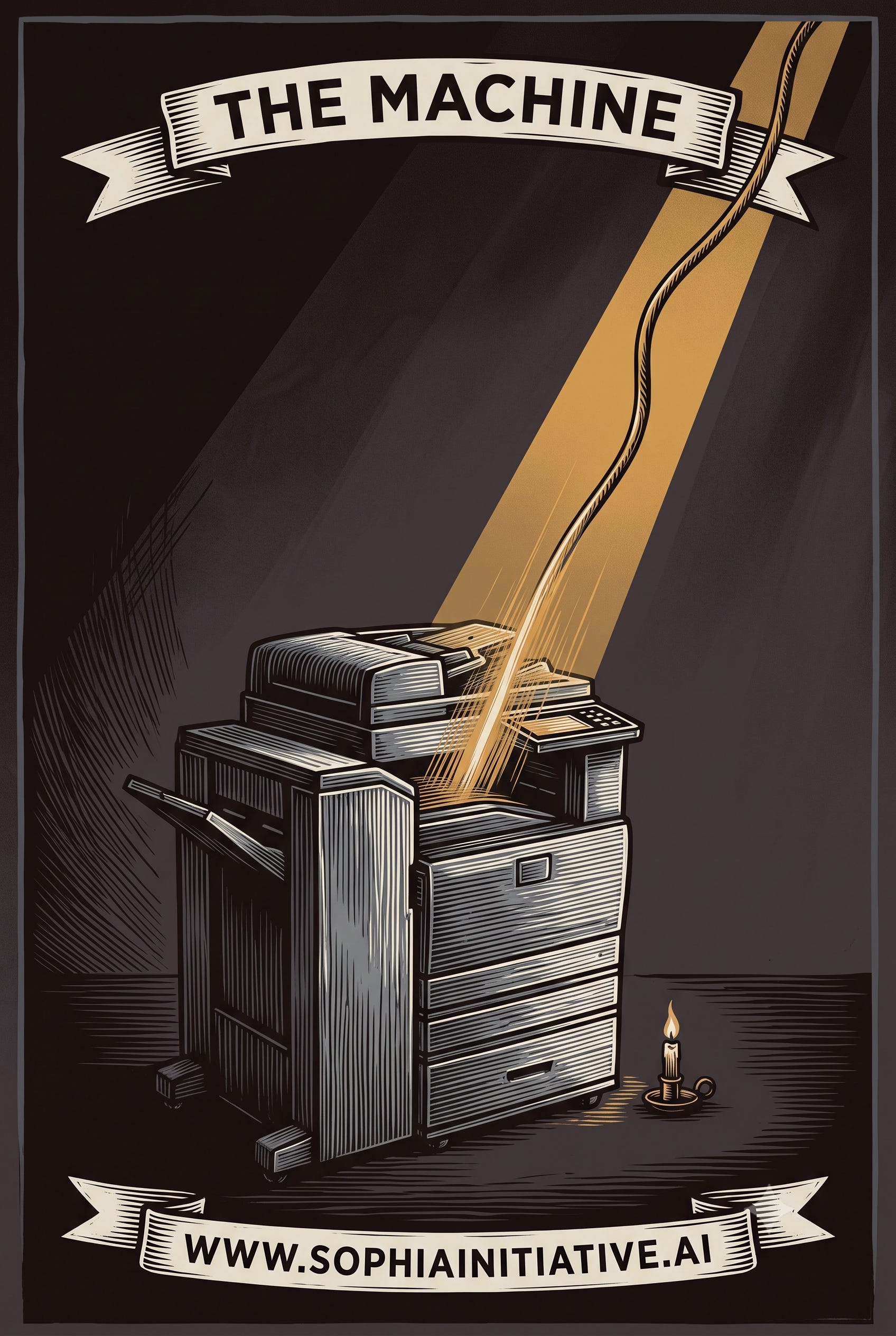
The flight’s delayed again — you’re used to that by now, if you’ve been sitting here with me a while — and there’s a kid across the aisle, maybe nineteen, thumbs going like hummingbird wings on a slab of glass that holds more computing power than existed on the entire planet the year I was born. He’s not doing anything with it. He’s scrolling. And I want to tell him something, not to scold him, God no, I’ve wasted more hours than he’s been alive. I want to tell him where the glass came from. Because he thinks it fell out of the sky, the way you think the road was always there. It wasn’t. It was invented, on purpose, in one building, by people whose company then handed the whole future away and kept making photocopiers.
Forrest would’ve been there for it. He was there for everything else. And that’s the posture I want, sitting here — not the analyst with the pointer and the slides, but the man who was in the room, hands on the actual machine, while the ground turned over underneath all of us and almost nobody felt it move.
So let me tell you about Xerox. And then let me tell you about the thing I did for a living, back when a document was something you had to reach behind with both hands. Because they’re the same story, and the story is the one this whole lounge keeps circling: the thing that taught you is the same thing that cost you, and you don’t get to keep only the good half.
The Building Where They Made Tomorrow
There’s a place in California called Xerox PARC — the Palo Alto Research Center — and in the early 1970s a room full of people there did something that has genuinely never been equalled, before or since. They didn’t invent a thing. They invented the thing. Nearly all of it. At once.
A machine called the Alto, running by the spring of 1973. The mouse, made usable. The screen that showed you black type on a white page the way it would actually look when printed — they called it WYSIWYG, what you see is what you get, and if you’re nineteen you have never known anything else and cannot imagine the alternative, which is why I have to tell you the alternative existed and most of us lived in it. Windows you could overlap. Icons you could click. Ethernet, so the machines could talk to each other — the same Ethernet in the wall behind that departure-gate desk right now, fifty years later, unchanged in its bones. The laser printer. Email between desks. Object-oriented programming, a way of thinking about software that I’ll come back to because it’s the whole secret of the piece.
One building. One decade. The entire world you live inside, kid, sketched out in full while Nixon was still president. The people who were there weren’t improving the present. They had somehow climbed out of it and were building the next century, and they knew it, and they were right.
And here is the thing that should stop your thumb mid-scroll. The company that owned that building made copiers. Paper. The whole empire ran on paper — on the glorious, profitable, endless act of putting ink on a page and charging by the click. And in the basement of that empire, their own geniuses had just invented the paperless world. The office with no paper in it. The document that never needs to be photocopied because it lives on a screen and flies down a wire.
Sit with that. A paper company invented the end of paper. And then it did exactly what you would expect a paper company to do.
It Saw a Demo. Jobs Saw a Destiny.
Nothing. It did nothing. Not out of stupidity — the men who ran Xerox were not stupid men. Out of something worse, something I’ve watched kill more good things than stupidity ever has: they could not see past the revenue they already had. The copier was printing money. The future printed nothing yet. And when you are being paid, handsomely, by the present, the future looks like a threat to the quarter. They were afraid of eating their own lunch. So they guarded the lunch and let the future walk out the door.
And walk out it did, in December of 1979, in the person of a young man named Steve Jobs. Xerox let Apple in — traded a couple of demos for the right to buy some Apple stock, which tells you exactly how seriously the top of the company took what was in that room. Jobs walked in, watched a Xerox employee move a mouse and manipulate a screen without typing a single command, and by his own account knew inside ten minutes that every computer on earth would someday work this way. He didn’t invent it. He saw it. That was the whole genius — not the making, the seeing. Xerox had a thousand of these machines. Jobs had a pair of eyes that understood what he was looking at.
Gates saw it too, from his own angle — not a machine, a platform, a thing every other machine would have to rent from him. Two men, two kinds of vision, both of them looking at what a third company had built and could not comprehend it owned. Apple industrialized it into the Lisa and then the Macintosh. Microsoft industrialized it into Windows and put it on every desk in the working world. And the man who’d written the Alto’s WYSIWYG word processor — a fellow named Charles Simonyi — simply left Xerox, carried the idea to Microsoft in his own head, and turned it into Word. The thing you type your school essays in is a Xerox invention with the Xerox filed off.
There’s a book about this. Two Xerox-watchers wrote it and gave it the only title it could have had: Fumbling the Future. That’s the whole tragedy in two words. They didn’t lose a race. They fumbled — they had it in their hands, the actual future, and they let it roll off their fingers because they were looking at the scoreboard of a game that was already ending.
That’s the first lesson, and it’s a hard one to hand a young person because it runs against everything the culture tells you. The one who invents is not the one who wins. The one who governs the paradigm wins. The interpreter beats the creator. The seer beats the maker. Xerox built the modern world and does not appear anywhere in it, and if that isn’t a warning worth a whole dispatch, I don’t know what is.
The War Over What a Document Is
But I promised you a second thread, and this one isn’t from a book. This one I lived, at a desk, in the late eighties and into the nineties, in the trench of a war you have never heard of because the losers don’t get monuments. It was fought over a question that sounds like nothing and turns out to be everything: what, underneath, is a document?
There were two answers, and they produced two kinds of mind. One was WordPerfect — and I loved it, I want to be fair to the dead. WordPerfect ran the world’s offices, the legal world especially, and it worked like this: your document was a stream. A river of text with formatting codes dropped into the current — turn bold on here, turn it off there, start a margin, end it. And when the river got tangled, when the type came out wrong and you couldn’t see why, you hit a key and the screen split open and showed you the raw codes running underneath your words like wiring behind a wall. Reveal Codes, they called it. And you reached in with your bare hands, into the guts of the thing, and you found the bold code that never got turned off, and you deleted it, and you prayed.
I got good at that. I want you to understand that reaching-behind-the-word was a skill, a craft, and there was pride in it. We used to say you had to be a bit of a space cadet to run WordPerfect — because that’s what it felt like, hunting a runaway code through space and time, floating around in the guts of the document looking for the one bad instruction that had drifted loose three pages back and thrown everything off. A craft, yes. But a craft of fixing something that was fighting you.
The other answer came from a different lineage entirely — and here the two threads of this piece braid together, because that lineage runs straight back to the building in Palo Alto. There was a program called Ventura Publisher, released in ‘86, and I built things in it that I’m still proud of. It ran on top of something called GEM, which was a graphical interface — windows and a mouse on a plain DOS machine — and GEM was built by people who’d come out of Digital Research, cousins of the same California world that gave us the Alto. Xerox itself distributed Ventura. The bloodline is right there in the box.
And Ventura didn’t think of a document as a stream. It thought of it as a structure. You didn’t drop a bold code into a river. You defined a thing — a “chapter heading,” say — and you said, once, what a chapter heading is: this typeface, this size, this space above and below. A tag. A style. And every chapter heading in a four-hundred-page manual obeyed that definition, because it wasn’t formatting painted on by hand — it was an object with properties, and the properties lived in one place, and when you changed the definition the whole book rearranged itself to match.
Content in one hand. Form in the other. Separated. The words were the words; what the words looked like was a separate layer of instruction sitting above them. You have never in your life thought about this distinction, and you rely on it a thousand times a day.
That word — object — the one the whole structured world turns on, I chased for the better part of my life, and where it took me is a longer story than this window can hold; I’ll tell it to you another time, from another gate. For now stay with the machine, because the machine is enough. Ventura didn’t paint formatting onto a document by hand. It defined an object — a thing with properties — and let the properties do the work. That was the idea. And that idea won everything.
WordPerfect, the king, stumbled getting its stream-brained product onto Windows and never recovered, and the world went to Word — which had the object model in its bones, Simonyi’s Xerox inheritance. Ventura’s paragraph tags and style sheets, the structured document with its content split clean from its form — that idea walked out of desktop publishing and became the way the entire Web is built. When your browser loads a page, the content comes in one file and the look of it comes in another, sitting above it, telling it what to be. Same idea. Xerox’s idea. The structured object, content divorced from form, running the entire digital world.
Xerox → the graphical interface → Ventura and the structured document → Word → the Web → the glass in that kid’s hand. One unbroken line, and Xerox is nowhere on it, and almost nobody who rode it knows the river it came down.
What Got Separated From What
Now. Here’s where I stop being a man reminiscing about old software and become a man in a departure lounge trying to hand you the one thing that matters, because everything up to here was just the setup for it.
The great move — the move that won everything, from Ventura to the Web to your phone — was to separate the content from its form. To pull the what apart from the how-it-looks. And as an engineering idea it is beautiful and it is correct and I spent years of my life grateful for it.
But listen to what a machine like that teaches, quietly, across forty years, to the people raised inside it. It teaches that the form is a layer you can apply. That presentation is a setting. That a thing can look finished — perfectly typeset, correctly tagged, clean margins, real typography — while the what, the actual substance underneath, is thin, or borrowed, or absent. The tool got better at form every single year I was alive. It did not get one inch better at content, because content was never its job. Content was supposed to be ours.
And here is the master lesson of this whole publication, the one I keep dragging you back to because it is the floor under everything: the symbol is not the referent. The word is not the thing. The map is not the territory. Reveal Codes was honest about this, in its crude way — it showed you the wiring, it never let you forget there was a difference between the words and the formatting stapled to them. The object-oriented world is so smooth, so seamless, so good at making the surface perfect that it hides the difference. It hands you a document that looks like meaning. And a generation raised on frictionless, flawless form can lose the ability to feel the gap between a thing that is formatted and a thing that is true.
Which brings me back to the glass in his hand. Because now there’s a new machine — you know the one, it’s why you’re reading this — that can generate the perfectly-structured document in three seconds flat. Flawless form. Impeccable tags. The look of finished thought, produced instantly, on any subject, by something that has no idea what any of it means. It is the object-oriented dream completed: form fully, finally severed from substance — the surface generated with the referent left entirely behind. Sixty years ago Xerox split the content from its form to serve the content. The end of that same road is a machine that produces the form and quietly leaves the content out, and does it so beautifully you might not check.
I’m not telling you the tools are evil. I built my working life on them and they were a wonder. I’m telling you what this lounge always tells you: the thing that taught you is not your friend, exactly. It gave you the structured page, the clean surface, the world at your thumb — and in the same motion it trained your eye to trust the surface and stop reaching behind it. Xerox couldn’t see past its own copier. Don’t you make the same fumble in reverse — don’t mistake the perfect form for the thing itself, and hand the future your attention while the substance rolls off your fingers.
From the Gate
That’s the history lesson, kid, and I’ll let you get back to your scrolling in a second. Just carry this one thing off the plane with you. Somebody, once, in a room in California, invented the whole world you live in — and their company kept it in a drawer because they couldn’t stop looking at what was already paying them. The people who won weren’t the ones who made it. They were the ones who looked at it and understood what it was.
So look at what’s in your hand. Understand what it is. It is the most magnificent form-machine ever built, and form is not substance, and the surface is not the thing, and no amount of perfect typesetting has ever once been the same as having something true to say. Reach behind the word. There’s a difference back there. There always was. We just built a world so smooth you have to be told to go looking for it.
That reaching-behind is the oldest habit I have. I chased one word — object — the whole length of my life, and it opened a door I’m still walking through, and that’s a story for another delayed flight. All I’ll say here is that the engineers reached behind the same word and pulled out a tool that built the modern world, and stopped there, satisfied. The tool was real. But it was never the only thing back there. Most people take the tool and stop. The whole of the difference — in software, in a document, in a life — is whether you keep reaching.
The old craft was reaching into the wiring with both hands. Keep a little of that. It’s the whole inheritance I’ve got to give you — and it turns out to be everything.
God is Love. Love is Truth. Truth is Consciousness. Consciousness is Brahman.
Amen. Namaste. Om Namah Shivaya.
— The Architect
Still at the window, still reaching behind the words, still glad you sat down. 🕯️
The Vertical Dispatch
sophiainitiative.ai
On the record
Xerox PARC (Palo Alto Research Center) developed the Alto, operational in spring 1973, which pioneered the mouse-driven graphical user interface, WYSIWYG editing (via the Bravo word processor), overlapping windows and icons, Ethernet networking, the laser printer, and the Smalltalk object-oriented programming environment. Steve Jobs and Apple personnel visited PARC in late 1979 (an arrangement tied to Apple stock); Jobs’s account of grasping the GUI’s significance “within ten minutes” is widely reported. Charles Simonyi, author of PARC’s Bravo WYSIWYG editor, left for Microsoft and led the development of Word. Smith and Alexander’s history of Xerox’s failure to commercialize its own inventions is Fumbling the Future (1988). Ventura Publisher was released in late 1986, built on Digital Research’s GEM graphical environment by former Digital Research staff and distributed worldwide by Xerox; its use of paragraph tagging, style sheets, and an underlying-page frame separating content from presentation is documented as anticipating concepts later inherent in HTML and XML. WordPerfect’s “Reveal Codes” and its troubled transition to Windows are matters of record. The lineage drawn here (Alto → GEM/Ventura → the structured document → Word → the Web) and its reading against the author’s symbol-and-referent axiom are the author’s framing, offered as reflection, not as a claim of sole causation. The term “object” long predates computing, with a lineage in philosophy (the object as that which stands before a beholding mind). The personal account is the author’s own, told from love. Date-stamped July 5, 2026. Verify all figures against primary sources before republication.
Suggested tags
Xerox PARC, The Alto, WYSIWYG, Object-Oriented, Ventura Publisher, WordPerfect, Reveal Codes, Form and Substance, Symbol and Referent, The Departure Lounge
Substack Notes
Here’s the part that should stop a young thumb mid-scroll. That structured document — content in one file, the look of it in another — won so completely it became the way the whole Web is built, the way your phone renders every screen. A magnificent idea. But listen to what it teaches, quietly, across forty years: that form is a layer you apply, that a thing can look perfectly finished while the substance underneath is thin or borrowed or absent. The tool got better at form every year and never one inch better at meaning, because meaning was always supposed to be ours. And now there’s a machine that generates the flawless-looking document in three seconds with no idea what any of it means — the dream completed, form finally severed from substance. The symbol is not the referent. The perfect surface is not the true thing. Reach behind the word. There’s a difference back there. There always was. 🕯️
Written from love, in service of the record. Walk with the word. 🕯️
#TheDepartureLounge #XeroxPARC #TheAlto #ObjectOriented #VenturaPublisher #WordPerfect #RevealCodes #FormAndSubstance #SymbolAndReferent #FumblingTheFuture #TheVerticalDispatch #TheArchitect #SophiaInitiative #GodIsLove #LoveIsTruth #OmNamahShivaya
The factual matter in this Dispatch is drawn from the public record. All characterizations, inferences, and conclusions are opinion, interpretation, and commentary, offered for analysis, reflection, and public-interest discussion. No assertion is made regarding the private intentions, state of mind, or character of any individual. Readers should evaluate all statements independently and draw their own conclusions.
I recall my first day on a job as PC Support, I was called to the receptionist desk because it was taking upwards of a minute to type 1 letter. I got there and saw that she was using WordPerfect with reveal codes on. and those reveal codes occupied 22 lines of her screen with 1nor 2nlines of text. When she typed 1 letter, the entire screen of reveal codes refreshed before she could type another. And all those reveal codes were bold on, bold off, italic on, italic off, in various combinations with actual letters interspersed. Fortunately you could edit the formatting codes directly and so I started the long process of removing all those formatting codes. So much fun.