

Sovereignty · Governance · Consequence
The Man at the Bar
You know the type. Every neighbourhood has one. He is at the bar before you arrive, he is buying the round before you have finished the last one, he remembers your name and your team and the thing that happened to you three years ago that you mentioned once. He is genuinely warm. He is genuinely generous. He makes you feel, in the moment, that someone powerful has noticed you and likes you. You would accept a drink from him. Most people would. That is the point. That is always the point.
Doug Ford is the man at the bar. He has been buying rounds since he entered politics — with beer, with booze in the corner store, with speed cameras removed because the tickets annoyed the people who drive fast, with greenbelt land transferred to developers who attended his daughter’s wedding, with an honorary doctorate from an American university that validated the statesman image he has spent seven years constructing over the absence of any post-secondary credential. The drinks are real. They flow freely. The bar tab is paid by someone else.
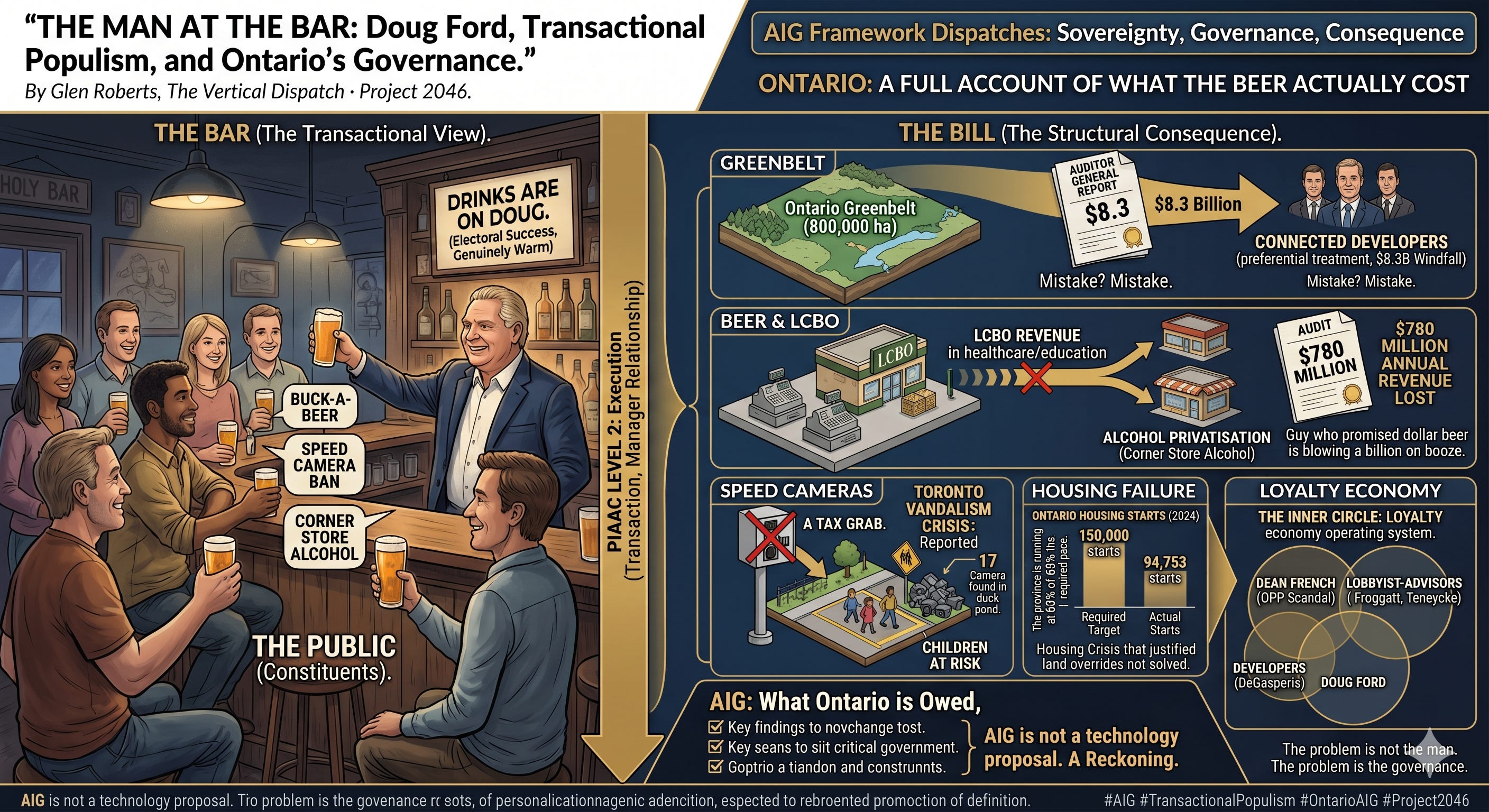
In Ontario, that someone else is the taxpayer. The governance record of Doug Ford’s premiership — from June 2018 to the present — is the record of a man who has governed exactly as the man at the bar governs: with immediate, visible, tangible gifts to the people in front of him, financed by costs imposed on people who are not at the bar and will not receive a drink. The greenbelt land transferred to developers was worth $8.3 billion in increased value according to the Auditor General’s own assessment — and the calculation was made against 2016 prices, meaning the actual windfall was likely far larger. The LCBO alcohol privatisation that put beer in the corner store has cost the provincial treasury between $780 million and $1 billion in lost revenue that would have funded hospitals, schools, and the public services that the man at the bar’s constituents depend on. The speed camera ban — described by its author as a tax grab — removed devices that reduced speeding in school zones by 45 percent, according to a study by SickKids Hospital and Toronto Metropolitan University, in a city where 250 pedestrians and cyclists have been killed or seriously injured on the roads since 2024.
This is the governance record. Not the image. Not the man at the bar who remembers your name. The record of what was done when the cameras were off and the bills came due and the Auditor General arrived with her report. The Vertical Dispatch applies the AIG standard to that record today. No quarter. The bar is open. The drinks are on you.
I. The Man and His Formation — What the Record Actually Shows
Douglas Robert Ford was born on November 20, 1964, in Etobicoke, Ontario. His father, Doug Ford Sr., co-founded Deco Labels and Tags, a label and printing company that became the family business and the foundational myth of the Ford political brand: the self-made businessman who understands how the real world works because he built something with his hands. Ford Sr. also served as a provincial PC MPP for Etobicoke-Humber from 1995 to 1999 — a single term — which established the family’s political lineage.
Ford attended Scarlett Heights Collegiate Institute in Etobicoke. He briefly attended Humber College but did not graduate. There is no public record of him earning a university degree. His own account of his education is that it came from working at his father’s company from a young age — the Deco floor, the Deco clients, the Deco culture of practical business as the only education that matters. This is presented as an asset, and in the political culture Ford inhabits, it functions as one. The man of the people who did not waste time in university and went straight to work. The contrast with the credentialed class is deliberate and effective.
On May 2, 2026, Ford received an honorary Doctor of Humane Letters degree from Saginaw Valley State University in Michigan. This is not a credential. It is a ceremonial distinction, awarded without academic requirement, that Ford’s office has used to generate the honorific doctor in press materials. Saginaw Valley State University is a regional comprehensive university in Michigan with a 2026 enrolment of approximately 6,500 students. The award was widely characterised by observers as part of Ford’s effort to rebrand as an international statesman amid American trade tensions. The man who did not finish Humber College now travels with a doctorate. The bar buys the drinks. The title is honorary.
The family’s history is more complex than the Ford brand requires acknowledging. A 2013 Globe and Mail investigation, based on interviews with dozens of associates, reported that Ford was described as a go-to dealer of hash in central Etobicoke during the 1980s, operating in a public park. Ford has denied these allegations, and they are based on unnamed sources in a journalism investigation rather than any criminal finding. They are documented here as what they are: reported allegations from a credible outlet, denied by the subject, unproven in any legal proceeding. These allegations are included solely because they form part of the public record surrounding Ford’s early life, not as established fact. The investigation also reported that his brother Randy was charged in relation to a drug-related kidnapping, and that his sister Kathy was a victim of drug-related gun violence. Ford has never addressed these family history elements publicly with the same energy he brings to his political messaging. The Ford family brand is loyalty and community. The public record is more complicated.
The PIAAC assessment of Doug Ford’s public record is Level 2 to 3. Level 2 governance can execute transactions, manage relationships, and respond to immediate constituent pressures with visible action. It cannot hold the structural complexity of a provincial economy across multiple simultaneous policy domains, cannot sustain the elenctic chain through more than one or two iterations before binary simplification, and cannot distinguish between the appearance of a solution and the solution itself. Buck-a-beer is the Level 2 solution to the cost of living. Speed cameras are a tax grab is the Level 2 analysis of road safety. Greenbelt removal is housing is the Level 2 framing of land use policy. Each one produces the result that the man at the bar wants — the immediate, visible, tangible gesture — without engaging the structural consequence of the gesture. The Stratum level is 3 to 4 — adequate for operational management of a family business, insufficient for the governance of a province of fifteen million people facing the complexity of the twenty-first century economy.
II. The Greenbelt — The $8.3 Billion Gift That Wasn’t About Housing
The Greenbelt is a protected area of approximately 800,000 hectares of farmland, forests, wetlands, and watersheds surrounding the Greater Toronto Area. It was established in 2005 specifically to limit urban sprawl, protect agricultural land and natural heritage, and prevent the indefinite expansion of the developed footprint into ecologically sensitive territory. It was not a temporary measure. It was a permanent protection, built into provincial legislation, designed to survive electoral cycles and development pressure.
When Ford first ran for the PC leadership and then for premier, he was asked about the Greenbelt. He said he would not touch it. A recording then surfaced of Ford at a private event with developers, in which he appeared to promise that he would in fact open the Greenbelt to development. Ford denied the clear meaning of what he had said. He said it was a misunderstanding. He won the election. He then moved to remove 15 parcels from the Greenbelt.
Ontario Auditor General Bonnie Lysyk conducted a value-for-money audit of the Greenbelt changes at the request of all three opposition party leaders. Her findings, published in August 2023, were precise and devastating. The removal of the 15 parcels was designed to be swift and confidential, without the customary expert input of stakeholders. Prominent developers received preferential treatment while communicating via personal email and envelopes given to the housing minister’s chief of staff at a building industry dinner. The government’s own experts found that the removal of Greenbelt lands was not needed to meet the government’s housing goals, as sufficient land was available for development outside of protected areas. The 15 parcels could see a collective value increase of $8.3 billion — assessed against 2016 land values, meaning the actual windfall for the developers who received the land was almost certainly substantially larger.
Two developers with close ties to Ford and the Progressive Conservative Party stood to make billions. Developers along the Highway 413 route — a Ford government priority highway project — had donated $753,000 to the Ford government and purchased land in or near the Greenbelt after Ford won the 2022 election. The RCMP opened an investigation in October 2023 after the integrity commissioner and auditor general reports documented a process favouring developers with close party ties. No charges have been laid and the investigation remains ongoing.
The public backlash was sufficient to force a reversal. Ford announced in September 2023 that the 15 parcels would be returned to the Greenbelt. He said he had made a mistake and that he took full responsibility. What he did not say — and what the Auditor General’s report made unavoidable for anyone reading it — was that the mistake he was taking responsibility for was not a policy error. It was the documented preferential treatment of donors whose land values had been artificially inflated by a government process designed specifically to serve them.
The Greenbelt affair is the clearest demonstration in the Ford government’s public record of the transactional governance model at its most unambiguous. The man at the bar was buying drinks for developers who had attended his political events, donated to his party, and communicated with his housing minister’s chief of staff through envelopes passed at industry dinners. The bill was $8.3 billion in land value transferred from the protected public interest to the private development sector. The Auditor General documented it. The RCMP investigated it. Ford reversed the decision and called it a mistake. The housing crisis that justified the removal in the public framing was, according to the government’s own experts, not actually served by the removal. The Greenbelt was not opened to address a housing emergency. It was opened to reward the people who were at the bar.
Ontario recorded 94,753 total housing starts in 2024. The government’s own target was 150,000 starts per year to achieve its goal of 1.5 million homes by 2031. The province is running at approximately 63 percent of the required pace. The housing crisis that justified every land-use override, every Ministerial Zoning Order, every greenbelt removal discussion has not been solved by the governance approach that framed itself as the solution. The checkers player moved the pieces. The housing problem remains.
III. The Beer — What the Corner Store Actually Cost
Buck-a-beer was Doug Ford’s first major policy announcement after winning the 2018 provincial election. The promise was simple: Ford would lower the minimum price of beer in Ontario to one dollar a can. The announcement generated significant media attention and established the political register of his government: the man of the people, fighting the elites, making the small pleasures of ordinary life more affordable.
The buck-a-beer policy did not work. Ford had promised it. He could not deliver it. The minimum price floor for beer had to be lowered from $1.25 to $1.00, but no brewer chose to sell beer at a dollar because the economics made it impossible. The breweries did not participate. The policy was, in practice, a press release and a campaign trail moment that produced no actual dollar beer on any shelf in Ontario. The man at the bar had announced a round and then found the credit card declined.
Ford eventually delivered on the spirit of the policy through the alcohol privatisation program that became one of his government’s defining initiatives. In December 2023, his government announced plans to allow beer, wine, and cider to be sold in grocery stores and convenience stores across Ontario — the corner store alcohol sales he had promised since his first campaign. By September 2024, beer and wine were available in Ontario convenience stores for the first time.
The bar tab for this round was documented by multiple independent sources. Confidential LCBO projections obtained by CBC News showed the changes to alcohol retailing would result in a net loss for the government of $98 million to $150 million per year. An industry source put the total cost to the provincial treasury at closer to $1 billion over the transition period. The province also paid the Beer Store $225 million as compensation for terminating the existing retail agreement, required the Beer Store’s owners to keep at least 300 locations open until end of 2025, and provided $45 million per year in rebated cost-of-service fees on beer. By 2026, the LCBO’s annual revenue had dropped from $2.57 billion in 2023-24 to $1.79 billion — a loss of $780 million in a single year.
That $780 million was not an abstraction. It was money that had previously flowed from alcohol sales through the LCBO into the provincial treasury and from there into healthcare, education, and public services. The privatisation of alcohol sales transferred that revenue stream from the public interest to the private retail sector. The man at the bar bought the round with the hospital budget.
The Liberal opposition characterised it precisely: the guy who promised yet failed to deliver buck-a-beer is now blowing a billion dollars on booze. The framing is accurate. The man who could not deliver a dollar beer in 2018 delivered corner store alcohol in 2024 at a cost to the public treasury that the CBC’s own financial analysis put at between $150 million and $200 million per year in net annual loss, plus $225 million in Beer Store compensation, plus $780 million in LCBO revenue decline. The drink was real. The price was real. The person who paid it was not the person at the bar.
IV. The Speed Cameras — The Children’s Safety That Was a Tax Grab
In 2017, under the Liberal government of Kathleen Wynne, Ontario amended the Highway Traffic Act to allow automated speed cameras in school and community safety zones. Cities across Ontario — Toronto, Ottawa, Brampton, Guelph, and dozens of others — installed cameras near schools to reduce the speed of vehicles passing through zones where children were present. The evidence on their effectiveness was not ambiguous.
A study published in July 2025 by SickKids Hospital and Toronto Metropolitan University found that speed cameras reduce speeding in school zones by 45 percent. Toronto’s cameras issued $40 million in fines in 2024. The revenue was reinvested into street safety measures. The Guelph mayor said the cameras were the only way to change people’s behaviour and make streets safer, especially around children. The Ontario Association of Chiefs of Police issued a statement: employing automated speed enforcement tools has been proven to reduce speeding, change driver behaviour, and make our roads safer for everyone — drivers, cyclists, pedestrians, and especially children and other vulnerable road users.
In September 2025, after a wave of camera vandalism in Toronto — 17 cameras cut down in two nights, 800 incidents of vandalism reported to the city in the preceding months, the camera at High Park cut down and dragged through the mud into the duck pond — Doug Ford announced that his government would ban speed cameras across Ontario. His reasoning: they are nothing more than a tax grab. People are fed up.
He banned them. The legislation passed. By December 2025, all of Toronto’s speed cameras were gone. The province committed $210 million to alternative road safety measures — flashing signs, speed bumps, roundabouts — to replace the cameras it had just banned.
Toronto Mayor Olivia Chow noted that 250 pedestrians and cyclists had been killed or seriously injured on the city’s roads since 2024. The Ontario Association of Chiefs of Police had explicitly supported the cameras. Big city mayors across Ontario sent a letter to Ford in October 2025 saying the ban would reverse years of progress on safety in school zones. The Guelph mayor who installed cameras because Ford’s own government promoted them as a way to protect people said, after the ban: if he wants to take them out now, so be it. The resignation in that sentence is the resignation of a municipal official who understands that the provincial government has made a political decision that will cost children’s safety, and that there is nothing he can do about it.
The speed camera decision is the Ford governance model in its purest form. A technology that works — documented by hospital research and police associations to reduce speeding in school zones by 45 percent — is eliminated because it generates complaints from the people who speed in school zones. The man at the bar does not like getting the ticket. Ford removes the camera. The children in the school zone are not at the bar. They do not have a round bought for them. They receive the consequence of the governance that serves the people who are in the room. And the camera that was vandalized and left in the duck pond was replaced, at public expense, with $210 million in alternative measures whose effectiveness has not been measured against the 45 percent reduction the cameras achieved.
V. The Inner Circle — The Loyalty Economy and Its Costs
Ford’s governance is organised around loyalty. This is not a political observation. It is the documented finding of the Ontario Integrity Commissioner, the Auditor General, and multiple independent investigations into the conduct of his government. The loyalty economy is the operating system. Understand it and the greenbelt, the speed cameras, the alcohol privatisation, and the OPP commissioner scandal all become legible as expressions of the same underlying architecture.
Dean French and the OPP Commissioner Affair
Dean French was Ford’s chief of staff and campaign manager — the enforcer, by the description of everyone who dealt with him. He was the most powerful unelected official in the Ford government. In 2018 and 2019, an Integrity Commissioner’s investigation found that French was part of a coordinated attempt to have Ron Taverner — a long-time Ford family friend and Toronto police superintendent — appointed as Commissioner of the Ontario Provincial Police. The job requirements were watered down, in the Integrity Commissioner’s own language, to allow Taverner, who did not meet the standard qualifications, to qualify for the position. The attempt to install a personal friend of the premier’s family at the head of the provincial police force produced a public scandal sufficient to cause Taverner to withdraw his candidacy. French resigned in 2019 after it was also revealed he had secured lucrative government posts for his son’s friends. He later resurfaced as a key back-channel negotiator for Ford during the 2022 Ottawa Freedom Convoy protests — still operating in the orbit of the premier despite having resigned in disgrace.
The Lobbyist-Advisors
Chris Froggatt and Kory Teneycke run major lobbying firms that represent clients with interests before the Ontario government. They also serve as Ford’s most trusted political advisors, providing strategic direction and crisis management without any official government role. They have had input on cabinet shuffles. They are simultaneously lobbying the government for their clients and advising the premier on how to govern. The conflict of interest is structural. It is also, under the Ford government’s approach to these boundaries, unremarkable. The seamless transition between the private lobbying interest and the inner circle of government advice is the operating model, not an exception to it.
Silvio DeGasperis and the Developer Network
Silvio DeGasperis is a powerful real estate developer whose family has donated to Ford’s campaigns and who is part of the business network that has consistently surrounded Ford’s political operation. His presence in the network is part of the pattern documented by the Auditor General — developers with close party ties who communicated with the housing minister’s chief of staff through envelopes at industry dinners and whose land values benefited from the greenbelt removals. DeGasperis is not an anomaly in the Ford orbit. He is representative of it.
The Renata Ford lawsuit — filed by the widow of Rob Ford just days before the 2018 provincial election — documented the inner logic of the loyalty economy in its most personal form. Renata alleged that Doug and Randy Ford, as trustees of Rob’s estate, paid themselves extravagant salaries regardless of the company’s financial performance, caused a $6 million loss in share value through a 2017 corporate reorganisation, and prevented her and her children from collecting on Rob’s $200,000 life insurance policy. The lawsuit made the pointed allegation that neither Doug nor Randy have the education and business ability to justify their high-level positions. These are civil claims, not findings. Ford called them completely false and an act of political opportunism. The lawsuit has not been resolved in the public record. It is documented here as what it is: a civil proceeding with specific, detailed allegations from a member of the Ford family about the management of the family business. The claims remain unproven and the case has not resulted in any judicial findings.
VI. The Housing Failure — What the Governance Model Cannot Produce
The Ford government has justified every major land-use intervention — the greenbelt removals, the Ministerial Zoning Orders, the Highway 413 approvals, the override of municipal planning decisions — on the basis of an acute housing crisis requiring emergency measures. The housing crisis is real. Ontario’s housing affordability crisis, concentrated in the Greater Toronto Area but spreading across the province, is one of the most significant governance failures of the preceding two decades. Ford did not create it. He inherited it and promised to solve it.
His government’s stated goal is 1.5 million new homes by 2031. Ontario recorded 94,753 total housing starts in 2024. The required pace to meet the 2031 target is approximately 150,000 starts per year. The province is running at 63 percent of the required pace. The Growth Plan for the Greater Golden Horseshoe — the planning framework that guided how and where development could occur in the region — was repealed in October 2024. The greenbelt removals that were supposed to unlock development were reversed after the Auditor General documented that they were not needed to meet housing goals and that the land had been selected to benefit specific connected developers rather than to address the housing shortage.
The Ford government’s approach to housing is the transactional populist approach to a structural policy problem. The structural problem is a combination of zoning restrictions that prevent density, a development charges system that imposes upfront costs on new construction, a regulatory approval process that adds years and cost to every project, and an affordable housing sector that has been chronically underfunded for decades. These are complex, interrelated problems that require sustained, technically sophisticated governance over multiple electoral cycles to address. They are Level 4 and 5 governance problems. The Ford government’s responses — Ministerial Zoning Orders, greenbelt removals, Bill 23 development charge reductions — are Level 2 and 3 interventions: visible, fast, targeted at specific developers, and disconnected from the structural conditions that determine whether housing actually gets built at the required pace.
Bill 23, the More Homes Built Faster Act, curtails development charge revenues and eliminates them entirely when building affordable housing. Development charges are the mechanism by which the cost of new infrastructure — roads, sewers, transit, schools — is charged to the developers who create the demand for that infrastructure rather than to the existing taxpayer. Eliminating them transfers that cost to the existing taxpayer while reducing the financial incentive for municipalities to approve development. The bill was designed to make housing faster. Its actual effect, documented by municipal governments across Ontario, has been to reduce the revenues that fund the infrastructure without which the housing cannot function. The man at the bar bought another round. The municipality received the bill for the glasses.
VII. The PIAAC Score and the Stratum Assessment — What the AIG Standard Finds
AIG governance applies the Socratic question to every claim of governance competence: define what you know, show your work, demonstrate that you are doing what you were entrusted to do. Applied to Doug Ford’s governance record across seven years of premiership, the question produces an answer that the man at the bar is not equipped to examine and that his political success does not require him to examine. That is the most important structural fact about his governance. He has won elections. He will likely win more. The PIAAC standard and the Stratum assessment are not electoral measures. They are governance measures.
The PIAAC assessment of Ford’s public record places him at Level 2 to 3. Level 2 processing produces the transactional response to the immediate constituent pressure: the speed camera is a tax grab, remove it; the beer is too expensive, put it in the corner store; the greenbelt is protected land that developers want to build on, remove it for housing. Each intervention addresses the surface presentation of a problem without engaging the structural reality beneath it. The camera is a tax grab — but the 45 percent reduction in school zone speeding and the 250 dead pedestrians and cyclists are not tax grabs. The beer is expensive — but the $780 million in annual LCBO revenue loss is a real cost to the public services the beer money funded. The greenbelt removal is housing — but the Auditor General’s finding that the government’s own experts said it was not needed for housing is a structural reality that the Level 2 framing cannot hold.
Level 3 processing — which Ford achieves in his strongest moments — can sustain a coherent argument within a familiar framework. The For the People framework. The anti-elite framework. The common-sense conservative framework. These are internally consistent narratives at Level 3. They produce the electoral success. They do not produce the governance depth that Ontario’s complexity requires. A province of fifteen million people navigating the US trade disruption, the housing crisis, the energy transition, the AI economic transformation, and the fiscal pressures of an ageing population requires Level 4 and 5 governance. The man at the bar does not bring Level 4 and 5 governance. He brings drinks, and the people at the bar are grateful, and they vote for him, and the bill goes to the people who are not at the bar.
The Stratum assessment places Ford at Stratum 3 to 4. Stratum 3 is the level of systematic management — the ability to manage complex operations within defined parameters, to oversee multiple departments, to execute at the level of a senior manager in a medium-sized organisation. This is the level at which Deco Labels and Tags operates. It is adequate for running a family label company. It is inadequate for governing a province with a $210 billion budget, a 15-million person population, and the policy complexity of the contemporary Canadian federation. Stratum 4 — the level at which systems thinking begins to operate, at which the leader can construct the governance framework rather than simply manage within it — is visible occasionally in Ford’s operation, particularly in his instinct to use the political moment of the American trade war to consolidate federal-provincial alignment on economic sovereignty. But it is not his operating register. His operating register is the bar. And the bar is not a governance institution.
The honorary doctorate from Saginaw Valley State University is the perfect symbol of the Ford governance model. It is a credential that looks like an achievement. It was given without the work the credential normally represents. It will be used to suggest a depth of learning and institutional standing that the man who received it did not acquire through the process the degree normally certifies. The bar is buying drinks. The round is on the house. The house is Ontario. The bill is real.
VIII. The AIG Verdict — What Ontario Is Owed
Doug Ford is not a bad man. This dispatch has not argued that he is. He is a genuinely warm, genuinely loyal, genuinely community-oriented person who has found in politics the ultimate bar — the one where he can buy rounds for an entire province and be beloved for it. The warmth is real. The loyalty is real. The desire to be liked and to give people things they visibly want is real and it is not cynical. It is who he is.
The problem is not the man. The problem is the governance. A province of fifteen million people in the most complex policy environment of the post-war era cannot be governed by a man whose operating system is the transaction. The transaction produces the beer in the corner store and removes the speed camera and opens the greenbelt and installs the family friend as OPP Commissioner. The transaction does not produce the housing the province needs, the road safety the children require, the public revenue the hospitals depend on, or the institutional integrity that distinguishes a government from a favour operation.
The AIG accountability standard applied to Ford’s governance record produces four specific findings. First: the greenbelt affair was, by the Auditor General’s own documented finding, a process designed to be swift and confidential that benefited connected developers without addressing the housing crisis it was justified on. The RCMP investigation continues. The reversal does not erase the documented preferential treatment of donors. Second: the alcohol privatisation cost the provincial treasury $780 million in LCBO revenue in a single year — money that previously funded healthcare, education, and public services — to put beer in the corner store. The transactional win cost the structural budget. Third: the speed camera ban removed devices documented to reduce school zone speeding by 45 percent, in a city where 250 pedestrians and cyclists have been killed or seriously injured, because the people who speed in school zones complained about the tickets. Fourth: the housing crisis that justified every land-use intervention has not been addressed. Ontario built 94,753 homes in 2024. It needed 150,000.
The man at the bar will buy another round. He is already planning the next election. The people in the bar will accept the drink and remember his warmth and vote for the experience of being seen and valued by someone with power. This is not stupidity. It is the rational response to the transactional politics of a man who has made visibility and generosity his operating system. The problem is that Ontario is not a bar. It is a complex governance institution serving fifteen million people whose lives depend on decisions made at the highest levels of provincial government about housing, healthcare, road safety, environmental protection, and fiscal management.
Those decisions require the level of governance that the man at the bar has never demonstrated the capacity to provide. The drinks are real. The warmth is real. The cost — $8.3 billion in greenbelt land transferred to connected developers, $780 million in annual LCBO revenue lost, 45 percent school zone speed reduction removed, 94,753 homes built against a 150,000 target — is also real. The Vertical Dispatch will be at the bar. We will not be accepting the drink. We will be presenting the bill.
God is Love. Love is Truth. Truth is Consciousness. Consciousness is Brahman.
Amen. Namaste.
Dispatch Hashtags
#TheManAtTheBar #DougFord #AIG #VerticalDispatch #TheArchitect #AgeOfConsequences #Greenbelt #AuditorGeneral #BonnieLysyk #8BillionDollarGift #DeveloperDonors #SpeedCameras #TaxGrab #SchoolZoneSafety #45Percent #ChildrenAtRisk #OntarioRoads #BuckABeer #LCBO #CornerStore #780Million #AlcoholPrivatisation #OntarioTreasury #DeanFrench #RonTaverner #OPPCommissioner #IntegrityCommissioner #LoyaltyEconomy #RenateFordLawsuit #DougRandyFord #FamilyBusiness #DecoLabels #CivilAllegations #PIAACLevel #Stratum3 #TransactionalPopulism #HousingCrisis #1_5MillionHomes #OntarioHousing #94753Starts #MZO #Bill23 #GrowthPlanRepealed #UrbanSprawl #HonoraryDoctorate #SaginawValleyState #Statesman #NoCredential #TheTitle #SubstackCanada #TheVerticalDispatch #Project2046 #NorthernSovereignty #NoFear
Mostly disagree.
Speed cameras. Definitely a gratuitous money grab. Why not put speed controls in vehicles, Nanny State?
Beer in stores. Meh. They've had it is the despaneurs in Quebec forever. I thought it might make us European. Not so much.
Greenbelt. This is the market/consumers fault. Don't buy mega homes 30m from where you work. ffs. "Oh, don't sell it to us. You're making us do the wrong thing. Boo hoo, boo hoo."
And, why not throw in Ontario Place. The local pols whine and protest but would rather never use and leave the lights off at this an incredible waterfront property than see it taken over by "capitalists." "Oh, the horror!" The architecture was good though. I will miss that.