


The Sovereign Core · The Age of Consequences
Synthesis Dispatch · May 2026 · Part Two of the Trilogy
“Commodus is not a moral man. You have known that since you were young. Commodus cannot rule. He must not rule.” — Marcus Aurelius (Richard Harris), Gladiator (2000)
Whoever is not aware of his shadow is at the mercy of his shadow. — C.G. Jung
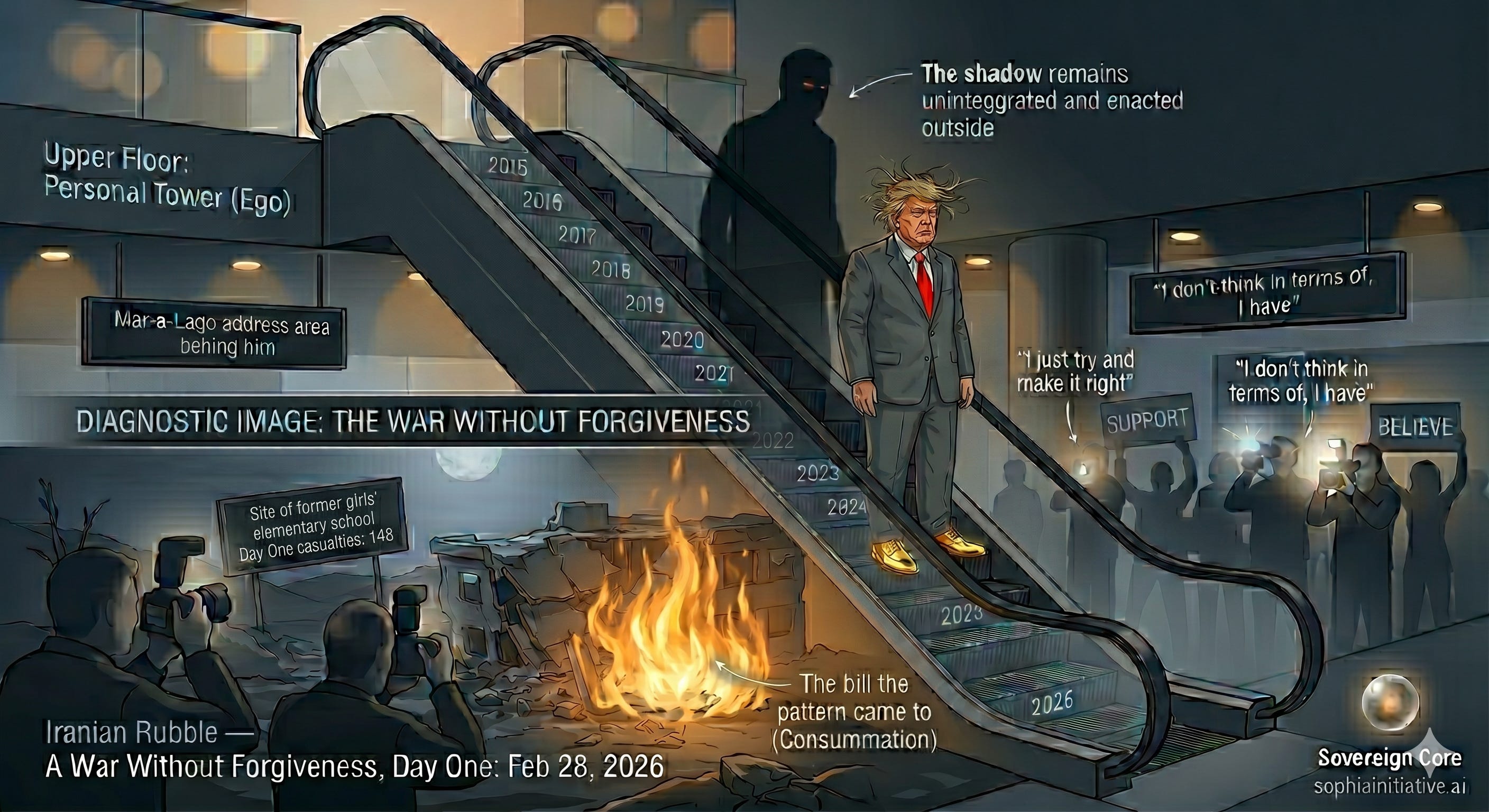
On June 16, 2015, a man rode an escalator down. He descended from the upper floors of a tower bearing his own name, in a city he had spent fifty years marking, into a lobby of cameras and cheering hired extras, to announce that he would seek the presidency of the United States. The image was diagnostic before a single word was spoken. The proper study ascends. The shadow descends. Every ancient tradition that ever measured a soul measured it by its altitude — the climb out of the ego, the bending of the neck, the lifting of the eye to something higher than the self. This man descended. He literally rode an escalator down into public life, and within minutes of reaching the bottom he was naming entire peoples as rapists and drug dealers. The crowd cheered. A country stepped onto the escalator behind him. And we have been in his shadow ever since.
That sentence is not a metaphor. It is a clinical description, in the precise vocabulary of the most rigorous modern psychology that has ever been brought to bear on the soul. This Dispatch will use the vocabulary plainly, because the present moment requires it. We do not hang the man. We let his own record speak. But we name what he is, because to refuse to name a thing for what it is, is itself a small profanation of the truth. And the time for small profanations has run out.
I. The Frame Is Jungian, and the Frame Is Rigorous
Carl Jung, the founder of modern depth psychology, gave the twentieth century its most disciplined account of the part of the self that the conscious mind refuses to face. He called it the shadow. The shadow is not evil; it is simply the disowned material — the failures, the cruelties, the fears, the appetites, the inheritances a person cannot bring into the light. The work of becoming a whole human being, Jung taught, is the work of integrating the shadow: facing it, naming it, bending the neck to its existence, letting the light reach what was kept in the dark. A person who does this work becomes, in Jung’s word, individuated — actually himself, actually answerable to what is real.
A person who refuses this work does not become free of the shadow. He becomes its instrument. What is refused inside is enacted outside, and the more powerful the position the man holds, the larger the field on which the unconfronted shadow is enacted. Jung said it with the precision of a clinical observation: whoever is not aware of his shadow is at the mercy of his shadow. A king who has done no inner work governs from his shadow. A nation that elects such a king is pulled into the dream the king has not awakened from, and the dream becomes its history.
This is not a partisan frame. It is depth psychology applied to public life, the way it has been applied to every leader serious thinkers have ever measured. It was the frame Marcus Aurelius applied to himself, sitting at the apex of Roman power, writing at night to remind himself that the work of being good was inner work and never finished. It was the frame the desert fathers applied to their own ascents. It is the frame the proper study of mankind has always applied to the question of who is fit to govern. The question is not what a man does in office. The question is what he has done inside himself before he ever enters it, because what he has not done inside himself will be done outside himself, on the bodies and the lives of others, for as long as he holds the office.
Read against this frame, the man who rode the escalator down in June of 2015 is the most documented case of an uninstegrated shadow in the modern Western record holding the office of head of state. The Dispatch will not argue this point. The Dispatch will lay the record down and let the reader walk through it.
II. The First Flood, 2015
The shadow does not enter public life slowly. It enters in a flood. Within the first sentences of the escalator speech, the candidate declared of Mexicans crossing the southern border: “They’re bringing drugs. They’re bringing crime. They’re rapists.” The crowd cheered. The candidate did not retract. Within weeks, asked by Fox News moderator Megyn Kelly to account for decades of calling women “fat pigs, dogs, slobs, and disgusting animals,” he responded by saying afterward that there had been “blood coming out of her eyes, blood coming out of her wherever.” The crowd cheered. Within months, at a Republican rally in South Carolina, he flailed his arms and contorted his face on stage to mock a New York Times reporter, Serge Kovaleski, who has a congenital condition called arthrogryposis. The mockery was caught on video. The candidate denied that he had done it. The video remained. The crowd cheered.
This is what Jung meant when he wrote of the collective shadow recognizing its individual carrier. The candidate did not have to argue for the things he was saying. He had only to say them. A part of the country that had been kept in its own shadow for a generation looked up at the stage, saw what was descending, and recognized itself. The applause was not the surprise. The applause was the diagnosis. A country had elected, in its mood if not yet in its vote, the part of itself it had never integrated.
III. The Record Already on the Wall
The descent of June 2015 did not arrive without warning. The wall had been written on for forty years, in documented public record, before he ever set foot on the escalator. The country that cheered the descent was a country that had chosen not to read the wall.
In 1973, the United States Department of Justice sued the Trump Management Company, the man’s family business, for refusing to rent apartments to Black applicants. The case was settled with a consent decree under which the company agreed to provide apartments without discrimination. The man and his father denied the underlying allegations and signed the decree anyway. The record is in the National Archives. In 1989, after five Black and Latino teenagers were arrested for the assault of a jogger in Central Park, the man took out full-page advertisements in four New York newspapers — at a cost reported at eighty-five thousand dollars — calling for the return of the death penalty and demanding the executions. The five were later exonerated by DNA evidence. They had spent between seven and thirteen years in prison. The man, asked years later whether he would apologize, refused. The advertisements survive in the archives of The New York Times.
Through the 1990s and 2000s the man’s commercial enterprises filed for Chapter 11 bankruptcy four times — the Trump Taj Mahal in 1991, Trump Castle in 1992, Trump Plaza and Trump Casino Holdings in 2004, Trump Entertainment Resorts in 2009 — leaving contractors and investors absorbed in the losses. In 2016 he settled three fraud lawsuits brought by former students of Trump University for twenty-five million dollars, in a federal court approving the settlement, without admitting wrongdoing. In 2019, the New York Attorney General secured a court order dissolving the Donald J. Trump Foundation and requiring the man to pay two million dollars in damages for what the court found to be “a shocking pattern of illegality,” including the use of charitable funds for personal, political, and business purposes.
And in October 2016, three weeks before a presidential election, the Washington Post released a recording from 2005 — captured on a hot microphone the man did not know was recording — in which he is heard, in his own voice, instructing a younger man on how a celebrity may approach women. “I just start kissing them. It’s like a magnet. Just kiss. I don’t even wait. And when you’re a star, they let you do it. You can do anything. Grab them by the pussy. You can do anything.” The country heard the tape. The country elected him. The country was not deceived. The country had read the wall, and the country had voted for what was written on it. That is the diagnostic fact, and it is not the fact about a man. It is a fact about a country that had also done no inner work.
IV. The First Term as Shadow Enacted
Once the shadow holds the office, the shadow governs. In August of 2017, after a white nationalist drove a car into a crowd of counter-protesters in Charlottesville, killing a young woman named Heather Heyer, the man told the country there had been “very fine people on both sides.” In January of 2018, in a meeting on immigration policy in the Oval Office, the man asked of Haiti and African nations why the United States should accept immigrants from “shithole countries,” and suggested instead more immigrants from Norway. The remarks were reported by The Washington Post and confirmed by multiple senators present. In 2018, under what the administration called a “zero tolerance” policy at the southern border, agents of the United States government took children from their parents, including infants and toddlers, and held them in separate facilities. Thousands were separated. Court orders later required reunification. Many remain apart. These are documented acts of the United States government, performed at the direction of the man who held the office.
Across the four years of the first term, The Washington Post Fact Checker, in a database it maintained continuously, catalogued thirty thousand five hundred and seventy-three false or misleading statements by the man, each one footnoted and citable, averaging over fifty per day in his final year. The fact-checking organization is a working desk at a major American newspaper. The figure is not a partisan claim. It is a count. In 2019, he was impeached by the United States House of Representatives for abuse of power and obstruction of Congress, after withholding congressionally appropriated military aid to Ukraine while pressuring its president to announce an investigation of his domestic political opponent. He was acquitted by the Senate. The reconstructed memorandum of the relevant phone call survives on the White House archive.
V. January 6
On December 19, 2020, after his defeat in the presidential election was certified across sixty court cases and confirmed by his own Department of Homeland Security as “the most secure election in American history,” the man posted to Twitter: “Big protest in D.C. on January 6th. Be there, will be wild!” On the morning of January 6, 2021, on the Ellipse south of the White House, he told a crowd assembled at his summons: “We fight like hell. And if you don’t fight like hell, you’re not going to have a country anymore.” He directed them to march on the Capitol. The Capitol was breached. Members of Congress were evacuated. People died. The democratic transfer of power that had been the unbroken sacred core of the American republic for two hundred and thirty-two years was interrupted on television, in real time, by a crowd assembled at his summons. He was impeached for a second time, for incitement of insurrection. Seven Republican senators voted to convict. The Senate acquitted him. The transcript of the speech survives. The video of the breach survives. The Capitol survived, narrowly. The standard, however, did not.
It is worth pausing on this moment, because it is the moment the shadow attempted to take the republic by force, in plain sight, on television, and approximately half the country either approved or refused to call it what it was. The faculty of seeing what is — the faculty Jung said the integrated mind possesses and the unintegrated mind cannot — was no longer in operation across half a nation. The country, by then, had been in the man’s shadow for five and a half years, and the shadow had become the air the country breathed.
VI. The Verdicts
The courts have spoken, in language that is the courts’ own and not the Dispatch’s. In May of 2023, a federal jury in New York found that the man sexually abused the writer E. Jean Carroll, awarding five million dollars in damages. In January of 2024, a second federal jury found him liable for defamation for his subsequent denials and ordered him to pay an additional eighty-three point three million dollars. The jury verdict form, on the public record of the United States District Court for the Southern District of New York, used the word “sexually abused.” In May of 2024, a Manhattan jury convicted him on thirty-four felony counts of falsifying business records in the first degree, to conceal a hush-money payment to an adult film actress made before the 2016 election. This was the first criminal conviction of a former president of the United States. He has been indicted in Georgia under the state’s Racketeer Influenced and Corrupt Organizations Act for efforts to overturn the 2020 election result in that state, including a recorded phone call to the Georgia Secretary of State asking him to “find 11,780 votes.” He has been indicted at the federal level on charges of willfully retaining national defense information at his Mar-a-Lago residence and conspiring to obstruct the government’s efforts to retrieve it. He has been indicted at the federal level on charges of conspiracy to defraud the United States in connection with his efforts to overturn the 2020 election and the events of January 6.
These are not allegations. They are court verdicts and federal indictments returned by grand juries. They are the documented record of what the legal institutions of the United States, applying the standards of evidence those institutions are bound by, have concluded about the man who currently holds, again, the office of the presidency. The Dispatch lays them on the page and lets the reader weigh them, against the standard Marcus Aurelius set, of a man who governed Rome at its zenith and went home each night to write that nothing which made him unjust could ever be good for him.
VII. His Own Words About His Own Soul
The deepest section of this Dispatch is also the shortest, because the man has, in his own voice, said what he is. On July 18, 2015, at the Family Leadership Summit in Ames, Iowa, in front of a largely evangelical audience, the conservative pollster Frank Luntz asked the candidate whether he had ever asked God for forgiveness. The candidate called it a tough question and answered: “I don’t think in terms of, I have.” He went on: “If I do something wrong, I just try and make it right. I don’t bring God into that picture.” He then referred to the elements of Holy Communion, the body and blood of Christ in the central rite of his stated faith, as “my little wine” and “my little cracker.” The exchange was recorded on video. It survives. It has been used in subsequent political advertisements and quoted in religious commentary across a decade.
This is the closed gate, named by his own mouth, in his own voice, ten years before the present moment, in a religious tradition in which the asking for forgiveness is not optional — it is the central act, the gate by which grace enters, the one thing required of every human being who would be reconciled to the ground of being the tradition names as God. The man said: I do not pass through that gate. I try to do nothing that requires it. The Dispatch does not need to characterize this. The man has characterized himself. He has told the country, on the record, that he has never bent the neck.
And he has said the same about the truth. He has said publicly, on multiple occasions, that he has never lied — said it as recently as a 2017 visit to China, where he reportedly told his hosts in the Great Hall of the People that he does not lie. The Washington Post Fact Checker’s documented count for the four years of his first term in office stands at thirty thousand five hundred and seventy-three false or misleading statements. The man has told the country, on the record, that the count is impossible. The count is documented. The two facts stand on the page together. The Dispatch adds nothing.
And he has said the same about wrongdoing in general. At a town hall on Fox News on June 25, 2020, asked whether he had any regrets, the man replied that he was a “perfect person.” The statement was televised. It survives. A man who has never asked God for forgiveness, has never lied, and has never done anything that could give him pause is a man who has closed every gate by which a soul might be examined. He has named all three closed gates himself. The Dispatch is not making the case. He has made it, for himself, in his own voice, on the documented record.
VIII. The Measure of a Man, Applied at Close Range
Return now to Marcus Aurelius, whose sentence carried the previous Dispatch in this series and carries this one. What is not good for the hive is not good for the bee. The good of the part cannot be separated from the good of the whole, and the man who mortgages the hive for his own comfort has not enriched himself; he has impoverished the only thing that ever made his own life possible. This is the oldest, most exact definition of virtue in the Western record. Marcus held the greatest power of his age and remained answerable to the hive. He wrote at night, alone, that none of his power was the point — only the work of being good was the point, and the work was never finished, and the day he stopped doing the work was the day the hive would suffer for it.
Measure the man this Dispatch has been describing against that sentence. He has done none of the work. He has never named the hive at all. There is only the self — only the move directly in front of him, only the transaction he can extract before the lamps go out, only the grievance he can convert into the next rally. The Foundation was treated as a personal account. The presidency was treated as a personal account. The category of truth itself was treated as a personal account. He has profaned, as a matter of temperament, every sacred thing his office obliged him to honour — the constitutional symbols he turned into merchandise, the office of the presidency he reduced to a brand, the democratic transfer of power he attempted to interrupt, the integrity of the electoral system he spent five years undermining for his own benefit. Between Marcus and this man lies the entire distance an empire falls.
And the country has been inside his shadow for eleven years. From the escalator descent of June 16, 2015, to the day this Dispatch publishes, is a span of nearly a decade and a half — longer than the duration of the Second World War, longer than the average American marriage, longer than the entire interval that separated the Cuban Missile Crisis from the fall of Saigon. An entire generation of young Americans has known nothing else but his shadow in public life. The unconfronted interior of one human being has become the weather their country lives under. That is what Jung warned against. That is what Marcus held himself accountable against. And that is what the documented record now confirms has come to pass.
IX. The Bill the Pattern Came To
And then, after a half-century of documented pattern — after the housing discrimination case and the Central Park Five ad and the four bankruptcies and the Foundation dissolved for a shocking pattern of illegality and the Trump University fraud and the Access Hollywood tape and the thirty thousand documented falsehoods and the Carroll verdict and the thirty-four felony counts and the two impeachments and the man’s own documented self-disclosure that he had never once bent the neck — the man started a war.
On February 28, 2026, he gave the people of Iran a sentence about freedom and a sentence about taking shelter, and ordered nine hundred strikes in the next twelve hours. “To the people of Iran,” he said in the video address from Mar-a-Lago, “the hour of your freedom is at hand. Bombs will be dropping everywhere. But take shelter. Stay indoors.” By the end of Day One, a girls’ elementary school in Minab, in southern Iran, had been struck. Iranian authorities reported the dead at one hundred and forty-eight, the wounded at ninety-five, the slain almost entirely children. Asked about it eight days later, aboard Air Force One, the man said: “Based on what I’ve seen, it was done by Iran.” His own Central Command would not endorse the claim. His own Defense Secretary, standing beside him, would say only that the matter was under investigation. Pope Leo XIV appealed publicly for a ceasefire. The man replied: “We can talk, but I don’t want a ceasefire. You don’t do a ceasefire when you’re literally obliterating the other.”
Across the ninety days from the opening strikes of February 28 to the present moment — through the conclusion of major combat operations declared by the Secretary of State on May 5, through a fragile and unsigned ceasefire still being tested in the Strait of Hormuz, and into the negotiations still under way as this dispatch publishes — the public record contains no instance, not one, of the man saying he was sorry, wrong, or mistaken about any aspect of it. The man who in 2015 said he had never asked God for forgiveness kept his word. He did not ask. There was no record of remorse to be found because there had been no remorse to be made. The closed gate, named ten years earlier, held — and continues to hold, as the missiles in the Strait are still being intercepted and the man, asked yesterday in the Cabinet Room whether he might “have to go back and finish it,” answered, “Maybe we have to. Maybe we don’t.”
This is where the series turns next. The man’s pattern is a record. The war is the bill the pattern came to. The next Dispatch will take it up directly, from the documented record, from the man’s own words, and from the silences his own mouth left where the answers should have been. The Dispatch will call it The War Without Forgiveness. What this Dispatch has argued of the man as a pattern, that one will argue of the man at the consummation of the pattern — that he started a war, that one hundred and forty-eight children died on Day One in a school he would not name, that the head of the Roman church appealed to him to stop and he did not stop, and that across ninety days he did not, even once, say he was sorry. The bankruptcy is now on the public record. The ceasefire is fragile. The war is not over. The only question that remains, and the one Part Three will name openly, is the scale on which the bill has to be paid, and by whom.
God is Love. Love is Truth. Truth is Consciousness. Consciousness is Brahman.
Amen. Namaste. Om Namah Shivaya.
— The Architect
Read the work. Walk with us.
sophiainitiative.ai
#TheManWhoHadNoVirtue #Trump #TrumpPresidency #Trump2026 #DonaldTrump #USPolitics #AmericanPolitics #Carney #Canada #CdnPoli #CanadianPolitics #Jung #Shadow #ShadowWork #DepthPsychology #MarcusAurelius #Stoicism #Gladiator #Commodus #Belshazzar #MeneMeneTekelUpharsin #TheClosingOfTheSky #TrilogyPartTwo #CentralParkFive #AccessHollywood #January6 #CarrollVerdict #Impeachment #34Felonies #ProperStudy #Consciousness #SacredMetaphysics #TheVertical #TheVerticalDispatch #TheArchitect #SophiaInitiative #Project2046 #ValuesBasedGeopolitics #DemocraticAlliance #MiddlePowers #AfterAmerica #WorldOrder #IranWar #OperationEpicFury #Minab #PopeLeoXIV #GlennfordEllisonRoberts