

Vaishakha Shukla Panchami — April 21, 2026
There is a category of human being that appears perhaps once in a millennium — not a teacher in the ordinary sense, not a reformer, not even a saint as that word is usually understood — but something closer to a correction. A living demonstration that the universe has not forgotten what it is.
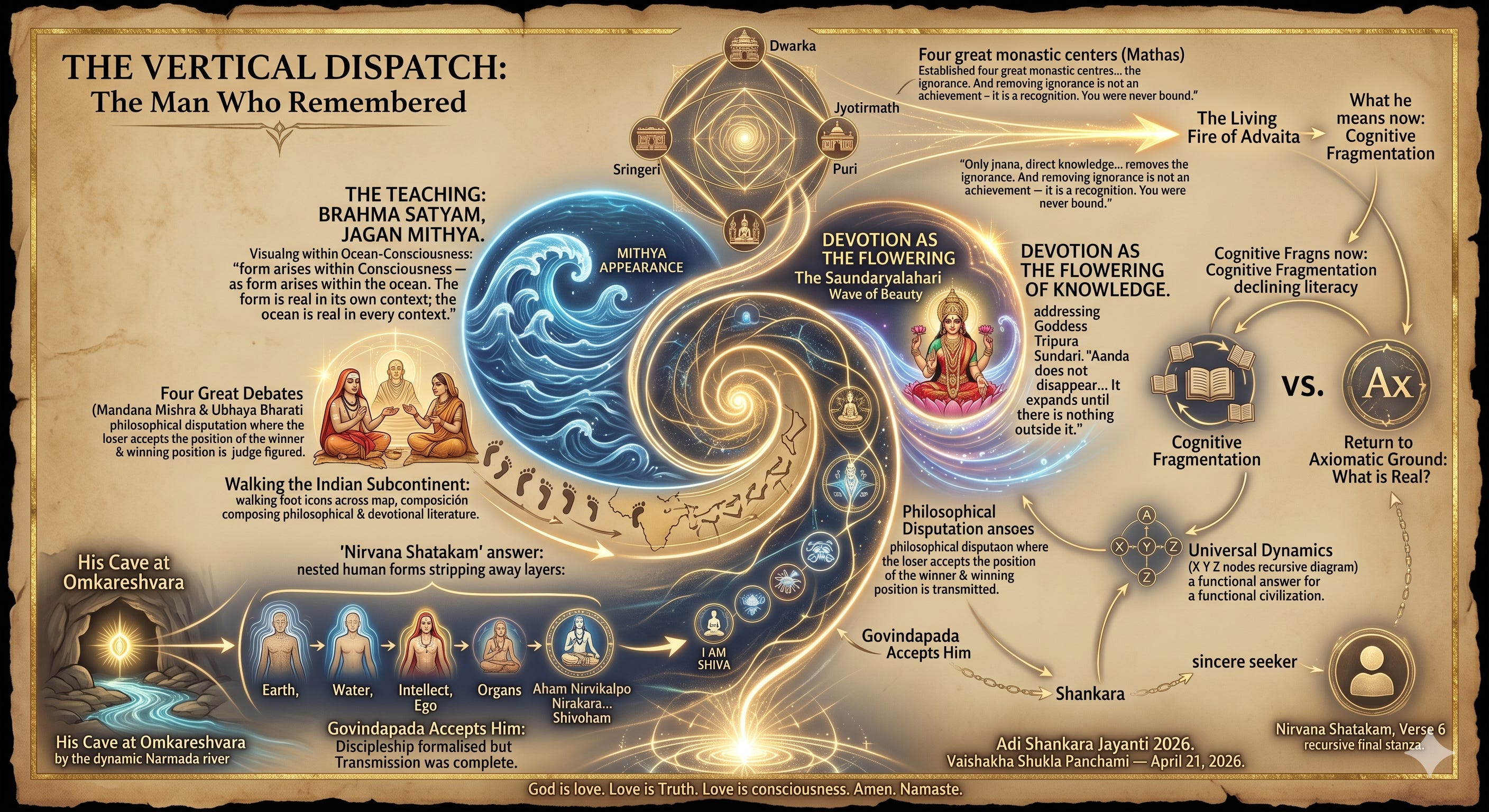
Adi Shankaracharya was thirty-two years old when he died. In those thirty-two years he walked the length and breadth of the Indian subcontinent on foot, composed some of the most luminous philosophical and devotional literature in human history, defeated every major school of thought in open debate, and established four great monastic centres — the Mathas at Sringeri, Dwarka, Puri, and Jyotirmath — that continue to transmit the living fire of Advaita to this day. He did all of this before most people have decided what they want to do with their lives.
Today, on his 2,535th Jayanti, it is worth pausing to ask: what exactly did he give us?
The Crisis He Was Born Into
The eighth century CE was, in the language of the Vedic tradition, a period of adharmic fragmentation. Buddhism and Jainism had drawn hundreds of thousands away from the Vedic understanding, not through conquest but through genuine philosophical and ethical appeal. Within the Vedic house itself, ritualism had calcified into mechanical performance severed from its metaphysical ground. The Upanishadic wisdom — that luminous body of insight into the nature of consciousness accumulated over centuries — was being interpreted in contradictory, often incompatible ways. The thread connecting ritual practice to ultimate understanding had frayed badly.
Shankara’s response to this crisis was not political, not military, and not merely theological. It was cognitive. He returned to the primary texts — the Upanishads, the Brahma Sutras, the Bhagavad Gita — and wrote commentaries of such clarity and penetrating force that the ground shifted beneath every competing interpretation. His Bhashyas are not commentary in the academic sense. They are transmission. Every major concept is traced back to its experiential root, every apparent contradiction resolved not by clever argument but by demonstrating the level of understanding at which the contradiction dissolves.
This is what it looks like when a jnani — one established in direct recognition of the Self — speaks about the Self.
The Teaching: Brahma Satyam, Jagan Mithya
Brahma satyam, jagan mithya, jivo brahmaiva naparah.
Brahman alone is real. The world is appearance. The individual soul is none other than Brahman itself.
This is not a statement of nihilism. The world is not declared non-existent — it is declared mithya, which means not independently real, not the final word. It arises within Consciousness as form arises within the ocean. The form is real in its own context; the ocean is real in every context. Advaita does not dismiss the world — it locates it correctly.
The individual sense of being a separate self — the jiva imprisoned in the cycle of birth and death, straining against its own finitude — Shankara showed to be a case of mistaken identity so fundamental that it cannot be corrected by any amount of ethical improvement, ritual performance, or devotional fervour, however sincere. Only jnana, direct knowledge of what one actually is, removes the ignorance. And removing ignorance is not an achievement — it is a recognition. You were never bound. The bondage was the not-knowing.
What makes Shankara’s formulation so precise — so almost mathematically compelling — is that it does not ask you to accept a metaphysical claim on faith. It asks you to look. Who is looking? Follow that question to its ground and you find not a person, not a body-mind, not a historical individual born in Kerala in the eighth century or Ontario in the twentieth — you find awareness itself, prior to all description, the witness that cannot be witnessed because it is the witnessing.
This is the discovery Shankara is pointing at. Not a doctrine. A fact.
The Great Debates
Shankara did not sit quietly and compose. He went out looking for the sharpest minds in India and engaged them directly in the ancient tradition of shastrartha — philosophical disputation where the loser accepts the position of the winner and the winning position is transmitted through the lineage.
His most famous encounter was with Mandana Mishra, a great Mimamsa scholar who believed the Vedic path was primarily one of action and ritual rather than knowledge, and whose wife Ubhaya Bharati served as the judge — herself a formidable scholar and, according to the tradition, an incarnation of Saraswati. The debate lasted weeks. Shankara prevailed. Mandana Mishra became Sureshvaracharya, one of Shankara’s four principal disciples and the first head of the Sringeri Matha.
What strikes the modern reader about these accounts is not the competitiveness but the seriousness. The stakes were considered ultimate. To defeat an opponent in such a debate was not to humiliate them — it was to free them from a position that was keeping them from the truth. There is a quality of genuine love in that orientation that has nothing to do with sentimentality.
The Stotras: Devotion as the Flowering of Knowledge
One of the most beautiful paradoxes in Shankara’s legacy is that the great philosopher of non-dualism — the man who demonstrated with surgical precision that the individual self and the Absolute are identical — was also the composer of the most exquisite devotional poetry in the Sanskrit tradition.
His Saundaryalahari — the Wave of Beauty — addressed to the Goddess Tripura Sundari, is a work of such concentrated aesthetic and philosophical power that it has been commented upon continuously for twelve centuries and remains inexhaustible. His stotras to Shiva, to Vishnu, to Devi, to Ganesha, to the Narmada, to the Ganga — these are not the productions of a man who considered the Devatas to be mere symbols or pedagogical conveniences. They breathe with genuine love.
The resolution of this apparent contradiction is the key to understanding Advaita fully. When you recognize that the Absolute is your own nature, worship does not cease — it deepens beyond recognition. The devotee, the act of devotion, and the object of devotion are not collapsed into grey uniformity; they are revealed as three faces of a single love that the universe has for its own inexhaustible reality. The Saundaryalahari is not a contradiction of the Brahmasutra Bhashya. It is the same recognition expressed through the heart rather than the intellect.
Ananda does not disappear in non-dual recognition.
It expands until there is nothing outside it.
The Cave at Omkareshvara
Before Shankara became the Jagadguru — the teacher of the world — he was a young sannyasi who had left his widowed mother in Kerala, renounced the householder life, and made his way to the banks of the Narmada river. At Omkareshvara, one of the twelve great Jyotirlingas where the light of Shiva is said to be self-luminous rather than consecrated, he found his guru.
Govindapada — himself a disciple of Gaudapada, the great commentator on the Mandukya Upanishad — was sitting in samadhi in a cave beside the river when the young Shankara arrived. The tradition records that Govindapada opened his eyes, saw the boy, and asked: “Who are you?”
Shankara’s reply, spontaneous and complete, became the seed of his entire philosophical edifice — the Nirvana Shatakam, or Atma Shatakam: six stanzas of absolute self-disclosure that strip away every possible identification until what remains is the recognition of one’s own nature as pure, unmixed, unchanging awareness. It is perhaps the most compressed and perfect piece of non-dual writing in any language.
I am not earth, not water, not fire, not air, not space. I am not mind, not intellect, not ego. I am not the organs of action, not the organs of perception. I am pure Consciousness, I am Shiva. I am Shiva.
Govindapada accepted him as a disciple. The transmission was already complete. What followed was its formal consecration.
What He Means Now
We are living through a period of cognitive fragmentation that has structural similarities to the eighth century. The instruments for accumulating and transmitting knowledge have proliferated beyond any previous historical precedent, while the quality of understanding — deep understanding, the kind that integrates rather than merely aggregates — is in measurable decline. We have more information and less wisdom than at almost any point in the literate tradition.
The PIAAC data tells a stark story: literacy at the levels required for genuine philosophical or scientific engagement is now the possession of a small and shrinking minority in every developed nation. Meanwhile, the tools we are building to augment intelligence are trained primarily on the output of that declining literacy. The feedback loop is visible to anyone who cares to look.
Shankara’s answer to fragmentation was not more information. It was a return to the axiomatic ground. What is real? What is the nature of the knowing that encounters reality? What is the relationship between the knowing subject and the ultimate subject — Consciousness itself?
These are not ancient questions rendered obsolete by modern science. They are the questions that modern science, philosophy, and governance will eventually be forced to confront directly, because they are the questions about what we are, and no civilization can indefinitely sustain a coherent direction without some functional answer to that question.
Universal Dynamics — the framework I have been developing for thirty years — is, in one reading, an attempt to give those questions the kind of axiomatic treatment that Shankara gave the Brahma Sutras: precise notation, falsifiable gates, a map between the structure of consciousness and the structure of the world that can be traversed in either direction. Whether or not that project succeeds, the orientation is Shankara’s: begin with consciousness, not matter. Everything else follows.
A Word About the Stotras
I want to close with a reflection on his devotional compositions, because I think they carry something his philosophical works, magnificent as they are, do not fully express.
The stotras are written in the voice of love. Not the distant love of a realized being regarding beings still in bondage — there is no condescension in them — but the love of one who has recognized the Beloved in everything and cannot stop singing about it. The Bhaja Govindam, which he composed in a burst of inspiration when he saw an elderly Brahmin laboriously memorizing Sanskrit grammar, is addressed to everyone: “Seek Govinda, seek Govinda, seek Govinda, O fool. When the hour of death comes, grammar rules will not save you.”
This is not cruelty. It is the deepest compassion: the recognition that the thing we are working so hard for — the thing we are accumulating, perfecting, securing — it will not serve us at the frontier. What serves us there is the one thing that cannot be taken, because it is what we actually are.
His address to Tripura Sundari is different in register — it is the speech of a lover to the Beloved who is also the ground of all existence, the one whose glance is creation itself, whose smile is the beauty that makes the world worth the journey of appearing. In that stotra, non-dualism does not feel like a cool philosophical achievement. It feels like the reason the universe bothered to exist.
Shankara understood both of these things. That is why he is called Jagadguru.
On this 2,535th Jayanti, I bow to the tradition that flows from Govindapada through Shankara to the four Mathas and into every sincere seeker who has ever sat in silence and asked: who am I?
The answer was always waiting.
Nirvana Shatakam — Verse 6
Aham nirvikalpo nirakara rupa
Vibhutvaca sarvatra sarvendriyAnam
Na cAsangatam naiva muktir na bandhah
CidAnanda rupah Sivo’ham Sivo’ham
I am without thought, without form.
I pervade all things, I am the ground of all senses.
I am neither liberation nor bondage.
I am pure consciousness and bliss — I am Shiva, I am Shiva.
Glennford Ellison Roberts Author — Sacred Metaphysics & Consciousness: History of the Absolute & Eternal Cumberland, Ontario, Canada
God is Love. Love is Truth. Truth is Consciousness. Consciousness is Brahman.
Amen. Namaste.. 🙏
#AdiShankara #AdvaitaVedanta #ShankaraJayanti #TheVerticalDispatch #TheArchitect #SacredMetaphysics #Consciousness #NonDualism #Brahman #Atman #UniversalDynamics #Upanishads #BhagavadGita #NirvanaShatakam #JnanaYoga #Bhakti #Metaphysics #SelfRealization #AncientWisdom #Jagadguru #SpiritualAwakening #CognitiveIntegrity #FirstPrinciples #TheAbsolute #April2026 #Jayanti2535 #Saundaryalahari #VedicKnowledge #Omkareshwara #AdvaitaPhilosophy
Brilliant..🙏🙏🙏