


Φ
THE VERTICAL DISPATCH
We write for the mind, the eye, and the ear.
Read it. Look at it. Listen to it. The Vertical Dispatch is built for all three — prose with rhythm, made to be heard as much as read.
From metaphysics to geopolitics, from culture to history, from the sacred to the street — and everything in between. One lens, every subject. No ego. Just the record, named clean.
Press play. Walk with the Word. 🕯️
The Age of Consequences
As of June 9, 2026
— The Dispatch —
“A society grows great when old men plant trees in whose shade they will never sit.”
— Greek proverb
There is a reductionism at work in the first-anniversary commentary on the Carney government, and it needs naming. It goes like this: the government was elected on economic anxiety, therefore its legitimacy will be measured week by week against the price of groceries and the size of the next paycheque. If the number goes up, he’s governing. If it doesn’t, he’s failing.
This is a checkers reading of a Go mandate.
The record of the election itself says otherwise. The 2025 campaign was not fought over grocery receipts. It was dominated by the trade war with the United States and centred on one question: who was best positioned to handle the relationship with a mercurial American president and the economic turbulence of his tariffs. That was the board Canadians were looking at when they marked their ballots on April 28, 2025. A year later, Carney has led national polling all year as the leader Canadians consider most capable of managing that relationship — and the July review of CUSMA, the continental trade architecture itself, is now weeks away.
That is the mandate. Sovereignty. The trade relationship. The question of whether Canada remains a country that sets its own terms. What Canadians expressed in that election was not a transaction — not “give me $20 more next Friday and we’re square.” It was a demand for a believable future, and they handed it to the candidate who named that horizon rather than the one who named their grievances.
Horizons don’t poll well on a Tuesday. They don’t show up in next week’s payroll deposit. They live in the long arc — in decisions made now about industrial capacity, trade architecture, energy, and the institutional nerve of a country that very nearly lost it.
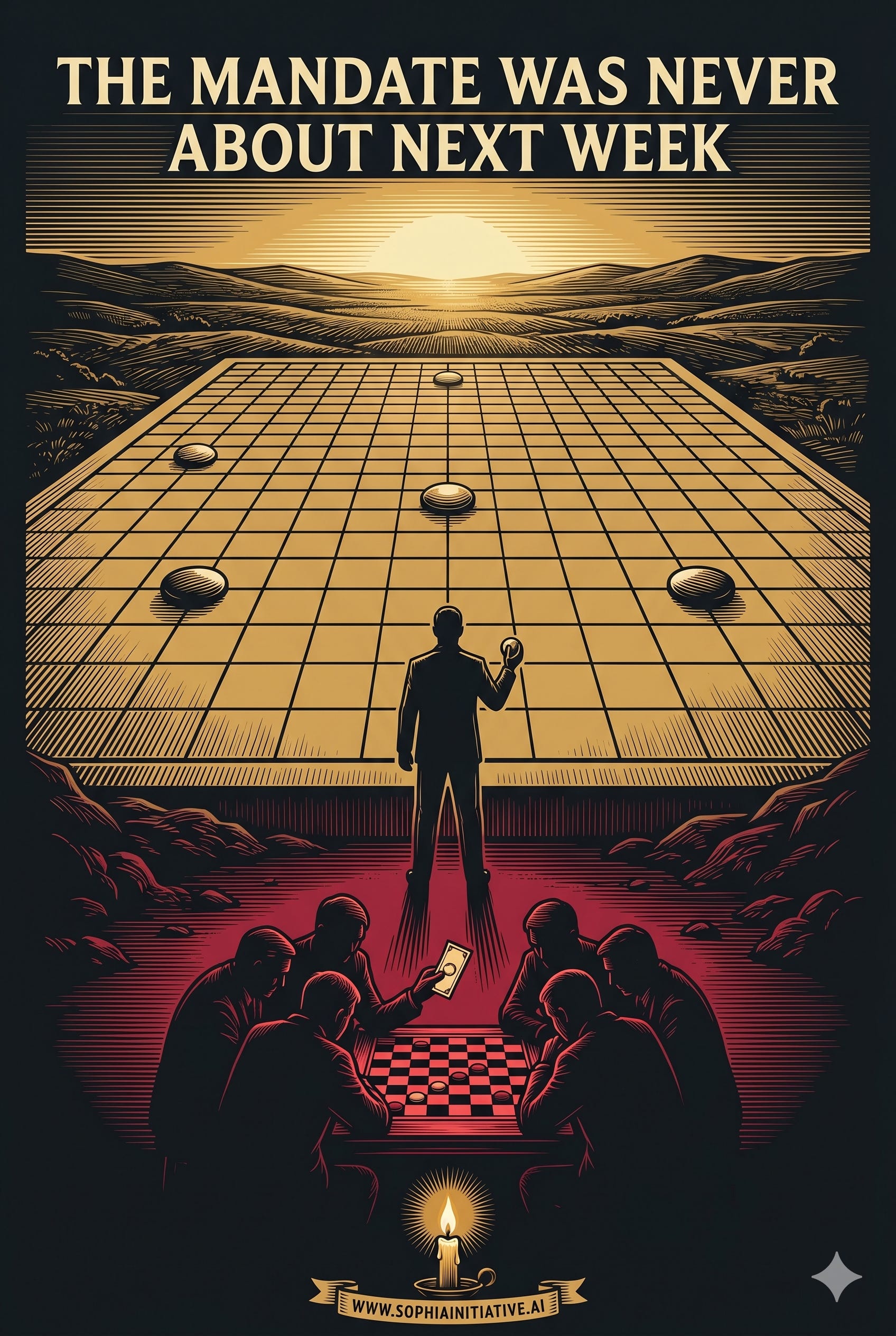
The Scorecard Has Migrated
Watch what has happened in the year since. The Angus Reid Institute’s first-year report card finds 70 per cent of Canadians saying the government has fallen short on the cost of living, and 67 per cent saying it missed the mark on housing affordability — while the same poll gives the government a passing grade on the international file, the very file the election was fought on. Abacus Data finds the rising cost of living the top priority for two-thirds of Canadians, with Donald Trump now ranked fifth.
The mandate was issued on the sovereignty question. The evaluation has migrated to the payroll question. That migration is the whole story, and almost no one in the commentary is naming it.
The Concession the Argument Requires
Honesty requires this paragraph, so here it is. The checkers scorecard was not purely a punditry invention. The Liberals themselves pledged the “most ambitious housing plan since the Second World War” — and housing starts fell six per cent last month. The Prime Minister himself, jousting with the Opposition leader on the Commons floor, claimed affordability is “the best it’s been in over a decade” — a claim now being picked apart, fairly, province by province, kitchen table by kitchen table. The government printed some of these score sheets itself. When you play on the weekly board, you invite the weekly audit.
So the argument here is not that the government is above the affordability question. Families are not wrong to feel what they feel, and the record says they feel it: food prices up 44 per cent over the decade against 29 per cent for everything else. The argument is narrower and harder: that the affordability ledger, real as it is, was not the mandate — and that collapsing the mandate into the ledger is a category error that serves the opposition’s frame, not the country’s interest.
Transformation Has a Lag
Transformational governance does not settle in a news cycle. You do not rebuild sovereign industrial capacity over a long weekend. You do not reorient a continental trade relationship — with the CUSMA review bearing down in July — between polling updates. You do not restore a generation’s faith in their country’s future by next Friday.
What you do, if you are governing at the right level, is hold the line. You keep the architecture visible. You resist the gravitational pull toward the small and the immediate. And — this is the part the concession demands — you stop volunteering claims the kitchen table can falsify. The horizon defends itself if you let it. The weekly boast does not.
The stakes have risen, not fallen. The government now holds a majority, secured through floor crossings and byelection wins in Ontario and Quebec. The “no excuses” frame is coming, and it will arrive wearing the $20 question as its mask.
The question was never whether Carney can deliver $20 more next week.
The question is whether he — and we — can resist the frame that insists that’s what we asked for.
God is Love. Love is Truth. Truth is Consciousness. Consciousness is Brahman.
Amen. Namaste. Om Namah Shivaya.
— The Architect
The Vertical Dispatch
sophiainitiative.ai
On the record: Angus Reid Institute, first-year report card on the Carney government — 70% say the government fell short on cost of living; 67% on housing affordability; passing grade on international relations; Carney leading all year as the leader considered most capable of managing the U.S. relationship ahead of the July CUSMA review (via The Globe and Mail, April 29, 2026). Abacus Data, federal tracking, May 28–June 2, 2026 — cost of living top priority at 66%, economy 39%, healthcare 34%, housing 33%, Trump fifth at 32%. Liberal housing pledge (“most ambitious housing plan since the Second World War”) and housing starts down 6% last month (Canada Mortgage and Housing Corporation, via The Globe and Mail). Prime Minister’s Commons-floor claim that “affordability’s the best it’s been in over a decade” (House of Commons exchange with the Leader of the Opposition, April 2026; verify exact sitting day against Hansard before republication). Food prices up 44.1% 2014–2025 against 28.8% for all other consumer prices (Fraser Institute, citing Statistics Canada). Canada Food Price Report 2026. Majority secured via floor crossings and byelection wins in Ontario and Quebec (public record, 2026). Election date and campaign framing: April 28, 2025; campaign dominated by the trade war and the question of managing the U.S. relationship (The Globe and Mail). This Dispatch judges frames and structures, never individuals. Date-stamped June 9, 2026. Errors and omissions excepted; corrections will be made on notice. Verify all figures against primary sources before republication.
#TheMandateWasNeverAboutNextWeek #Canada #MarkCarney #CanadianPolitics #Sovereignty #CUSMA #Affordability #GoNotCheckers #TheAgeOfConsequences #TheVerticalDispatch #TheArchitect #SophiaInitiative #GodIsLove #LoveIsTruth #OmNamahShivaya
Suggested tags: Canada, politics, Carney, economy, trade, public policy
Substack Notes — The $20 Distraction
There’s a reductionism in the first-anniversary commentary that needs naming.
Canadians didn’t vote for Mark Carney because they expected an extra $20 in next week’s paycheque. The record of the 2025 campaign is plain: it was fought on the trade war, on Trump, on whether Canada sets its own terms. That’s the mandate.
A year on, the scorecard has migrated to the payroll question — 70% say the government fell short on cost of living. The affordability pain is real, and the government invited some of the audit with its own promises. Concede that.
But a Go mandate is being evaluated on a checkers scorecard, and almost no one is naming the migration.
Transformational governance has a lag. The CUSMA review is in July. The mandate was never about next week.
Thread — Five Posts
[1] Canadians didn’t vote for $20 more in next week’s paycheque. The 2025 election was fought on the trade war, on Trump, on sovereignty. That’s the mandate. Don’t let the punditry collapse a Go mandate into a checkers scorecard.
[2] One year on, the record shows the migration: the election was won on the international file — the same file where the government still earns its passing grade. But 70% now grade it weekly on the grocery bill. The mandate was issued on one board. The evaluation moved to another.
[3] Fair is fair: the government printed some of those score sheets itself. “Most ambitious housing plan since the Second World War.” “Affordability’s the best it’s been in a decade.” Play on the weekly board, invite the weekly audit.
[4] But transformational governance has a lag. You don’t rebuild industrial sovereignty in a news cycle. You don’t reorient continental trade — CUSMA review in July — between polling updates.
[5] The question was never whether Carney could deliver $20 more next Friday. The question is whether we — and he — can resist the frame that insists that’s what we asked for. The mandate was never about next week.
The factual matter in this Dispatch is drawn from the public record. All characterizations, inferences, and conclusions are opinion, interpretation, and commentary, offered for analysis, reflection, and public-interest discussion. No assertion is made regarding the private intentions, state of mind, or character of any individual. Readers should evaluate all statements independently and draw their own conclusions.
You're shining the light in the right direction. "Transformational governance does not settle in a news cycle. You do not rebuild sovereign industrial capacity over a long weekend."
Even a four-year governing term is very short relative to the speed CDNs need to engage and participate to change historical economic focus. Becoming a building/manufacturing economy rather than solely extraction.
"Don’t let the punditry shrink it." and "But a Go mandate is being evaluated on a checkers scorecard ..."
The press, quite some time ago, allowed themselves to be drawn down to the level of an opposition that can do nothing but oppose. Their purpose has become, not to expose and inform, but simply to profit, which requires only that they stir up more attention by whatever means necessary to prove to their advertisers that people are reading what they write.
"... and almost no one is naming the migration."
Who is left to do so, but writers on alternative media sites?