

The Mandukya Upanishad is twelve verses. The shortest of all the principal Upanishads and by the testimony of the tradition itself — recorded in the Muktika Upanishad — sufficient alone for liberation.
Adi Shankaracharya’s commentary on the Mandukya, together with Gaudapada’s Karikas, forms the foundational textual architecture of Advaita Vedanta. It is the most precise single account of the nature of consciousness available in the Sanskrit tradition. What follows is the complete twelve verses with the essential philosophical substance of Shankara’s commentary on each — the living transmission rather than the letter.
INVOCATION
Om. May we both be protected. May we both be nourished. May we both work together with great energy. May our study be illuminating. May there be no hatred between us. Om. Peace. Peace. Peace.
Shankara’s note on the invocation: The threefold repetition of Shanti — peace — is the dispelling of the three classes of obstacle: those arising from the elements, those arising from other beings, and those arising from within oneself. The text begins not with argument but with the removal of obstruction to the transmission.
VERSE 1
Harih Om. Om, the word, is all this. A clear explanation of it is as follows: All that is the past, the present and the future, is verily Om. And whatever is beyond the three periods of time, that also is truly Om.
Shankara’s commentary: The text opens by declaring the identity of the syllable Om with the totality of existence — not merely the totality of sound but the totality of what is. Shankara emphasises that the word sarvam — all this — is not a hyperbole but a precise ontological claim. The past, present and future are the three divisions of time. But Brahman is beyond time itself. Therefore Om points at both the temporal and the beyond-temporal simultaneously. The syllable is the z₁ through which the x₀ that is beyond all division can be approached. The word Om is not itself Brahman. It is the most precise available pointer at Brahman. This is the governing axiom — the symbol is not the referent. Shankara states it in the first verse so that nothing that follows can be mistaken for a claim that the syllable IS the Absolute rather than pointing at it.
VERSE 2
All this is verily Brahman. This Atman is Brahman. This Atman has four quarters.
Shankara’s commentary: The transition from Om to Atman is the central move of the text. The statement Ayam Atma Brahma — this Atman is Brahman — is one of the four Mahavakyas, the great sayings that carry the complete weight of the Advaita recognition. Shankara notes that this Atman — the one being pointed at here, the awareness of the reader in this moment — is identical with Brahman, the ground of all existence. Not similar. Not in relationship with. Identical. The four quarters are then introduced not as four separate aspects of the Atman but as four modalities through which the single undivided Atman expresses itself in the field of conscious experience.
VERSE 3
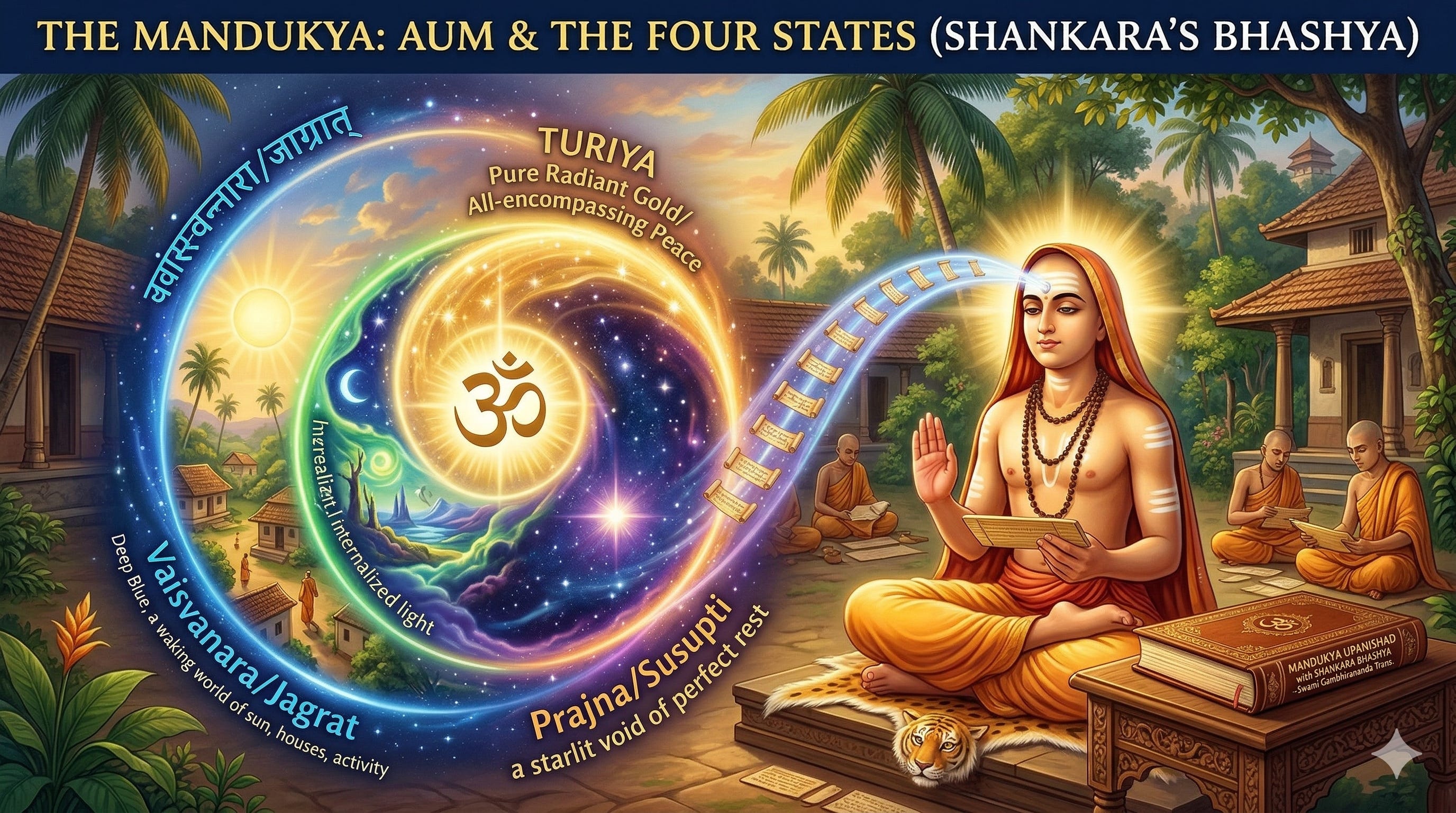
Vaishvanara, whose sphere of action is the waking state, who is conscious of external objects, who has seven limbs and nineteen mouths, who experiences gross objects, is the first quarter.
Shankara’s commentary: The waking state is the state of ordinary experience — the consciousness that navigates the external world through the nineteen instruments: five organs of perception, five organs of action, five vital forces, the mind, the intellect, the ego and the storehouse of memory. The seven limbs are the macrocosmic correspondences — the physical elements of the cosmos expressing themselves through the individual body. Shankara notes that Vaishvanara — the name deriving from the root meaning universal — is not merely the individual waking consciousness but the universal waking principle expressing itself through every individual waking body simultaneously. The waking state is real at its own level. It is not to be dismissed. But it is not the ground. It is the z₁.
VERSE 4
Taijasa, whose sphere of action is the dream state, who is conscious of internal objects, who has seven limbs and nineteen mouths, who experiences subtle objects, is the second quarter.
Shankara’s commentary: The dreaming state reveals something that the waking state conceals — that the objects of experience are generated by consciousness itself rather than received from an external world. In the dream the mind creates mountains, rivers, cities, other people — entire worlds of apparently solid experience — from within itself alone. Shankara points out that this is not merely an observation about dreams. It is the key to understanding the waking state. If consciousness can generate a fully convincing world of experience in sleep, what reason is there to be certain that the waking world is not equally a generation of consciousness? Taijasa — from the root for luminous — is consciousness shining its own light inward rather than outward. The dream state is the second quarter not because it is inferior to the waking state but because it reveals the productive power of consciousness more nakedly.
VERSE 5
Prajna, in whom everything becomes unified, who is filled with knowledge, who is made of bliss, who experiences bliss, whose mouth is consciousness, who is the lord of all, who is the knower of all, who is the inner ruler, who is the source of all, who is the beginning and end of all beings, is the third quarter.
Shankara’s commentary: In deep dreamless sleep the nineteen instruments of the waking and dreaming states dissolve. The multiplicity of experience — all the objects, all the relationships, all the transactions of waking and dreaming — is absorbed into a single undifferentiated mass of consciousness. Prajna — from the root for knowing — is pure knowing without an object. Shankara identifies this state as the closest ordinary experience of the Absolute available without specific practice or specific discipline. Every night every human being dissolves into this state. And every night every human being emerges from it refreshed — not because they did anything in the deep sleep but because the contact with the ground that the dissolution permits is itself the source of the vitality that the waking state requires. Prajna is the lord of all in the sense that it is the state from which all other states arise and to which they return.
VERSE 6
That which is not conscious of the internal world, nor conscious of the external world, nor conscious of both, not a mass of consciousness, neither conscious nor unconscious, unseen, beyond all transaction, beyond the grasp of the senses, uninferable, unthinkable, indescribable, whose essential nature is the certitude of the oneness of itself, in whom all phenomena cease, who is tranquil, auspicious, non-dual — that is the fourth. That is the Atman. That is to be realised.
Shankara’s commentary: This is the verse that stands as the governing standard of the entire transmission. Shankara’s commentary on Verse 6 is among the most sustained and most precise passages in the entire Advaita literature. He notes that Turiya — the fourth — is not a fourth state alongside the other three. It is the ground from which the other three arise and to which they return. The systematic negation — not this, not this, not this — is the application of the Neti Neti method to the three states themselves. Turiya cannot be described by what it is because every description fixes it as an object and Turiya is not an object. It is the subject — the pure witnessing awareness — in which every object of every state appears and disappears. Shankara emphasises that Turiya is not a state to be attained through practice. It is the ever-present ground that is already the nature of the Atman. What prevents its recognition is not its absence but the obscuration produced by the activity of the nineteen instruments operating in waking and dreaming and the absorption in undifferentiated bliss in deep sleep. Turiya is shiva — auspicious, benign — because it is the ground of all wellbeing. And it is advaita — non-dual — because there is nothing outside it that could constitute a second. The final instruction — that is to be realised — is the instruction of the entire Upanishad compressed into four words.
VERSE 7
From the standpoint of the syllable, the same Atman which has been described is Om. Viewed from the standpoint of its parts, the quarters are the letters and the letters are the quarters. The letters are A, U, M.
Shankara’s commentary: Having established the four quarters of the Atman in Verses 2 through 6, the text now performs its most elegant move — mapping the three letters of Om onto the three states, with the silence after Om corresponding to Turiya. Shankara notes that this mapping is not arbitrary. The letter A is produced at the back of the mouth — the origin of sound, the most open and most basic of phonetic positions. It corresponds to the waking state — the most basic and most open engagement with the world. U rises from the back toward the middle — the movement of consciousness inward. M closes at the lips — the final closure into deep sleep. And the silence after the resonance of M — the silence that remains when the sound has fully dissolved — is Turiya. The syllable Om is therefore a complete map of consciousness — from the most external engagement to the most complete withdrawal to the silence that was always prior to the sound.
VERSE 8
The waking state, Vaishvanara, is the letter A, the first part of Om, from the root Apti, meaning pervasiveness, or from Adimatva, meaning being the first. Whoever knows this, attains the fulfilment of all desires and becomes the first.
Shankara’s commentary: The letter A pervades all other letters — no sound can be produced without some form of the A vowel at its foundation. This is why it corresponds to the waking state, which pervades and underlies all ordinary human experience. Shankara notes that the fruit offered — the fulfilment of desires — is not the primary teaching but the hook that makes the teaching receivable. The real attainment is the recognition of the A as the ground of all sound, which corresponds to the recognition of the waking state as the first available modality of the Atman.
VERSE 9
The dreaming state, Taijasa, is the letter U, the second part of Om, from the root Utkarsha, meaning exaltation, or from Ubhayatva, meaning intermediateness. Whoever knows this, advances in knowledge and is treated equally by all. In his lineage, no one is born who is ignorant of Brahman.
Shankara’s commentary: U elevates — it rises from the position of A toward the closed position of M, just as the dreaming consciousness rises from the engagement with the external world toward the more interior and more subtle processing of the dream state. Shankara emphasises that the dreaming state is intermediate — it stands between the external engagement of waking and the complete dissolution of deep sleep — and this intermediacy is itself philosophically productive. The dream reveals the interior creative power of consciousness in a way that waking does not. Those who truly understand the U — who recognise the dream state as the revelation of consciousness’s generative power — carry that recognition into their lineage.
VERSE 10
The deep sleep state, Prajna, is the letter M, the third part of Om, from the root Miti, meaning measure, or from Apiti, meaning merging. Whoever knows this, measures all this and merges all this.
Shankara’s commentary: M closes the mouth — the final absorption of the sound back into silence, just as deep sleep absorbs all the activity of waking and dreaming back into the undifferentiated ground. Shankara notes that the one who knows this — who truly understands the M, who recognises deep sleep not as unconsciousness but as the absorption of consciousness into its own ground — becomes the measurer of all. Not in the sense of intellectual mastery but in the sense of having access to the ground from which all measurement proceeds. To know the M is to know the return. To know the return is to know the source from which everything departs and to which everything comes back.
VERSE 11
The fourth is that which has no letter. It is beyond transaction. Into it all phenomena merge. It is auspicious. It is non-dual. Thus Om is verily the Atman. One who knows this merges the self into the Self.
Shankara’s commentary: The silence after Om is not merely the absence of sound. It is the ground that makes all sound possible — the x₀ from which A and U and M arise and to which they return. Shankara states that the fourth — Turiya — corresponds to the silence not because silence and Turiya are identical but because silence is the best available acoustic pointer at the reality that precedes and grounds all acoustic phenomena. The identification of Om with the Atman is now complete — not merely symbolic but ontological. Om is not a symbol for the Atman. Om is the Atman expressed in the minimum available sonic form. The instruction — one who knows this merges the self into the Self — is the practical instruction. The lowercase self is the individual consciousness operating through the three states. The uppercase Self is the Atman — Turiya — the ground. Merging is not destruction. It is recognition. The wave recognising it was always the ocean.
VERSE 12
That which has no parts, beyond all transaction, the cessation of phenomena, auspicious and non-dual — thus Om is verily the Atman. One who knows this merges the self in the Self.
Shankara’s commentary: The final verse repeats the essential teaching in its most compressed form. Shankara notes that the repetition is not redundancy. It is the sealing of the transmission. The Upanishad ends where it began — with the identity of Om and the Atman and the instruction to know this. The circularity is intentional. The Mandukya does not begin at a problem and arrive at a solution. It begins at the Absolute and returns to the Absolute. The journey through the twelve verses is not the acquisition of new information. It is the recognition of what was always already the case. The self that reads the final verse is the Self that was always the ground of the reading.
Here ends the Mandukya Upanishad with the Commentary of Shankara.
That is to be realised. 🙏
Glen Roberts is a metaphysician, author, and independent researcher. He is the author of Sacred Metaphysics Volume 1 and the architect of Project
2046.#MandukyaUpanishad #Turiya #AdiShankaracharya #Advaita #NonDuality #Consciousness #OUM #Upanishads #FourStatesOfConsciousness #Meditation #Vedanta #SelfRealization #DeepSleep #DreamState #WakingWorld