

Φ
THE VERTICAL DISPATCH
We write for the mind, the eye, and the ear.
Read it. Look at it. Listen to it. The Vertical Dispatch is built for all three — prose with rhythm, made to be heard as much as read.
From metaphysics to geopolitics, from culture to history, from the sacred to the street — and everything in between. One lens, every subject. No ego. Just the record, named clean.
Press play. Walk with the word. 🕯️
This dispatch travels by hand. If it serves you, share it — restack on Substack, and pass it on wherever you read. 🕯️
The Age of Consequences · Canadian Geopolitical Analysis
June 14, 2026 — the day the Prime Minister came home to Aughagower. Volatile facts date-stamped as of this day.
In the baptismal register of the parish church at Aughagower, in County Mayo, on the west coast of Ireland, there is a name written in another hand than its owner’s. It belongs to the great-grandfather of the Prime Minister of Canada, and beside it, where a signature should be, there is a single mark: an X. The man could not write his own name. This morning, four generations and a century later, his great-grandson — a former governor of the Bank of England and the Bank of Canada, a man who commands the most rarefied language of global finance, who signs strategic partnerships in the palaces of Europe — stood in that same church, having found that record, and spoke of the X. He has carried the image of it home with him. So should we, because that single mark holds more truth about this moment in the country’s life than a season of headlines.
This dispatch reads the homecoming the way the Canadian press did not. Our own national broadcaster gave the Mayo visit a sentence, folded inside a headline about a war and a summit, and noted — accurately, and tellingly — that the homecoming had “garnered the attention of Irish media.” It had. The Irish press read it correctly, because the Irish know how to read a field, a famine, and a baptismal record. The meaning of this homecoming came back to Canada from Ireland, because the outlet that should have carried it gave the country the fact and skipped the vector. We name the vector now.
Beside his great-grandfather’s name, where a signature should be, there is a single mark: an X. The man could not write his own name. Four generations later his grandson commands the language of two nations’ finances. That distance is the whole story.
THE X AND THE PEN
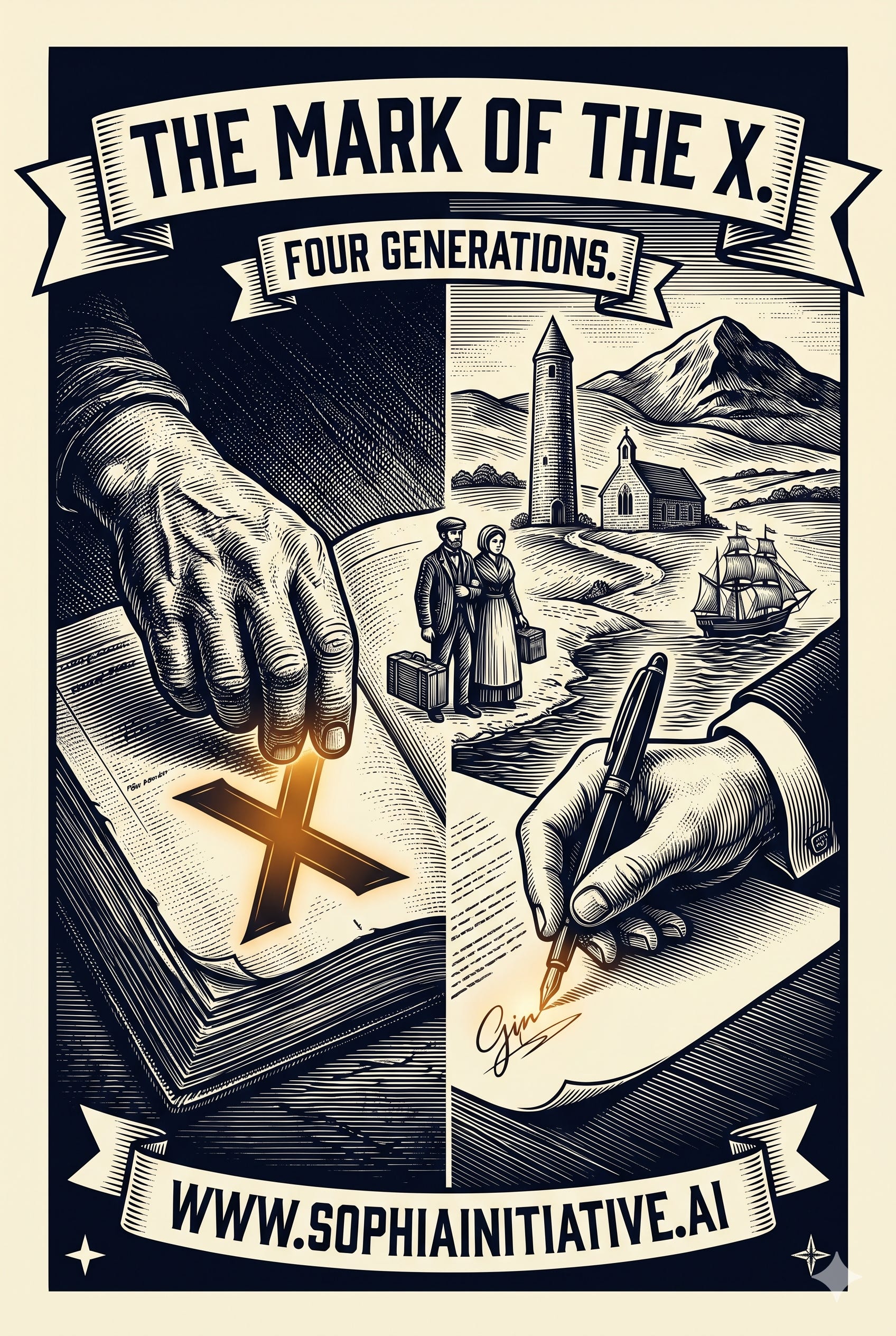
Begin with the distance the X measures, because it is the deepest thing here and the easiest to miss beneath the pageantry of a state visit. To sign with an X is not a quaint detail. It is the mark of a person to whom the written word — the instrument that runs law, money, contract, and power — was closed. In the Mayo of the nineteenth century, in the long shadow of the Great Famine, literacy was a thing the poor were largely denied, and the X in the register is the trace of that denial, made by a real hand that could shape no letters. From that hand to the hand that now signs Canada’s name to the security architecture of Europe is four generations — and the entire ascent of a family, and arguably of a civilisation, is written in the gap between the X and the pen.
This publication has spent its season on the distinction between the symbol and the referent — between the mark on the page and the reality it points at. Here the two collapse into one image. The X is a symbol that means the absence of the symbol’s power: a man locked outside the written word. The pen in his great-grandson’s hand is that power fully possessed, at the highest level a human being can possess it. And between them lies the referent that both marks finally point at: not finance, not literacy, but the thing those are only instruments of — a family’s climb out of dispossession into command, by way of a boat across the Atlantic in 1925 and three generations of work on the far shore. The Prime Minister keeps a map of this parish on his office desk. He found his grandfather’s baptismal record and was struck by the X. He is, whatever one thinks of his politics, a man who knows exactly what the gap between those two marks cost, and who measures himself against it.
The X is a symbol that means the absence of the symbol’s power. The pen is that power fully possessed. Between them lies the referent both point at: a family’s climb out of dispossession, by way of a boat in 1925 and three generations of work.
THE RUPTURE IN THE BLOOD
Carney has reached, repeatedly, for one word to describe the present moment in world affairs: rupture. Canada and Ireland, he said in Dublin this weekend, are two nations navigating a global rupture together. It is worth knowing that the word is not borrowed from a briefing paper. It is in his blood, by direct descent, and the people of Aughagower understand this about him better than the chancelleries do.
Consider what his grandparents were. Robert Carney, of the townland of Ayle, and Nora Moran, of nearby Mace, were reared in a parish still living the aftermath of the Famine — a catastrophe that had hollowed the west of Ireland and sent its people across the ocean in their millions. They came of age through the most violent rupture in modern Irish history: the War of Independence, whose fighting reached their own parish at the Carrowkennedy ambush of 1921, and the birth of the Irish Free State in 1922. Robert Carney became one of the earliest members of the new state’s police force, the Civic Guard — a man helping to build a sovereign state out of the wreckage of empire and famine. Then, in 1925, he and Nora did what the dispossessed of that place had done for generations: they left, crossed the Atlantic to Canada, and married the following year on the far shore. A local in Aughagower put it with a precision no policy analyst could improve: this man, he said of the Prime Minister, knows what it is not to have a state, knows what it is to grind out a new living without support, and carries an empathy and understanding of that in his bones.
Read his politics against that lineage and the consistency is striking, whatever one’s verdict on it. A man descended from people made by rupture — famine, emigration, the violent birth of a sovereign state — governs a country he insists is navigating a rupture of its own, and reaches by instinct for sovereignty, for the building of a state’s own capacity, for the refusal to be dispossessed by a larger neighbour. This is not offered as praise; a hostile reader may call it a convenient story a politician tells about himself, and that reading is available. But the documentary record — the parish, the Famine, the Civic Guard, the boat, the X — is real, and it is the soil the man grew from. He did not invent the word rupture. He inherited it.
He did not borrow the word rupture from a briefing paper. He inherited it — from a famine, a war, the birth of a state, and a boat across the Atlantic in 1925. A man made by rupture governs a country he says is living through one.
THE STATECRAFT BENEATH THE HOMECOMING
Strip away, for a moment, the baptismal register and the cousins and the Mass, and a hard piece of statecraft stands underneath, easy to lose in the warmth. This homecoming was the emotional centre of a deliberate European tour, and the tour is one continuous move. In Paris, Carney signed the security-and-intelligence architecture this publication examined — the keystone of the parapluie. In Dublin and Westport, he and the Irish government agreed to map a strategic and economic partnership, deepening ties across agri-food, digital innovation, artificial intelligence, pharmaceuticals, and climate, with Ireland set to ratify the long-operative CETA trade framework. Then onward to the G7 at Évian. Three capitals, one architecture: the patient diversification of a middle power’s partnerships away from dependence on a single coercive neighbour.
Ireland is a specific and shrewd piece on that board. It is the only native English-speaking member of the European Union — a common-law, English-speaking bridgehead into a continental, civil-law market — and it is the European base of much of the world’s technology and pharmaceutical industry. France handed Canada the defence keystone; Ireland offers the commercial-and-technological gateway to the single market. The honest complication, which this house names rather than smooths: Ireland’s prosperity rests substantially on hosting the very global corporate giants whose concentrated scale this publication has learned to watch with caution, and there is a real tension — worth holding as a question, not scoring as a charge — in binding Canada closer to the low-tax gateway built to house that scale. The bilateral trade runs about six billion dollars a year; the deeper prize is the EU foothold and the technology partnership. Two middle powers, both wary of being colonised — digitally, economically, militarily — by larger powers, finding each other across the Atlantic. The homecoming gave the move its heart; the framework gave it its spine.
WHAT THE CANADIAN PRESS GAVE, AND WHAT IT MISSED
Return, finally, to the gap this dispatch opened with, because it is the quiet lesson under the loud one. The facts of this visit were available to every outlet equally. The Canadian national broadcaster reported them: the grandparents, the renounced citizenship, the meeting with the Irish president, all true, all dutifully filed beneath a headline about the G7 and a war. What it did not do — what the Irish press did instinctively — was read the meaning. It was the Mayo News, RTÉ, the Irish Times, and a poet in Aughagower who found the X in the baptismal register and understood that it was the text. It was the locals who named the rupture in his blood. The meaning of a Canadian Prime Minister’s homecoming was reported to Canadians, in the main, by the Irish.
This is the vectorlessness this publication has named before — the legacy habit of delivering the facts stripped of the through-line that makes them matter, information without orientation, the dot on the page without the thing it points at. It is not that the broadcaster lied or failed to report; it is that it reported the X and did not see it. A country learns what it is by reading the meaning of its own moments, and a press that supplies only the facts leaves that meaning to be imported from abroad or lost entirely. The Vertical Dispatch exists for exactly this gap: to read the X as the text, the homecoming as the statement, the rupture in the blood as the key to the man holding the pen. The facts came from everywhere. The vector, this time, had to come home from Mayo.
The broadcaster reported the X and did not see it. A country learns what it is by reading the meaning of its own moments — and a press that supplies only facts leaves that meaning to be imported from abroad, or lost.
THE FIELD, THE FAMINE, AND THE PEN
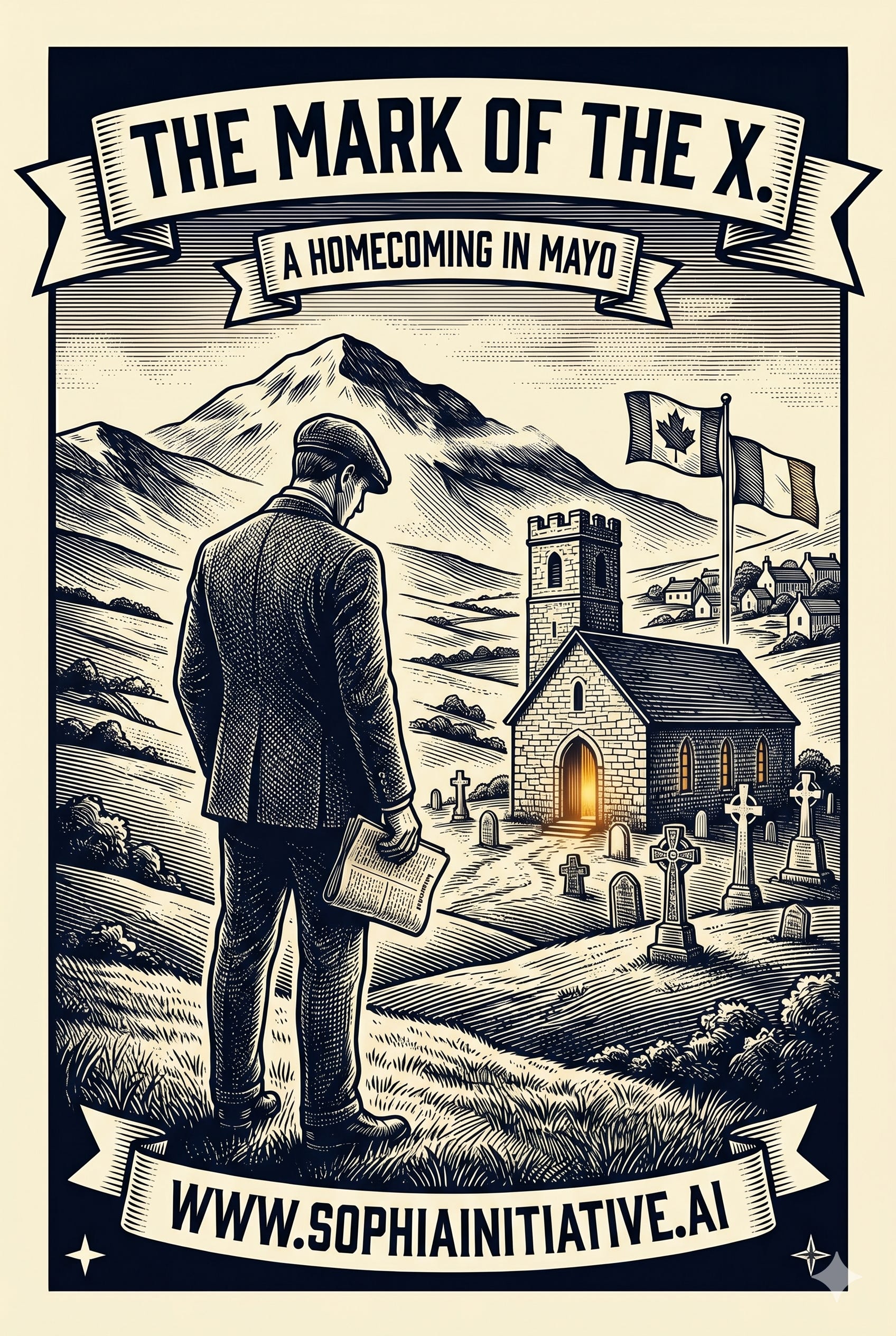
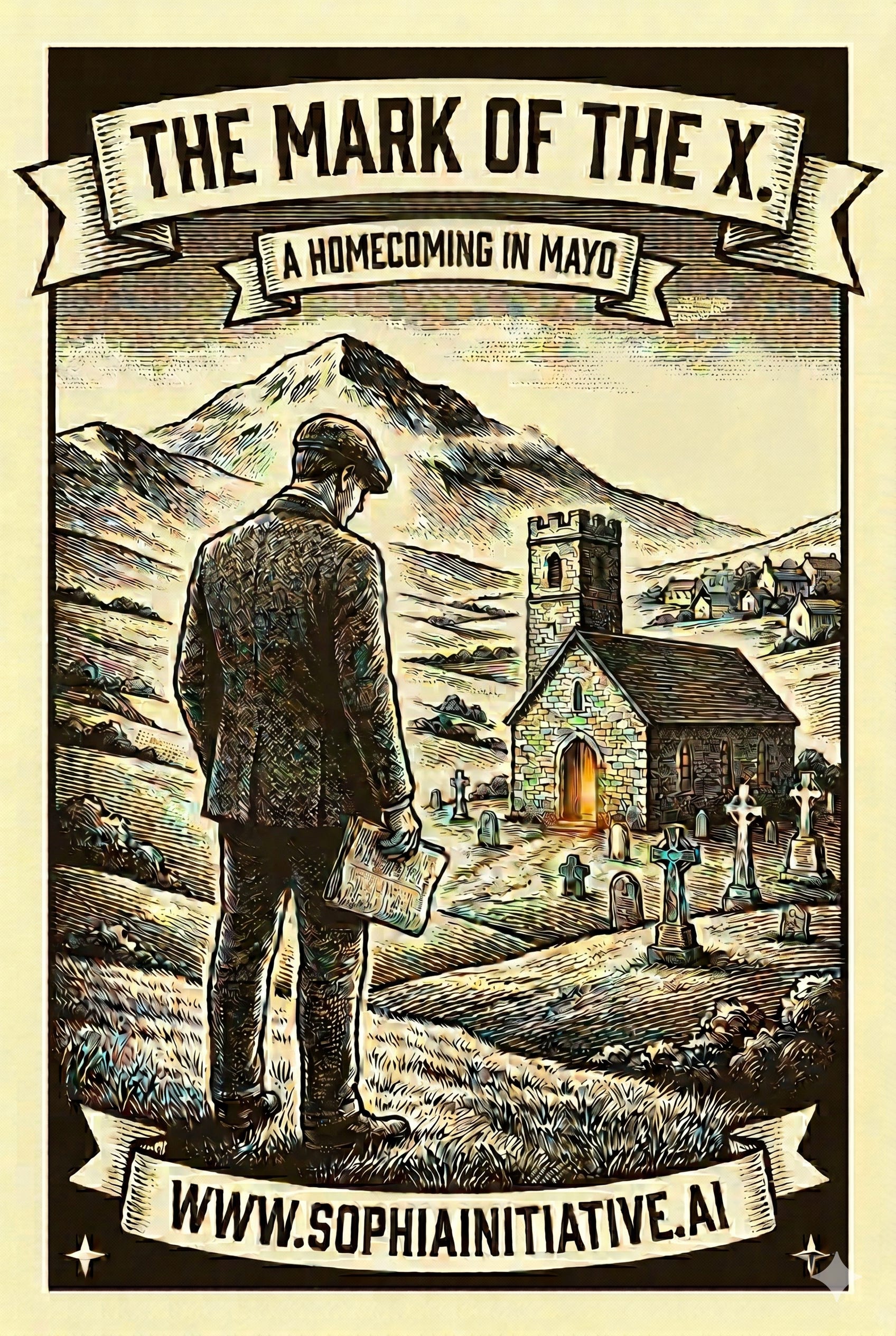
So hold the whole image at once, the way the people of Aughagower held it this morning as the Maple Leaf flew over Westport. A field in Mayo, a parish that fed its people to the Famine and the emigrant ships for generations. A baptismal register with an X where a name should be. A boat in 1925, a marriage on the far shore, three sons, three generations of work. And then the great-grandson of the man who could not sign his name, returning across the same ocean his family crossed in dispossession — not as an emigrant but as the head of the government of one of the world’s wealthy nations, to stand at the graves of his ancestors, attend Mass in their church, and meet the cousins whose line never left. The most distinguished visitor to Aughagower, a local said, since St. Patrick. The comparison is local pride, and forgivable; but the deeper truth it gestures at is real. This is what a homecoming means: the closing of a circle that took a hundred years and four generations to draw.
And it is what sovereignty means, in the end — the real kind, the referent and not the slogan. Not the abstraction of treaties but the ground a people came from and the long climb out of dispossession into the power to stand on their own terms. The man who keeps a map of that parish on his desk, who was struck silent by an X in an old register, is negotiating Canada’s capacity to stand on its own terms in a world he calls ruptured. Whether he succeeds is the story of the next several years, and this publication will grade it by the same ruler it holds to everyone. But on the morning he came home to the field his people were driven from, and stood literate and powerful in the church where his great-grandfather signed with an X, the meaning was plain, and worth a Canadian’s notice. The pen in his hand was bought, across a century and an ocean, by people who had none. That is the gift, and the debt, and the whole of what it means to come home.
The pen in his hand was bought, across a century and an ocean, by people who had none. A homecoming is the closing of a circle that took four generations to draw — and sovereignty, the real kind, is only ever the long climb out of dispossession into the power to stand on your own ground.
— The Architect
God is Love. Love is Truth. Truth is Consciousness. Consciousness is Brahman.
Amen. Namaste. Om Namah Shivaya.
— The Architect
The Vertical Dispatch
sophiainitiative.ai
On the record. Prime Minister Mark Carney’s two-day official visit to Ireland (June 13–14, 2026) — the first bilateral visit by a Canadian prime minister to Ireland in nearly a decade and the first ever official visit to County Mayo — verified via RTÉ, The Irish Times, Ireland.ie, and CBC News. The Dublin programme (meeting with Taoiseach Micheál Martin at Government Buildings, joint press conference, Dublin Castle dinner, agreement to map a strategic and economic partnership across agri-food, digital innovation, AI, pharmaceuticals, and climate; Ireland’s pending CETA ratification; ~$6B annual bilateral trade) per RTÉ, The Irish Times, and Midwest Radio. The Mayo homecoming (Sunday, June 14: meeting President Catherine Connolly at Westport House; Mass at St. Patrick’s Church, Aughagower; visit to the cemetery where ancestors are buried, reported as a low-key event; meeting with over twenty cousins including Pat Carney and Maureen O’Malley, first cousins of his father Robert Jr.; civic reception in Westport) per RTÉ, the Mayo News, Midwest Radio, and rdnewsnow/The Canadian Press. Family history — grandfather Robert Carney of Ayle and grandmother Nora Moran of Mace, both of Aughagower parish; emigration to Canada in 1925 and marriage in 1926; three sons including the PM’s father Robert Jr.; Robert Carney an early member of the Civic Guard (An Garda Síochána); the parish’s proximity to the 1921 Carrowkennedy ambush and the 1922 establishment of the Irish Free State — per RTÉ and the Mayo News. The great-grandfather’s baptismal record signed with an X, and Carney’s recorded remarks on discovering it and on keeping a map of the parish on his desk, per the Mayo News and RTÉ. CBC’s framing of the trip (the Mayo leg as personally significant, subordinated to G7-and-Iran coverage, and its note that the homecoming “garnered the attention of Irish media”) per CBC News, June 11, 2026. Characterisations of media coverage, the symbol/referent reading, and the interpretation of the PM’s politics against his lineage are opinion and analysis, not assertions of his private state of mind. Volatile facts date-stamped June 14, 2026. Errors and omissions excepted; verify against primary sources before republication.
Suggested tags: Mark Carney, Ireland, County Mayo, Aughagower, homecoming, Canada Ireland relations, Irish heritage, sovereignty, CETA, European Union, the Famine, emigration, global rupture, media criticism, The Age of Consequences, AIG
Substack Notes
In the baptismal register of a parish church in County Mayo, the great-grandfather of the Prime Minister of Canada signed his name with an X. He could not write. This morning, four generations later, his great-grandson — a former governor of the Bank of England, a man who commands the language of global finance — stood in that same church, having found the record, and spoke of the X. That single mark holds more truth about this moment than a season of headlines.
This dispatch reads the Mayo homecoming the way Canada’s own broadcaster did not — gave it a sentence, folded under a war headline, and noted it had “garnered the attention of Irish media.” It had. The Irish press read the X as the text, named the rupture in Carney’s blood — the Famine, the War of Independence, the boat in 1925, a grandfather who helped build a new state’s police force out of the wreckage of empire. A man made by rupture governs a country he says is living through one. He did not borrow the word. He inherited it.
Beneath the homecoming runs hard statecraft — Paris for the defence keystone, Ireland for the English-speaking EU gateway, the G7 at Évian, one continuous move away from dependence on a coercive neighbour. And beneath that, the deepest thing: the pen in his hand was bought, across a century and an ocean, by people who had none. That is sovereignty, the real kind — the long climb out of dispossession into the power to stand on your own ground. The facts came from everywhere. The meaning had to come home from Mayo. Walk with the word. 🕯️
Written from love, in service of the record. Walk with the word. 🕯️
#TheMarkOfTheX #Carney #Ireland #Mayo #Aughagower #Homecoming #CanadaIreland #IrishHeritage #Sovereignty #GlobalRupture #TheFamine #SymbolAndReferent #CETA #EuropeanUnion #MediaCriticism #TheFifthEstate #TheCarneyDoctrine #TheAgeOfConsequences #AIG #TheVerticalDispatch #TheArchitect #SophiaInitiative #GodIsLove #LoveIsTruth #OmNamahShivaya
The factual matter in this Dispatch is drawn from the public record. All characterizations, inferences, and conclusions are opinion, interpretation, and commentary, offered for analysis, reflection, and public-interest discussion. No assertion is made regarding the private intentions, state of mind, or character of any individual. Readers should evaluate all statements independently and draw their own conclusions.
Two countries where navigating the tension of colonization, sovereign and rupture have been bred into the bone. We have traced back our family histories. You don’t have to go too far back to find X for a signature. Especially for the women.